Duell - Motorsports for the stock market

Marketing brochure:

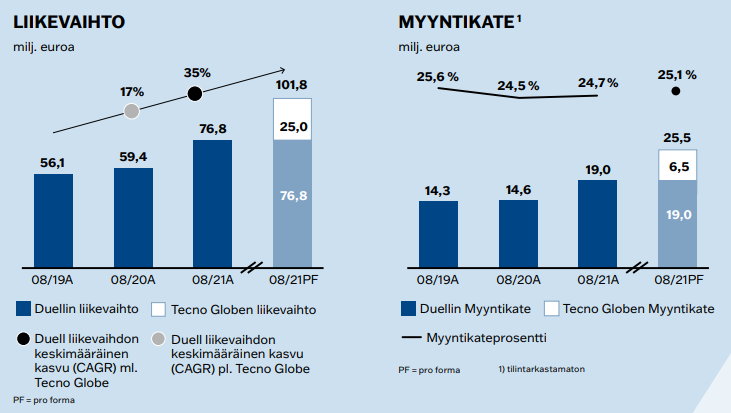
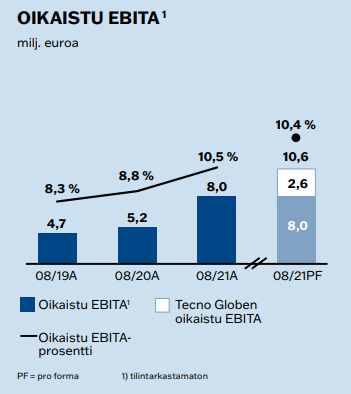
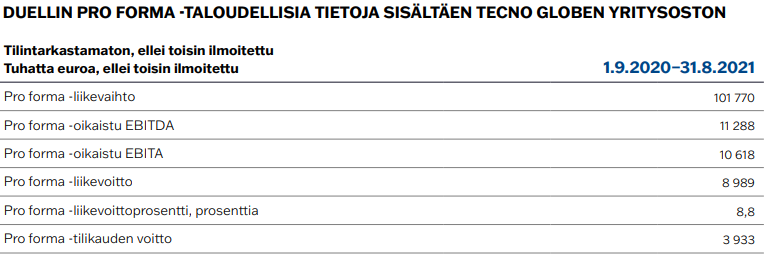
ProForma figures describe the situation better than without Tecno Globe figures

A quick look at these figures shows a rather moderate valuation for sales, but perhaps not so much for earnings. Growth is certainly expected, so it should be considered in relation to that. Of course, this is wholesale trade, so there’s no point in trying to use SaaS figures as a comparison here :sweat_smile:

P/S ~1.3 (€131.3M / €101.77M)
P/E ~33.4 (€131.3M / €3.933M)

Sales distribution:

image

How does electrification affect this? For example, will the need for engine parts decrease? A small part of the whole, but something nonetheless.
And how about the post-COVID era, have the devices been serviced and will sales be lower in the future? Or have more hobby equipment been sold and in the future, more maintenance and accessories will be needed around them?

Edit: Corrected P/E calculation based on the pro forma operating profit for the fiscal year. Not so affordable anymore…

17 Likes

Thanks a lot for these!

Electrification was discussed at the 32:08 mark.
In short, personal equipment such as helmets, jackets, boots, etc. accounts for about 40% of sales, and these would be sold anyway.
Then, regarding wearing parts, according to Jarkko, brake pads and wheels wear out more due to the higher torque in electric bicycles. But more batteries and chargers are also for sale.

At some point, the following was said in the anti-prospectus, from memory.
The base of electric bicycles is small, and regulation for them is significantly less compared to car driving.

4 Likes

I did some quick back-of-the-envelope calculations for the value of shares offered to the public:
Maximum valuation of the entire share capital 131M
Shares offered maximum 71%, i.e., 92M
Anchor investors’ commitment 50M, i.e., 55%
Remaining for public offering 42M, i.e., 45%

For comparison, for Modulight, anchor investors’ commitment was 67% in a similarly sized offering. Nightingale sought 110M and anchor investors’ share was 35%.

This is like reading tea leaves, but I personally guess that small investors will continue to seek quick profits, while institutions generally won’t sell their investments immediately. Thus, the institutional share may predict the outcome of the offering.

By this measure, Duell ranks in the middle. I believe a small quick profit is to be expected, but no rocketing. I ended up subscribing for slightly more than the minimum.

13 Likes

That was an exceptionally impressive company presentation; the CEO, in particular, seems to really know what he’s talking about. I’m somewhat surprised how the forum’s attention currently seems almost entirely focused on Norrhydro (and in the forum survey, interest in Duell was quite low), even though Duell’s growth prospects aren’t much worse, or perhaps even better.

Furthermore, in my opinion, the business risks are significantly lower, and it’s a less cyclical industry (though I don’t know how the phasing out of internal combustion engines will affect market size; of course, electric two-wheelers could emerge in the future, even if I personally wouldn’t engage in off-roading with a silent and numb electric whisk).

Is it just a “too boring company because risks are minor, prospects are good, and history is strong” situation? :smiley:
Of course, the offering size for Duell is significantly larger, whereas Norrhydro, in turn, offers mere pennies, making oversubscription a certainty.

Market leadership is already established in Finland and Sweden, and according to the CEO, also in Norway by 2022. There is ample room to expand into Europe, as the market has many small players who are not as strong due to their size. The acquisition card can be played when entering new markets. Although profitability is not “Harvia-like” on the “forum scale,” it is still better than Kamux’s.

The company aims for over 10% organic growth (even greater with acquisitions) and a 13% EBITDA% in the longer term (Kamux probably has half of that). And why do I compare it to Kamux? The industry is different, but somehow the company feels like a good comparison due to similar growth opportunities (expansion into Europe, fragmented market), even though Duell is likely a much stronger player in its category.

24 Likes

{“content”:“Admittedly, an interesting IPO, even though I haven’t had time to do the calculations yet.\n\nThe CEO was convincing regarding the business, but unfortunately, he was completely out of touch with the IPO itself. He couldn’t remember the subscription price and seemed very uncomfortable having to present the offering portion.\n\nReputable anchor investors have been gathered very impressively.”,“target_locale”:“en”}

2 Likes

I also wrote an IPO analysis of Duell.

For some reason, I found myself comparing it to Kamux due to the discussion sparked by their recent earnings release, even though the industry is completely different. At the same time, I notice that I’m also much more enthusiastic about Norrhydro, because Duell is in a very traditional industry and doesn’t have a clear competitive advantage, except for its size. But as often in investing, boring industries that no one is interested in are often where the best long-term returns come from!

Especially having seen many IPOs this year, I have always been puzzled why the CEO’s presentation skills are criticized, because it tells nothing about the CEO’s expertise and competence. To my eyes, the CEO was perfectly composed, but perhaps the most annoying thing was that he didn’t answer the audience question about naming competitors, which one would have imagined to be relatively important information for every investor.

These consolidating industries can now be found practically everywhere around us, but the difference is that some industries are able to increase their profitability with consolidation, while others are not. At the moment, it seems that Duell has successfully increased its profitability with growth in the past, but relative profitability has not improved significantly. It is therefore difficult to see huge economies of scale in profitability in this business, which is why I will gladly pass on this offering.

36 Likes

Thank you for the good write-up.
Evaluating the CEO’s or other management’s performance can play a significant role in my investment decision. If, for some reason, the management fails to convince me, I rarely invest. Of course, this, like all other things, is a matter of opinion, and everyone has their own style.

1 Like

In the Duell case, I noticed that online stores were not a threat but rather excellent partners for Duell. Market leadership didn’t sound bad either. So, it was easy to subscribe.

10 Likes

During the financial year ending August 31, 2020, Duell fell victim to a cybercrime, which resulted in costs of €439,000 for Duell.

What kind of mess did they get into there? :astonished:

An interesting company, but in some aspects, it feels a bit homemade. Hopefully, the due diligence for foreign acquisitions has been handled better than their cybersecurity.

5 Likes

I went through the listing prospectus and did some of my own modeling on Duell’s listing, and it looks good to my eye.

Duell’s business is not very difficult to understand compared to many other listed companies; on the contrary, it is very straightforward. And for this reason, it won’t be a ten-bagger, but I believe there are ingredients for good development.

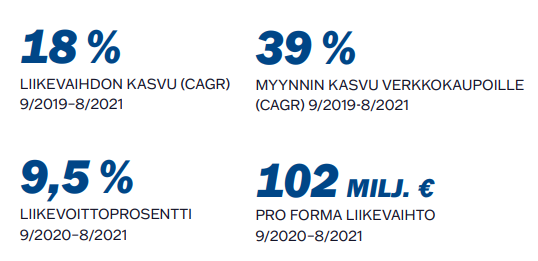
Duell’s history goes back a long way, but in my opinion, it is essential to look at the last three years when Sponsor has been involved. Operations have grown rapidly, but profitability has remained relatively stable. It will certainly never make a leap, although there is certainly some room for improvement, e.g., in terms of pricing advantage as operations grow. The market will only grow by about 2% per year, but Duell has managed to gain market share quite nicely, and I see no reason why this could not continue, as long as acquisitions are successful (this, of course, harbors one of the biggest risks). A certain scalability is also conceivable in that acquisitions open up avenues to sell “old” products to new distributors. But as I said, the scalability potential is not the best possible here, but Duell certainly has the means to grow its operations significantly. If the current level of profitability can be maintained at the same time, this machine will grind out cash flow.

The P/E is quite salty based on the 08/2021 pro forma figures, but if organic growth continues, it will decrease quickly. The money from the offering will be used to pay off the VVK loan (hybrid bond) with interest. This is certainly sensible, as the interest rate on it is 10%. After this and the IPO costs, there will still be plenty of war chest left, so it certainly won’t be long before new corporate arrangements are made/started to be explored. My confidence that the management knows this business is strong; the biggest risks, in my opinion, relate to the success of acquisitions. Cash flow management is also critical. For example, in the 08/2021 financial year, inventory growth practically ate up the entire operating cash flow (although this was reportedly intentional, as inventory was increased due to supply difficulties for the current financial year, so by all accounts, inventory should be released quite nicely in the current financial year). But if, for example, inventory management fails unintentionally, or if problems arise with receivables, it will immediately show in the cash flow. However, I see that there are ingredients here for strong and mostly manageable cash flow.

I need to crunch the numbers a bit more accurately, but with preliminary modeling, I get a pretty good upside for this. I would have liked to see this with Sponsor for another couple of years, for example, to have a bit more of a track record. This is a fairly quick exit now, but apparently, the market is just so hot that it’s a good time to do it.

I will indeed participate in this, but I guess there will only be crumbs available from this offering.

Oh yes, I got a very positive impression of the CEO’s performance, and he has undeniably done a good job. His expertise is exactly where it should be, i.e., in running the business. I don’t consider it a big minus if he doesn’t answer every question perfectly, or if his presentation is a bit rough around the edges.

24 Likes

The price is admittedly quite high based on August 2021 figures. I’ve tried to find listed benchmarks to compare the valuation to, but without much success. The competitors mentioned in the prospectus are all unlisted.

What do you think, could Relais provide a benchmark for a market-accepted valuation level? Relais does pretty much the same business but in the automotive sector. Even the revenue development in Inderes’ forecasts is comparable to Duell’s medium-term goals.

According to Inderes’ forecasts, Relais’ EBIT is not expected to rise significantly above 8%, so there is a notable difference here compared to Duell’s profitability targets (>13% EBITA). However, based on historical prospectus data, Duell has only achieved an adjusted EBITA percentage of approximately 8.5-10.5%.

The market values Relais at P/E ~ 17, and EV/EBITDA ~ 16x.
I get a valuation for Duell with pro forma figures of approximately P/E ~ 33.5 and EV/EBITDA ~ 13.5x.

After listing costs and the repayment of VVK, approximately €12M in cash will remain from the offering. Some inorganic growth will occur with that, but then it will be debt-financed, which after the offering will still be around €30M (net debt), or about 3X adj. EBITDA, which is at the upper end of the medium-term target.

Anchors have also been gathered in a more convincing way than average, in my opinion, so please tell me what’s wrong with this or my calculations :smiley: The offering is certainly priced okay, but is it already fully priced? Has anyone found benchmarks or pondered what an acceptable valuation level for Duell could be?

19 Likes

A bit off-topic, but a cybersecurity expert asked a while back how many S&P 500 companies were hacked at that moment. The correct answer is all of them.

It’s a bit unclear to me how Duell’s e-commerce model is structured:

  • Does Duell sell directly to consumers under its own name and from its own warehouse, or
  • Does Duell sell products to consumers through a retailer’s online store and only handle logistics to the consumer from its own warehouse, or
  • Does Duell sell goods to a retailer and deliver them to the retailer’s warehouse, from where they are delivered to the consumer?

If the middle option is the prevailing operating model, at what point does ownership of the goods transfer from Duell to the retailer, or does it not transfer at all? I’m mainly wondering whose risk the goods are sitting in the warehouse under.

2 Likes

Off-topic, but this fact can be found in Mikko Hyppönen’s book.
https://www.tekniikkatalous.fi/uutiset/tietoturvaekspertin-elama-on-kuin-agenttielokuvasta-hypposen-uutuuskirja-paljastaa-kuinka-suuryrityksia-on-hakkeroitu/6dd6417a-2286-4d4d-b275-ed3361a8d0e5

I wonder if the Duell case involved a traditional CEO fraud, where fake invoices were paid under pressure from criminals?

3 Likes

Duell is a growth company! Although COVID-19 stay-at-home orders may have helped organic growth. Duell’s P/S valuation is very low compared to Relais. Revenues are now “in the same ballpark”, but Duell’s market cap is €131M and Relais’ is >€400M!!??

I don’t know what tables you’re reading, but your claim that “revenues are now roughly in the same class” can already be called nonsense. Relais: Revenue 1-9 164 million, so quite far from the same class, but everything is relative of course.

2 Likes

@Geologiopiskelija had accurately identified the reasons why I, too, find this company interesting, but this IPO doesn’t appeal to me. For the European expansion, the balance sheet should have been strengthened much more to my liking, meaning a proportionally larger share issue should have been done. Now, this is primarily a greedy share sale.

The valuation relative to the previous fiscal year’s figures and even pro-forma figures is particularly shocking, but the management practically guides that the profit will double in the current fiscal year (Tecno Globe + 15% organic growth + significant reduction in financing costs), which would bring the forward-looking P/E ratio to around 20. But that’s a promised figure, and still, in my opinion, too much, especially since we don’t know what kind of guide the company’s management is: do they have a good outlook on future results, can their word be trusted, etc. The company has not yet proven itself to the markets for such high multiples to be accepted with just a shrug. There’s little room for error. If growth falters in the current fiscal year, the stock will recoil significantly downwards.

The preceding was my opinion. Now for the factual part of the message.

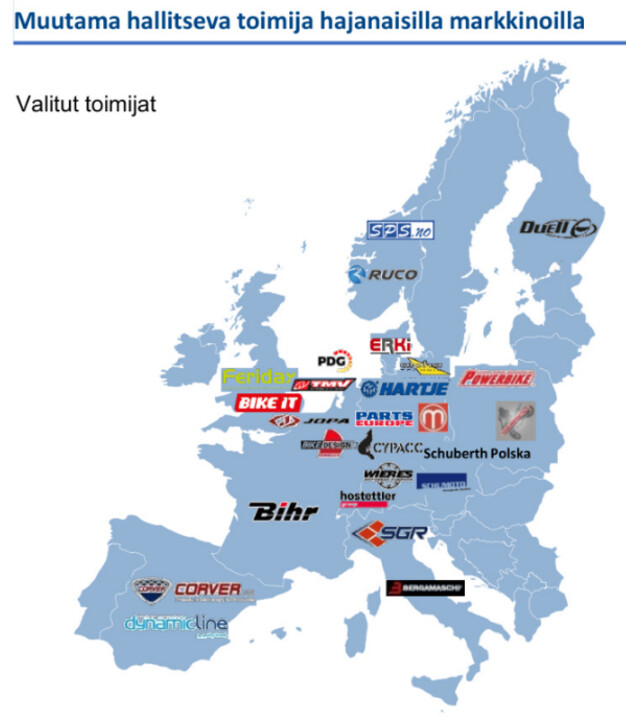
Duell, Bihr, and Parts Europe are the three major players in Europe, with revenues exceeding 100 million euros. All of Duell’s competitors are private companies, but I tried to find their financial data with varying success.

Here is an article about Bihr, a leading player in France:

Bihr employs 400 people, including 240 in France and 100 in Spain, and turns over 140 million EUR, of which the largest share of 120 million EUR is generated through the sale of spare parts and accessories, and 20 million through protective clothing and helmets. Operating in the B2B segment, the company supplies more than 14,000 dealers across Europe with over 200,000 brand-name articles.

Additionally, I found information that Bihr’s revenue in 2019 was 102 million and profit was 3.1 million.

Parts Europe is a leading player in Germany. In 2020, revenue was 109 million euros. Gross margin 31%. EBIT 3%. Profit 1.7 million. Revenue growth 16.4%.

Swiss Hostettler has 950 employees, but it is only partially a competitor to Duell.

In the Benelux countries, a major player is apparently Powersports Distribution Group, which advertises itself as “Europe’s fastest-growing motorcycle parts distributor.” The company has made many acquisitions in recent years.

The financial data of all Norwegian and British private companies can be found online for free. Here are the financial data for some (smaller) competitors for 2020:
- Ruco Scandinavia. Revenue 13.6 million euros. Gross margin 30%. EBIT 8%. Profit 0.7 million euros. Revenue growth 13%.
- Spare Parts Service AS. Revenue 6.2 million euros. Gross margin 38%. EBIT 14%. Profit 0.6 million euros. Revenue growth 11%.
- Feridax Group Limited. Revenue 16 million euros. Gross margin 35%. EBIT 17%. Profit 2.3 million euros. Revenue growth 0%.
- Bike It International Limited. Revenue 8.6 million euros. Gross margin 23%. EBIT 0.8%. Profit 50,000 euros. Revenue growth 15%.

For comparison, Duell’s 2020 figures: Revenue 59 million euros. Gross margin 25%. EBIT 7%. Profit 1.7 million euros. Revenue growth 6%.

This is a somewhat mixed and, of course, incomplete sample, but at least a couple of observations can be made:

  1. All companies have grown significantly in a market that reportedly grows only 2% annually.
  2. Duell’s gross margin is lower than almost all competitors. Is the secret to Duell’s success that they just sell goods cheaper? One would think that as a wholesaler, this would at least gain market share. A more negative explanation would be that it’s not a pricing strategy, but rather Duell is compelled for some reason to sell goods cheaper than all its competitors.

It would be worthwhile to examine the competitors’ figures in more detail, and I realized that these figures probably should have been compiled into a table, but I’ll do that sometime later. I encourage others considering investing in this company to conduct a comparative analysis relative to competitors.
33 Likes

Duell’s revenue is so many times larger than these; does that equalize the margin? Perhaps others are more specialized companies, while Duell offers a wider selection, which dilutes the margin?

Parts Europe is larger than Duell, and their gross profit margin has been 31%, 32%, 34%, 33%, and 35% in 2020, 2019, 2018, 2017, and 2016, respectively. Duell’s gross profit margin has remained at around 25% since at least 2018. Duell and Parts Europe are both large wholesalers; according to their websites, they sell the exact same goods, and partly in the same markets, so it’s an interesting question what explains this difference. But this isn’t necessarily a bad thing; now that Duell is entering Germany and selling 5-10% cheaper than competitors, the Germans will surely panic and go bankrupt from this competitive pressure. :grinning:

10 Likes

This would, at first glance, seem like that famous competitive advantage, selling the same (?) goods cheaper and still achieving a better operating profit margin. If Parts Europe were to sell goods with the same gross margin as Duell, it would be operating at a loss according to these figures.

5 Likes

The valuation is indeed high based on the pro forma figures for 08/2021, but in this case, one must look forward. If Ämmälä’s estimated growth materializes in the current fiscal year, I will get a P/E ratio of approximately 20 for next year (EV/EBITDA approx. 11), which is still not low, but also does not include the impact of acquisitions. If these are made (and organic growth continues), the P/E will drop to a reasonably low level within 2-3 years, and the story will get new momentum. Will profitable growth materialize? That is ultimately the question; if one does not believe in it, one should not invest in this. In my opinion, the evidence (albeit short) is credible. The expansion in recent years has been successfully executed, at least based on available figures. The CEO has extensive, long experience in this business and a firm grasp of contacts and fieldwork. To put it bluntly, I do not find Ämmälä’s certain “street smart” presence at all detrimental in a business where public relations and contacts play a significant role.

Since the intention is to grow in a controlled manner, I do not see a reason to raise a larger amount of equity at this point. The market is quite fragmented, so massive acquisitions are unlikely. From the perspective of return on equity, raising a large sum into the balance sheet all at once would not be sensible at this point. Financing costs will settle at a good level (2-3%), the main thing is to get rid of high-interest short-term loans and vendor notes. The cash flow enabled by growing operations will then leave plenty of room to take out loans for new deals, without NIBD/EBITDA growing beyond targets.

I calculated my own DCF model with development below the company’s own growth target, and slightly below the current EBITDA margin. Still, this still looks relatively attractive to me. In my calculation, however, inventory should decrease reasonably during the current fiscal year, bringing additional operating cash flow. If this does not materialize, the target price will be weaker. For all other forecast years, I calculated the change in working capital to be a negative item for cash flow, which is, of course, to be expected with strong growth.

I will gladly add this to my portfolio.

23 Likes