Coinmotion - Domestic cryptocurrency broker

A summary of last year is publicly available, for example, from Asiakastieto:

Through Finder, you can also find a bit of history:

https://www.finder.fi/Mainospalvelut/Coinmotion+Oy/Jyväskylä/yhteystiedot/2680416

If you want more detailed documents, you can order them through these services or directly from the PRH (Finnish Patent and Registration Office). You can, of course, also ask the company itself.

However, the public reporting obligations for an unlisted company are significantly narrower than for a listed company, and especially the frequency does not match that of listed companies. This is good, because time should mainly be used for other things than reporting. Small companies also do not have an obligation to write an activity report according to the Accounting Act, but Coinmotion likely exceeds those limits.

Of course, the financial sector may bring additional obligations beyond general ones. More information may certainly be available to shareholders and/or interested investors, but some of it may be subject to confidentiality obligations – at least to some extent.

However, I do know that the company is strongly cyclical, like most companies operating in this sector – even large international exchanges. Cyclicality is a result of excessive buying enthusiasm when prices rise. In reality, one should of course buy when it’s cheap, but the average buyer doesn’t act this way – not even with housing.

Yes, I’m familiar with those customer data matters, but it’s too superficial if one wanted to invest. And I asked here because unlisted companies don’t have reporting obligations. Otherwise, that would be basic information and could be found on the company’s website.

It might be best to ask the company directly. They at least know what can be freely shared.

Regardless of historical figures, Coinmotion now has a so-called ‘golden opportunity’.
It is the only Nordic broker with a European operating license compliant with current regulations.
For Finland, this already means there are no other competitors left in Finland.

In Sweden, other Nordic countries, or even the Baltics, there are no licensed operators. However, many of these still have a transition period, so old operators are still continuing. (Finland is again first in regulation…) Coinmotion is in any case moving into these markets as well, and operations are already being opened in Sweden. Licensed operators will surely come, but some of the current operators will cease operations.

Such expansion, of course, guarantees nothing, costs money, and can fail, but that’s always the case. However, it is possible to increase market share relatively easily right now.

1 Like

This must be corrected, as there is no real competitive advantage regarding the license. All Finnish operators will also receive that license ASAP once their applications have been processed. While waiting for that, the operations of marketplaces without a license will continue completely normally. The same applies to other countries.

In fact, Finnish marketplaces will specifically lose their important competitive advantage with the new EU license. With the new licenses, global giants can also enter the Finnish market, meaning they can advertise on the front page of Helsingin Sanomat and offer their services in Finnish.

Until now, the Finnish market has been protected, but in the future, Binance and Coinbase and ByBit and other giants can come with hundreds of millions in advertising budgets and put banners on the front page of Helsingin Sanomat, sponsor sports clubs, etc.

I’m not claiming that Coinmotion’s stock is a bad investment despite this. The strength of Finnish companies will surely continue to be their domestic nature. Probably many Finnish investors want to a) support domestic entrepreneurship and b) do business with domestic companies.

However, it is important to understand what these EU licenses really mean and how the field will change.

I don’t yet have an idea of how much global giants will invest in the Finnish market. Probably investments will first be made in Central and Western Europe, where there is a much larger population. Finland is a small market area and still requires experts due to its special language, although the threshold will certainly decrease with the help of AI.

Edit: The ongoing bull cycle has also been very peculiar compared to previous ones. Soon three years will be complete, and this period only includes a couple of 2-3 month “booms” when trading volumes have actually been high. It has been a huge disappointment for me as a content creator. I don’t know if the future will be like this or if we will see different cycles.

2 Likes

The Financial Supervisory Authority (Finanssivalvonta) did process those applications simultaneously in the spring. The law obliged the Financial Supervisory Authority to approve all operators whose operating conditions met the level of the new regulation by the first day of July. Maintaining such an application queue would be unlawful, and other operators would certainly complain about it then.

This is, of course, only speculation based on laws and regulations, as well as the official communication of the Financial Supervisory Authority, but it is supported, among other things, by the fact that Kvarn is currently not marketing its services anywhere and is not accepting new registrations for its service. My own assumption is that Fiva has required this from them because the application or processes are not at the desired level. This is purely my own guess, which has not been confirmed by anyone from Fiva or Kvarn.

It is true that marketing will be significantly liberalized with the new regulation. Expanding a license within the EU area is relatively easy; for us, it only took a couple of weeks to expand the license to Sweden. However, it has been questionable until now whether there are any regional restrictions, as most marketing takes place online and is difficult to restrict. Multinational companies have therefore already marketed in Finland to some extent through social media and Google, even though this has not been legally okay.

I personally still see domesticity as an important advantage. Domestic customer service and, for example, in problem situations, adhering to domestic consumer protection and legislation are quite important things. For example, no one really knows where to hire a lawyer to pursue a case if, for example, things go wrong with Binance.

-Aki, Coinmotion

1 Like

In crypto, people seem to be divided into two camps regarding this: some only want the lowest possible costs regardless of anything else, and others are happy to pay a little extra to get Finnish and Finnish-language service.

Hopefully, Finns will continue to favor domestic operators in the future so that companies in the sector can succeed. It would be important for Finland more broadly to have successful companies in the sector here and, through that, increasingly more expertise in the field.

5 Likes

Hi

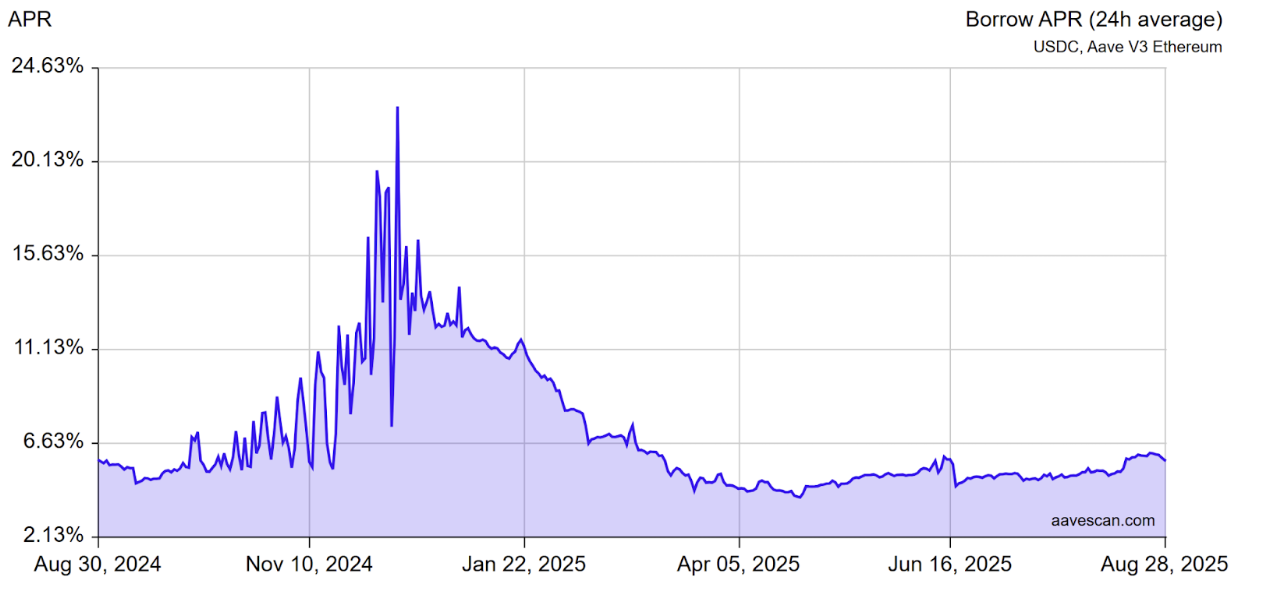
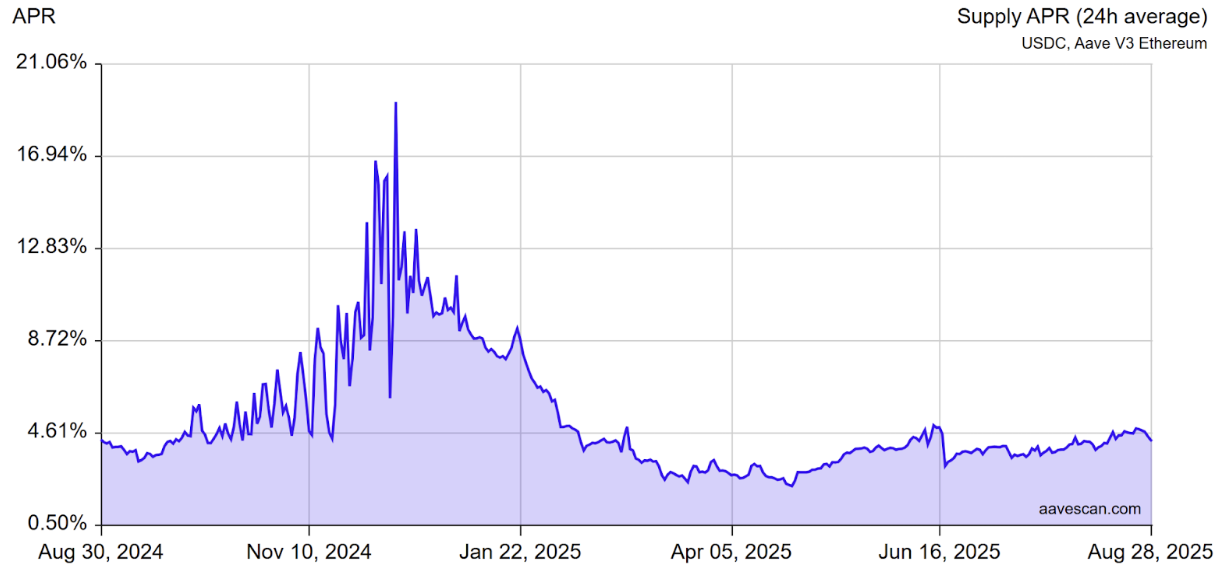
Let’s return briefly to the development of the lending market in the crypto world. According to blockchain data, the DeFi lending markets are currently thriving and growing at a tremendous pace. The growth of DeFi lending markets may partly stem from the current stablecoin boom and purely from the fact that the supply of stablecoins is increasing, and thus indirectly also the lending markets. The current bull market and the resulting demand for stablecoins (e.g., the need for leverage and other DeFi activities) certainly also influence lending services.

The tokenization of assets can also affect the DeFi loan book, as traditional assets are wrapped to be DeFi and stablecoin compatible, e.g., as collateral for loans (for example, Aave Labs launches Horizon, offering institutional stablecoin borrowing against tokenized RWAs | The Block)

On the RWA side (Real World Assets), assets worth approximately 27 billion dollars have currently been tokenized (source: rwa.xyz). Most of these come from Private Credit and the US bond market.

  1. Active “loan book” in various DeFi protocols

  1. Deposit interest rate for USDC stablecoin in Aave protocol over the last year (Ethereum V3)

  1. Interest rate for lendable USDC in Aave protocol over the last year (Ethereum V3)

1 Like

Hi,

At the request of our customers, we have once again started producing longer format content. In the first episode, Thomas Brand, and the episode discusses Bitcoin balance sheet companies.

2 Likes

Even if the company has very promising prospects for the future, I consider it primarily important to know what size slice of the cake one is buying - the share price found on Osaketori only tells the price of the slice.

In addition, this situation, together with Tesseract, raises some concern, as customer funds are now stuck.

Coinmotion has launched a staking feature in cooperation with Bitpanda:

It’s a shame that it only applies to cryptocurrencies held in custody on Bitpanda. I would have liked to stake the rest of my Ethereums; some are already “stored” with Tesseract.

2 Likes

Ethereum staking is possible through our OTC service, but it requires having an entire node’s worth of Ethereum to stake, which is 32 ETH. It might be possible at some point to open up staking for Ethereum in the same model as currently available for Bitpanda’s cryptocurrencies, but unfortunately not in this first wave.

  • Aki, Coinmotion
1 Like

An important point about staking in general, because there are many investors on this forum who are not so familiar with the crypto world.

Someone might think this way: ‘Hey, I have a bunch of euros in my account, and Coinmotion offers a 9% annual yield for Cosmos staking, so let’s put those euros to work.’ This carries a big risk, because naturally, the price of Cosmos can drop by more than 9% in a year, and especially in a bear market, it can drop by as much as 80-90%. Also, staking rewards are paid in the staked token, not in euros.

Staking is a perfectly viable option if you already own crypto that can be staked and you are holding it anyway. For example, if you have Solana in your portfolio, you might consider whether it’s worth getting a few extra percentage points of annual yield while you’re holding it regardless.

If you have euros in your account and want to put them to work earning interest in the crypto world, you could, for example:

  1. Buy USDC stablecoin and earn interest on it
  2. Buy EURC stablecoin and earn interest on it

Interest can be earned through Earn services on traditional exchanges or from the DeFi side, such as Aave, roughly in the same ballpark as government bonds.

The USD/EUR currency pair has its own risks, which can be avoided with a euro-based stablecoin. Unfortunately, no Finnish trading platform seems to list any euro-based stablecoins, so those purchases must be made through other means.

In my opinion, there would be room for improvement at a fundamental level in Coinmotion’s retail app as well, even if the demand isn’t huge (you can probably buy them from OTC services). Finland also has its own euro-based stablecoin.

It’s convenient in Coinmotion’s service that these staking services go directly to the staked balance, meaning you benefit from the compound interest effect. Additionally, staking can be stopped immediately without long delays.

4 Likes

Could Antti, for example, briefly explain the worst pitfalls of crypto staking?

I’m not the best expert on this, as I don’t personally engage in staking. My principle is simply that if I have an asset that yields 50-100% annually on average (like BTC, ETH, SOL, etc.), I don’t see the point in trying to get an additional 5% return on it through any mechanism (which is never completely risk-free).

I understand seeking yield for stablecoins better. I also understand taking out loans against crypto. However, I’m not a fan of, for example, Ethereum staking.

Coinmotion’s website has a summarized overview of these risks: Ansaitse palkkioita kryptoillasi! - Coinmotion: Invest in Crypto Securely
(click ‘more questions’ and ‘staking risks’)

The biggest problem is mainly that the probability and impact of these risks are extremely difficult to assess. The risks are very small, but if something happens, what actually happens in practice? Precedents seem to be mainly from hacks and service bankruptcies.

Perhaps @Casteliero can comment on this better.

1 Like

Here is the latest Coinmotion review. :slight_smile:

7 Likes

Here’s the latest Coinmotion overview. :slight_smile:

2 Likes

Coinmotion’s CEO Antti-Jussi Suominen has written about how Finland would need a comprehensive strategy for the crypto industry. :slight_smile:

2 Likes

Coinmotion’s Director of Research and Institutional Services, Thomas Brand, was speaking about Bitcoin and his company at the Sijoittaja 2025 event. :slight_smile:

1 Like

Here is Coinmotion’s article on Ethereum. :slight_smile:

Ethereum is the world’s second-largest cryptocurrency and, in the eyes of many, the most interesting technological innovation since the internet. But what is it really? How does it differ from Bitcoin? And how can an average Finn invest in it safely? In this article, you will get answers to these questions without unnecessary jargon.

1 Like