Could the situation in Israel have influenced things, perhaps a “war covenant” imposed by local financiers? If the company doesn’t already know that a large asset, or perhaps even several, can be sold very quickly, I wonder how they are explaining the dividend to credit rating agencies.
4 Likes
First, no dividend is distributed; now, a fairly generous capital repayment. Situations change.
The latest list of largest shareholders is available. The increase in Citibank’s ownership remained unclear.
4 Likes
“The shares tendered in the tender offer, together with the current holdings of G City, G City’s wholly-owned subsidiary Gazit Europe Netherlands, and Chaim Katzman, represent a total ownership of 158,529,173 Shares, which corresponds to approximately 86.4 percent of all shares and votes in Citycon (“G City’s combined ownership”).”
4 Likes
It’s interesting how in Finland these things are accepted almost without question. The dividend is also worrying from a solvency perspective. What we should hope for now is that they’ve managed to sell an asset at a good price.
3 Likes
Any idea how this proceeds? They didn’t reach the 90% threshold for a squeeze-out. I’m holding these at a loss in an ESA (Equity Savings Account), which is why I didn’t agree to sell even though my position is quite small.
3 Likes
One would think Kissamies will continue buying if he can buy at a price of 3.80 or below. Then at 2.90 after the ex-dividend date.
2 Likes
This is playing out exactly as previously suspected: the majority owner is financing their tender offer with funds distributed from the target company. The original offer—a “robbery offer” in NAV terms as well—was valued at €4.00 vs. €8.45 EPRA NAV per share as of 31.12.2025 → the offered price was thus 47.3% of the NAV.
Following the dividend distribution, the offer price has since been adjusted to €3.80, and if a corresponding adjustment is made to the NAV, the offer-to-NAV ratio is €3.80 vs. €8.25 → 46.1%. The subsequently proposed future dividend (€0.90) sets the ratio at €2.90 vs. €7.35 → 39.5%. So, after the dividend distribution taking place this month, the original offer price corresponds to a discount of over 60% compared to the NAV value as of 31.12.2025 after dividend adjustments. Going cheap, one might say.
I’ve also been wondering about the majority owner potentially increasing their stake now that the offer period has ended – According to the Securities Markets Act (Arvopaperimarkkinalaki): If the offeror in a public tender offer, or a party referred to in Section 5, acquires securities in the target company on terms more favorable than the offer terms within nine months of the end of the offer period, they must compensate the security holders who accepted the offer for the difference between the acquisition on more favorable terms and the consideration offered in the public tender offer (compensation obligation).
Now, the offer consideration has been officially adjusted to €3.80, making that figure the offeror’s upper limit for the next 9 months. The proposed dividend distribution after the offer period changes the situation, and it would obviously be logical for the upper limit to be adjusted by the amount of the dividend, i.e., to €2.90. On the other hand, a €2.90 tender offer has never actually existed; it’s mostly a question of how the expression “on more favorable terms” is interpreted. As I said, a 1:1 adjustment equivalent to the dividend would certainly be logical for that upper limit, but I wonder if there’s some (vanishingly small) possibility that the matter could be interpreted differently from a legal standpoint—allowing the majority owner to pay, for example, more than €2.90 in market trading after the dividend distribution.
13 Likes
In my opinion, this was the best result for minority shareholders.
Kissa got a lot, but no squeeze-out. His incentives to intentionally screw with the company’s operations have decreased significantly.
3 Likes
Now the market should dare to buy Kania above that price, so that Kissamies doesn’t get more without significantly raising the price.
4 Likes
Pumping money out of Citycon could precede a directed issue being arranged for hybrid bondholders, potentially including Katzman’s own companies, on very favorable terms. With the company’s situation being critical following the upcoming credit rating downgrade, this would apparently also be justifiable. Reaching 90% would then, of course, be just a matter of arrangement. To quote the credit rating agency: “Citycon forms a sizable portion of the group’s asset base (about 40% on a fully consolidated basis) and is likely to remain an important part of the group’s long-term strategy, but we do not expect a strong likelihood of support from Norstar to Citycon because we think opportunistic arbitrages cannot be ruled out.”
3 Likes
In my opinion, the rabbit (Citycon) now has an absolutely outrageous risk-reward ratio. Base case average +50% in 1-3 years, bull +100%, and bear break-even. Actually, the only spots that worry me are the main owner’s antics (an 86% ownership surely reduces the share of intentional shenanigans) and a margin call resulting from rising interest rates + covenant breaches, and even then, the downside should be limited.
I mean, this current situation is, in my opinion, better than it would have been if Catman (Katzman) had gotten, say, 70% of the company. Even then, he would have had a qualified majority to do whatever he pleased by stretching the law a bit, but he would have had more motivation to screw over minority shareholders by crippling Citycon’s operations than now when he owns over 86%.
In my view, the situation is improved by the fact that the success of the tender offer is a clear reason now for why Citykani distributed its “carrots” even before the results of the tender offer were announced. So Catman is acting somewhat logically, and that shouldn’t involve taking unnecessary major risks for the company’s sake just to spite the remaining minority shareholders who own less than 14% of the firm. Of course, the capital repayment is a risk to the company’s balance sheet and for a margin call, but at least now a clear justification has been found for it (Catman’s own liquidity crisis).
The previously published 2026 financial outlook also suggests that the goal was no longer to paint a doomsday scenario. It is now in everyone’s interest to get all available money out of Citykani and/or get the company’s balance sheet into such a state that it supports the share price.
The only thing that really pisses me off in this case is that Catman’s outrageous gamesmanship was handsomely rewarded. Fools essentially sold the bulk of the company to him at the bottom.
Reflecting all this, I poured the rest of my Nordnet credit limit in (I also liquidated my Telia positions), even though Citycon was already the largest holding in my portfolio.
14 Likes
Am I calculating this correctly with my basic school math that:
Catman had about 108 million shares when he got them for cheap, from those he got 0.20 per share at first so the bottom of his wallet wouldn’t start showing = ~22 million euros, and now with the tender offer there were ~50 million shares to buy at €3.8 each = ~190 million euros.. and now that capital repayments are being handed out again since it’s so nice, that €0.9 per share, Mr. Cat gets about 144 mil from there.. and 144+22 = that’s 166 mil, so he doesn’t really need to dig into his back pocket much more.. covers the rest with some 0.15 repayment? 
5 Likes
A bit of a strange auction today in Citycon. The company’s share price was at 3.80, i.e., at the offer price, before the auction started, but then over a million shares appeared for sale, which pushed the price lower than it has been since the start of the tender offer.
It would be interesting to know where those shares ended up. A million shares is quite a significant portion of the remaining free float (which is under 30 million shares).
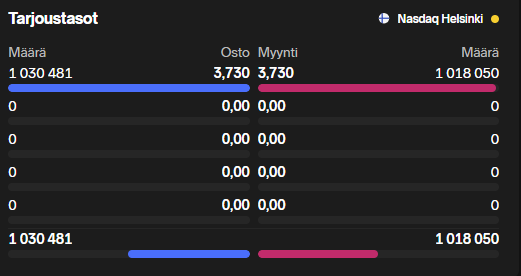
Edit: Actually, the free float is 25M shares, so 4% of the remaining shares changed hands there.
8 Likes
Good point. It seems the “cat” reached out with its paw and scooped up another big pile of shares. A strange selling move to sell below the offer price when they could have offloaded that same amount at a higher price just a moment ago. Was someone trying to corner the stock but decided to give up now, or why exactly did someone decide to do this? Of course, if the seller is the “cat man’s” accomplice, then this move pushes the price below €3.8, and it might be that the price ends up hovering at a lower level, allowing the “cat” to keep adding to their position.
4 Likes
On Discord, it was speculated that one or more nominee-registered investment funds might have been behind it. Rules may require selling a position if the ownership becomes too concentrated.
It doesn’t make any sense, but when playing with other people’s money, you have to follow the rules rather than logic.
6 Likes
“It is in everyone’s interest now to get all available cash out of Citycon and/or get the company’s balance sheet into such a state that it supports the share price. Isn’t "and" a bit much there? That is, you can either increase the balance sheet’s already excessive leverage (as Katzman has now done) or decrease it, as was supposed to happen according to the narrative, but wasn’t? I assume that higher leverage doesn’t yet lead to breaching covenants—that has likely been checked—but why wouldn’t the credit rating drop without some additional measures? That, in turn, would obviously ruin the bottom line. If there is no information about asset sales, I personally can’t think of any other options Katzman might still have other than a directed issue, for example, to hybrid holders. More equity needs to be obtained from somewhere if the balance sheet is not deleveraged on a fast schedule. In this regard, the latest capital return strongly suggests that there is no grand plan, and that the actions are already reactive at this stage.”
5 Likes
I wonder what the reasoning behind this is, now that board members (mainly Ball) have sold over 400k shares?
3 Likes
I suppose it’s quite common for executives to accept the majority owner’s tender offer.
4 Likes
Ilmarinen has sold its stake according to Kauppalehti.
Classic “pension fund always lets you down” scenario, so they sold their shares below the offer price? What now then? But I’m still left wondering if it’s certain that it was the “villain” they sold to?
1 Like