According to the AI, this would be a pretty clear textbook example of a “leveraged recapitalization” / “asset strip to fund acquisition” trick, where the board isn’t acting in the shareholders’ interest but rather in the interest of the majority owner, in the spirit of roastbeeff’s scenario… I assume, however, that such an operation cannot be carried out even if they wanted to (and it probably wouldn’t be a profitable idea in a business sense either).
And this “distributing 20 cents” out, which lowers the redemption price (and also funds the majority owner’s future buyouts), is very, very close to the line where someone should intervene… and maybe that’s exactly why this is being done: to “test” how the market/regulators react… if they don’t react → more “portfolio optimization” can be done to lower the redemption price again (and fund the buyout).
And perhaps this extension of the offer period is just “benevolent” in the sense that it might aim to wash their hands of any potential “collusion” (related to that distribution of assets), who knows… Maybe it’s not worth drawing major conclusions from this yet…
Citycon’s Board of Directors has not yet issued a statement regarding the mandatory tender offer, according to the latest announcement.
The board is reviewing the offer through its independent members and with the support of an appropriate advisor.?
When the statement is published, it could be, for example, a recommendation to accept, reject, or leave the acceptance of the offer to the shareholders’ discretion – so it doesn’t necessarily have to be a unanimous decision by the board.
That’s how the AI phrased it. The easiest statement could be “decide for yourselves”
Citycon Board of Directors. I don’t suppose they care much about the “fate” of the Finnish investor. Quote from the company’s website.
Chaim Katzman Chairman Israel and USA 1949
F. Scott Ball Vice Chairman USA 1961
Alexandre (Sandy) Koifman Vice Chairman France and Switzerland 1953
Judah Angster Member USA 1982
Adi Jemini Member USA 1978
David Lukes Member USA 1970
Per-Anders Ovin Member Sweden 1956
Ljudmila Popova Member Netherlands and Kyrgyzstan 1980
Eero Sihvonen Member Finland 1957
Keren Kalifa Member Israel 1976
See introductions of the Board members
All Board members, except for F. Scott Ball, who served as the company’s previous CEO, and Eero Sihvonen, are independent of the company. Furthermore, Judah Angster, F. Scott Ball, Alexandre (Sandy) Koifman, David Lukes, Per-Anders Ovin, Ljudmila Popova, and Eero Sihvonen are independent of significant shareholders. Chaim Katzman, Adi Jemini, and Keren Kalifa cannot be considered independent of significant shareholders due to their positions in the management of the company’s significant shareholder G City Ltd or its group companies, or their services to these companies.
It would be interesting to see the “independent board’s” stance if a potential written offer came in, say, 20 cents higher. It would suddenly be “unreasonable and does not reflect the company’s true value.”
That statement, combined with the dividend distribution mess, makes me more tempted to just resist and not sell. That is how outrageous the conduct of Katzman and his appointed “independent board” is.
Well, this was an expected response. The release explains the basis for it, along with the usual long-winded sections on risks. You get a bit of a feeling that they’re threatening people to sell cheap so things don’t end badly.
“Since Citycon’s shares have for a long period of time traded at levels significantly below its net asset value (EPRA Net Tangible Assets, NTA), Citycon’s Board of Directors has not considered the Tender Offer’s ratio to the most recently reported EPRA NTA value as a primary factor in its assessment.”
The board has indeed evaluated a whole host of factors that may influence a shareholder’s decision-making! It’s somewhat striking that not a single reason to maintain ownership was found here. However, the possibility of the share value decreasing has been brought up several times…
Certain other factors relevant to the decision to accept the Tender Offer
Below are discussed certain other factors that, in the view of Citycon’s board, may be relevant to Citycon’s shareholders as they decide whether to accept or reject the Tender Offer. The factors discussed here should not be considered an exhaustive description of all factors that may affect shareholders’ decision-making.
The implementation of the Tender Offer can be expected to further increase G City’s ownership share and correspondingly reduce the number of Citycon Shares that would otherwise be traded on Nasdaq Helsinki. Depending on the number of Shares validly tendered in the Tender Offer, this may weaken the liquidity and value of the Shares and adversely affect shareholders’ opportunities to sell their Shares at a favorable time or price after the implementation of the Tender Offer.
The Offeror is Citycon’s largest shareholder, and following the share transaction executed on November 3, 2025, G City’s ownership in Citycon, together with G City’s wholly-owned subsidiary Gazit Europe Netherlands and the Shares owned by Chaim Katzman, exceeded 50 percent of the voting rights attached to Citycon’s Shares. G City is thus a controlling shareholder in Citycon and can significantly influence Citycon’s business, such as strategy, business plan, and future corporate restructuring opportunities. There can be no certainty as to what impact G City’s significant influence will have on Citycon’s business from the perspective of other shareholders. It is also possible that G City’s significant influence would weaken Citycon’s ability to operate as a fully independent listed company in the future.
A shareholder whose shares represent more than half (1/2) of the votes cast at a general meeting can, according to the Finnish Limited Liability Companies Act (624/2006, as amended, the “Limited Liability Companies Act”), decide on all matters decided at a general meeting by a simple majority of votes. It is possible that as a result of the Tender Offer, G City may achieve an ownership share exceeding two-thirds (2/3) of the voting rights attached to Citycon’s Shares. A shareholder whose shares represent at least two-thirds (2/3) of the votes cast and shares represented at a general meeting can, under the Limited Liability Companies Act, decide on, among other things, directed share issues, share buybacks, amendments to Citycon’s articles of association, mergers, demergers, and placing Citycon into voluntary liquidation. It is possible that G City could in practice exercise such influence even if it owned less than two-thirds (2/3) of Citycon’s shares and votes, depending on the number of shares represented and votes cast at the general meeting at any given time.
As is customary, Citycon’s various financing agreements and other business agreements contain or may contain provisions in the event of a change of control in Citycon. These provisions may lead to an obligation to renegotiate the agreement in question or entitle Citycon’s counterparty to terminate the agreement. If, as a result of the Tender Offer, G City were to acquire an ownership stake in Citycon that exceeds the limit set for a change of control in financing agreements, this may lead to the Company having to renegotiate its financing and other agreements, in addition to which it is possible that some of Citycon’s counterparties will terminate their agreements with the Company. In the assessment of Citycon’s board, the potential renegotiation of financing and other business agreements involves inherent risks, such as a potential increase in costs, which are difficult to assess as their probability depends on several factors outside the Company’s control, such as the general market situation and the attitude of the Company’s counterparties.
Since the Offeror has acquired a controlling stake in Citycon, no other party can acquire control in Citycon without also acquiring the Citycon Shares owned by G City, in whole or in part. In the assessment of Citycon’s board, this may have a weakening effect on the willingness and possibilities of other parties to make a public tender offer for Citycon’s Shares in the future.
Shareholders who accept the Tender Offer will not benefit from any future favorable development of the market price of the Shares and Citycon’s business. On the other hand, shareholders who accept the Tender Offer will correspondingly not bear the risk of potential future negative development of the market price of the Shares or Citycon’s business.
Shareholders who do not accept the Tender Offer will not receive the Offer Consideration of EUR 3.80 per Share upon the implementation of the Tender Offer. If a shareholder who has not accepted the Tender Offer wishes to sell their Shares, they must sell them on the open market or negotiate an alternative transaction regarding them. Shareholders who do not accept the Tender Offer are exposed to opportunities, but also risks, related to the future development of the market price of the Shares and Citycon’s business. It is uncertain whether the market price of the Shares will rise or fall or remain at its current level after the Tender Offer. Citycon’s board notes that since the announcement of the Tender Offer, the Shares have been traded on Nasdaq Helsinki at price levels lower than the Offer Consideration.
Shareholders who accept the Tender Offer will only receive payment for their shares after the end of the offer period of the Tender Offer. Until then, shareholders who have accepted the Tender Offer may not have the opportunity to sell or otherwise transfer their Shares. According to the offer document, acceptances regarding the Tender Offer are binding and cannot be withdrawn unless otherwise provided by applicable law.
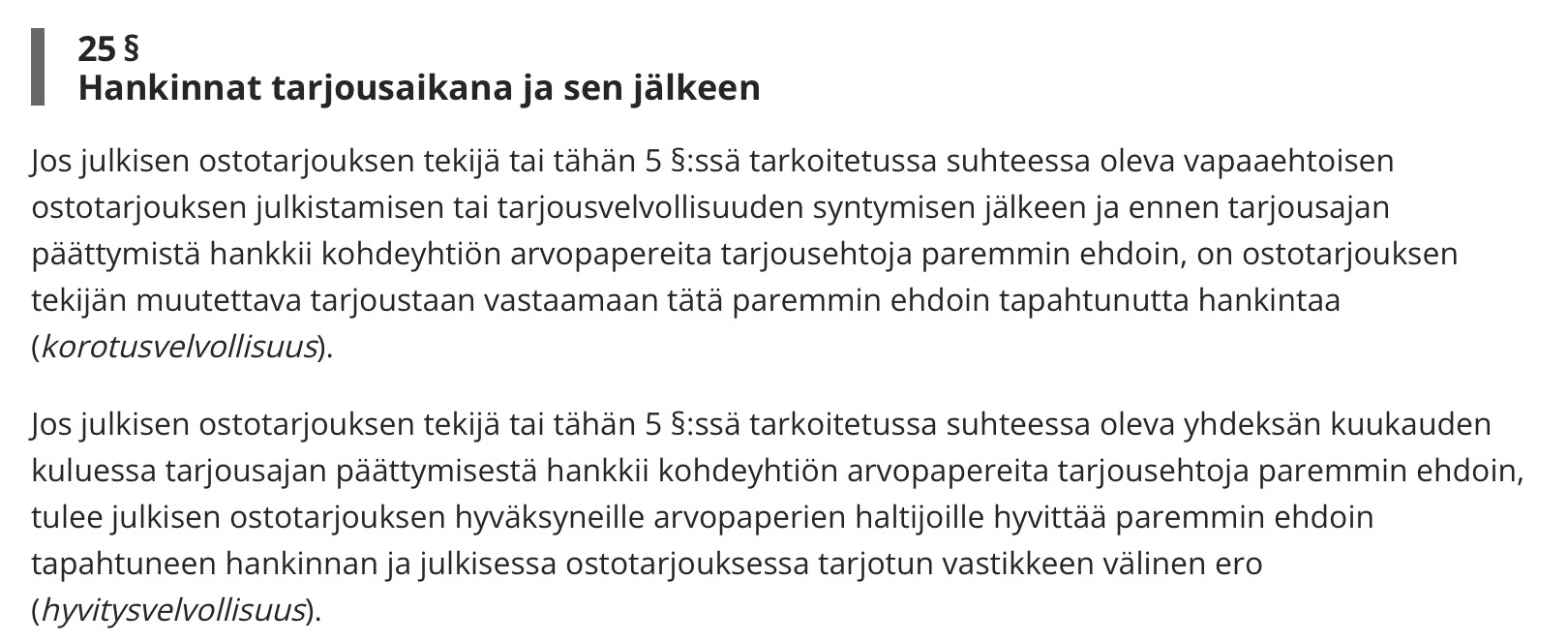
If G City were to acquire more Shares within nine (9) months of the end of the offer period under the Tender Offer on terms more favorable than the Tender Offer, G City is, under the Securities Markets Act, obligated to compensate the difference to those Citycon shareholders who accepted the Tender Offer. Such compensation is not paid to those shareholders who did not accept the Tender Offer. After the end of the nine (9) month period, G City can acquire more Shares on terms more favorable than the Tender Offer without an obligation to compensate shareholders who accepted the Tender Offer.
A shareholder who has more than nine-tenths (9/10) of Citycon’s shares and votes is, according to the Limited Liability Companies Act, entitled, and at the request of other shareholders obligated, to redeem the shares owned by other shareholders. If G City’s ownership share after the implementation of the Tender Offer exceeds this amount, G City can redeem the Shares owned by those Citycon shareholders who did not accept the Tender Offer in a minority share redemption procedure under the Limited Liability Companies Act at a fair price determined based on the Limited Liability Companies Act. Such a fair price may be higher than the Offer Consideration, equal to the Offer Consideration, or lower than the Offer Consideration.
I wrote a longer piece for the blog, so I’ll post a slightly modified version of the Citykani (Citycon) section here to see if it sparks some discussion / fresh thoughts:
Additionally, over the next couple of months, I’ll be faced with the question of how to proceed with the Citycon takeover bid. There are still seven weeks left until the offer period expires, so there’s plenty of time for my mind to change, but given recent developments, I am increasingly reluctant to sell a large portion of my shares.
The offer is unbelievably brazen, and it’s not at all impossible that book values are close to the liquidation value. “Kissamies” (Catman) is certainly a terrible majority owner, but if he manages to get over 80 percent of Citycon, he will likely seek to raise the company’s value in the eyes of financiers. He might not be able to afford endless antics and crimes for the sake of his own financial liquidity, even though I don’t believe he has any kind of moral compass to prevent all sorts of malicious actions toward minority shareholders. Against this, however, Ilmarinen is likely to remain an owner, backed by its own army of lawyers.
On the flip side, the argument for trimming Citycon would be that a better competing offer is unlikely to emerge, and as I understand it, “Kissamies” is not allowed to buy shares above the current offer price for the next 9 months. And there is always the risk that “Kissamies” is actually a primarily malicious majority owner who will start even worse shenanigans if this “legal robbery” doesn’t go through.
Citycon’s board statement made the fairness of the offered consideration quite clear. The last time the share was at a book value of about eight euros was years ago. The consideration offered by Kissamies represents the value the stock market has given to the share. I suppose the market has been the best place for determining the value. As I understand it, the consulted bank considered the consideration fair.
If Kissamies buys shares at a higher price during the next nine months, he will have to compensate the difference to those who accepted the offer. So he is unlikely to buy even a single share—or obviously only at a lower price—for the next nine months.
What worries me most is the 2/3 majority control that Kissamies might obtain. Then he will perform all sorts of maneuvers. I doubt Ilmarinen’s lawyers will be an obstacle. For instance, a directed issue to improve the financial situation (“for his friends”).
If it eventually leads to a redemption (squeeze-out), Citycon’s board puts it diplomatically. You might get more, the same, or less. Indeed.
Unfortunately, I have quite a lot of these. It used to be a good dividend machine. At first, I thought I’d see it through to the end, but after reading the board’s statement, I think I’ll realize my losses and consider investing the funds in something “safer.” If such a thing even exists anymore.
I have to tip my hat a bit to Aki Pyysing for that piece.
The whole takeover bid is legalized robbery, where assets worth 8+ euros per share are being redeemed for 4- euros. I’ve been dreaming that some major owners (Ilmarinen) would have taken a stand against the bid, but there hasn’t been any signal of that.
In Finland, we also have financial media (Kauppalehti, Arvopaperi, Talouselämä, HS Visio) and the Finnish Shareholders Federation, but not much criticism has been seen while a foreign majority owner robs a company from the Helsinki stock exchange.
The Financial Supervisory Authority (Finanssivalvonta) or others probably aren’t very interested in what kind of Corporate Governance is being used to handle things either.
If I didn’t have my own money tied up in the company, I’d be laughing out loud at this statement from Deutsche Bank:
I’m not exactly surprised that not a single person’s name can be found in the document. I wouldn’t have the nerve to sign something like that either and would just put the company name at the bottom
The board’s statement apparently contains the answer to what happens if you don’t accept the offer:
”A shareholder whose shares represent more than half (1/2) of the votes cast at a general meeting can, according to the Finnish Companies Act (624/2006, as amended, the “Companies Act”), decide on all matters that are decided at a general meeting by a simple majority of votes. It is possible that G City may, as a result of the Tender Offer, achieve an ownership interest exceeding two-thirds (2/3) of the votes represented by Citycon’s Shares. A shareholder whose shares represent at least two-thirds (2/3) of the votes cast and the shares represented at a general meeting can, according to the Companies Act, decide on, among other things, directed share issues, share repurchases, amendments to Citycon’s articles of association, mergers, demergers, and the placement of Citycon into voluntary liquidation. It is possible that G City could in practice exercise such influence even if it owned less than two-thirds (2/3) of Citycon’s shares and votes, depending on the number of shares and votes represented at the general meeting in question.”
Apparently, the intention is to use those measures to transfer all the money into the pockets of the majority owner and their inner circle
I originally set the poll to end on Feb 20th, which was when the offer period was supposed to expire, but this whole mess took a completely new turn and, along with it, a new closing date. I think it’s fun to see others’ perspectives on the matter through the poll.
The company certainly isn’t as close to bankruptcy as some parties suggest, considering they are borrowing over 500 million euros more.
In my opinion, we should take the dividends and demand a proper price for Citycon from the “Catman” (Katzman). Let’s not cave in to blackmail and this legalized robbery or “mandatory tender offer.” If we trim our positions, let’s sell them to the market and not to the “Catman.”
The likes of Maija Vehviläinen (Arvopaperi journalist) and others talk about investing the money in “better opportunities.” They just can’t seem to name even one. It’s rare to get premium shopping centers at half price.
Taking this additional loan smells strongly of a squeeze-out play. But there’s nothing for it but to sit tight and then go to arbitration if they manage to scrape together that 90 percent, which I’m a bit skeptical about. It might be that they’ll wait at least 6 months and buy out the rest if they don’t get enough and really want to take full control of the company.
This matter came up on Discord, and I thought I’d ask if anyone here has definitive information on the matter.
As I understand it, the situation after the tender offer is that if Katzman / G City does not reach 90% of the shares, he cannot buy Citycon shares at a price exceeding 3.80 euros over the next 9 months without paying additional compensation to those who accepted the tender offer.
Could Citycon, however, start buying back its own shares at any price without Katzman having to worry about it? That would be a very effective way to indirectly increase Katzman’s ownership stake and a convenient way to circumvent the aforementioned regulation according to the letter of the law.
Previously, it was clarified that Citycon was allowed to buy back its own shares, and exceeding the 50% ownership threshold because of this did not create a mandatory bid obligation for G City and the “Catman” (Katzman).
“Based on an exemption under the Securities Markets Act, when the change in ownership share results solely from the company’s own actions, exceeding the threshold does not trigger an obligation to make a mandatory public tender offer until Gazit-Globe, which exceeded the limit, acquires or subscribes to more shares in the company or otherwise increases its voting rights in the company.”
I don’t know if there is any reason why the above legal provision wouldn’t apply, but I would assume that share buybacks are kosher.
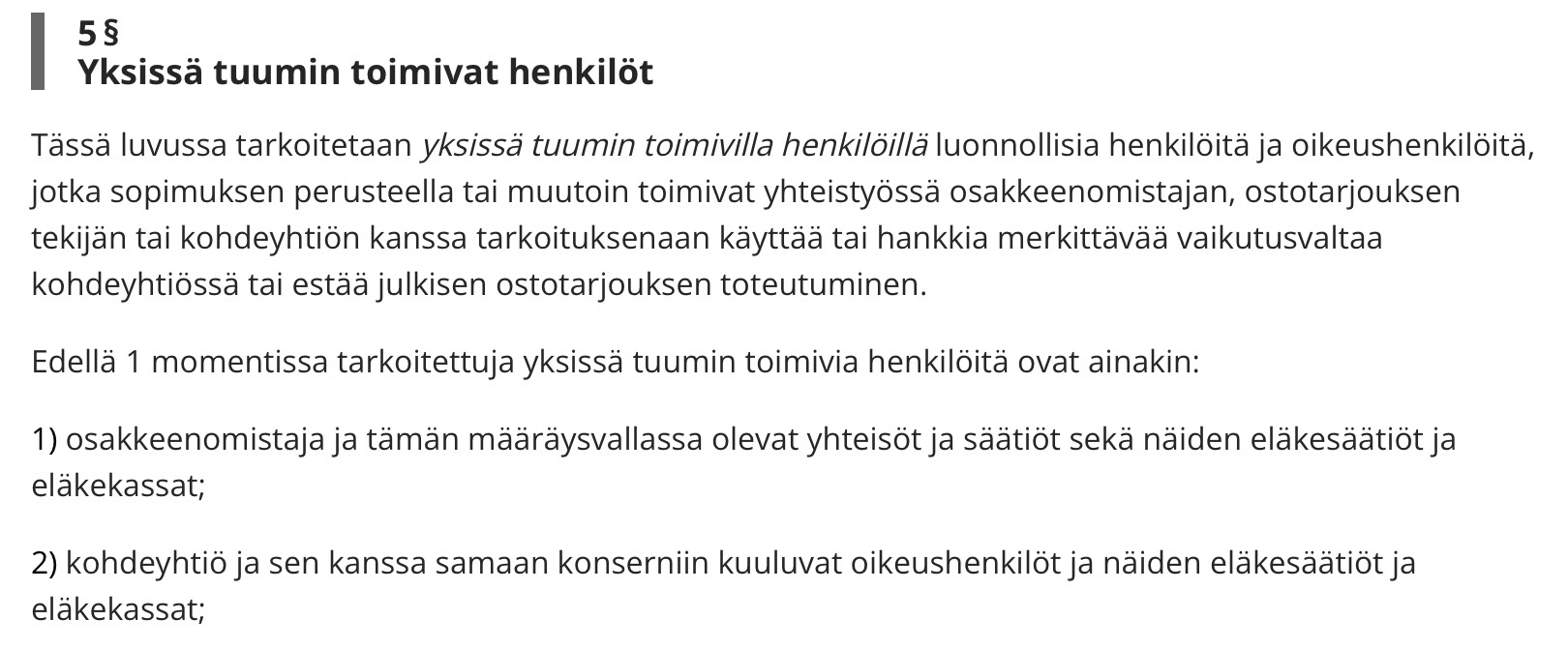
In my opinion, the kind of activity you described would go directly against the basic principles of the Limited Liability Companies Act, but fortunately, we do not have to rely solely on my shaky interpretation, as the answer to this can be found in Chapter 11 of the Securities Markets Act:
What has been exceptional in this case is that the board’s statement was issued so late compared to the announcement of the mandatory tender offer. Normally, it is issued immediately after the announcement of the mandatory bid, or at the latest when the offer document is published. This time, it was only released after those. Clearly, it wasn’t an easy matter for the board or Deutsche Bank – who knows. This won’t end here.