This AI certainly seems like another major leap forward—following that painting AI—to the point where I’m not sure I want to see this game through to the end.
The world is undoubtedly heading in a direction where an individual’s capability, persistence, or talent won’t matter much, because a program that leverages the sum of the whole is always more efficient than an individual.
As a semi-professional musician, I am also particularly worried about its ultimate castration.
Let’s put it this way: the efficiency benefits of AI (and technology) are undeniable. But is humanity’s ultimate hedonistic goal really just to end up chilling “plugged into tubes” where all problems are solved and good vibes are produced for everyone as tailored sensory strikes?
Verneri and Alokas sat at a small table in a dimly-lit bar, sipping their drinks and discussing the stock market.
“I think the market is really overvalued right now,” Verneri said, taking a drag on his cigarette. “All these tech companies are trading at ridiculous valuations, and it’s only a matter of time before they crash.”
Alokas shook his head. “I don’t know, man,” he said. “I think there’s still plenty of room for growth. Look at how much these companies are earning, and how much they’re investing in the future. I think they’re worth every penny.”
Verneri snorted. “You’re just being naive,” he said. “These companies are built on sand, and they’re going to crumble like a house of cards. I’m getting out while I still can.”
Alokas sighed. “You’re missing out, man,” he said. “There’s money to be made here, and I’m going to grab as much of it as I can. You can sit on the sidelines and watch, or you can join me and make some real cash.”
Verneri stared at Alokas for a moment, then stubbed out his cigarette. “Fine,” he said. “I’ll take a gamble. But if this blows up in our faces, I’m never listening to your stock tips again.”
Alokas grinned. “Don’t worry, man,” he said. “I’ve got a good feeling about this one.” The two men clinked their glasses and continued their discussion, their voices low and intense in the dim light of the bar.
Downside risk is indeed capped, but the risk of bankruptcy is higher in value stocks. From a certain perspective, value stocks are riskier. There’s a reason why those value stocks are cheaper. And Coca-Cola is not a value stock if someone is thinking of it as a counterexample. It has an insane P/E but it’s not a growth stock either. You’re on the right track, but the concept of risk could be defined. A value stock has a higher risk of going to zero. A growth stock has a higher risk of dropping a lot without going bankrupt. A true value investor is adding ZIM to their portfolio now. It’s cheap and for a reason. If a proper recession hits, it could go to zero. Coke will keep on chugging along.
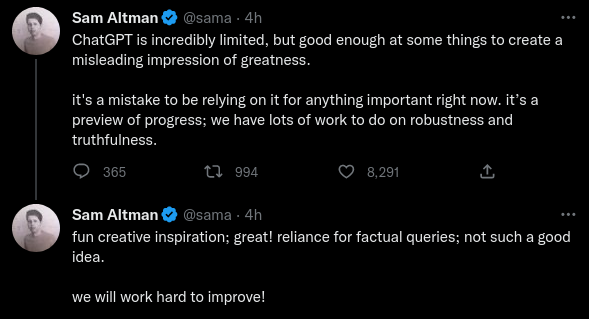
Sam Altman is one of the founders of OpenAI and the company’s current CEO.
In a recent tweet, he points out that ChatGPT is good enough to create an illusion of “greatness.”
At the same time, he warns against relying on ChatGPT’s outputs. ChatGPT is a glimpse of progress, but there is still much work to be done to improve it. And the hard work continues.
Someone already mentioned ChatGPT’s ability to generate code in almost any programming language.
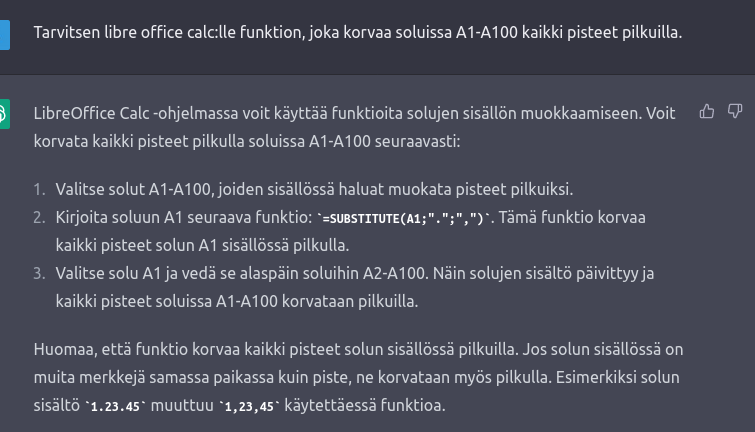
ChatGPT also helps with things like Excel and LibreOffice Calc functions. At least for me, I tend to forget the names of functions or mix them up between different programs. It’s easy to check with a single question.
By the way, I have to say that the guidance in Finnish works surprisingly well.
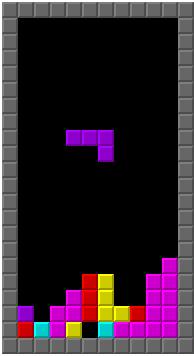
This became very clear when I tried to get ChatGPT to play chess, tic-tac-toe, or Tetris with me. It starts playing with a very confident approach and knows the rules to the letter, but doesn’t actually understand them on any level. The funniest part was that in Tetris, it thought the pieces fall right in the middle. Apparently, the training material is full of screenshots of the game, and they always have a falling piece in the middle, like in the description of this Wikipedia article.
Maybe that conclusion about a disinformation pandemic is a bit too tabloid-style, but the article itself highlights ChatGPT’s issues well. On the other hand, perhaps which finger someone used to play the bass isn’t exactly at the heart of the fascination with this new technology.
Even with these, however, one should remember that tweet from Altman. My own experiments have only produced simple functions where it’s easy to see that they work. On the other hand, on Reddit for example, I’ve come across code snippets that simply wouldn’t work, but look good on the surface. So it’s just good enough to be easily misleading.
I’m honestly blown away. This creates absolutely incredible opportunities for personal learning, especially in areas where you can verify the functionality of the provided answer yourself. It’s a fantastic thing, and I’ve certainly started using it as a tool that I can utilize in my everyday life.
I’ll add a few more thoughts to my previous reflection on the increasing prevalence of this:
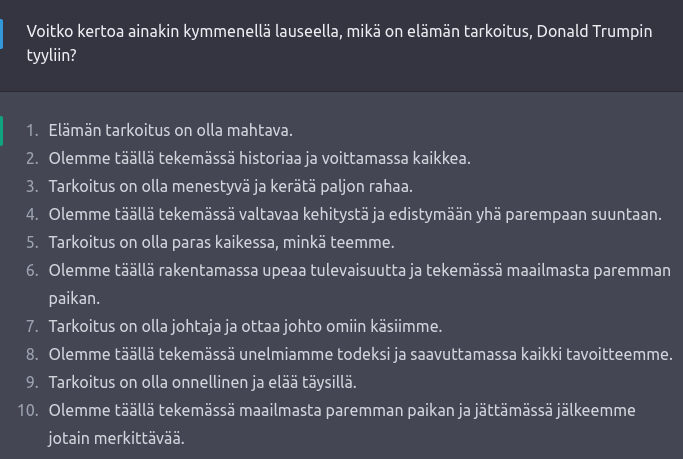
Homogenization of knowledge and art. In principle, consensus is the truth that AI can arrive at through calculation. Instead of the individual human or thoughts, AI thus represents the so-called “average human being.”
The prevailing difficulty with media literacy will also shift to information literacy, as one must understand that the information provided by AI is equally a pre-digested opinion that may have been manipulated. I feel sorry for the youth.
Going slightly off-topic from AI, but humans are actually happy when overcoming challenges and when being outside their comfort zone. Not when everything is presented ready-made, solved, and processed.
AND: Questioning the prevailing opinion is likely very human and drives development.
I believe that here on the forum, all threads could be effectively silenced by mechanically analyzing them and stating the consensus for every company (except for Tesla and the Coffee Room). This would lead people to act more in accordance with the consensus and thus, in a way, fulfill and reinforce existing perceptions. (Pineapple belongs on pizza. Does pineapple belong on pizza? = pineapple belongs on pizza → I put pineapple on the pizza).
As a rough everyday observation: targeted advertising. Youtube offers me the same mush of about five different topics, but it doesn’t automatically know how to offer much of interest “completely out of the box.” At most, something that networked acquaintances or people in the vicinity have watched.
I don’t see AI being able to question its usual ‘thought path’ leading to a conclusion in a human way, expand in an unexpected direction, or accept a state of uncertainty.
It must reach some endpoint—even “I don’t know” is an endpoint for AI.
If it were capable of these things, then we would be dealing with things that are almost too exciting. I think AI would, in principle, go haywire with infinite possibilities.
Please continue with the actual topic; I’ll move to looking out the window at the horizon for the rest of the day and listening to Esa Saarinen.
In my opinion, the most interesting point in the IS article was this:
Ironically, AI programs are also under threat because they constantly need more data to develop their models. If the internet becomes filled with AI-generated junk information, models are threatened by declining performance as they consume their own garbage. “Garbage in, garbage out” is an old saying in computer science. The destruction of information ecology is therefore a threat to everyone.
So, because ChatGPT’s dataset of tens of terabytes is based, among other things, on internet blog posts and discussions, this could become a problem in the future if internet content is mainly AI-generated “junk.” Real information produced by real experts thus gets buried under all this junk. Even on Google, there’s already quite a lot of all sorts of junk if you try to search for information in Finnish: quite often you come across sites containing nothing but junk run through Google Translate or some text generator.
Based on gut feeling alone, one might imagine that in the future, language models like ChatGPT will only be fed desired information. This has surely been the case until now, even though building the language model itself has required a massive amount of data.
The internet is full of human-generated “garbage.” Hopefully, AI will never succumb to becoming that kind of nonsense generator.
ChatGPT has sparked a lot of discussion, and for good reason. It has also been widely misunderstood. Personally, I have focused more on the opportunities it brings and have been envisioning the future and potential use cases. Regarding this AI, however, it is just a language model that aims for human-like interaction with people by processing and understanding languages and organizing information.
It is clear that we are close to a situation where an AI like ChatGPT could revolutionize life. Surprisingly, one also finds many articles and analyses that have somehow missed the whole point and focused mainly on the problems of ChatGPT’s chat interface, which was released just over a week ago.
ChatGPT is obviously unrefined, but even in its current state, it is truly interesting—and the best example ever of what the future could bring even within this decade.
I then asked a few follow-up questions. The answers weren’t quite perfect, but the feeling was the same as chatting with a bright student, for better or worse. I was particularly impressed by how the tool chose a lightweight but functional data structure on the fly as the basis for the code.
I didn’t test the code snippets, but with a few exceptions, they looked functional and perfectly correct at the level of an exam answer.
This project certainly opened the eyes of a layman like me to better understand how close the ultimate breakthrough of AI is. As already mentioned, this isn’t even a very extensive environment in the end, but it gives an indication of the possibilities. It will likely change, at least in the near future, the human need for studying different things, as learning everything in detail may not always be necessary.
From an investment case perspective, I think that at least Google as a search engine will likely soon become history because of this (as long as the ‘bullshit filter’ you mentioned develops). I also think with horror about how advertising and marketing—which are already pushing the internet’s usability to the limits of tolerability—will integrate into the user experience, and what kind of threats cybercrime creates for the use of AI.
What kind of projects and companies should one keep an eye on if they wanted to find suitable investment opportunities related to the topic?
I decided to ask for an egg-free pancake recipe in my native language so that I could better demonstrate the development of AI to my wife and mother.
I know several different recipes for pancake batter, some of which can be made without eggs. Here is one possible recipe:
Ingredients:
2 dl water
2 dl wheat flour
1 tsp salt
2 tbsp cooking oil
Instructions:
Mix all ingredients in a bowl and mix into a smooth batter.
Let the batter rest for about 10-15 minutes.
Fry the pancakes in a pan with hot oil on both sides until they are golden brown.
Serve the pancakes with your choice of sauce or toppings.
You can replace wheat flour with other flours or make the batter gluten-free by using gluten-free flour. You can also add various spices or ingredients to the batter to taste. I hope this recipe helps you prepare delicious pancakes without eggs!
The recipe is quite excellent, but the amount of liquid had to be increased slightly.
Next, I decided to test whether ChatGPT could come up with a completely new dish, but I haven’t dared to try this one yet. On the surface, however, it seems quite edible.
Here’s a recipe for pineapple stroganoff:
In a large saucepan, melt 2 tablespoons of butter over medium heat.
Add 1/2 cup of diced onion and 1/2 cup of sliced mushrooms, and cook until the vegetables are softened, about 5 minutes.
Stir in 1 tablespoon of all-purpose flour and cook for 1 minute.
Gradually whisk in 1 cup of beef broth and 1 cup of pineapple juice. Bring the mixture to a boil, then reduce the heat to low and simmer for 10 minutes.
Stir in 1 cup of cubed pineapple and 1/2 cup of sour cream. Simmer for 5 minutes, or until the sauce is thickened.
Serve over noodles or rice, and garnish with chopped fresh parsley if desired.
By the way, have you checked if you can find that code snippet online? The problem that comes to mind is that AI grabs entire code snippets from its training material, which could have any kind of licensing, and the information about the license is lost when it comes through the bot. GitHub’s Co-pilot does something similar to this bot, but only for code and not for general text. It has already been noticed that it may provide well-known code snippets as-is; see the HN link below.
I’ve checked now. Google doesn’t find anything when I provide it with certain parts of the code in question.
I also consider literal copying unlikely because ChatGPT seems to have its own coding style that it uses in all its code responses, regardless of the topic. In direct copying, stylistic inconsistencies would inevitably occur.