There, they are talking about production volumes in the tens of thousands of tons. So, the quality and intended use of these carbon nanotubes must be very different from Canatu’s case. Among the industries mentioned were battery materials, and our initiation of coverage report also seems to mention that tons of carbon nanotubes can go into batteries, but then we are talking about a completely different business. In Canatu’s case, we are talking about one or two kilograms of carbon nanotubes produced per year.
ChatGPT stated the following regarding this:
Carbon nanotube (CNT)
“Carbon nanotube” is a general term for all nanotubes composed of carbon.
They are hollow, cylindrical structures with one or more layers, consisting of a hexagonal lattice formed by carbon atoms (like in graphene).
CNTs are divided, for example, into:
SWCNT = single-walled carbon nanotube
MWCNT = multi-walled carbon nanotube
Graphene nanotube
The use of the term depends on the author, but most often it refers to:
a nanotube formed by rolling up a single graphene layer
→ which is practically the ideal form of SWCNT.
In marketing, the term “graphene nanotube” is sometimes used as a more convincing-sounding name for SWCNT, but scientifically:
Relationship
All graphene nanotubes are carbon nanotubes
But not all carbon nanotubes are graphene nanotubes (e.g., MWCNTs)
“During this week I’ve got to know the ins and outs of the Canatu CNT technology and saw first-hand the immense amount of effort and skill that is put into it.”
I wonder if I could also do a week of TET? Or someone from down south Investors, send your children to TET!
Competitive landscape. Are Beryllium-based pellicles gaining traction? More information coming in February
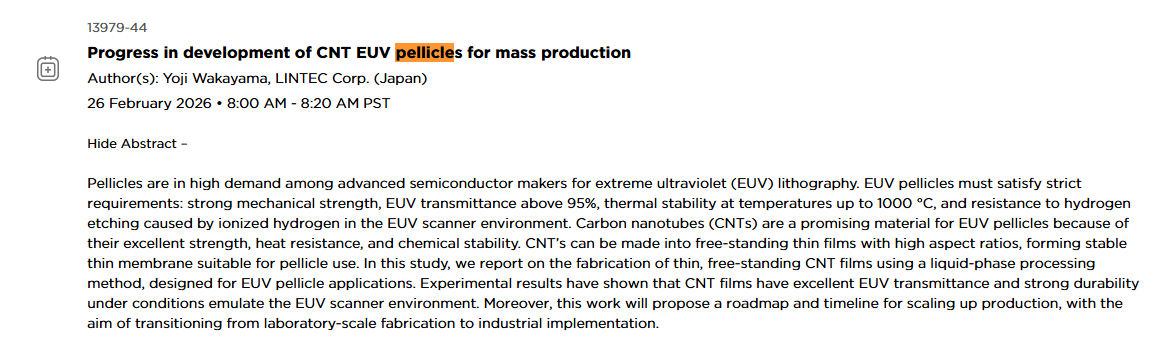
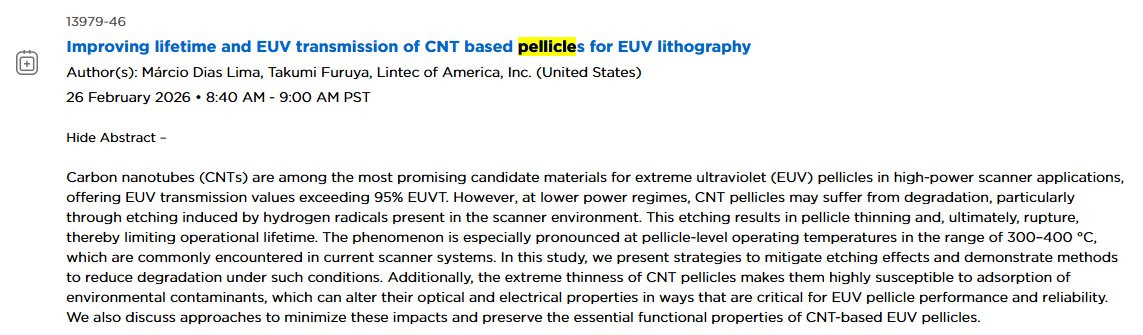
These kinds of claims could be justified a bit better. Why do you think Beryllium is the winning choice? At least to my eye, it would still seem that Beryllium is still very much in the research phase, and applications scalable to mass production are not yet in sight. And it would not directly seem that Beryllium would be a better material for pellicles vs. carbon nanotubes. In those Beryllium-related studies, over 90% EUV transmittance results have been achieved with prototypes, whereas Canatu’s films reach over 97%. In Beryllium studies, the durability of the films for prototypes was mentioned as a current challenge. In Canatu’s case, the first customers are already initiating mass production of pellicles in real-world applications.
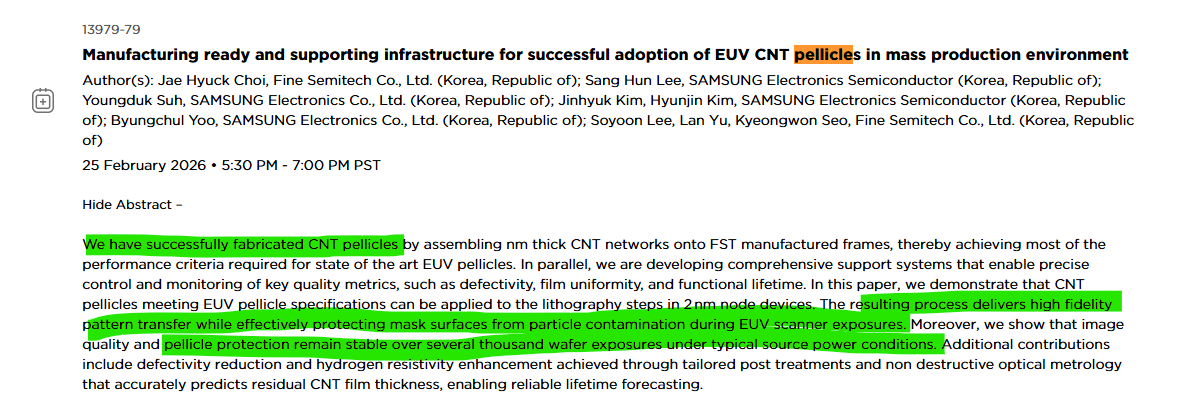
Samsung: “we have successfully manufactured CNT pellicles with FST using 2nm technology”. I don’t know if a similar comment from Samsung has been seen in writing anywhere yet?
edit. Samsung has reported that 2nm technology has reached 60% yield. I’m an amateur, but as far as I understand, 60% is an important ‘threshold’ for commercial production (I might be wrong, but this was mentioned in Jukan’s tweet below)
One of the bright spots in Samsung’s latest disclosure is the chip yield improvement. The company is reporting between 50 and 60 percent yields for its 2 nm production, a significant jump from earlier estimates of about 30 percent
The proving ground is already set. Samsung has decided to equip next year’s Galaxy S26 series with its in-house application processor (AP), the “Exynos 2600.” Exynos is an in-house chip for which the non-memory (System LSI·Foundry) division handles everything from design to production, and the foundry division will manufacture it using the 2nm process. Depending on how successful Exynos is, the competitiveness of Samsung’s foundry business will be determined.
An industry official said, “It appears that Samsung has begun to communicate its 2nm competitiveness to the market. It may be difficult to say that the improvement was dramatic, but it does indicate that continuous performance enhancements are underway,” adding, “In particular, since the Exynos 2600 adopting the 2nm process will fully enter the market next year, Samsung’s 2nm competitiveness will be proven by whether Exynos succeeds or not.”
As a conclusion, it could be that Canatu’s pellicles have the opportunity to debut in Samsung’s 2nm production in 2026. These would then be going into at least the Galaxy S26… Or maybe not, who knows anymore.
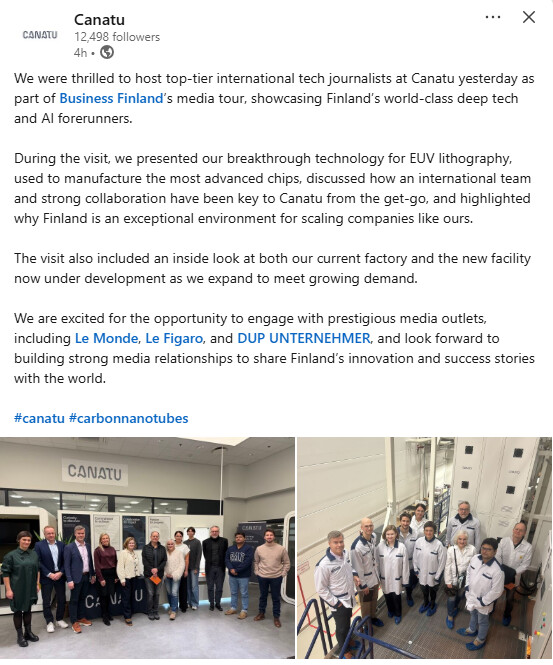
In the coming days, there might be media visibility in Le Monde, Figaro… Or maybe not. Who knows anymore. However, it doesn’t compare to KL’s ‘these stocks have the most upside potential’ articles.
Since the beginning of the year, it has dropped a good 30%. The price apparently still has high expectations for a promising future. H1 showed a small crack in growth, but in my opinion, the project has progressed well during the year. Well, time will tell how this H2 really went.
At the 5:30 mark of the video, the CEO mentioned that both reactor customers are from Asia, which in my opinion quite certainly confirms that in addition to FST, the other customer is TSMC. FST is mentioned by name after this.
According to BofA, the adoption of High-NA EUV technology is progressing, even though not all issues have been fully resolved yet. The bank estimates that volume orders will begin in late 2026 or early 2027, and revenue will mainly materialize only in 2028–2029, when High-NA will become a new, multi-year growth driver for ASML.
It is now quite interesting to follow whether Canatu’s pellicles might be seen in ‘regular’ NA devices before High NA. Furthermore, it is interesting to see to what extent Canatu would be seen in High NA.
Recommendation for this YouTube video, which vividly explains the world of processors and electrical circuits, their development curve in recent years, and their future. According to the video creator Anastasi (Anastasiia Nosova), she has a background as a circuit designer, and for example, a researcher interviewed at Imec (a top research center in Belgium) has followed her channel. High-NA EUV is also highlighted in the video, in addition to ASML; ASML’s equipment apparently undergoes test runs at Imec before delivery to customers. I didn’t spot that 0.2 nm circuit from the title in the video (0.2 nm is probably roughly the width of one atom), but otherwise, this was quite an info dump.
How would an appearance by Canatu fit on that YouTube channel, which has about 400k subscribers? I believe that Canatu’s activities would interest the creator and subscribers as a topic, and interest in the company could grow considerably. Kempower gained considerable recognition a few years ago through the Norwegian electric car YouTuber Björn Nyland.
This Kvanttinova building coming to Espoo (investments of about half a billion euros) sounds good; it will surely benefit Canatu as well. For example, potential employees will be trained and will come to the capital region.
This is excellent news, even if Canatu itself is not a shareholder in the system. It’s difficult to be a lone player - or one of a few - in a rapidly developing field that needs new experts. You can’t train everyone from scratch yourself. Kvanttinova helps create the necessary ecosystem where experts in the same field develop and grow in different companies, and employees occasionally switch employers, resulting in new ideas and products that would never emerge in a single company. Additionally, skilled labor will be available when expansion is needed. Or at least more readily available than it would be without such a concentration.
Silicon Valley has succeeded precisely because experts in the same field have concentrated in a small area there. Let’s do the same in Espoo.
We bought Canatu, a manufacturer of advanced carbon nanotubes, as a new company for the Model Portfolio. After its SPAC listing in September 2024, Canatu has had to postpone its ambitious growth targets, and the stock has been under pressure this year. In our opinion, the company’s long-term potential remains unchanged, and in the semiconductor sector, demand for the company’s EUV pellicle films made from carbon nanotubes is accelerating in the coming years. The company’s valuation (2025e-2026e EV/S 14x-7x) requires strong growth in the coming years, but we see a realistic path for the company to multiply its revenue over the next 5 years. Should this materialize, the stock would also, in our view, offer an excellent return from current levels. Due to a significantly higher-than-average risk level, we added the company to the Model Portfolio with a smaller 3.5% weighting. With this transaction, the Model Portfolio’s cash weighting decreased to just over 13%.
Does Inderes believe that Cantu’s share price will increase tenfold with a 12% or even greater probability? One might infer something like that from the size of the bet.
Canatu is indeed a good candidate to become a ten-bagger with a 10-year horizon, as there are other potential applications besides pellicles for the semiconductor industry, and the company’s playing field is global.
Seriously, that 10X would require a market capitalization of over 3.5 billion. If you look at Canatu’s own estimates of the market size, for example, it’s completely incomprehensible to expect such an increase in value, and in a relatively short time at that.
You are now focusing your assessment on the semiconductor sector. In ten years, other fields might also gain momentum. Some of them might even generate hype.
I certainly wouldn’t value, for example, a medical device company at a P/S of ten or an automotive OEM. You can take as a comparison, for instance, Siemens Healthineers, whose P/S is around 2, or DENSO (in some collaboration with Canatu), whose P/S is 0.5.
A stock shouldn’t really be valued based on P/S, but rather on future cash flow.
If we assume for Canatu, for example, a 300M€ revenue and a 100M€ profit (which in itself would already be very strong), a market capitalization of 3 billion would require a growth rate of around 20% even after 10 years.
 Carbon nanotube (CNT)
 Relationship
 Investors, send your children to TET!