As your quotes indicate, TSMC can improve wafer yield with its current equipment. The fact is that resolution can only be reduced by decreasing the wavelength of light or by increasing the NA of the optics, which cannot be done without ASML. Of course, from a business perspective, it’s good to get all the ‘power’ out of old equipment before making a high NA investment of approximately 400 million.
4 Likes
I’m probably asking stupid questions now, but… Why is everything so much guesswork and speculation? So Canatu apparently can’t say who they’re supplying the reactors to, at what price, and what the deal is regarding royalties?
1 Like
I’m probably asking stupid questions now but…Why is everything so much guesswork and speculation? So Canatu apparently can’t say to whom it delivers reactors, at what price, and what’s the deal regarding royalties?
Yes, these are trade secrets for which there is no more detailed information yet. There are some estimates regarding the impact of these first two reactor sales on the result (in the range of €5-10m/device?). In addition to your questions, open questions include, for example, when will EUV-NA devices actually come into mass use? By whom first? Is Canatu their pellicle supplier? Is Canatu’s technology a winning technology or is there competition with the Japanese method? To what extent will Canatu’s CNT-pellicles be used in previous generation lithography devices? Will Canatu succeed in significantly (financially) expanding into other verticals, or will they remain on R&D and prototype tables?
3 Likes
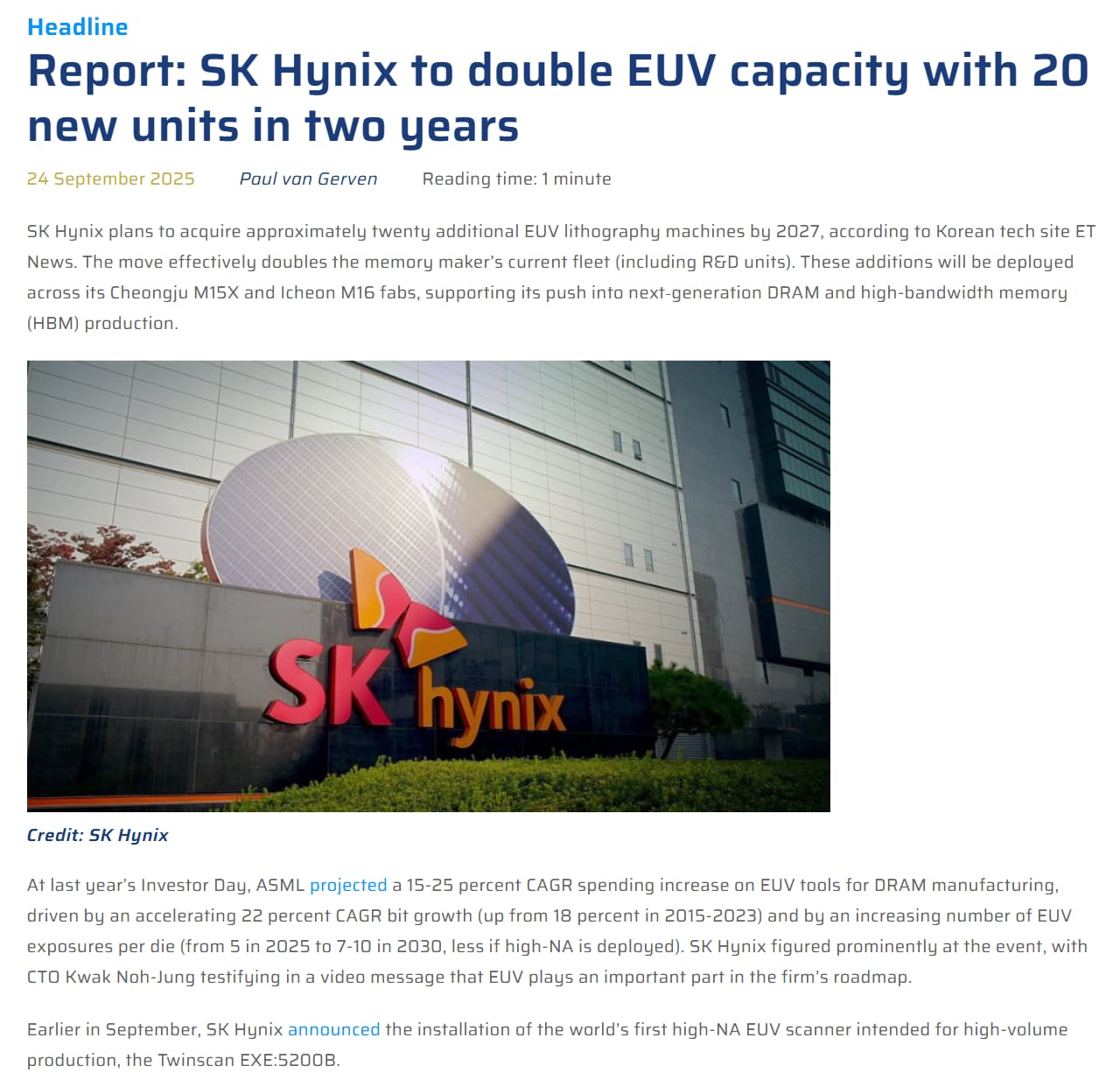
Report: SK Hynix to double EUV capacity with 20 new units in two years - Bits&Chips
Inhoamani AI on tietävinään:
AI-yhteenveto
Canatu and SK hynix are two different companies, with Canatu being a deep-tech company developing carbon nanotube (CNT) technology and SK hynix being a South Korean memory semiconductor manufacturer. While not a partnership in the traditional sense, SK hynix is mentioned as an early adopter of Canatu’s technology, indicating a business relationship where Canatu supplies its CNT products and manufacturing equipment to SK hynix, a leading memory producer.
Canatu
What they do: Develops advanced carbon nanotubes (CNTs) and related products for the semiconductor, automotive, and medical diagnostics industries.
Technology: Offers its proprietary CNT manufacturing equipment and technology to customers, allowing them to produce CNT products themselves.
Industry focus: Creates CNT membranes for advanced EUV lithography and heating films for ADAS systems.
SK hynix
What they do: A major South Korean manufacturer of memory semiconductors.
Relationship with Canatu: SK hynix is a memory manufacturer that has adopted Canatu’s technology.
Key takeaway
Canatu provides its specialized CNT technology to companies like SK hynix to improve their products and manufacturing processes. SK hynix, in turn, integrates these advanced materials into their semiconductor manufacturing, showcasing an important customer-supplier relationship in the deep-tech and semiconductor sectors.
13 Likes
https://wccftech.com/intel-reportedly-increases-asml-high-na-euv-equipment-orders/
And Intel is buying 2 more High-NA-EUV machines from ASML.
Canatu’s reactors will presumably sell like hotcakes soon, as the race for High-NA EUV equipment seems to be heating up. 
And at the same time, that also means significant growth in ancillary sales, royalties, etc. for Canatu.
Looks good.
30 Likes
Selected from Canatu’s H1/2025 half-year review:
“Canatu believes that its competitive position in the market has even improved compared to the situation at the time of listing, as significant progress has been made with existing reactor customers and projects are underway with new customers. According to the company, no other entity than Canatu has sold carbon nanotube reactors for the production of carbon nanotube pellicle membranes for the semiconductor industry. The company is also in discussions with potential new customers entering the market. Canatu estimates that its market share in the developing market for carbon nanotube-based pellicle films is very large. The total market for carbon nanotube-based pellicle films is predicted to be 1.0–2.0 billion euros by 2030.”
If/when Canatu has no real competitor and Canatu’s pellicle films are practically essential for the manufacturing of more advanced chips, one could quickly imagine an acquisition offer for the entire Canatu being very possible. (And when the share price has been driven almost through the floor).
What significance would it have, for example, for ASML or individual chip manufacturers, if, say, an individual ASML customer were to acquire Canatu? (gaining a monopoly on practically essential membranes/carbon nanotube films).
20 Likes
A recent market estimate:
The global Pellicle market was valued at US$ 884 million in 2024 and is anticipated to reach US$ 1493 million by 2031, witnessing a CAGR of 7.8% during the forecast period 2025-2031.
19 Likes
ASML forecasts revenue growth for 2026, even though demand is expected to weaken in China. With the AI boom, demand for the latest EUV equipment would thus seem to continue growing, and this should be positive for Canatu in the coming years.
35 Likes
Highlights from ASML’s conference call related to Canatu:
I myself have been under the impression that when moving from low NA to high NA, the customer’s process would be simplified by moving from multiple patterning to single exposures, and therefore I have also assumed that the number of masks in high NA would decrease. However, ASML’s management was asked regarding DRAM whether they expect the mask layers to drop when moving from a 6F2 architecture to 4F2.
" If we look at the number of EUV layer going from 6F2 to 4F2, we do not expect the number of layer to drop. In fact, as 4F2 roadmap continues after transition, we in fact expect the number of EUV layers continue to grow. So it’s in fact adding overall more litho mask, more advanced litho mask. "
This is indeed very good news for Canatu. The more masks are needed, the more pellicles are used.
35 Likes

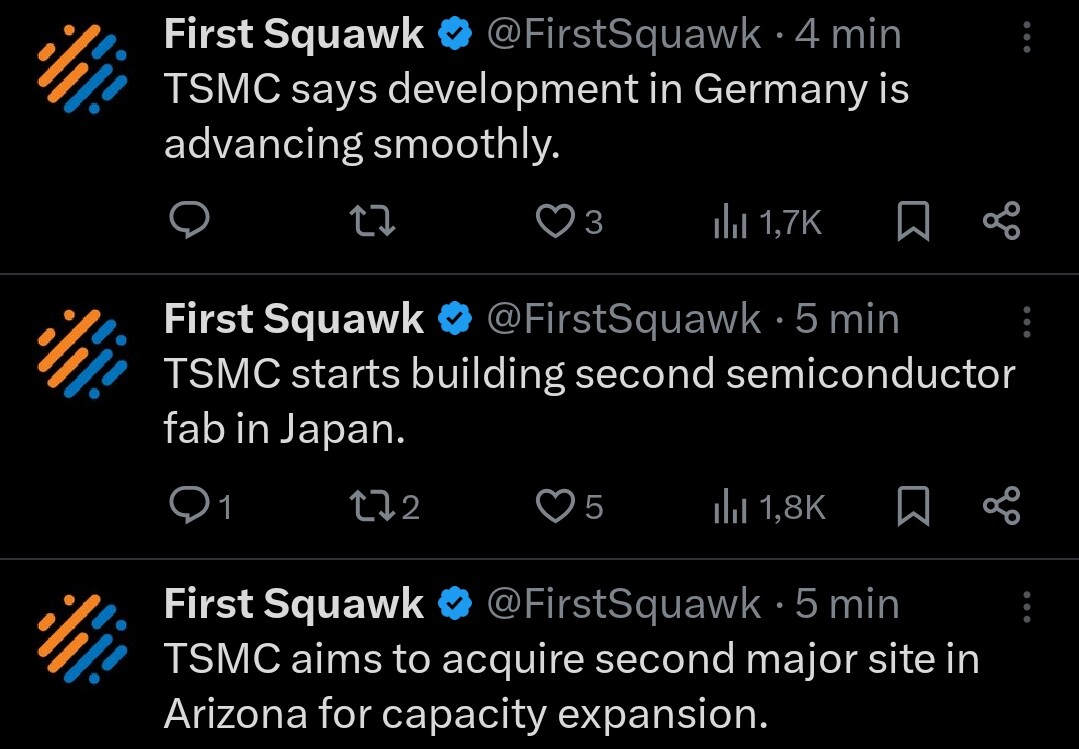
Here’s something about the schedules (TSMC):
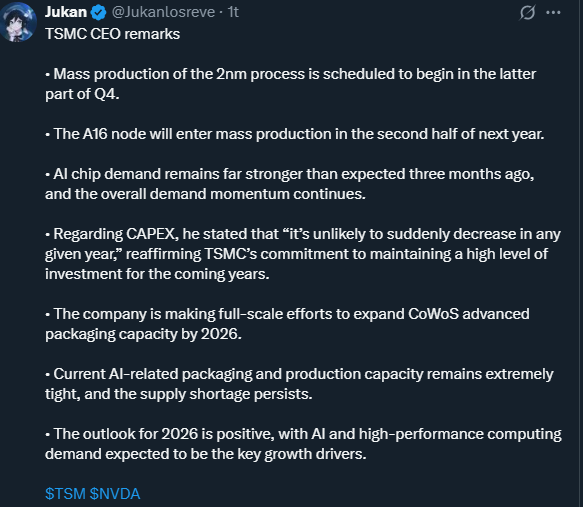
edit. i.e. 1.6nm A16-node into production H2/2026. So that’s it then…
13 Likes
Market chatter about Intel’s 1.8nm customer. This would then logically fall into the High NA EUV category

https://x.com/StockSavvyShay/status/1979186070647419159/photo/1
1 Like
There have been some rumors on the internet that Intel’s wafer yield with high-NA equipment is terrible. If the wafer yield is already low, then there’s probably no need to use a pellicle on the mask; it likely won’t bring much additional yield in Intel’s case 
However, let’s take internet writings with a grain of salt and wait if Intel wants to comment on its yields in the future.
5 Likes
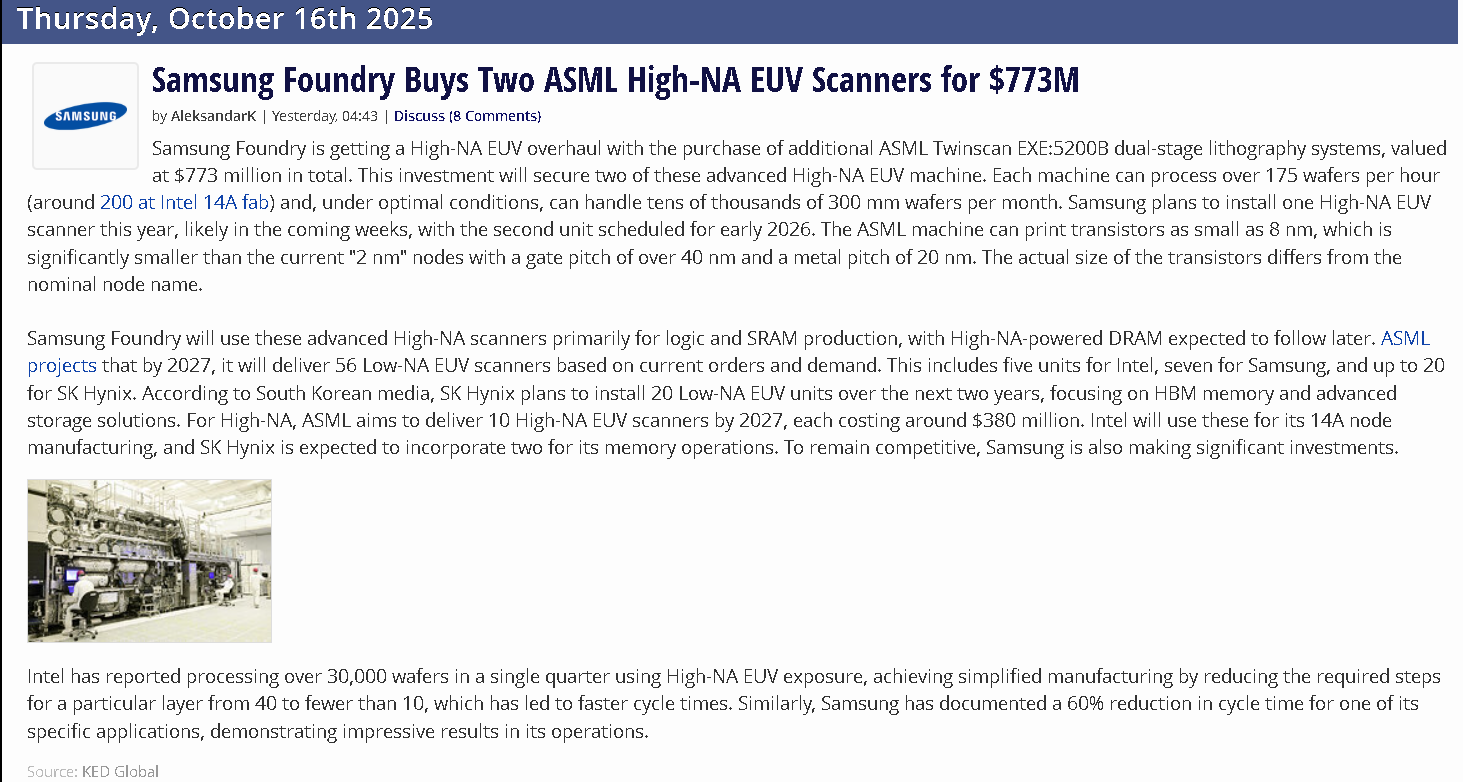
For someone new to stock investing, this analysis of Canatu feels quite like Greek to me. What kind of return is realistic to get from the market if the products are proven to be effective?
4 Likes
“What kind of slice” good question,
It’s worth investigating the market situation; it somehow feels like some companies don’t really provide it or they beat around the bush. Good financial journalists should get an answer to that and/or do the analysis themselves.
Carbon nanotube films have been the subject of intense research for years, with the dry method being the focus due to its many advantages, such as long carbon nanotubes. The wet method, for example, breaks up carbon nanotubes during purification, which is not a good thing.
Large companies like Mitsui Chemicals and Lintec have apparently conducted extensive research without much fanfare, and new factories from them will soon be completed. And perhaps not like this: In the Canatu listing prospectus dated 2.8.2024, it states: “Unlike Canatu, its carbon nanotube industry competitors appear to have based their carbon nanotube technology on so-called wet dispersion technology.”
The aim is to get carbon nanotubes in an aligned CNTs parallel to the film plane style, and FC-CVD (floating catalyst) is likely suitable for this, rather than CVD, where carbon nanotubes are fixed to the device via a catalyst.
Floating catalyst enables carbon nanotubes to float, and carbon nanotube films form spontaneously and support themselves, free standing films.
Spontaneously? Yes, but tools are needed to form the desired film. It’s possible that the most significant competition will take place at this point, and Canatu also has good chances of succeeding there.
7 Likes
Is it possible that the best technology doesn’t win if the second best is good enough? And for example, easier and cheaper?
3 Likes
Yes. Ultimately, marketing capability decides between those who have good enough technology. A good example is from the 80s, Sony’s Betamax vs. VHS battle in the VCR market. Betamax was technically superior and probably wasn’t even more expensive technology, but Sony forbade recording pornography on its own cassettes. The rest is history.
The worst enemy of the best is good enough. And one’s own or opponents’ stupidity.
10 Likes
Quite a lot of misinformation is circulating in the thread, so I’d like to clarify a bit.
Pure carbon nanotubes do not withstand ASML’s equipment, regardless of the power, because ASML uses hydrogen as a process gas. Pure carbon nanotubes would be etched away in a few seconds under hydrogen plasma. As analyst Atte and I, among others, have pointed out, pellicles need to be coated so that they withstand the hydrogen plasma generated in ASML’s process.
User Real has stated in several posts that Canatu has not published sufficiently good SEM images of the pellicles. If I were Canatu, I would do exactly the same. SEM images reveal a great deal about the technology the company uses; they should absolutely not be leaked online for other competitors to scrutinize. Of course, a competitor can surely buy/acquire Canatu’s pellicle and take SEM images, but there’s no need to put them directly online.
28 Likes
I came across this
https://www.thelec.net/news/articleView.html?idxno=5452
Wiser people can assess the impact on Canatu, but without deeply understanding the industry, one can say that things are happening in the market.
1 Like