Cadence Design Systems - Tools for AI chip design and simulation

Let’s create a dedicated thread for Cadence, as there’s not much information available about it. I bought some of this (Ostin/myin juuri äsken (Osa 7) - #7226 käyttäjältä Yu_Gong - Osakkeet - Inderes forum) earlier this month after reading about the AI chip value chain.

Apparently, there are 2 software tools in the world that can be used to design these chips and simulate their production. This is Cadence, and the other is Synopsys. Apparently, Cadence is a rising star, and yesterday they seemed to have good results and a positive outlook, if I interpret it correctly, and the stock is surging. :smiley: Welcome to bull this with me in a new thread xD

Cadence: https://www.cadence.com/en_US/home.html
Synopsis: AI Solutions for Chip Design and AI Chip Development | Synopsys
Nordnetissa: Cadence Design Systems (CDNS) osake | Nordnet

11 Likes

Q2 results seemed to come out yesterday. :slight_smile:

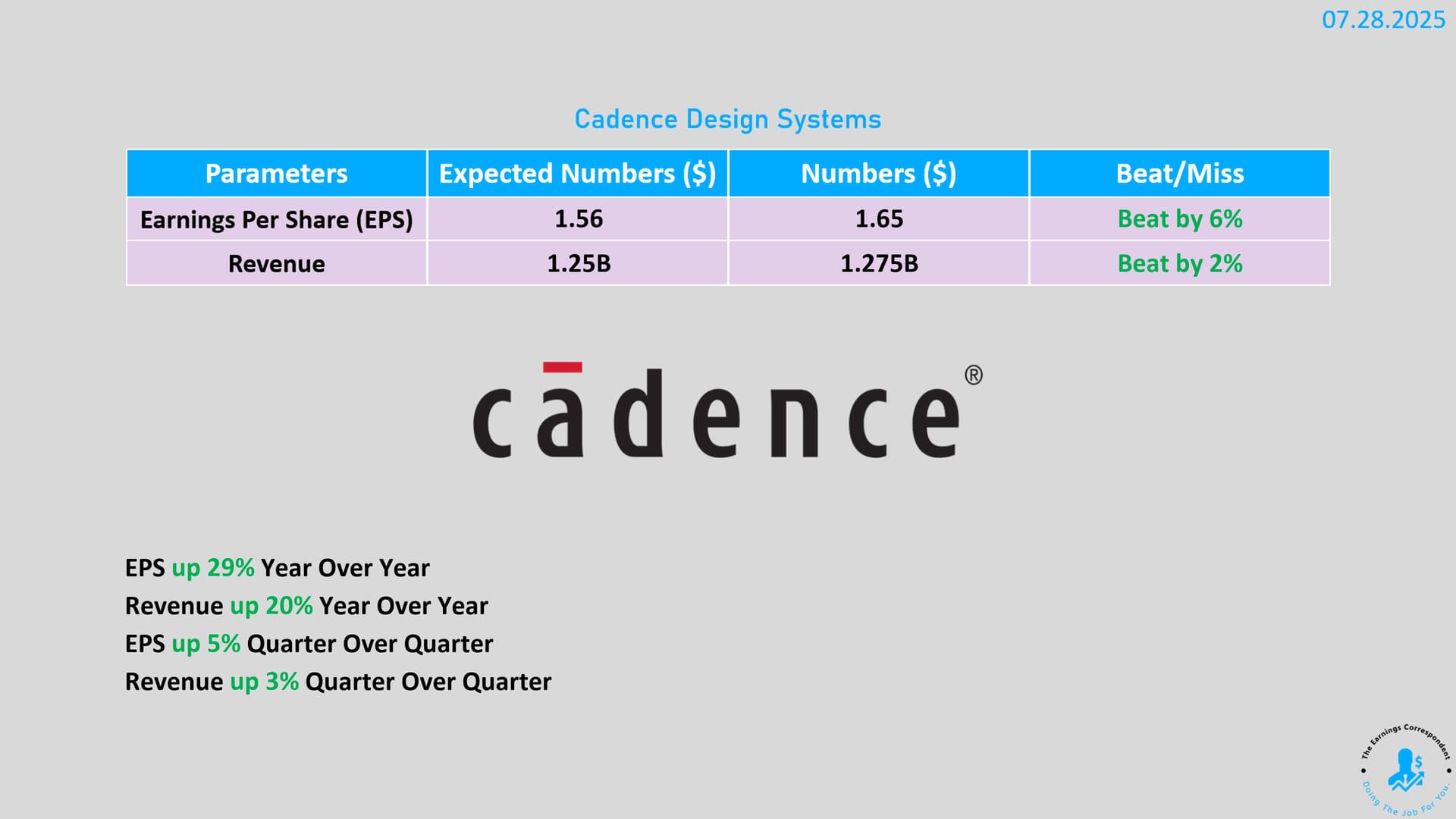
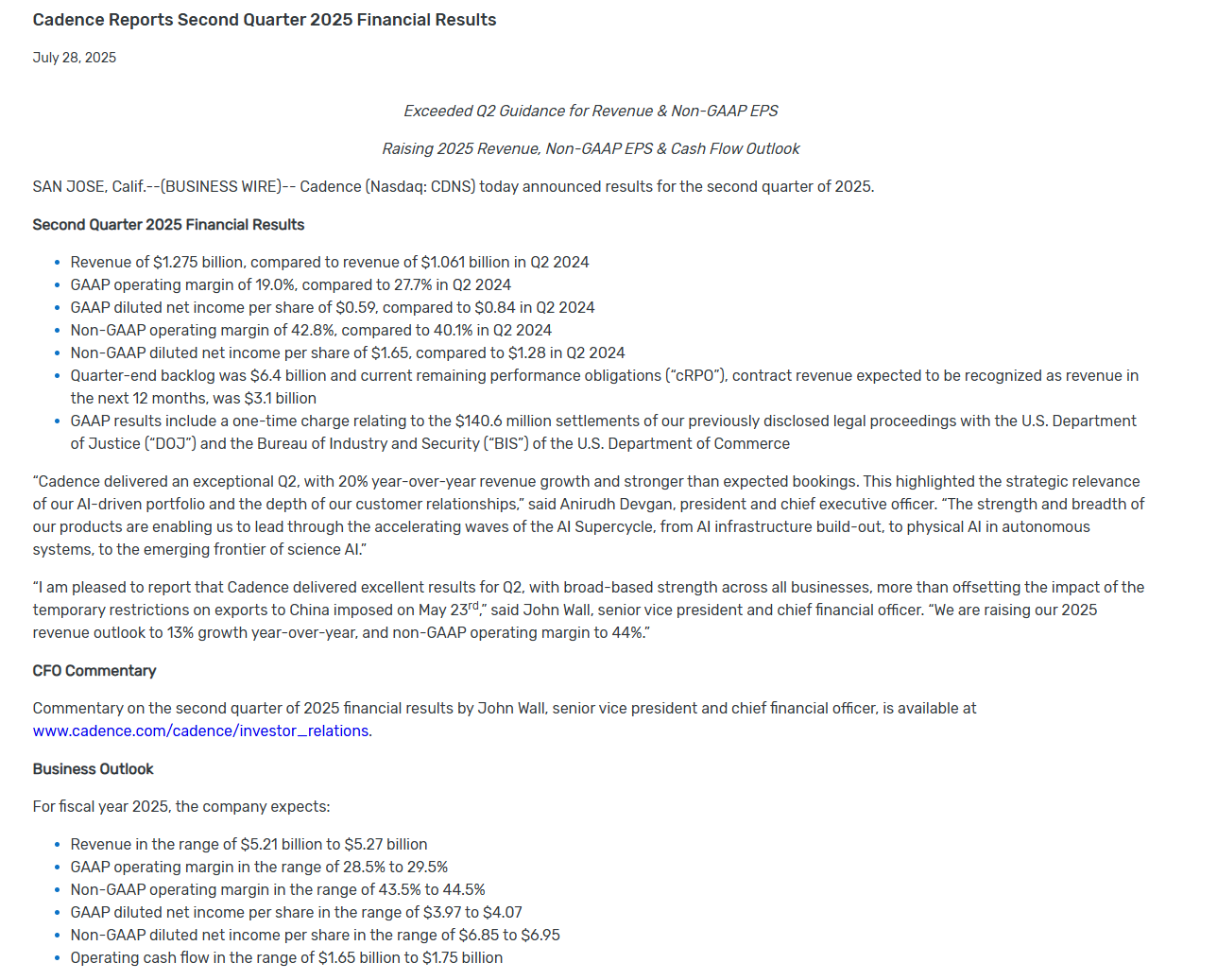
Cadence’s second quarter was strong, at least revenue grew significantly and order backlogs exceeded expectations.

The company’s AI-based product portfolio was apparently a major driver, and strong customer relationships, which provide security and future prospects, were also highlighted in the comments.

Despite export restrictions to China, all business areas grew, and according to the company, the outlook for the rest of the year also improved.

https://x.com/earnings_guy/status/1949923398609523103/photo/1

image
image

https://investor.cadence.com/news/news-details/2025/Cadence-Reports-Second-Quarter-2025-Financial-Results/default.aspx

Company’s own materials:

image


Here’s some additional information about the company, which is a bit unfamiliar to me so far. :slight_smile:

On the company’s website, there was this so-called general description of the company:

Cadence is a pivotal leader in electronic systems design, building upon more than 30 years of computational software expertise. The company applies its underlying Intelligent System Design strategy to deliver software, hardware, and IP that turn design concepts into reality.

Cadence customers are the world’s most innovative companies, delivering extraordinary products from chips to systems, chemicals to drugs, and specification to manufacturing for the most dynamic market applications, including hyperscale computing, 5G communications, automotive, mobile, aerospace, consumer, industrial, and life sciences.

We pride ourselves on creating and sustaining a company culture that drives innovation and business success. Cadence is recognized as a Great Place to Work around the world, including as one of the Fortune “100 Best Companies to Work For” for the last 10 years.

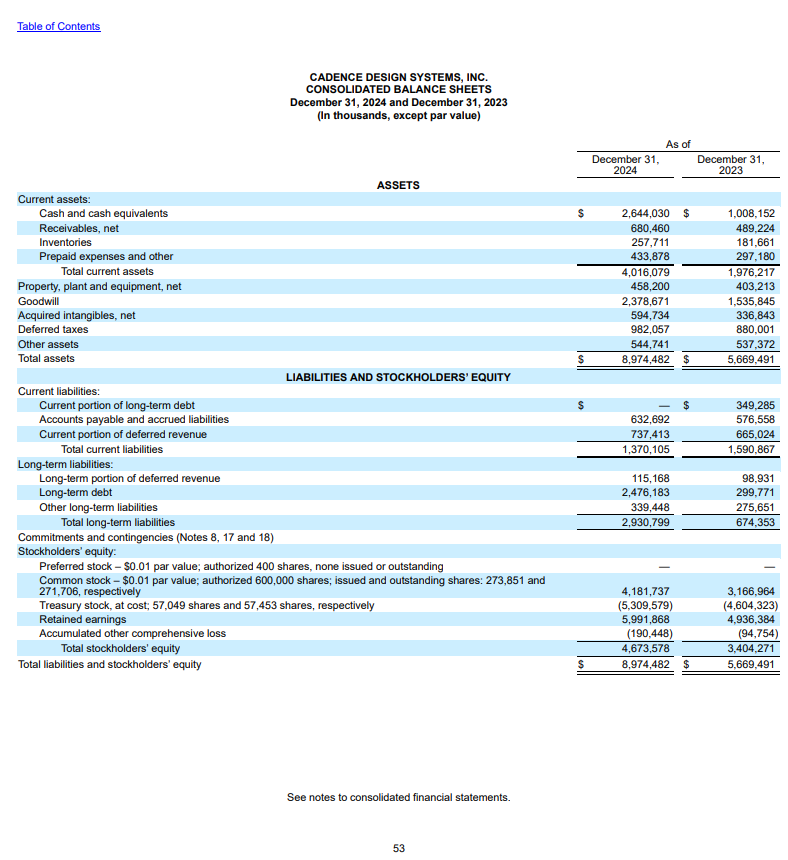
Here are last year’s figures:

image
image

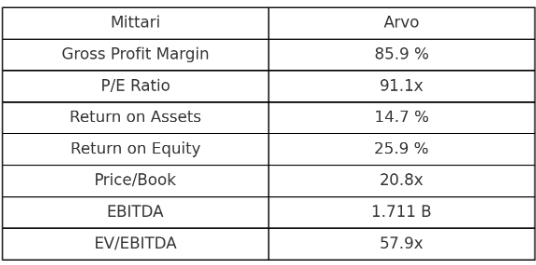
Then some figures from today (29.7.):

image

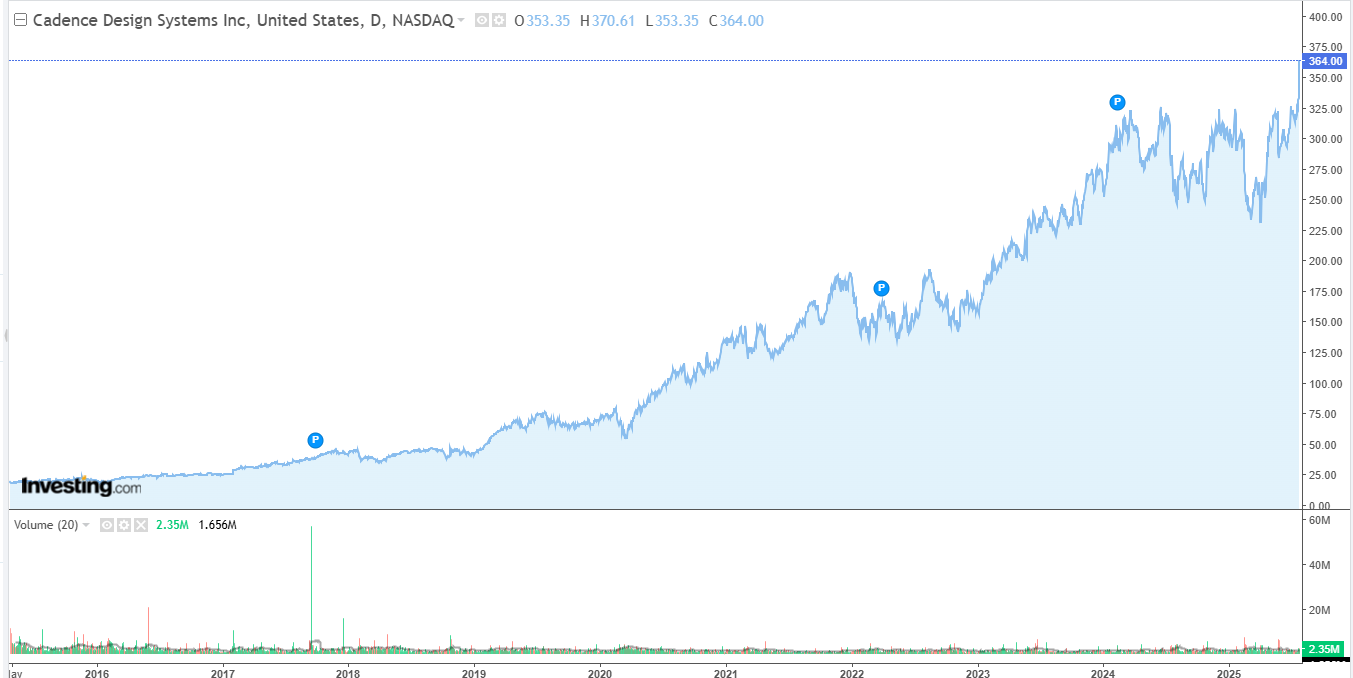
And the company’s stock chart:

image

6 Likes

Apparently, there are three significant companies providing so-called EDA (Electronic Design Automation) platforms: Cadence, Synopsys, and Siemens.

What distinguishes Cadence from the others is that it has particularly good integration with TSMC production facilities, and therefore can offer more versatile design for circuit boards, simulate how production is carried out in TSMC facilities, and also supports photonics-based technologies, not just electronics-based ones :thinking:

For example, Nvidia uses Cadence in some way for circuit board design.

https://blogs.nvidia.com/blog/cadence-millennium-nvidia-blackwell/

image

https://www.cadence.com/en_US/home/company/newsroom/press-releases/pr/2024/cadence-and-tsmc-collaborate-on-wide-ranging-innovations-to.html

At the recent TSMC Technology Symposium, groundbreaking advancements were unveiled, including design tool certifications for the N2P, A16 with Super Power Rail, and N3C process. And collaborating on the A14 technology.https://t.co/93PPx59vP0 pic.twitter.com/fivVUlSsgz

— Cadence (@Cadence) July 22, 2025
7 Likes

What is the purpose of these chips? Almost all serious AI currently revolves around CUDA and Nvidia chips. NPU (Neural Processing Units) are gradually being introduced into mass-market computers by Intel, AMD, Qualcomm, MediaTek, Apple, and Samsung, enabling significant power savings in daily AI operations. It’s unclear to me who Cadence sells to and why?

Based on their websites, the products seem to be aimed at industrial customers and the design of demanding models, for which a successful AI hype pivot has been made for investors:

kuva

3 Likes

That’s a good question though. These references aren’t the clearest in the world and are full of terms that I, at least, don’t fully understand without Googling or Copiloting. :smiley:

But apparently, Cadence sells to these chip designers, e.g., Nvidia. If I interpret correctly, Nvidia uses their equipment and software to enhance the chip design process. Also, vice versa, Cadence’s equipment also contains Nvidia’s technology.

“Huang also announced that NVIDIA plans to purchase 10 Millennium Supercomputer systems based on the NVIDIA GB200 NVL72 platform to accelerate the company’s chip design workflows.”

Cadence Taps NVIDIA Blackwell to Accelerate AI-Driven Engineering Design and Scientific Simulation | NVIDIA Blog

Instead, other significant customers, e.g., Intel, might not necessarily use Cadence specifically for AI chip design, but rather for designing and simulating various circuit boards in general, where AI features enhance the process: https://www.cadence.com/en_US/home/resources/white-papers/intel-and-cadence-collaboration-on-ucie-wp.html

4 Likes

Yeah, in building such a supercomputer, you certainly have to use design software and some custom solution, as it’s not enough to just throw GPUs into a rack and connect the wires :smiley:

However, the supercomputer market is not massive by any means, and the news in that link seems like a one-off collaboration. Due to the chiplet revolution, design is indeed becoming more demanding, so there will certainly be more customer demand from there.

Cadence used NVIDIA Grace Blackwell-accelerated systems to calculate the fluid dynamics at work when an aircraft takes off and lands. Using NVIDIA GB200 Grace Blackwell and the Cadence Fidelity CFD Platform, Cadence was able to run in under 24 hours highly complex simulations that would take several days to complete on a CPU cluster with hundreds of thousands of cores.
Cadence also used NVIDIA Omniverse application programming interfaces to visualize these intricate fluid dynamics.

I would assume that in this press release, a CPU cluster was used as a benchmark for misleading purposes, and the same could certainly have been achieved with a regular NVIDIA GPU cluster without a supercomputer.

I don’t understand the company or its potential, but the stock price is rising, so this probably can’t be a very bad investment :man_shrugging:

6 Likes

Don’t call this good yet, this might still be a really bad investment if none of us understand anything about it XD

If I interpret correctly, the potential is in these: “aerospace, defense and automotive” - whose electronics are becoming more complex every day: Cadence reports strong revenue growth but 2025 forecast disappoints investors - SiliconANGLE

More complex circuit boards and chips are needed, so the supercomputer’s AI features, simulations, and integrations with TSMC will be increasingly necessary for them.

7 Likes

Wait, which chips? :thinking: Cadence makes software for designing microchips and electronics, not microchips themselves. Nvidia is therefore a customer of Cadence and its main competitor Synopsys.

A comparison from a slightly different industry is, for example, AutoCAD/Autodesk, which engineers and architects use for designing machines and buildings.

Regarding microchips, EDA tools are used to “draw” - or practically program - all the billions of transistors, wires, and other features that microchips include, and to design how they are practically manufactured in a factory.

The largest companies in the field are indeed Cadence and Synopsys, with Siemens EDA being somewhat smaller as the third. I don’t know anything about the competitive advantages or weaknesses of these companies, but often companies that design or manufacture semiconductors (e.g., AMD, Apple, Broadcom, Nvidia, Qualcomm, Samsung, TSMC, etc.) are, to my understanding, customers of more than one EDA software company simultaneously in different areas.

China is a separate matter, by the way. Just a week ago, Cadence was fined over $140 million for selling software to a Chinese university on the sanctions list: Office of Public Affairs | Cadence Design Systems Agrees to Plead Guilty and Pay Over $140 Million for Unlawfully Exporting Semiconductor Design Tools to a Restricted PRC Military University | United States Department of Justice

@Pandakarhu, do you have any insights/opinions on these EDA companies, by the way? :nerd_face:

5 Likes

A further note on business scalability is that these EDA software companies do not directly benefit from, for example, Nvidia selling large quantities of Blackwell or some other chip at a high price, because they do not receive any royalties based on sales volumes or prices. Nvidia pays them the same amount regardless of whether it was a hit or a miss.

The companies’ growth, therefore, requires some combination of an increase in the quantity/quality of software licenses sold to semiconductor and electronics companies (either to old or new customers) and further improvement in pricing power.

Edit: However, there is also an IP business segment (13% of revenue) where they sell, for example, ready-made design components for implementing protocols, interfaces, or buses. These likely offer opportunities for royalty income as well.

7 Likes

I won’t start guessing who will come out as the winner. I don’t have direct expertise in these SoC design companies. I know that these are increasingly needed, because the added value they provide, for example, significantly lowers costs in the semiconductor industry. Previously, components were finalized and then tested and iterated dozens of times, and that, if anything, costs money.

As a side note, it’s worth mentioning that KLA and Lam Research have bought small unlisted design companies that specifically focus on, for example, lithography and plasma etching simulation. If I had to make a prediction, all kinds of simulation will be emphasized significantly in the coming years.

4 Likes

It seems like the result was quite good. I need to check it more closely when I have time ^^\n\n

4 Likes

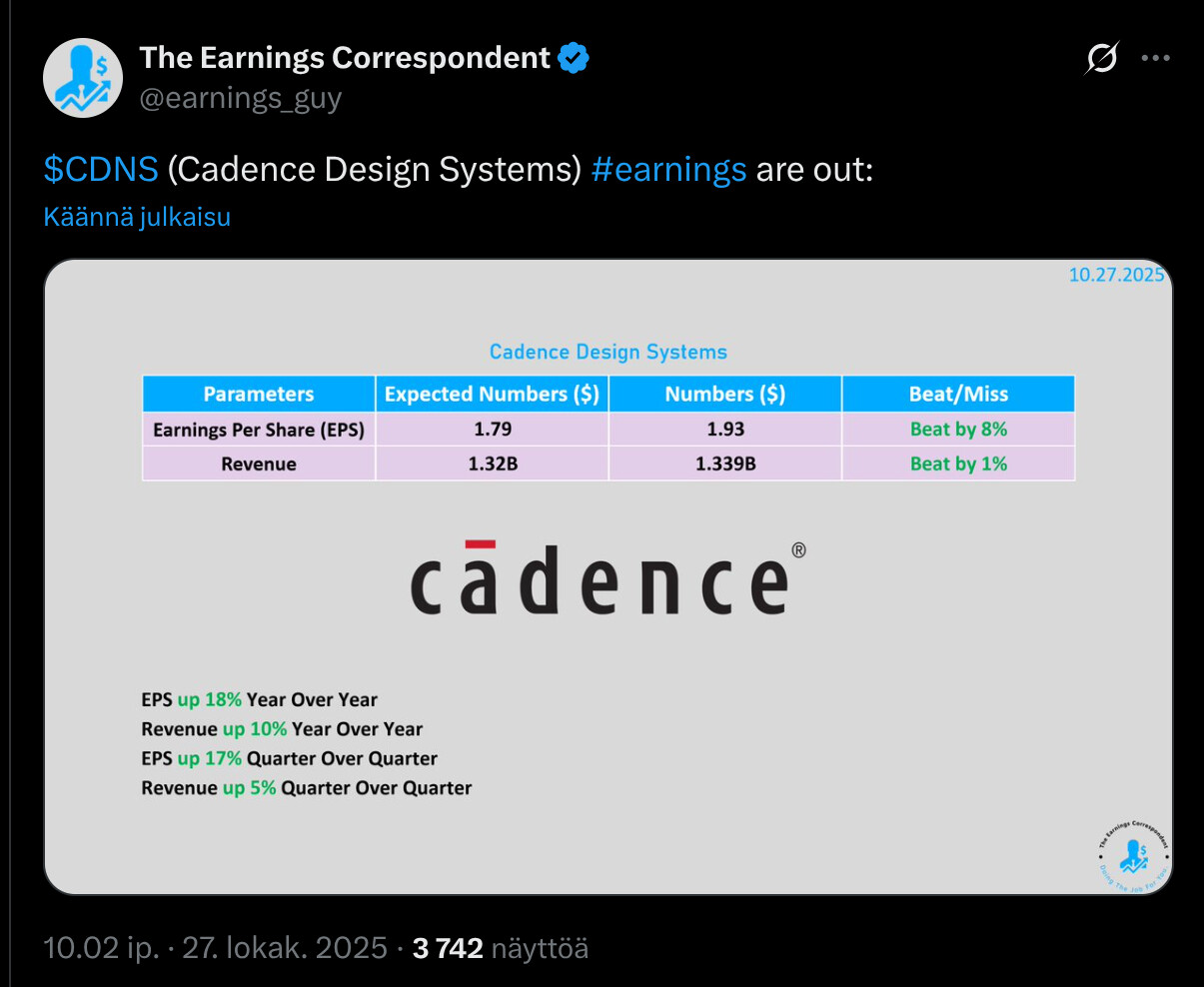
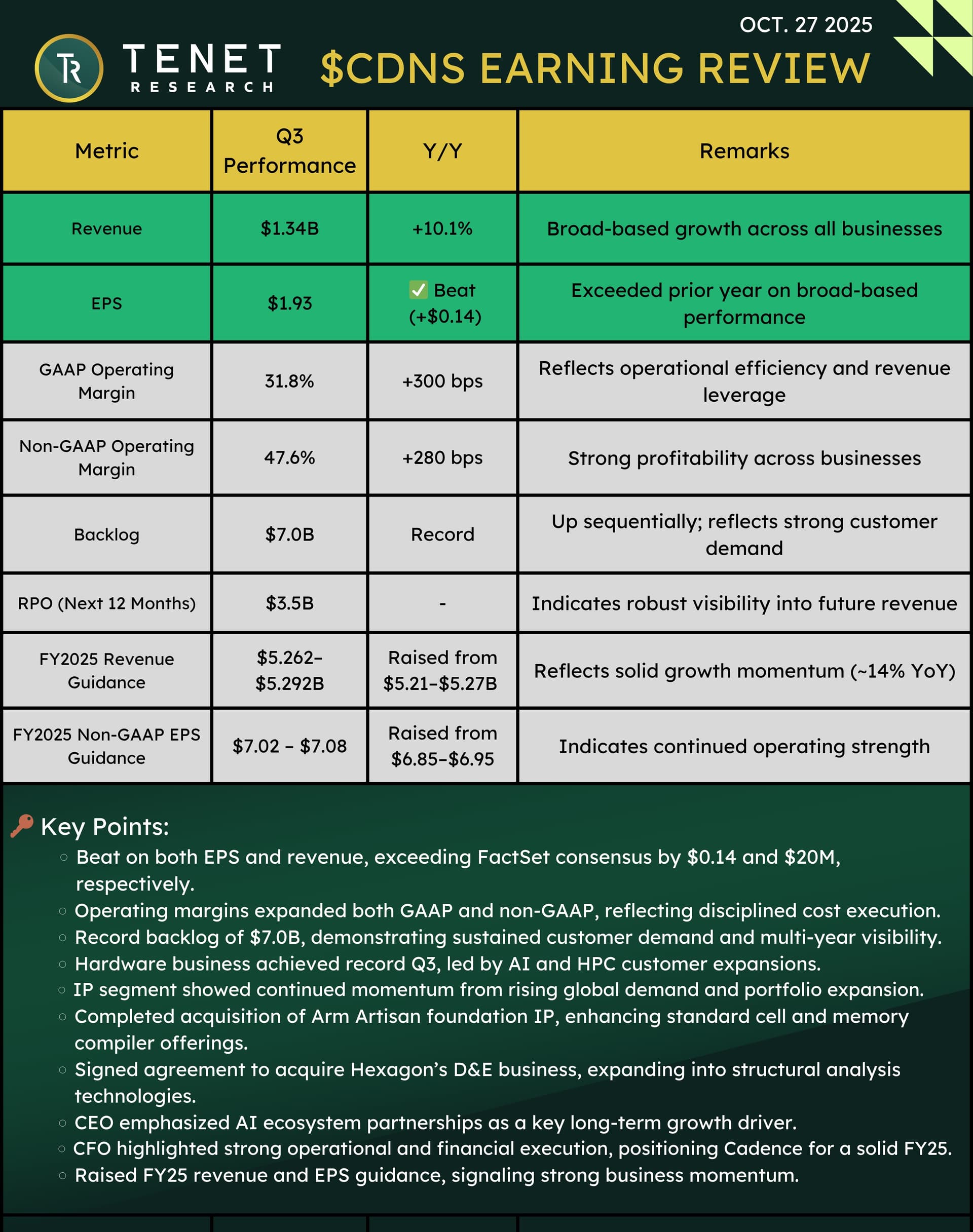
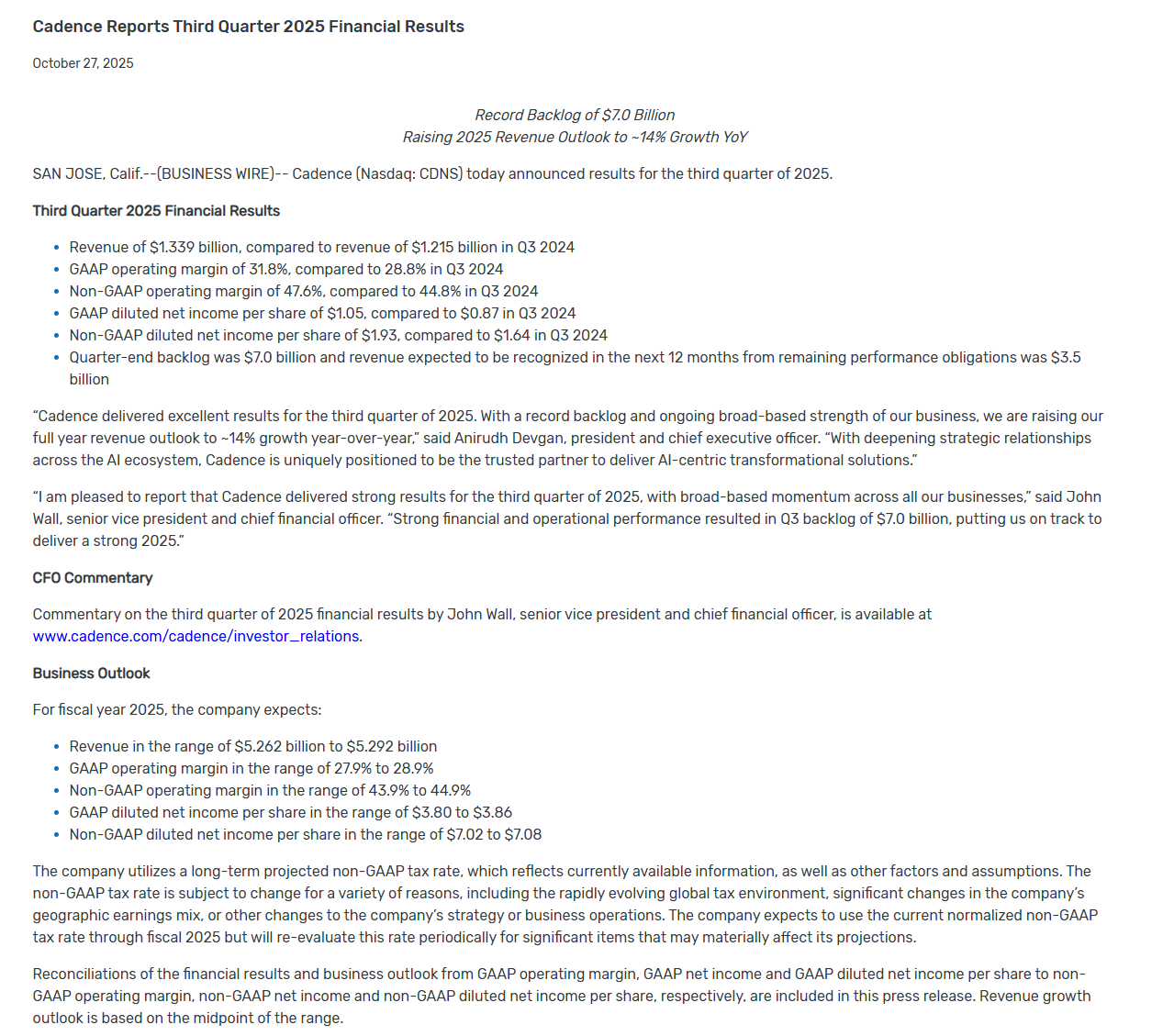
Cadence had a great quarter, and the company also raised its full-year outlook. :slight_smile:

The order backlog is record-high, which provides good visibility for the future. China’s developments have partly supported the company’s progress, even though earlier, China specifically worried investors, as I understand it. :thinking:

The company’s narrative is further boosted by the AI boom, which encourages customers to invest, and the share of recurring revenue also returned to its target level, which reassures investors.

Cash flow weakened and the accounts receivable turnover period lengthened for the third consecutive quarter. :grimacing: In any case, people seem to be satisfied with the overall result. :slight_smile:

https://x.com/tenet_research/status/1982912546173759941


The Company’s Own Materials


5 Likes