A cautionary tale about making agreements…
2 Likes
Bonuses were previously discussed in this thread here: 
However, the earnings logic for salaries changed from the previous tender offer. The program could have scaled earnings to the acquisition price level in a takeover situation, not automatically to the maximum. From the owners’ perspective, I think this would have been justified and would have allowed for a slightly higher per-share tender offer at the same acquisition price, as there would have been fewer shares outstanding to be redeemed.
1 Like
Here are some amino acids for thought and reflection. A valuable and insightful “lessons learned” from Capman’s Juha Mikkola on LinkedIn, concerning Avidly’s recent transition from public to private. It’s something worth reading and contemplating, including the comment section, but it’s not a black-and-white issue. I was personally very critical and disappointed with the exit valuation of Avidly, which had a valuable strategic position and the starting blocks of a compounder. Juha Mikkola responded directly and honestly that Avidly’s valuation in the private market would have been double its listed value.
6 Likes
Thanks for bringing this up! A very interesting discussion. A few of my own observations:
- The author might have some personal interest in being against IPOs

- The stock being mispriced, undervalued by double as a private company, etc., is, in my opinion, utter nonsense. Markets are not always efficient, but in the long run, a company’s value follows its ability/potential to generate profit. In this regard, Avidly had/still has something to prove, and of course, its ugly history from recent years certainly weighed on its valuation (as it should).
- If the company was so undervalued, why was it sold with such a weak premium? Capman was, after all, leading the deal. It’s hard to believe that the “true” value would never emerge while listed.
- Surprisingly many companies are bought from stock exchanges, even though, according to the author, listing kills interest…
11 Likes
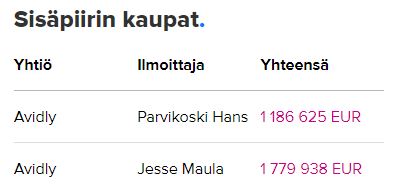
The company is sold at a weak valuation, then management’s “performance-based” bonuses are paid at an artificially high valuation, trampling on the interests of shareholders. Brilliant logic from Mikkola.
1 Like
I didn’t accept that tender offer. When might I receive the money for the remaining shares in my equity savings account (OST) through the squeeze-out process?
1 Like
Hi @Siika ! This hasn’t been explicitly stated, and the company likely doesn’t know the exact duration of the process themselves. This latest press release published on October 3rd only mentions the start of the redemption proceedings
The tender offer and delisting of Next Games probably provides a ballpark figure for the timing. In that case, the redemption proceedings for the remaining shares after the offer periods began on May 31st, and ownership of the redeemed shares transferred to Netflix on August 23rd, i.e., just under 3 months later. Basware has the same process underway; the redemption proceedings started on July 20th, but this is still ongoing nearly 4 months later.
The redemption proceedings for Avidly shares began on October 3rd, so following a timeline similar to Next Games, the redemption of Avidly shares (and presumably the payment) would happen toward the end of December. Following Basware’s timeline, the redemption of Avidly shares would still be ongoing at the end of January.
Hopefully, this gives you some idea of what to expect 
3 Likes
@Antti_Luiro, do you have any information on whether a redemption has ever been cancelled somehow after trades were made?
Best, Viljo, who was still buying at 5.28 on the exchange while someone was selling… There is a 5% upside “risk-free”, isn’t there?
1 Like
I asked some colleagues, and we don’t recall any case where a initiated redemption was canceled. Sometimes the redemption price is negotiated, and it has been possible to get it increased.
However, the redemption is initiated after the tender offer is completed (regulatory approvals cleared and >90% ownership obtained), and at this point, the right/obligation to redeem (minority shareholders have the right to have their shares redeemed) seems to be very clearly expressed in the Limited Liability Companies Act:
Section 1
Right and Obligation to Redeem
One who holds more than nine-tenths of all shares and votes in a company (the redeemer) is entitled to redeem the shares of other shareholders at a fair price. A shareholder whose shares can be redeemed (a minority shareholder) has a corresponding right to demand the redemption of their shares.
4 Likes
Steps forward in the redemption process 
- For Next Games, a similar announcement was made on May 31, i.e., about 2.5 months before the share was delisted from the stock exchange (August 23).
- For Basware, a similar announcement was made on August 22, and the right of redemption was confirmed about 3 months later on November 25 (the share is about to be delisted, trading has already been suspended).
So it is possible that, instead of the earlier rough estimate (late December - late January), the redemption might be a bit further away, e.g., around February  this is speculation, as the durations of processes are unlikely to be fully comparable between companies.
1 Like
And of course, there’s still a long time between a stock being delisted and the redemption price being paid. The Next Games money seems to have arrived last week; Ahlström-Munksjö was delisted 1.5 years ago, but we’re still waiting for the redemption money 
1 Like
The redemption is progressing again
- For Next Games, a similar release was issued on June 23, i.e., 2 months before the stock was delisted from the exchange on August 23.
- For Basware, a similar release was issued on September 30, and the stock was delisted just over 2 months later on December 9.
With this schedule, the process could last until the end of March / beginning of April, in which case the company might still publish one more financial statements bulletin as a listed company.
1 Like
@viljo Replying here: I can’t say off the top of my head, but I’ll ask my colleagues and get back to you on this
2 Likes
Did you find out if it went as normal, @Antti_Luiro? They were delisted quite a while ago.
I’ve already got a target in mind for the money..
1 Like
No information found on this yet; I’m guessing our group has more often been in the camp of those accepting tender offers I just asked again. If it doesn’t clear up, please report back here when the payment arrives; I’d be interested in getting at least one data point on the duration of that phase 
1 Like
I’ll post it when it arrives; a while ago the listing name changed at the broker and trading stopped.
It’s strange that the money is still being awaited after that.
I felt the deal going through was pretty certain, so I bought some up from the market to make a few hundred, which was okay for a down market since I have the cash… That’s why I still have those shares.
1 Like
Would June be a good guess for the money to arrive? First, there must be a certain arbitration court decision on the matter.
Today, April 12, the money has finally arrived in the Nordnet account and Avidly has been removed from the portfolio.
Not in Mandatum yet. Hopefully soon.
The money actually arrived in the account today.
If anyone is interested, with Basware it took 109 days from the confirmation of the redemption right to the payment of the funds, whereas with Avidly it only took 21 days. So, there can be significant variation, and it’s not worth waiting around for the redemption—whether by accident or on purpose—if you have better uses for the money in mind.
Of course, now that interest rates have risen, you do get a small bit of compensation for the wait, as the redeemer pays the reference rate according to the Interest Act (currently 2.5% p.a.) starting three weeks after the application for arbitrators. I’m not entirely sure what that application for arbitrators means in practice, though. From Basware, for example, just under 0.5% in interest was paid out. Perhaps we’ll get some interest from Avidly too…
4 Likes