Alzchem - health benefits from creatine and the disruption of the world order

The company that won the pitching competition, in my opinion, deserves its own thread.

The actual presentation should naturally be done with user @Jackfin’s excellent pitch:

My own interest in the company arose precisely through these investments. To my understanding, they are targeting precisely the company’s most profitable segment.

Segment Year External Sales (EUR thousand) EBITDA Margin (%)
Specialty Chemicals 2021 220,499 23.0
2022 288,361 18.4
2023 319,802 22.9
2024 348,089 27.0
Basics & Intermediates 2021 176,274 6.2
2022 227,539 2.2
2023 192,183 5.0
2024 174,003 6.2
Other & Holding 2021 25,520 5.5
2022 26,323 7.4
2023 28,664 1.6
2024 32,140 5.6

I also asked NotebookLM to create a podcast based on the company’s three latest financial statements. However, the emphasis in them was so much on ESG matters that the podcast also became focused on that theme. It also starts repeating itself after about twenty minutes.

If the Greens do not manage to destroy the German government’s recovery plans, the company could be expected to see growth in the future, at least after the investments. That is, by 2027 at the latest. According to the financial statements, about 75% of the current production facilities’ capacity has been in use, although the most profitable parts have been in full production. Perhaps considering the promising future, the stock is not prohibitively expensive even after the recent price increase.
image

Addition: low-quality discussion about the company can be found here, for example.

12 Likes

Great to see that there was enthusiasm to create a thread about the company.

A few things related to the company’s business. Opportunities but also risks that I didn’t mention in the pitch.

The construction and financing of the nitroguanidine plant to be built in Germany have been set in stone. Unfortunately, there is no public information available on production capacity or demand, but expanding the German investment even beyond its current scope could be justified for security reasons. European decision-makers are certainly currently considering whether American aid can be relied upon in any way.

That is an interesting option, but it should not be relied upon too much because the consumption of nitroguanidine appears to be relatively slow:

https://usfcr.com/search/opportunities/?oppId=75f4c16b27a343c18c624a7d47c61623

The article in question discusses the United States’ nitroguanidine reserves and their expansion, as well as the decentralization of production. It becomes clear that they had reserves manufactured in the 80s, which, of course, required processing to be suitable for modern purposes.

What I’m trying to refer to with this is that nitroguanidine is an important but very slowly consumed substance.

In previous investor calls, management stated that facilities are used according to customer needs. The current environment indeed suggests that demand in Europe is high, both due to consumption and the building of emergency reserves. In the United States, on the other hand, there is no hurry, as indicated by the unhurried search for a factory construction site.

Thus, it is expected that the demand for nitroguanidine will be cyclical unless the war expands. I assume that the company will operate nitroguanidine plants at full capacity for some years, but it is quite reasonable to assume that at some point, the utilization rate will decrease significantly. The market is unlikely to be interested in this, as that moment is still years away, and for now, accelerating earnings growth is on people’s minds.

Regarding the US investment - a change in government should have no bearing on the investment decision.

Then, about the risks. Transparency in the specialty segment is poor because the company does not want to disclose figures related to creatine so that current or future competitors do not gain information, or due to confidentiality reasons concerning security sector customers.

The market size is indeed very small, and potential price competition would be very destructive for the company. Of course, it also lowers the barrier to entry into the market.

Import tariffs and economic weakening can have unexpected effects. Since Trump appears to be treating Chinese imports with tougher tariffs, at least for now, this should benefit Alzchem in two ways.

1. Chinese creatine becomes more expensive, and creatine manufactured by Alzchem becomes more competitive and gains market share.
2. If the Chinese want to keep their products competitive, they will have to lower prices, making further competition for market share by lowering prices impossible, as profitability would decrease significantly.

However, tariffs and economic weakening can turn against Alzchem with leverage:

1. Due to tariffs, demand in the creatine market decreases, and Alzchem is forced to lower prices.
2. As purchasing power weakens due to recession, demand decreases.

There is thus a possibility that the company will be hit twice due to the current macroeconomic environment. In connection with Q4, the company stated that growth would continue, although macroeconomic weakening was mentioned as a risk.

Other interesting points; they would very much like to expand by building or through acquisitions in the United States.

10 Likes

Alzchem’s Q1 results will be released tomorrow. Here is the link to the call:

2 Likes

Alzchemin tuloksessa ei mitään ihmeellistä. Vastaan tuli muutama kiinnostava havainto kylläkin.

In the first quarter of 2025, Alzchem’s economic and indus-
try-related environment was characterized by the change
of government in the USA and the associated expectations
of changes in US customs policy, which then materialized in
April. Alzchem considers the NAFTA region to be an import-
ant growth market and is looking for a location in the USA
for this reason, among others. For many products, Alzchem is
the only manufacturer outside China and is therefore hardly
in direct competition with US companies but is certainly in
intense and direct competition with Chinese suppliers. The
current discussion about disproportionately higher US tar-
iffs on Chinese products could possibly even represent an
opportunity – however, it is still too early for a detailed and
well-founded assessment. Overall, Alzchem considers the US
and NAFTA market as a whole to be intact and with high po-
tential. The Defense and Human Nutrition sectors in particu-
lar are expected to continue to provide strong impetus.

Saa nähdä mille tasolle tullit lopulta jäävät.

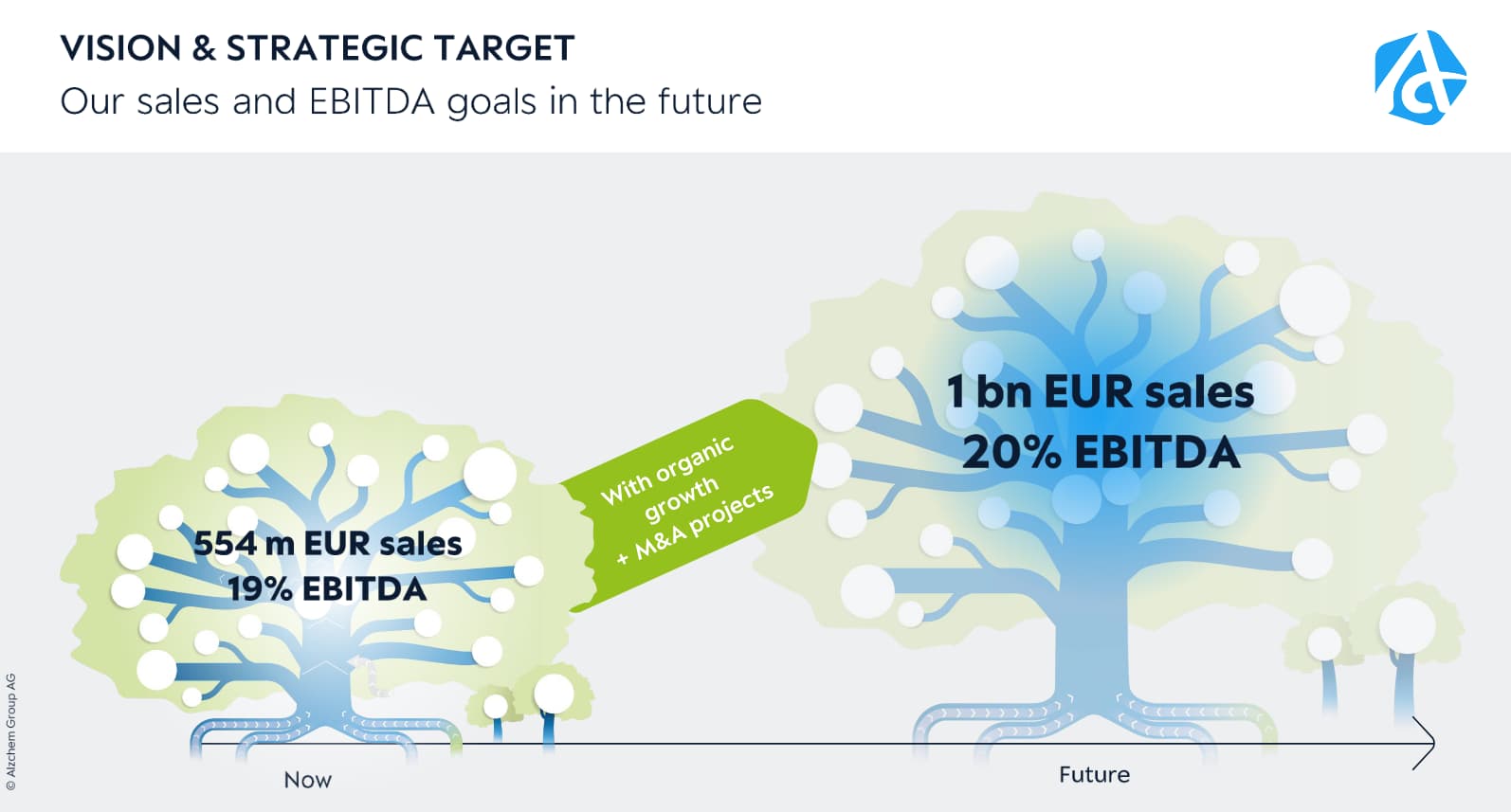
Yhtiön presentaatiossa oli nyt myös ensimmäistä kertaa kasvutavoitteita edustava dia.

Vaikuttaa viiden vuoden aikajänteellä realistiselta tavoitteelta jos molemmat nitroguaniidilaitokset toimivat täydellä käyttöasteella sekä kreatiinituotteet jatkavat kasvuaan. M&A on villikortti ja odotan johdolta tarkempia kommentteja minkälaisia yhtiöitä he ovat miettineet.

4 Likes

The rise has been strong before the earnings report.

3 Likes

Screenshot_20250730_105917_com_android_chrome_ChromeTabbedActivity

Alright, let’s let some air out now.

Alzchem invests 120 million in increasing creatine production. A welcome announcement. The investment should increase turnover by well over 100 million and margins should be in line with current business, meaning ROI remains above 20%.

If the company has brought the German nitroguanidine plant to full capacity by -28 after this news, free cash flow will probably be 100 million. If the slowly progressing US nitroguanidine plant is operational by -31, then probably 140 million in free cash flow? I didn’t bother to calculate it more precisely; I just threw the numbers into Excel.

-28 P/FCF 15 and -31 P/FCF 10?

In Bloomberg’s article, there was an interesting comment from an analyst;
Warburg Research’s Schwarz said it would require a lot of investments and scale for other companies to mimic what AlzChem is doing.

To start producing these chemicals “we’re not talking investment of a few million euros, but actually 1 or 2 billion euros,” he said. “If you wanted to do it new, you would basically kill your margin.”

People like to pay for monopolies, but I wasn’t excited by the news and didn’t buy back shares. Perhaps a double could still be achieved from this in 3-5 years.

4 Likes