Exactly. And then in spring 2027, the remainder of the 2026 dividend. And then again sometime after Q2, the H1/27 dividend, etc.
5 Likes
Aki Pyysing has written about Ålandsbanken again 
16 Likes
The silence in this thread is quite telling, even though there is plenty of discussion about asset managers elsewhere. A couple of days ago, I read an interesting article in Kauppalehti about Ålandsbanken and Aktia. It once again sparked thoughts on how Ålandsbanken (ÅB) in particular seems to remain in the shadows of investment discussions, despite the company having a very strong track record. I agree with Aki Pyysing that it relies on a great customer experience.
I have followed ÅB’s activities and used their products and services both personally and professionally for about ten years. I have to say that the expertise in their “engine room” is something the market still doesn’t seem to fully grasp. For example, I recommend following the Nordic Dividend (Pohjoismaat osinko) fund and the corresponding Toplist Nordic (Toplista Pohjoismaat) asset management, which have been generating such results for a long time that they deserve significantly more exposure.
When following their portfolio movements and trading, you notice that the alpha (ylituotto) is driven by picking/weighting quality companies once or twice a year that have, for one reason or another, become temporarily undervalued by the market or ended up overcapitalized. Personally, I feel that ÅB represents the kind of “handcrafted” asset management based on deep company knowledge that I look for.
In my opinion, there is genuinely solid “judgment” in the background, which I personally trust. The bank’s Sweden-based strategists, Lars Söderfjell and Anders Rudolfsson (who recently jumped ship from DNB), are in my books at the absolute top of Nordic asset management—or at least they represent an investment philosophy I believe in. Both are quite well-followed figures in Sweden and know the corporate landscape very well, but for some reason, they don’t get much media exposure in Finland (if I were a financial journalist, I’d interview them immediately).
It is a bit strange how ÅB is often completely left out of asset management discussions, even though I see ÅB’s asset management as a staple for both private investors and institutions alike—a player that clearly stands out in the market, specifically due to its Nordic expertise. On top of that, the service experience has been significantly better than in many other places, especially as a client who was initially at the lower end of traditional private banking wealth thresholds. Many probably still perceive this as a traditional “island bank,” even though the real meat and value creation lie in the asset management and its operating models.
It would be great if ÅB could be included in comparisons and thus put on the same line as other asset managers
25 Likes
Well, you mean delivering returns for ÅAB, not for the investor who has put their money into a fund that loses to the index and charges a 1.32% subscription fee?
ÅAB is a perfectly fine day-to-day bank (I’ve been a customer myself for over 20 years), but I don’t understand what on earth anyone in today’s world needs a paid “asset manager” for, or why anyone would invest in these overpriced active funds from banks.
4 Likes
This thread is surprisingly quiet considering that we’re talking about a high-quality engine. On the other hand, perhaps this is exactly the kind of company that one buys, forgets, and occasionally adds to. You can’t really turn this into a hype case like some growth companies, and the major owners don’t seem to have any particular need to drum up the stock, as they don’t need to use their own shares as acquisition currency or for building a financing narrative.
Q1 was, in my opinion, pretty standard Ålandsbanken: nothing explosive, but the core operations are in good shape. Net interest income is declining, but fee and commission income and IT income support the whole; ROE remains at a good level, and assets under management are higher than a year ago.
What interests me most here is that ÅAB isn’t just a balance sheet bank; it involves asset management, private banking, and IT business. Competition for wealthy clients is certainly intensifying, but ÅAB has a long history, a clear niche, and apparently a very functional engine room.
As a small downside, I see the ownership risk. With the main owner already elderly, it’s hard to know what will happen to the holding in due course and where the shares will eventually end up. It’s not necessarily a big risk for the operational performance, but the continuity of the ownership structure is something that I don’t think can be completely ignored in a company like this.
Additionally, if the Finnish real estate and construction sector ever normalizes, their residential and real estate funds might gain more traction again. This isn’t a rocket, but a high-quality, boring, and shareholder-friendly financial company can, in the long run, be exactly the kind of thing the market undervalues simply because people don’t care to talk about it.
18 Likes
That’s a bold statement about a company that customers have actually praised a lot specifically for its asset management. Could it be, however, that both parties—the customers & Ålands—have benefited?
I also think the lack of index funds is definitely a negative thing that should be fixed, but it’s always worth remembering that there are customer segments for whom absolute index returns (let alone beating them) are not the primary goal. Sure, it’s easy to shove €300 a month into an index without a care in the world, but what if you receive a €500,000 inheritance? Even a slightly more experienced stock picker or index investor might find themselves at a loss then. I suppose we who spend time on this forum are the true niche—the ones who want to spend time thinking about expected returns on investments instead of just living life.
I returned as an Ålands shareholder today as the share price has dropped to a reasonable level due to the traditional dividend dip and other unknown factors. The reasoning is traditional: the sum of the parts is greater than the current market value. I believe there are long-term growth drivers in asset management and especially in that strong Private Banking business. Hopefully, the summer will still provide more buying opportunities
9 Likes
Exactly. I compared these services myself about 6–7 years ago and conducted a deep dive into my own needs. I ended up choosing Ålandsbanken after closely following the portfolio management of a couple of friends; both were using discretionary asset management (täyden valtakirjan salkunhoito) at the time with approximately 30% leverage. And indeed, with this combo, they had quite a nice return history.
I remember well sitting over wine one evening after I had met with a handful of the city’s asset managers regarding my own portfolio. We calculated how this “Ålandsbanken Nordic Dividend Top List” (a kind of crown jewel product of ÅB’s asset management) offers the investor a strategically strong structure. In this structure, the stable dividend stream from 20 carefully selected companies easily covers the interest costs of a 30% investment loan even at current interest rate levels, still leaving cash flow for annual portfolio rebalancing or small over- or underweighting of different companies. The international nature of the Stockholm Stock Exchange, combined with a few picks from Finland, Norway, and Denmark, allows a purely Nordic portfolio to form a sort of “world index in miniature,” as many of the companies on the list are global market leaders whose revenue is geographically diversified across the world. This diversification, combined with the strong anchor ownership typical of many companies (such as the long-term ownership of the Wallenbergs or Industrivärden), creates a solid backbone for the portfolio that smoothes out market fluctuations and supports long-term capital appreciation. Personally, I believe that with a Nordic focus, professional asset management is capable of weighting investments on such a concentrated top list in a way that the return beats the index—and at least for me, it has been 1–4 percentage points above it for a long time.
The cost-effectiveness of such an asset management model is highlighted when considering that asset management fees and investment loan interest are both fully deductible in capital gains taxation. As I understand it, a fairly typical asset management fee for a smaller portfolio is around the 0.6% + VAT level (which drops lower at around one million euros), and the asset management fee including VAT actually shrinks to only about 0.50% after the tax deduction benefit. Correspondingly, an investment loan tied to the 12-month Euribor with a total interest rate of, say, 3.5% actually costs the investor only about 2.3% after the tax benefit. When these net costs are proportioned to the portfolio’s return potential, the package rises above traditional funds in its risk-adjusted competitiveness: a moderate and, in my opinion, very realistically achievable 7–8% market return is enough with 30% leverage and tax benefits to easily raise the return on equity (ROE) to the 10% level or even above. This “tax leverage” means in practice that the risk-adjusted net return remaining for the investor is optimized significantly more efficiently than a purely debt-free portfolio. This is, at least for me, the reason why I have been involved for a long time, and I believe it is behind the satisfaction of many customers, in addition to the quality of service and a few other perks
Ålandsbanken also offers asset management implemented entirely with ETF products, or they can be used to build a portion of the portfolio alongside direct stocks. From what I’ve observed in my own circle of acquaintances, a typical model is to have direct stocks from the Nordics and handle international diversification via ETF products.
ÅB has clearly made a strategic choice that they are about long-term asset management tailored to the customer’s needs, rather than a trading platform for those who want to trade stocks and ETFs actively. And in this, ÅB certainly performs well, and at least for the people I know, this has brought quite good returns for a long time. Many then have a Nordnet portfolio or similar for their investment hobby, but at least for me, these serve completely different needs: ÅB provides the engine room for my core wealth, which ticks away with compound interest in the background, while on the hobby side, I can play this fun game where success has varied a bit from year to year I am strongly of the opinion that when building the core of a portfolio for the long term, it’s worth looking at an option like this, and many have been satisfied with it.
These are the kinds of thoughts that come to mind.
21 Likes
That is a rather peculiar customer group, if they want less than the index return. Is it some kind of status thing, being able to pay some private banker slick-back just so you don’t have to click through orders yourself? And having the luxury of accepting lower returns than what any “prole” gets from a standard index product?
I don’t understand why investing €500k would be any harder than €300. A large ETF is certainly liquid enough for the needs of even a slightly wealthier Finnish heir; for example, SXR8 easily trades €20M a day, so half a million should go through even as a single buy order.
There are very few people in Finland so wealthy that complex wealth management services actually make sense.
1 Like
ÅAB is a perfectly OK everyday bank (I’ve been a customer myself for over 20 years), but I don’t understand for the life of me why anyone in today’s world needs a paid “wealth manager,” or why anyone would invest in these overpriced active bank funds.
For regular salary earners who dream of building wealth and don’t have the energy to follow the stock market, index funds are by far the most sensible choice. However, the most important clients for wealth managers are foundations and institutions. For them, the priority is not so much maximal return, but obtaining steady, predictable returns in all market conditions and, above all, ensuring that the wealth is preserved for future generations. Investing in stock indices exposes one to equity risk. In the largest stock market crashes, index values have dropped by 20–80%. Since foundations and institutions are intended to exist for hundreds of years, several such crashes will occur during their existence. A regular mortal, on the other hand, will likely experience such a crash at most once in a lifetime, and in that case, a regular wage earner should just invest their salary even more aggressively into an index fund rather than worrying about lost assets. Foundations and institutions, because of stock market crashes, should own more than just exchange-listed stocks. With index funds, you are also always taking a view on the development of a specific market. It is not a law of nature that US indices will yield the best returns. At the beginning of the millennium, a Russian index might have felt like a winning index. Of course, this risk can be diversified by investing in several indices, but this would already require a certain level of expertise from the foundation’s key personnel. They would also have to get the investment plan approved by the foundation’s board and report on investments regularly. When hiring key personnel for a foundation, one would also have to consider that, in addition to all other skills, they must know how to invest in index funds sensibly. Many foundations and institutions may also have ESG requirements or impact goals, for which wealth managers’ products provide a ready-made solution. Some may also want to invest in Finnish mid-sized companies for reasons of principle. Currently, if you invest in a world index, you are investing with a heavy weight in US tech giants. In practice, foundations outsource asset management to wealth managers so they can focus on their core competencies. The Student Union of the University of Helsinki is a perfect example of why foundations should outsource asset management rather than trying to invest themselves or seeking better returns.
Also, for many wealthy families, preserving wealth for future generations is more important than high returns. They may similarly emphasize investing in Finnish companies or impact investing. I also wouldn’t underestimate how much value many people find in being able to regularly discuss their investments and economic events with a wealth manager.
I have invested in Ålandsbanken because I believe it has the most Finland-Swedish “old money” as its clientele. Because of this, I don’t believe the popularity of index investing poses much of a threat to Ålandsbanken. I would guess that Alexandria’s client profile consists of employees and entrepreneurs who really should be investing in index funds.
11 Likes
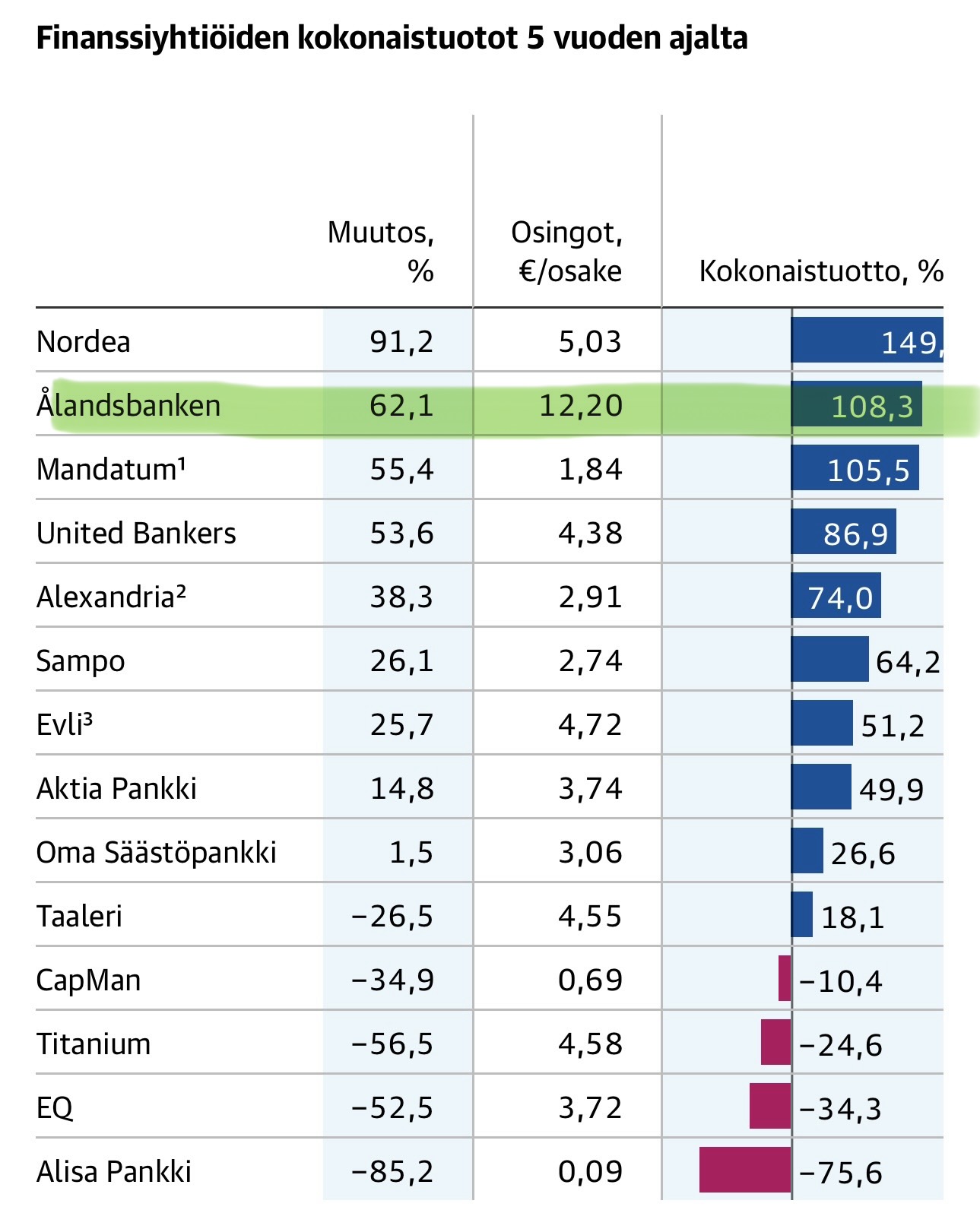
Ålandsbanken’s share of investor discussion regarding the asset management sector is probably in the range of a fraction of a percent, but in terms of total return over a five-year follow-up, it is second in the market.
Comparison table from today’s Kauppalehti.
14 Likes
The Pirkkalainen newspaper has interviewed Pekka Puustinen, the new director of Ålandsbanken’s Tampere branch. In my opinion, the interview provides a good insight into Ålandsbanken’s operating principles—even on a broader scale than just that specific branch.
9 Likes
Ålandsbanken offers employees favorable share savings
Even the staff are being kept satisfied.
It’s in my own portfolio and I believe and trust that this will generate more discussion. Thanks to @Timo_Huhtamaki for the good points.
I strongly believe that ÅB’s bankers or asset managers are allowed to do their work without overly directive sales targets, which means index-tracking ETFs can be found in clients’ portfolios, as well as custody linked to asset management fees. Granted, with MIFID, investment advice for exchange-traded products is an art form of its own, but a client discussing cost-effective products will certainly get them into their portfolio. My own acquaintances have cost-effective solutions, short-term corporate bonds, and specifically this Nordic dividend strategy, both as funds and direct stocks via discretionary mandate.
The constant talk about cost-effectiveness and indices is a bit peculiar in this industry. If one’s thoughts are like @Dollarijanis’s, then one wouldn’t have a single bank/asset manager in their portfolio. That’s where the profits come from in the long run for the banks too, and the beauty of it is that market development simply helps AUM (Assets Under Management) and fee income grow. As for this mindset—I don’t deny that index investing is sensible for individuals or even at a foundation level. My own thought is that bonds belong in a portfolio—anything else is perhaps a bit of “magic,” like PE (Private Equity) funds etc., although these too have their own clientele. Not everyone can or wants to think “over time” about what is the most sensible or efficient way to invest. Not everyone wants their portfolio to dip as much as the index does. Not everyone drives a Corolla, even though it is absolutely much smarter than driving a Porsche.
I want to see the discussion in the board of a small or large company when the chairman suggests putting the entire cash reserve into the S&P 500 index at these valuations. It’s good to understand that a lot of money is invested in the world that isn’t there forever, or with a long horizon—or via monthly savings. There are many people who invest significant sums of OTHER people’s money (municipalities, foundations, associations, and companies). One shouldn’t just think about this in terms of how few great listed companies etc. there are in Finland. An asset manager like ÅB can offer broad retail banking services, and at the same time, a banker’s portfolio can accommodate a few machinery entrepreneurs, farmers, etc. Much of the costs are tax-deductible, and entrepreneurs, in particular, usually know how to value a service and product relatively highly. They don’t always sell their own things at the cheapest price either.
Things aren’t always done in the way that is absolutely most sensible or efficient. That’s why we have different services and companies in the world, and I can certainly name dozens of stupider ways to spend money than an asset management fee. Furthermore, as an entrepreneur, I aim to spend 100% of my own time on things other than making investment decisions. A bank or banker relationship also involves much more. You can even become friends with some. Sometimes a property or a buyer for a property is found through those channels. Business acquisitions have also been closed when the banker has been a mutual contact or acquaintance. That is what banking, asset management, and especially relationship management is. It doesn’t all happen on the index lists of Nordnet and Kvarn.
13 Likes
Some good points here regarding the asset management of foundations etc. I’ve never really thought of Ålandsbanken as that kind of bank, as my image of them has been more of a bank focused on private individuals.
3 Likes
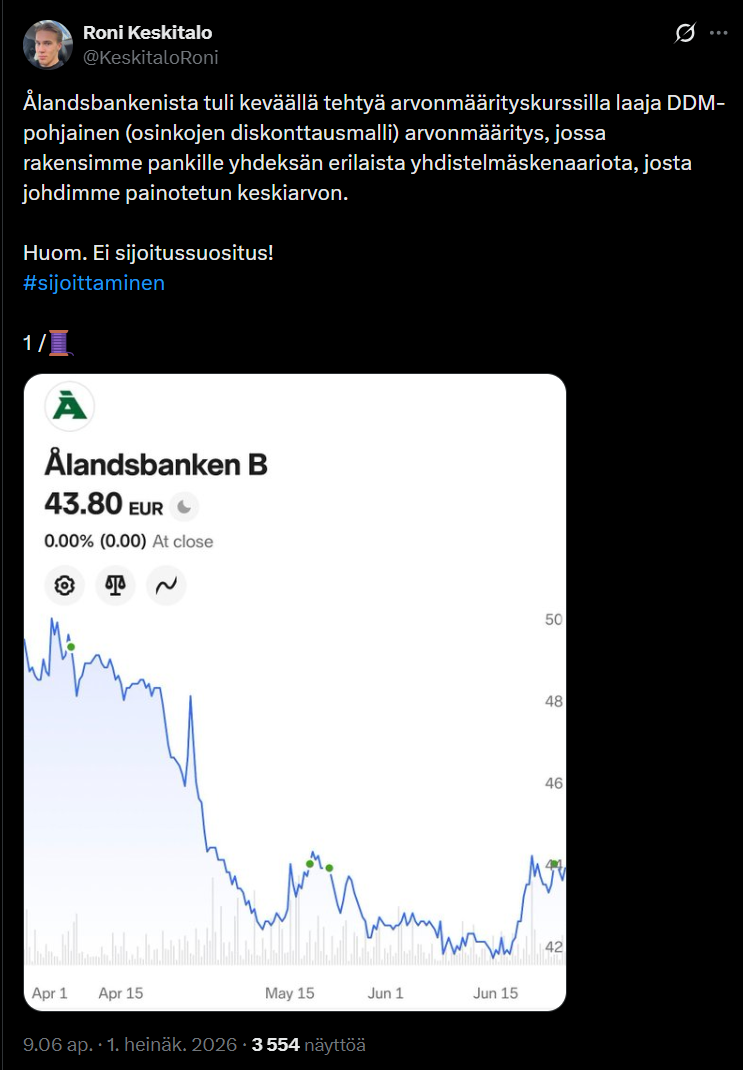
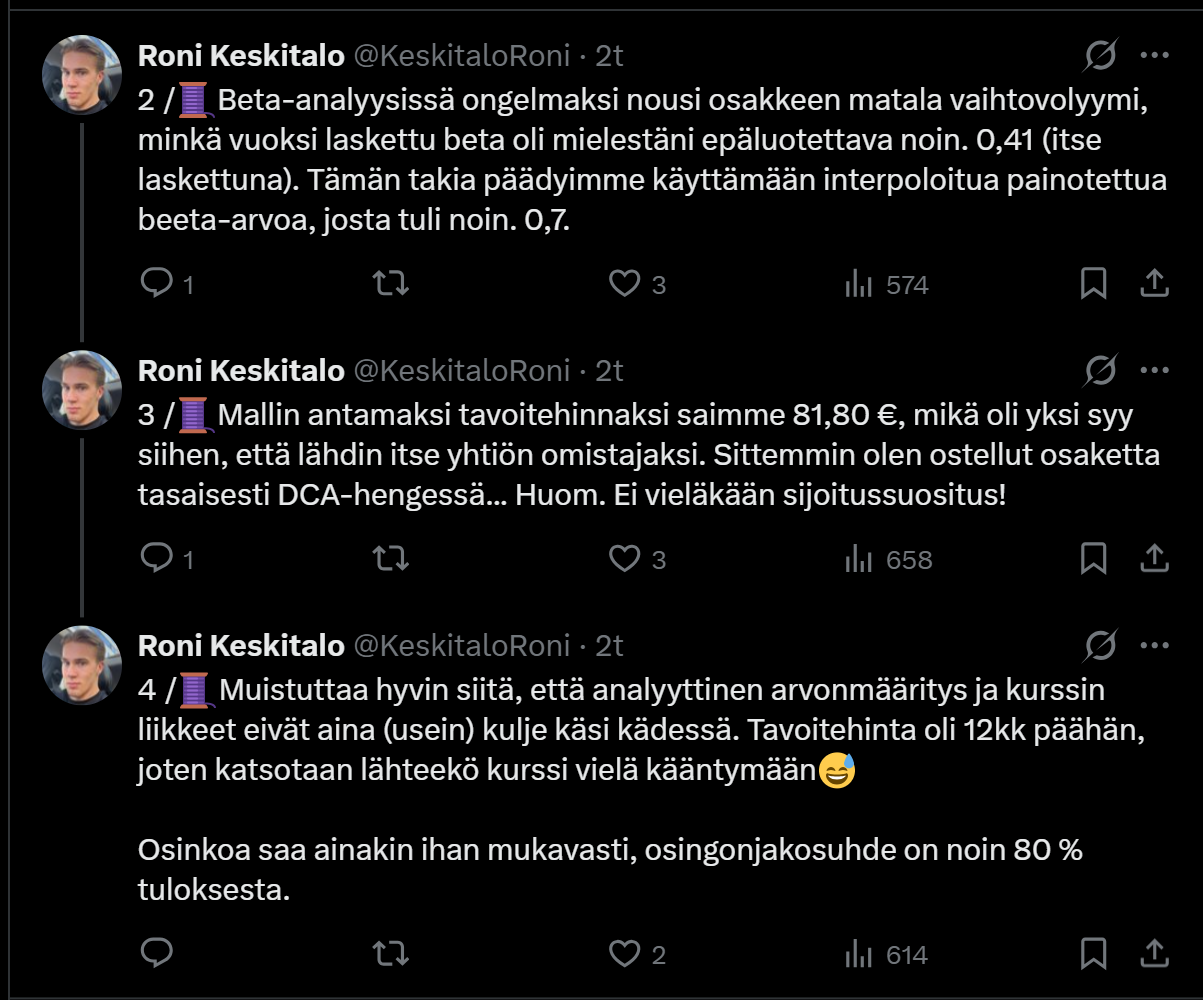
Roni has done a bit of valuation work on Ålandsbanken 
https://x.com/KeskitaloRoni/status/2072200200219734278
12 Likes
One of perhaps Finland’s best asset managers is now expanding its network organically to Northern Sweden
15 Likes
Q3 is out.
Bank of Åland Plc: Interim Report for the period January -
Return on equity (ROE) remained above 16.5%, clearly exceeding the 15% target. Operating profit (EUR 15.8 million) fell by an expected 4% year-on-year as net interest income leveled off, but the bank still managed to grow its core income by 2%. Still, a bit of softness in operating profit.
January−September 2026 compared to January−September 2025
- Net operating profit decreased by 11 per cent and amounted to EUR 45.6 M (51.0).
- Core income in the form of net interest income, net commission income and IT income increased by 2 per cent to EUR 162.0 M (159.1).
- Other income decreased by 69 per cent to EUR 1.5 M (4.8).
- Total expenses increased by 5 per cent to EUR 117.9 M (112.3).
- Net impairment losses on financial assets (including recoveries) amounted to a net recovery of EUR 0.0 M (net impairment losses of 0.6), equivalent to a loan loss level of 0.00 per cent (0.02).
- Return on equity after taxes (ROE) decreased to 15.8 per cent (18.4).
- Earnings per share decreased by 13 per cent to EUR 2.36 (2.71).
- The common equity Tier 1 capital ratio decreased to 12.4 per cent (12.7 on December 31, 2025).
- Unchanged future outlook: The Bank of Åland expects its return on equity after taxes (ROE) to continue to exceed its long-term financial target of 15 per cent during 2026.
The third quarter of 2026 compared to the third quarter 2025
- Net operating profit decreased by 4 per cent and amounted to EUR 15.8 M (16.3).
- Core income in the form of net interest income, net commission income and IT income increased by 2 per cent to EUR 52.4 M (51.1).
- Other income increased by 51 per cent to EUR 1.3 M (0.8).
- Total expenses increased by 5 per cent to EUR 37.7 M (35.8).
- Net impairment losses on financial assets (including recoveries) amounted to EUR 0.3 M (net recoveries of 0.1), equivalent to a loan loss level of 0.04 per cent (-0.00).
- Return on equity after taxes (ROE) decreased to 16.9 per cent (17.1).
- Earnings per share decreased by 4 per cent to EUR 0.82 (0.85).
Wealth management is currently the company’s strongest growth driver. Actively managed assets reached a new record of EUR 12.5 billion. This is also supported by the decision to expand operations into Northern Sweden by opening new offices in Haparanda and Luleå. By the bank’s own decision, this has been a growth driver for quite some time now. Let’s see how it develops—the direction is certainly right.
Expenses rose by 5%, but there are no concerns over credit losses. Net impairment provisions remained at a negligible EUR 0.3 million for the quarter, indicating that the loan portfolio has stayed healthy.
Let’s see how well the decline in net interest income can be compensated for going forward by growing AUM.
25 Likes
The fourth-quarter operating profit is set to include a positive non-recurring item of approximately EUR 8 million due to the early termination of the platform solutions agreed with Borgo.
Following the change, Ålandsbanken will continue as an intermediary for Borgo’s mortgages on the Swedish market and will remain an owner in Borgo.
The agreement is estimated to have a positive one-off impact on operating profit of approximately EUR 8 million, which will be recognized in the fourth quarter of 2026. In the longer term, the agreement means that Ålandsbanken’s revenues from the platform collaboration with Borgo will gradually cease as service delivery winds down during 2026 and 2027, which represents the primary long-term impact on Ålandsbanken.
7 Likes
Aki Pyysing has written his Sunday column about Ålandsbanken
“Ålandsbanken expects return on equity to continue to exceed its long-term financial target of 15 percent in 2026.”
What a dull, yet modest outlook. Considering the ROE was 16.9% in Q3 and 15.8% in January–September, the bar has been set pretty low. Especially since the final quarter will get an eight-megabuck boost from Borgo’s serviced loans.
10 Likes