Wow! An absolutely legendary response!
The reason I talk about the public sector in relation to Witted isn’t just because hearing your views is interesting (which it obviously is), but because I feel the discussion about the public sector also strongly crystallizes Witted’s market situation and cultural core as an IT company.
The first of those is simpler to explain: namely, with the exception of a few CV heavyweights, there is no such thing as a specific “public sector coder.” If the public sector reduces purchases, those same experts are thrown into the private sector to compete with Witted for a limited number of projects, lowering the revenue and/or profitability of all players. Because of this, an investor must always have at least a basic view on whether the public sector is increasing or decreasing its use of ICT consultants.
The second relates to Witted’s stated self-definition: “Witted Megacorp Plc is a new generation software development company that helps customers build successful software development teams and creates collaboration across the IT vendor field.” Let’s return to this later in the text.
Like all good know-it-all dilettantes, I also have a solution to public sector problems in my back pocket. In consultant style, I intend to present it right at the start and provide the justifications only afterwards. The public sector should corporatize its agencies and make all employees partners. Tax revenue would thus become the revenue of these companies. The reason this should be done is because the public sector’s incentive structure is permanently and deeply broken. I’ll demonstrate by drawing an incentive matrix burned into my subconscious long ago, which I’ll narcissistically name after myself here:
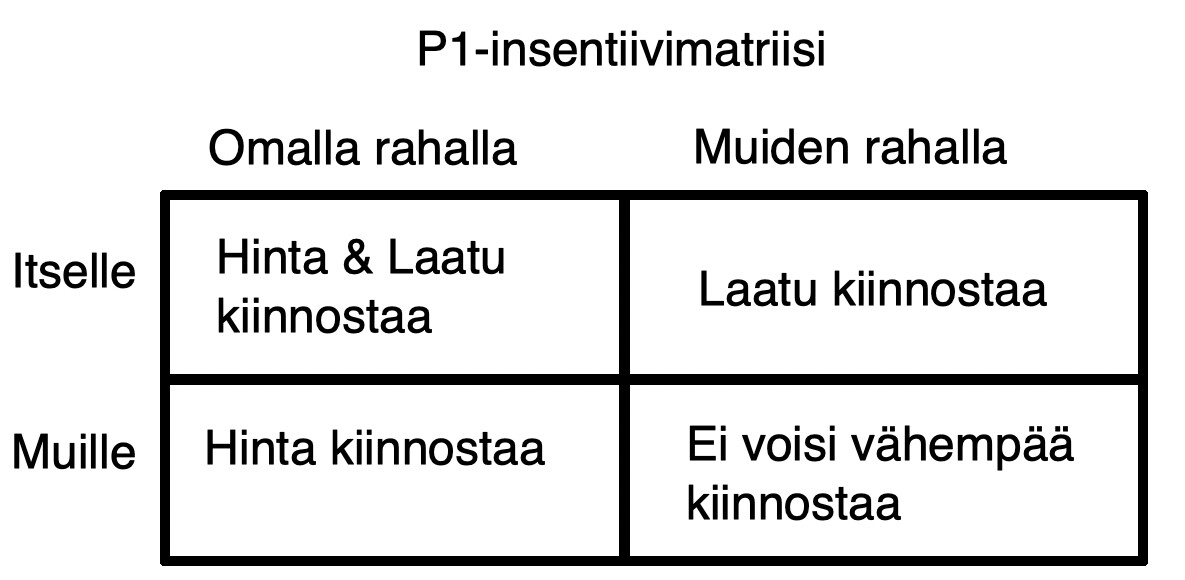
In the public sector, by definition, one operates with other people’s money, so over a long enough period, it ends up producing low-quality and expensive service, or in a slightly more optimistic scenario, overpaying for quality. “Pohjolan Nega” doesn’t believe in ethical or rational actors, but rather that in the long run, people act exactly as they are motivated to act. By default, the public sector has no incentive to strive for efficiency or cost savings, because these usually don’t provide any direct benefits to public sector actors.
For an outside actor, it would be easy—actually trivial—to find savings in any organization. Take Yle (the Finnish Broadcasting Company), for example, where there is now a desire to save money. Yle has three television channels and its own streaming channel in an era where linear television viewing is decreasing drastically. Worst of all, they can’t find enough meaningful domestic content for those television channels, so they have to buy it at high cost from abroad. An easy solution for permanent savings would be to shut down, say, TV2, stop buying Game of Thrones and similar series that citizens can get for ten euros anyway from streaming services, lay off staff, and concentrate Finnish-language content on TV1 and Yle Areena.
In reality, this is the last thing Yle would do. In a public sector organization protecting its own operations, the first things killed are always future investments (unless a project is under the management’s special protection), after which they move on to cutting mandatory maintenance and upkeep investments. Then they move reluctantly to personnel reductions, and only at the very end, as the final measure when every other stone has been turned, do they cut services—which is where the real permanent savings are generated.
Let’s return to Witted’s desire to help customers build successful software teams and their ability to choose the best experts from a large list of talent to help with projects. Does the public sector even want to build successful software teams or learn how to buy in general? Witted has grown excellently in the private sector but more poorly in the public sector, and in my opinion, one explanation for this could be that Witted’s core culture attempts to sell private sector mindsets to the public sector, where there is very little demand for them.
Now, when formal speeches claim that IT will save money, I haven’t seen any understanding of the mechanism by which this would happen, because no one has an incentive to save. The annual budget is given, and if it is underspent, you are punished next year with a smaller budget. Usually, in IT investments, the project length and payback period are more than one year, so it’s not worth starting them on one’s own initiative unless absolutely necessary.
Imagine, for instance, a digital project that makes life 5% harder for public sector workers for the next few years but saves 25% in money. In the private sector, justifications for starting the project would be found quickly, but which public sector worker wants to suffer even a small amount just because someone else saves a lot of money? You can always find a few self-sacrificing individuals, but in the long run, the roles end up being filled by people who are ready to reduce their own suffering with other faceless people’s money. Because of this, I believe that if Witted wants Gofore-like success in the public sector, the approach to public sector customer relationships would need to be changed significantly from what has been stated. That’s why I asked specifically for a view on the public sector earlier, and thank you again for the deep and thoughtful answers to my questions 
@Sijoittaja-alokas wouldn’t the right thread for those messages you moved have been this one instead of the Coffee Room?
https://keskustelut.inderes.fi/t/it-palvelusektori-sijoituskohteena/167?u=pohjolan_eka
We can continue discussions there if necessary regarding things that don’t directly relate to Witted. Of course, I believe investors are interested in this discussion and especially Harri’s general thoughts on the industry in general.