Is there a calculation error then? (1200+700)+2232+1125
I apologize, an “internal” inaccuracy as the missing portion of 4000 euros varies across several periods (wife receives salary and partial disability pension, only partial disability pension). That gap has been accounted for in my own calculation.
1 Like
Did I understand correctly that the idea of the 380k ETF is that it rises 3% per year and is to be used after 20 years?
Yes. The idea was to computationally examine how to use that (and other amounts) at a rate such that they are at zero after 20 years. That is, what spending allowance they enable on top of pensions, if used entirely within that period.
I arrived at this 3% when I asked ChatGPT about the long-term real return of SP500 after taxes, and it replied:
“(summarized: if the historical pre-tax real return is, for example, ~6%, then after taxes ~4.2% realistically at Finland-level (30%)).”
I used 3% as the basis for the calculation because valuation multiples are high now. My own brain just can’t seem to grasp whether that spending allowance is therefore rising with inflation (as nominal returns also rise). I asked for clarification on this, and after the calculation, the answer is:
 Summary:
-
Realistically, you can withdraw €2,107.47/month for 20 years.
-
Nominally, the first month is the same, but withdrawals increase by about 2% per year to maintain purchasing power.
1 Like
You need to note that taxes are paid only on profits, not on the entire sale.
11 Likes
If the real return on stocks is 6% and tax is paid on a nominal return of 8%, then the real return after taxes is 6% - 8% x 30% = 3.6%
Thanks for the comment! Certainly so, but in my own situation analysis, the worst-case scenario, which also needs to be endured, is 2000-2015 revisited, when starting from these Shiller PE ratios, real purchasing power (which in our situation is the only thing that matters) recovered in the S&P 500 after 15 years. Nominally, it did rise slightly earlier, but that only meant that taxes cut into “profit” if/when one sold. In that sense, a 3% real return after taxes on the current value in the coming years might even be overly optimistic. That’s why, for example, I am holding assets in an apartment in Helsinki city center for now. The intention is to keep as cash, at these valuation levels, what is required for 3-4 years of living expenses on top of pensions. My username is not pulled out of a hat😁.
Mentally, I am prepared to realize half of my housing wealth and invest heavily in stocks immediately if a truly deep slump in the stock market occurs. This moment is definitely not it. During the financial crisis (according to ChatGPT), apartment prices in Helsinki fell by about 10%, and hardly at all during the tech bubble. Relative to salary levels, apartment prices in Helsinki are lower than they have been in a long time. I hope that I will still get an opportunity in this life where stocks slump significantly and housing prices have held up. Selfishly, I hope this happens within 1-2 years. I believe it will happen (EDIT: may happen) a bit like in the tech bubble: expectations are ahead of their time, and the bubble bursts. A revolutionary change will inevitably begin (EDIT: materialize) in the coming years, followed by 10-15 years of new, unprecedented products and services, during which the economy and stock markets will go northeast.
If not, and we plod along with a steady historical return, whatever percentage that may be, then we’ll go with that. The above could perhaps be called an investment plan? The intention is to avoid all other tinkering.
3 Likes
This calculation of yours is a theoretical maximum of what taxes can be paid if one specifically wants to support the state economy. No rational investor acts by realizing all portfolio returns annually and paying full taxes on them.
Here is a more realistic calculation:
inflation 2 %
nominal return 8 %
portfolio 1,000,000 €
So, the portfolio grows by 8 % annually. Let’s leave the amount of inflation (2 %) in the portfolio and withdraw 6 % for consumption. This means 60,000 € is received.
But taxes still need to be paid. Not all money withdrawn is profit; some of it is always principal. Even if you sell a tenbagger stock, you can still use the 20 % acquisition cost presumption. For stocks owned for more than ten years, the acquisition cost presumption is 40 %. Let’s use the 40 % presumption here, as the financially independent person has long-held stocks:
60,000 € * (1 - 40 %) * 30 % = 10,800 € in taxes
So, what remains is 60,000 € - 10,800 € = 49,200 €
It is still important to remember to convert the remaining euros into real terms. Let’s account for 2 % inflation:
49,200 € / 1.02 = 48,235 €
Thus, one million euros with an 8 % nominal return yielded 48,235 €, or 4.82 %, in real purchasing power after taxes.
32 Likes
In practice, companies are bought off the stock exchange, or a company loses its earning capacity and the ownership has to be sold off. In such cases, the use of the presumptive acquisition cost is not always possible.
The capital gains tax rises to 34% at an early stage.
This is never true. The maximum is set by the acquisition cost presumption, i.e., (1-0.2)*34% = 27.2%. In practice, it’s always below this.
8 Likes
Wasn’t this thread supposed to be reserved for baronesses and barons?
Now the discussion revolves around some yield and tax percentages.
39 Likes
Well, if someone who has lived for years as a “baron” has practical experience living off capital income and its taxation and the effects of inflation, isn’t that quite relevant when the thread title is Barons/Baronesses Experiences?
9 Likes
Investment returns and after-tax investment returns are the most essential factors when considering a) the financial possibility of becoming financially independent and b) the kind of material standard of living one can maintain.
2 Likes
I’m not old, just 66, but I think the starting point should be a mindset about using funds that suits oneself. For some, it’s about making sure they get to spend everything as precisely as possible. Another consciously aims to leave an inheritance. A third control freak (here!) sees a declining cash balance as a factor of uncertainty, which is why the rest of their life is planned around pension + capital income, protecting the capital.
Another important thing is what you do in your work. Even after I had already agreed at work to leave at the statutory retirement age, I took a few months’ extra time, because there were still things to do, and my outsourcing from the company could be managed more smoothly and calmly by postponing it past the turn of the year. After chasing deadlines for long enough, I wanted to move towards the exit door slowly and calmly, at least one last time.
I personally appreciated this opportunity, which was mentally important to me. Of course, in terms of numbers, I had already seen for some years that I was working voluntarily and not out of necessity, which had made it easy to continue in my chosen profession. The lightened ending was just as great, because I got to say goodbye to my work role, which I had enjoyed, in peace. I felt like an actor in the final act saying goodbye to their role, already mentally orienting themselves towards the future. I was able to detach myself from work in peace and knew where I would end up without being lost for a single day after work ended.
In my opinion, Dr. Prudent’s calculation seems realistic and is not made for such a minimalist annual income that there is room for adjustment if it’s necessary in some year. Or rather, when it’s more profitable to invest more than to withdraw investments in some year.
14 Likes
I would say the most essential factor is the certainty of returns, because this is assumed to mean giving up working life permanently. For example, a significant rise achieved quickly in five years might look very good in a portfolio, but if one’s experience and history of investing is very short, that success can be quite deceptive. Perhaps most reliably, the true return should be calculated, for example, from the stock market’s 50-year average return minus inflation. Similarly, one’s own portfolio should be able to be shifted to an ultra-safe position, or at least be ready to do so on short
3 Likes
I certainly agree with your principles, but could you elaborate on what you mean by risk in this context?
Signed, should a retiree’s portfolio equity weighting be less than 100% after all, and not always all-in? And if so, why?
2 Likes
Mainly I mean that in investments, one cannot necessarily base the future on the same successes one has achieved previously. The fact that one has achieved, say, a 20% return over the last five years does not mean that this will continue from now on. It’s easy to confuse great skill with pure luck here. With a million-dollar crypto portfolio, one can certainly become a multi-millionaire, but just as easily end up in the unemployment line. Investments, stocks, and portfolios vary greatly, and especially in the short term, it can be difficult to see the risk in one’s own investments. The idea of a carefree lifestyle (vapaaherrailu) is a stress-free life, so great successes can quickly turn into intense pressure as the world changes.
5 Likes
You are still too confident there; if there is money in the market, there is no certain or safe return. Individual companies always carry risk, and even if this risk is diversified away, one still bears market risk. If we look at ten-year periods in round numbers, even in the United States, the real return of the market has been negative two out of five times, i.e., in the 70s and 2000s, which is 40% of the time.
No pain, no premium
5 Likes
Thanks for the clarification, now I agree without reservations. At least in the stock market, one must prepare for not only zero-profit years but also loss years. Or at least I must, because I can’t keep our portfolios continuously profitable.
I have precise accounting only for the last 15 years, and during that time, the annual returns of my and my wife’s combined four portfolios have varied between -63,000 and +128,000 €, so at least for our chosen 100% stock strategy, your warning is fully justified. Extrapolating based on that upper limit, or even the average return of the last decade, would be unrealistically optimistic.
We have minimized this risk by completing major and unavoidable home renovations somewhat in advance. The roof was serviced before installing solar panels, later additional insulation was added to the attic, and now a complete pipe and water heater renovation has been done, replacing everything from the water meter onwards. The goal is to complete the visible lifecycle renovations of our over 30-year-old house before my wife’s retirement, after which we hopefully can live for a few more decades in a well-maintained and tidy house with our own solar power plant and reasonable energy costs.
Another significant factor is the Finnish occupational pension, which, contrary to rumors, is on a sustainable footing. For example, last year about 55 billion euros flowed into the pension system, and about 36 billion euros were paid out in pensions, so pension funds grew by about 19.5 billion euros. The occupational pension provides a good basic livelihood, even though political pressures to cut what some consider overly generous pensions are probably increasing. Understanding this risk, by the way, was the main reason for directing my investment hobby towards a pension portfolio already in my early fifties, the returns of which can be used as long as money is needed.
The return on stock portfolios is only raised as dividends, with capital appreciation remaining to defend the portfolio against inflation in the long run. Sales of passive equity funds with a reasonable tax treatment based on a more than 10-year acquisition cost assumption are computationally dimensioned at 4% per year, but we are not dependent on this; instead, we can time the market, refraining from sales or even buying a little more when news reports that stocks have crashed.
Dividends are clearly more stable in value. Value fluctuates from a large minus to an even larger plus, averaging above zero in the long run, but due to volatility, the average cannot be used as a basis for safe withdrawal dimensioning in the long run. Dividends also fluctuate, but less, and dividends are always positive cash flow for oneself.
And let’s not start any share buyback vs. dividend debate here, please. Let the chairmen of the boards guide their companies’ profit distribution policies as they see fit, and the rest of us can focus on picking stocks of profitable companies.
21 Likes
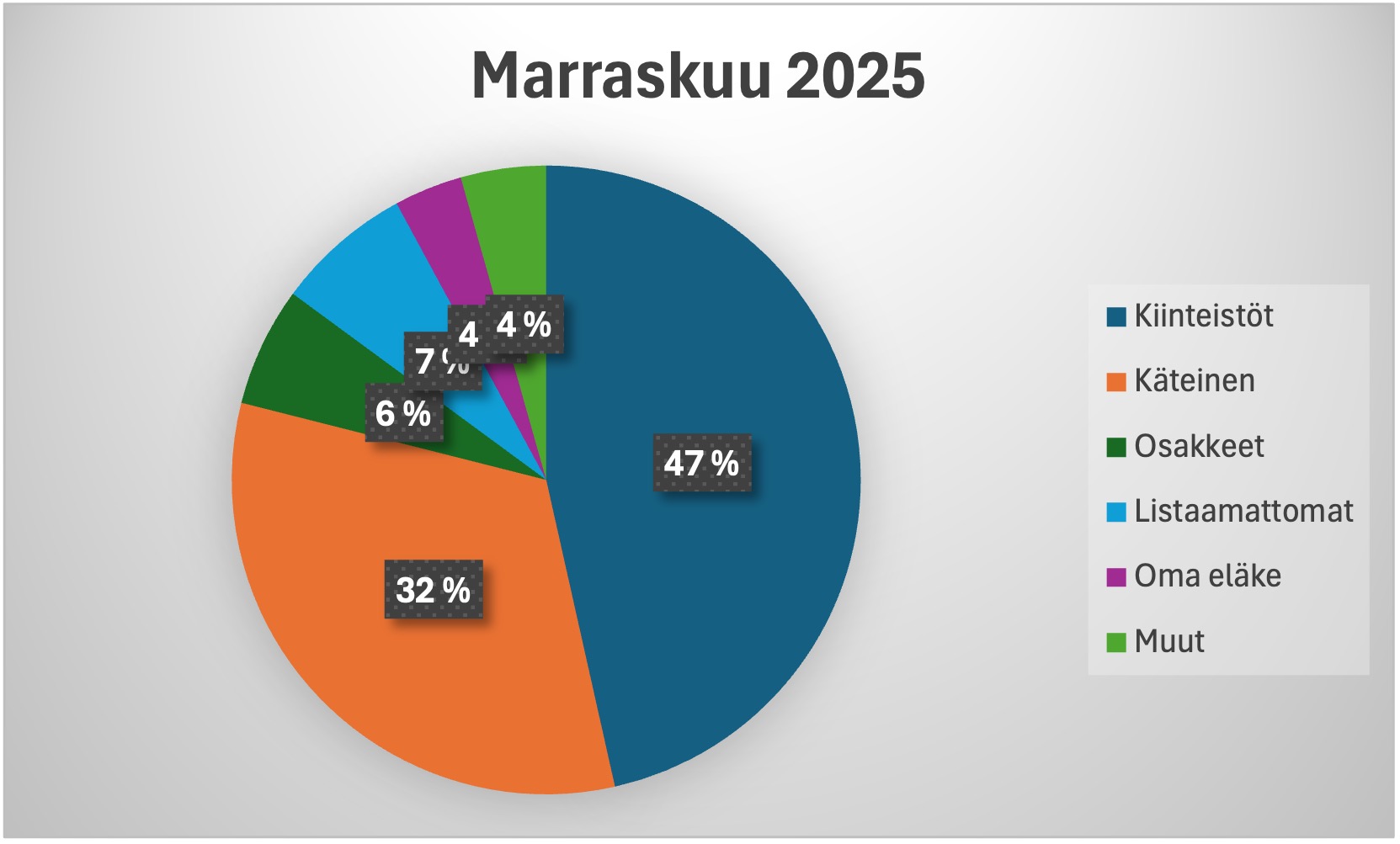
I have told here about my own “freedom” and its development.. let’s do a small update for November 2025.
NOVEMBER LIGHT
An overview of the progress of ownership in 2025. I love AI, but I consider its valuation a classic tech bubble. That’s why I have reduced the weight of stocks throughout the year and changed the allocation of my investments.
This year I have 1) bought a 3rd holiday property in Italy and 2) made a significant investment in an unlisted company, to which I will also join as chairman of the board. The cash portion is unnecessarily large, and next I will build a “three buckets” allocation where a portion is in a quickly usable form like cash (15%), the largest part, about 70%, in bonds and similar, and less than 15% in direct stocks. The goal is to keep the investment rate high and be ready to move into the stock market if prices melt.
No one learns anything if we don’t agree to share our views and discuss them. That’s why I share mine and aim to discuss the situation and alternatives with as many people as possible. In the long term, precisely 1) the investment rate and 2) the allocation seem to me to affect the results the most and best.
Enjoy the dark season! V
52 Likes