Isn’t it generally better to just sell units to pay less tax? You only pay tax on the portion that is profitable. I don’t think it matters if the number of profit units decreases, as their value will increase in the long run. The value of your ownership is the number of units multiplied by the price per unit, and that’s what matters. If the number of units didn’t decrease, the value of the units would drop accordingly, and the result of the multiplication would be the same in both cases.
4 Likes
Is that a slight oversimplification of the matter, even if it works nicely for one year?
In my opinion, no, it works in theory and should also work in practice.
In such a calculation, I understand one must also consider what happens over time, because with income units, the number of fund units remains the same, and with growth units, it starts to decrease.
Could you clarify this a bit? How does the number of fund units with growth units decrease over time and remain the same with income units?
If Matti buys €25k worth of income units today and Teppo buys €25k worth of growth units at the same time, the value of these units should theoretically remain the same until the fund next pays out dividends for the income units. Let’s assume that the value of the units has grown by 20% to €30k by the dividend payment date, and the fund now pays a 3% dividend. Matti’s income unit value will then decrease by €900, because the accumulated dividend in the fund is now paid out. The amount of growth units will similarly decrease by €900, as Teppo sells units for this amount and thus makes the same dividend himself.
The value of Matti’s and Teppo’s funds thus both decrease to €29.1k, but Teppo still received the aforementioned tax advantage of €270.
(I used a 3% dividend as an example, which is also mentioned on Seligson’s website, but the annual dividend, of course, varies. Regardless of the fund’s annual dividend percentage and the size of the fund ownership, self-made dividends from growth units can always be kept tax-free up to a thousand euros, as long as there are no other sales in that year.)
It may be that growth units are more profitable, but are they always in different scenarios? It seems like a quite challenging calculation with different assumptions, if my conclusions have any practical value at all.
In my opinion, with Seligson, growth units are always a more profitable option than income units, as long as the investment period is >180 days, which avoids the 0.5% redemption fees. I would like to get an example of a situation where income units would be a more sensible option.
1 Like
It’s going to be quite a challenging calculation with different assumptions, if my conclusions have any practical value at all.
As an off-topic addition to this, I think all well-founded conclusions and comments have value. By writing, one’s own thinking becomes clearer, things are examined from different angles, and new ideas may also emerge. At the same time, it also (hopefully) challenges others to clarify their statements and thoughts. So, keep it up!
1 Like
Ah, so I didn’t account for the decrease in the value of the distribution share by the amount of the dividend. Well, then the situation seems to lean nicely in favor of accumulation shares.
I’ve also noticed with distributing ETF products that their dividends are always a bit random, so their amounts aren’t really predictable. Of course, the same problem exists with dividends ending up in the balance of accumulation ETFs. I doubt there’s any foul play, but they always make me wonder.
Despite all this discussion, I always choose accumulation shares because the tax benefit without sales is so significant. The OMXH25 and the cessation of its dividend payments are really well reflected in the comparison index. The ETF takes off like a pike from the reeds once the distribution of returns has ended.
To add to the excellent comments above: I personally prefer two (or even more) client portfolios per service provider. For example, with Seligson, I have two, into each of which I save both monthly and occasionally (trying to time, or at least hit market dips with a larger sum than the monthly installment, if I have liquidity, which is another story).
I was able to open two different portfolios by requesting them separately. I save into both portfolios largely overlapping, i.e., into the same funds. The advantage of two portfolios is that when redeeming, you can choose which portfolio to sell from. I usually choose the one that results in lower tax consequences. You can also sell at a loss, considering your overall situation.
Of course, in that sense, the adjustment I made is unnecessary, as Seligson allows redeeming fund units by purchase lot, thus also choosing redemptions from a tax perspective.
And yes: all my fund units are growth units 
Edit: clarification
A very good fund that I also owned in the past. According to Morningstar, the cumulative annual return for the last 10 years for the Seligson Global Top 25 Brands Fund A is 14.36%. Which is also really good. So, an annual return of 30% over 15 years cannot be true.
https://www.morningstar.fi/fi/funds/snapshot/snapshot.aspx?id=F0GBR04O2R&tab=1
3 Likes
I myself saved all my stock investments in Seligson funds around 2006-2010. After that, I switched to direct investments.
My own thought model is that these will grow through compound interest until I retire from working life (probably around 15 years still).
At least in my own thinking, it is possible to divest the shares tax-efficiently over time through the acquisition cost presumption.
Some funds are already up several hundred percent. With the acquisition cost presumption, you can nicely trim a bit off the tax percentage. After more than 10 years of ownership, 40% of the sale price can be used as the acquisition cost instead of the actual acquisition cost.
I don’t personally understand a suitable use for profit shares. It’s easier and more tax-efficient to just sell shares when needed.
However, one doesn’t know what Finnish tax practices will be like in the coming decades. A suitably left-leaning Minister of Finance could remove such a tax relief as a “rich people’s hobby.” 
7 Likes
That would mean the fund’s value would increase 50-fold during those 15 years. Congratulations to the winners. 
1 Like
That would be a strong return % 
I think there was a typo in my original message. Thanks, KONTI, for correcting it.
By the way, has anyone asked Seligson how large of an amount you need to have invested in their funds to negotiate the fund management fees down? My understanding is that institutional clients, at least, receive lower management fees, but does a private client need to have investments in the millions to join the same club?
1 Like
Phoebus started his fund during a period when the market was in a strong downturn. He achieved significant excess returns in the early days by keeping the money in cash and delaying investment. Well, that’s a skill too 
When talking about the benchmark index, there isn’t much to consider precisely correct about Phoebus. The decision to go into US markets can, in itself, be considered correct. If one considers, for example, pure Finnish investments, things might have gone better, partly because Russia failed him badly this time. Luck always plays a big part when picking stocks yourself.
On the plus side, he also has his own money in the fund and his analyses seem smart. Ultimately, it’s perhaps good proof of how difficult it is to beat the market with active stock picking.
1 Like
Phoebus started in early October 2001. Oldenburg, if I remember correctly, transferred all his direct stock investments to Phoebus at the beginning of the fund. After the first quarter, Phoebus had 17% cash. The fund’s value rose by 19% in the first quarter, while the index rose by 14%. After the second quarter in spring 2002, cash was still high at 19%. At that point, Phoebus had risen 26% from the start, and the index 22%.
After the third quarter in summer 2002, the amount of cash had normalized to less than ten percent. Phoebus had risen 13% from the start, and the index 6%.
So, during the first six months, when Phoebus still had a lot of cash that Oldenburg hadn’t had time to invest, there was a strong bear market rally, and at that time Phoebus performed well against the index despite the cash, not because of it.
9 Likes
It has been a very long time since I made this conclusion. Well, I’m looking at the 2006 annual review, which happened to be at hand. Nothing older for now. The biggest return difference was thus made in every case before 2003, during a time when the index was falling.
At the end of 2006, Phoebus’s return from inception was 191.7% and the benchmark index was 119.5%. However, the return for the last 3 years was already such that the benchmark index was slightly behind, which seemed to be the normal situation even after that… So something happened specifically in the early days of returns compared to the index..
I’ll also provide the situation as of December 31, 2008.
From start date:
Phoebus 64.44%, benchmark index 26.7%
Last 5 years:
Phoebus 7.52%, benchmark index 12.46%
1 Like
Perhaps I’m talking about a time slightly after this, when the fund received a lot of new investments relative to its initial capital, but they weren’t immediately invested in the market. This was a bit later, during a time when the index was in a sharp decline.
So, during Phoebus’s first half-year, the market was on the rise and the fund had a lot of cash. During the second half of the year, cash quickly decreased to normal levels as the market declined. In the fall of 2002, a year after its inception, it was only 5%. From fall 2002 to spring 2003, the cash apparently rose to just over 10 percent, meaning investors likely contributed more money than could be calmly invested. But during this time, the market moved sideways, and Phoebus rose slightly. From spring 2003, a bull market began, and Phoebus generated significant outperformance in the latter part of the year.
Therefore, I simply cannot see that Phoebus benefited from cash in its early days. Throughout its history, it has suffered a bit from it, as Oldenburg has often kept a slightly larger cash reserve than he would have purely as an investor, so that potential large unexpected redemptions could be made directly from cash without touching the companies. In addition, Phoebus’s return, of course, has a management fee of just under one percent deducted every year. Considering these, I think it’s a perfectly fine performance. The best thing about Phoebus, however, is the blog, which is quite a treasure trove.
10 Likes
Well, from the annual report, one can clearly see from the yield curve that when there was a sharp drop in prices, the fund’s value remained relatively stable, meaning the difference in returns occurred during this period… So I disagree with your assessment that the difference in returns didn’t specifically come from the period when investors poured more money into the fund, and Oldenburg fortunately had time to calmly research where to invest it… But can that really be considered skill? Oldenburg always makes a point of mentioning the difference in returns from the start date, which makes me smile a little..
So that’s the period from autumn '01 to summer '02. The initial “cash drag” in the bear market rally offsets the “cash benefit” of late spring '02. In the following quarter, from summer '02 to autumn, the market fell 17%, and Phoebus 11%. During that quarter, the fund had a small amount of cash, 5-10%. At that point, the market more or less reached its bottom, and the review can actually end there.
3 Likes
The integration of LähiTapiola’s funds and Seligson seems to be progressing. Seligson’s funds have become available for subscription through LähiTapiola’s website:
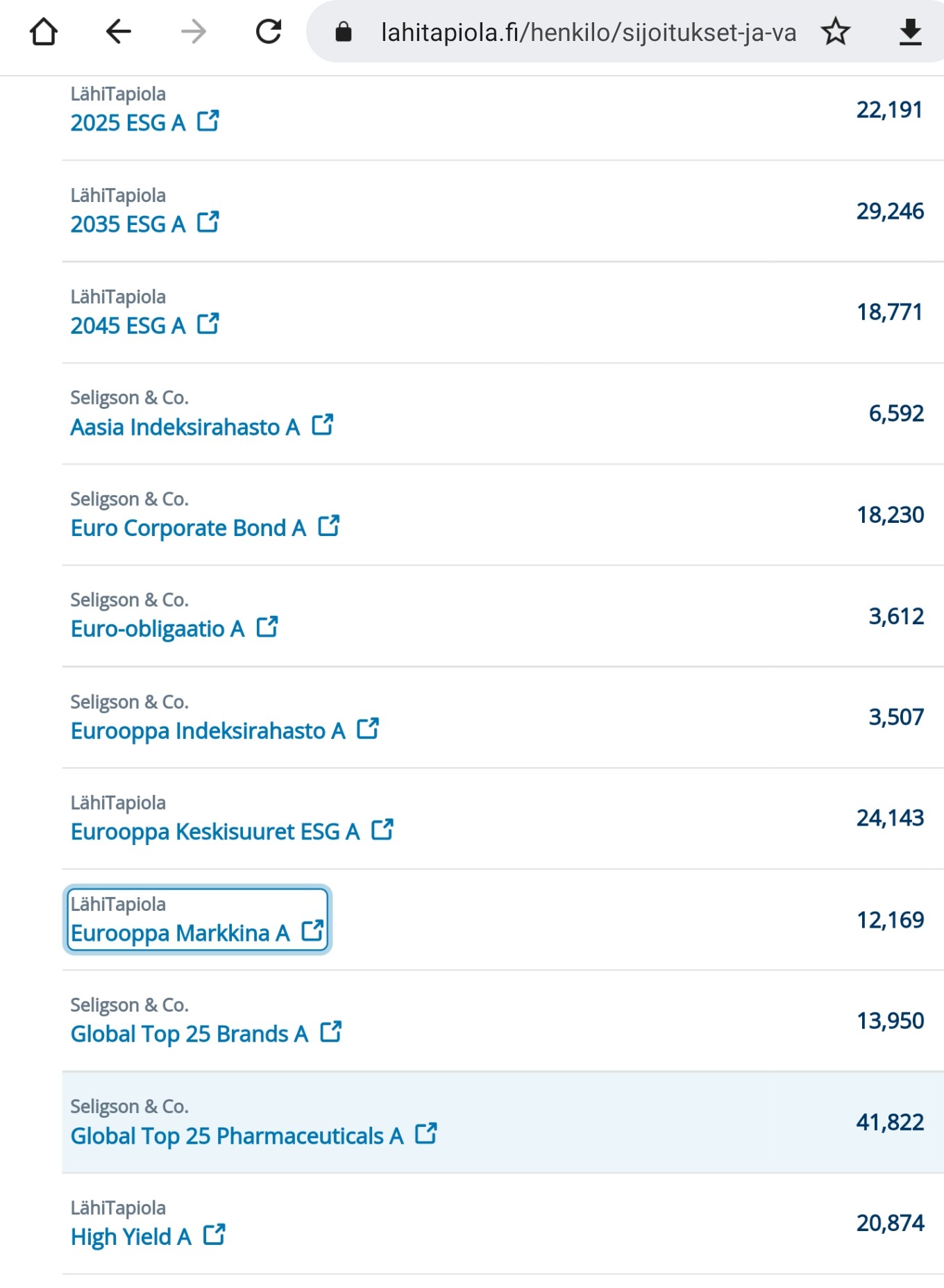
LähiTapiola’s funds became available on Seligson’s website and app in the spring. However, my accounts are separate for both. It will also be interesting to see what happens to the Seligson application, as LähiTapiola discontinued its portfolio monitoring application just over a year ago.
3 Likes
Have you found anything interesting in those LähiTapiola funds? I quickly looked into them myself, and they seemed reasonably expensive.
2 Likes