It certainly can. The main point was that investing is unlikely to make a low-income person very wealthy. Gaining access to higher income can do that. And that should be pursued instead.
My portfolio is somewhere between half a million and a million. The funds were saved from my own salaries; when I was young, I could really push overtime, and since I had nothing else to spend my money on, I put everything first into index funds and later into direct stock purchases. I’ve always kept my expenses low; even now, I can easily invest a couple of thousand euros monthly, even though I already have a family.
Fortunately, I became interested in investing at a young age, and Pasi Havia’s blog on financial independence, in particular, served as a motivator. Ever since I got my first summer job, I’ve invested the surplus. This even went so far that while in the army, I invested my daily allowances, which I didn’t spend on things like camp sweets or canteen donuts. While studying, I invested my summer job money monthly, diversifying over time.
The biggest single success in my career was investing in Revenio early on. At its peak, this stock alone accounted for a six-figure sum in euros in my portfolio.
For me, the whole thing has felt easy, natural, and interesting. In the coming years, the million mark should be broken unless the world ends.
I’m thinking about leaving working life and living off dividends + returns once my employer kicks me out as a result of some co-determination (YT) process, because I probably wouldn’t ever have the courage to leave on my own. I hope this happens by the time I turn 40 at the latest. ![]()
PS. The writings above about single parents and others are certainly valid, but it’s also a result of one’s own choices to end up as a single parent of three children before acquiring a sufficient financial buffer.
A little about my own situation in this thread. My net portfolio is now somewhere around €1.3M, and indeed, the share from the company exit is about €700K. The rest has been saved and earned through investments. From ages 17-30, I was very frugal, and even before the exit, I already had a portfolio of over €100K with a short career.
Now, especially in the last year, the brevity of life has become more apparent. I’m no longer as keen on saving; in fact, I’ve given myself permission to spend all my salary income if I want to.
The goal of achieving financial independence as quickly as possible has also started to slip a bit. One begins to think that all the experiences I want in life are more important than complete free time. Right now, I’d rather spend my entire salary on entertainment and let the portfolio grow peacefully.
A motorcycle also arrived in the yard, along with all the gear, of course. I’ve started booking more trips, festivals, etc. The children are still quite young, so we’re no longer really saving on their expenses.
One can lament the brevity of life, but the compulsive accumulation of material things and “experiences” under this pretext is somehow so last season. It might bring someone a momentary thrill, but tolerance grows, and eventually, nothing brings satisfaction. The late Lemmy once sang that “the chase is better than the catch,” probably thinking of something entirely different, but it’s the actual work/thought process, not the reward, that’s the real deal. Once you internalize this, you’ve come a long way. Everyone has their own way, of course, but the rat race doesn’t recede by recklessly increasing consumption.
I took a few extra days off work, went exercising, and now I’m sitting on the terrace reading the news and marveling at the darkening summer evening. At least the day job that bothers me won’t be waking me up in the morning
My own idea of time well spent, which perhaps someone else can relate to.
I think I wrote here sometime before. My income has never been extraordinary, but reasonable earnings, better-than-market investment returns, and a slight debt leverage have helped a lot over the years. In terms of priorities, young people should first focus on studying in a field from which they can potentially earn a reasonable income in the future. The importance of the expenditure side cannot be overstated for the middle class, and lastly, those income-generating loans, if other things are in order.
Indeed, spouses also die, without the other half contributing to it in any way. In people’s lives, there’s a hell of a lot that one cannot influence with their choices, and much that where the consequences of choices cannot be foreseen. The world is ultimately a rather chaotic place; no one lives in a vacuum here.
For some, life certainly runs on track like a train, but for most, there are some disturbances that derail them. Some get back on track, some never do.
Choices, of course, have an impact, often a great deal. Other times, none at all.
Yeah, you get used to everything.
But I think that almost everything can and should be tried for at least a while, to know if it’s “your thing”. Some things then become real hobbies.
Surely it’s better to have tried a little bit of everything when young, than to think when old that ‘I wish I had done that too’. Try everything that interests you once or for a while. And many cool things cost more than a gym membership or Netflix.
Still, it doesn’t mean that unnecessary “luxury” should be for continuous use.
Yesterday, I was playing with numbers again for fun. I managed to build a 0-100k€ investment portfolio in 82 months, of which roughly 25k€ was accumulated in just over 20 months. Now that the 100-200k€ goal is progressing well and is 1/4 of the way there, I accumulated this 25k€ in just 14 months. If I boldly multiply that by four, it would take about 56 months, or just over 4.5 years, to reach a 200k€ investment portfolio.
There are quite good chances of accumulating a 300k€ investment portfolio before I turn 50, for which I still have 9 years (the apartment will also be almost debt-free by then, so a net worth closer to 400k€ is also possible). I guess one can already practically see the effectiveness of the wonderful compound interest effect and the impact of sticking to the investment plan, regardless of what’s happening in the world. If things continue to progress this well, I’ll even be comfortably ahead of my boring investment plan.
I’ve noticed for my part that overly aggressive stocks don’t suit me, and one shouldn’t try to trade or adjust too much. An investment career doesn’t involve many sales compared to purchases, but I like to say, “buy and remember.” It’s good to stay on top of where things are going and remember to add over time, but never forget what you’re doing.
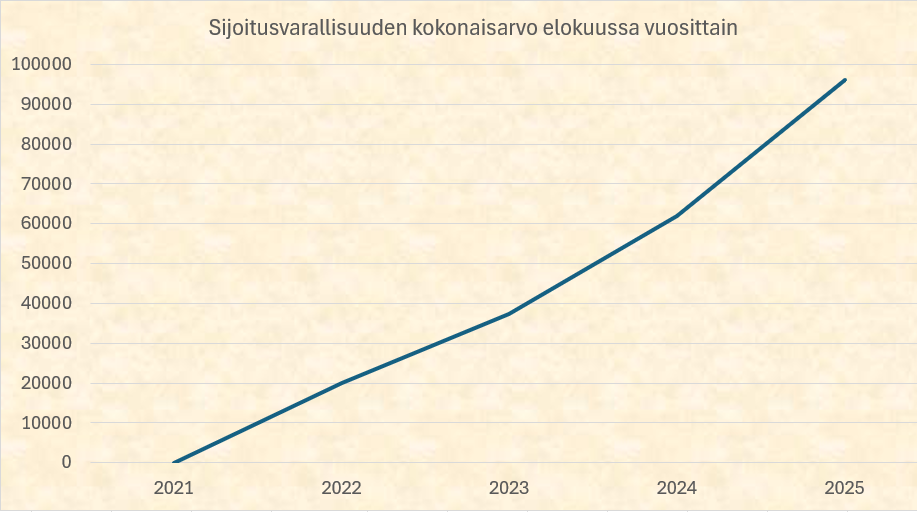
Just had the annual shareholder information meeting of the employer company’s main owner (private equity investor), where, among other things, the realized value development was presented. The first similar event was in August 2022, and the tradition has continued annually.
Based on this, one can again estimate the overall development of investment assets based on fairly reliable information.

Great portfolio development over 4 years. My own investment portfolio has grown in the same class in Euros, even though I already had a decent initial capital in 2021. I’m not even aiming for more than 5-7% annual return.
I’m particularly interested in how that realized value development was determined? How was it done in an unlisted company? I also have non-publicly traded investment assets, and I have to think about their valuation.
Otherwise, as a comment on this discussion, where does the money for large portfolios come from? As a young graduate, it was easy to save when expenses were low, and as a bachelor, I could do travel work around the world. I looked at my own accounting and saw that in 2008, I managed to save about 22,500 euros from a gross income of 58,000 euros. Of course, I also had per diems then. Nowadays, my income is double, but family, travel, and other lifestyle inflation + desire for comfort have caused me not to even strive for such a thing. I don’t need to anymore, as the goal seems to be met with less effort.
I have inherited about half of my wealth and saved the other half myself.
We already knew this: “most often, accumulating a million-dollar fortune requires, for example, investment properties or stock market shares – assets that generate and thus further increase wealth”
I don’t write much, mostly just read (I even registered for the forum quite late), but I thought I’d share my own story now; it feels good to go through my own history for my own sake. Sometime during the corona era, perhaps in 2021, I set a goal of having a €100,000 portfolio by the age of 30. The portfolio size was around €30,000 then, and €100,000 felt like a realistic goal. A year ago, I wouldn’t have believed I’d reach that goal, but more on that soon.
I started investing (or rather, practicing it) when I opened an account with Nordnet in 2016. I don’t remember if the idea came from my father, a friend, or from reading something online. I just remember getting a verification call from Nordnet, and I was a bit nervous. At the time, I was a second-year engineering student, and my stakes were mainly student loans and some small bits of cash. I bought some stocks completely without understanding anything and then panicked and sold at even a small dip, as many others probably do at the beginning. However, I managed to make a lucky profit of about €700 with UPM, if I recall correctly. I then exited the market for the rest of my studies, as a student, the money went towards living expenses.
In 2019, I graduated, and I remember having €1200 in my account. Almost immediately, however, I got a permanent job in my field, and as soon as my salary started coming in, I set up automatic monthly savings of a few hundred euros into Nordnet’s index funds. Then came the corona pandemic, and the feeling was that my savings were gone, but I continued as before. I also bought some direct stocks; W. P. Carey and Evolution come to mind, at least.
Perhaps sometime in 2021, I then sold the index funds and started tinkering with direct stocks. In terms of returns, it was by no means profitable, but it was at least educational. Sometime in 2022, inspired by WPC, I started investing quite heavily in REIT stocks. I made pretty good profits from these (minus MPW, which I realized at a heavy loss), as REITs were hit quite hard and also provided dividends. At its worst/best, the REIT portion was something like 60-70% of the portfolio. In hindsight, the weighting of REITs is quite frightening. In 2023, I also started saving into the Finserve Global Security Fund because, for various reasons, I also wanted defense industry exposure in my portfolio, and I couldn’t find another fund.
Then in 2024, change negotiations hit, and that same autumn, I was laid off. I had mixed feelings in a way. On one hand, it felt nice to extend my summer vacation and rest after years of hectic project work; on the other hand, it was a shame that my income (=regular savings) dried up. At the same time, I thought the €100k goal was pure utopia; the portfolio size at that time was around €70-80k. I then decided to reduce risk and shift to indexes. I sold all REITs, transferring a large portion to indexes. Then in 2025, I bought, among other things, Nebius in several parts. But it just so happened again that I started buying direct stocks, though this time I actually had time to do background research. Then some orange madness began, and at the very beginning of March, I sold all US index funds due to uncertainty and bought another 30% more Nebius (this is how risk is reduced..). I also added European company funds, and the rest of the cash I put into Iris Energy sometime in June-July. In August, I then sold the Finserve fund because I thought it was good to have cash, and the defense industry seemed to be going too high. This year, I have probably read and learned more than ever. For the first time, I have read quarterly reports of the companies I own thoughtfully and made my own conclusions, not just blindly trusting others.
Now that I’ve managed to spew out this text, I’ve tinkered far too much with direct stocks. Lately, I’ve been lucky with IREN and Nebius, and thanks to them, the portfolio has risen above the €100,000 mark today. With index investing, the portfolio would probably be even larger, but on the other hand, direct stocks have taught me a lot and kept my interest alive.
I haven’t listed all purchases and sales; I’ve also made big losses with direct stocks, at least Embracer, Smart Eye, and Harvia come to mind.
I am still laid off, and the job market is difficult. On the other hand, things are quite good for me as I don’t have to worry about finances, and I’ve gained experience. I’m more concerned about those who are graduating into this situation and competing with more experienced people just to get that experience.
Just a stream of thoughts like this at the cottage while waiting for the sauna to heat up (it already went out once). Oh, and where the money came from: About €50k from saving from salaried work, about €20k from realizing an inheritance, and the rest from appreciation.
Now I’m going to the sauna and enjoy a few cold ones.
P.S. I haven’t written such a long text since my studies, and I tried to proofread it; hopefully, no terrible confusions remained.
Should I? Maybe I should. To tell a bit of my own story, since I don’t really dare to tell it even to my closest circle.
It all started way back in the 80s. I started taking out a student loan, whose interest rate was probably around 5%. At the same time, banks paid well over 10% interest on longer-term savings accounts. Believe it or not. From there on, in short:
In the 90s, an inherited apartment, which helped acquire two more. Working abroad, where taxation was leaner. I’m a nurse, abroad is easily accessible. In the early 2000s, a bit of stock investing, but I sold all of these after a few years. More apartments came and went in the 2000s, and in 2016, I owned three three-room apartments in western Helsinki with the bank.
Then, through circumstances, I “had to” sell two of these three apartments, perhaps at a good time. It was probably 2020-21. If I remember correctly, about 250k euros remained in the account after the bank had taken its share. And I can tell you that one of these sold three-room apartments generated about 10,000 euros in added value between 2012-2020. So I didn’t exactly celebrate much with that either…Of course, a relatively significant pipe renovation and roof repair had been paid for there.
Well, I returned to the stock market just in time for the so-called peaks (at least the Helsinki stock exchange) in the summer of 2021. I started throwing money a bit here and there. The first year was loss-making, after that around zero until the beginning of 2024. At some point, I shifted my excessive diversification to less than ten companies, with Helsinki stocks on an OST and the rest of the world on an AOT (guess which one has performed better…).
After this, things started to happen. A few energy companies have been favorable to my view, and today my portfolio value is 679,000. (Pretty clear jinxing.)
I happened to become unemployed this summer, as my employer was not as favorable to my view…
. And at my age, there seems to be only a “sell” recommendation on the job market right now. So the money might actually come in handy here.
But I am proud that I have beaten OMXHGI in that period, 90% vs 8%. And with a background as an internal medicine-surgical nurse, mostly relying on gut feeling and the Inderes forum.
And I must mention, of course, that the real difficulty only begins now, when one should know how to sell at roughly a good point…
. After all, the portfolio’s content is just a number until it has been, so to speak, “cashed out.”
Have an excellent start to the autumn, everyone!!!
Is that necessary?… or is it enough to withdraw annually what one needs and keep the rest in the market. Of course, if you have risky assets, then if the desired level has been reached, move
My investing journey actually began in 2016 with the IPO of DNA, when I bought my first direct shares. Before this, I had bank funds, which I partly used for my first home, which I bought as a part-time employee in spring 2014. I sold the rest of the funds in 2016 when I changed employers, and a few thousand euros from these were then used for the aforementioned IPO and individual stock purchases.
Virtually all investment assets have accumulated from my own salary and side job income, if we don’t count an inheritance of less than 10,000 euros in 2017 and a few gifts from parents (would it be 2x 4,000 euros over the years). As an investor, I’ve always been a “invest and forget” type, meaning sales are made very rarely, and actually the only sales came when acquiring a house in autumn 2024, when sales amounted to about 16,000 euros for the down payment and transfer tax.
As of this date, I am still a few years under 40, with liquid investments of ~223,000 euros and my first home as an investment property (estimated value 110,000 euros and debt 76,000, major renovations recently done, which increased the debt).
Direct shares ~62% and funds ~38%. As an investor, probably quite average, but it’s enjoyable and you learn something new every day.
Let’s put my own story here too. In the summer of 2022, I started getting interested in investing and had saved over 20K€ in about a year, which I intended to use for stocks. In August of the same year, I opened an account with Nordnet, and somewhere in mid-August, during a lunch break at work, with trembling hands, I bought my first ever stocks (Nordea, Ponsse, Nokian Renkaat) and was immediately hooked
From that day on, a significant portion of my monthly salary has been put into stocks.
Today, I myself have reached a six-figure value in my portfolio, as a moment ago, after the US market opened, the value shown was: 100,114€ ![]()
In a nutshell: 3 years 2 months 6 days
Value increase (Max) +53.97% (OMX25 +15.08%)
Edit. All invested wealth has been acquired from salary income and contract work at the construction site.
Yeah, well, I’ve already sold a little bit, but it always feels like the prices just keep going up…..
. Which deadly sin was greed again?
Status update: 200k cracked and net monthly income has risen to 2200 euros. See you again in 100k!
I’ve always believed that a low-income practical nurse simply can’t save money. Everything goes to food, gas, loans, insurance, and living expenses. Oh, how wrong I’ve been! Let this be a lesson to all “prejudiced wrong-thinkers” like me.
I don’t have a portfolio worth hundreds of thousands, but as the founder of this thread, I consider it my right to write my own story about how I accumulated a 10,000€ portfolio.
It went something like this. Sometimes I’d scroll on my phone at night when I couldn’t sleep. More precisely, that was in July 2022. For some strange reason, I got the idea to put 25€ every Friday into the OP-Rohkea fund. That’s where it all started. And it’s a good thing it did. I can’t describe my beginning any more precisely to myself or others.
It was exciting to see numbers on the screen and check them daily. Then I bought some stocks with tens of euros, or maybe even a hundred. The hunger grew at a furious pace. No fund or stock “rocketed,” so to speak, but it was a nice feeling to have a little money stashed away, as I’ve been a hand-to-mouth type my whole life.
I Googled things and somehow found the Inderes forum. On the forum, someone advised not to necessarily put money into expensive funds, but rather into index funds. True. My interest grew even more. On my commutes and runs, I listened to various investment books and podcasts. Seppo Saario’s Pörssiraamattu (Stock Market Bible) has been listened to many times. Each time, the world opened up a little more. My enthusiasm and interest only increased. I’m still extremely bad with P/E, P/B, Return on Equity, and other very essential things. In fact, I’m still utterly useless at these. But I have my own logic according to which I pick stocks.
The 25€ weekly saving changed at some point to 100€/month, then 150€, and now it’s probably already 200€/month. Already, and it keeps growing. For some, that 200€ fluctuates in portfolio value in seconds every day. But it’s pretty silly to compare yourself to others. You can reflect a little, but not too much. There’s no benefit to it.
Or let’s compare it this way. In Finland, hundreds of thousands of people are in debt collection, and hundreds of thousands have a credit default entry. I don’t (at least not yet) belong to them. I have ten grand saved up! And let’s compare a little more. Many people my age have zero in their accounts. Portfolios worth hundreds of thousands don’t seem to be rare at all. But I am more than happy. It’s a little easier to breathe. Now I have something for a rainy day.
I haven’t hit any tenbaggers or anything else extraordinary. Kempower went +100% and then it plummeted, etc. No other individual stock has grown tremendously either. Just tens or hundreds of euros, but when most of them do this, it brings a nice return by my own measure. I’ve decided that I’m allowed to invest a maximum of 1000€ in a single stock. If it all goes, it would be incredibly frustrating, but I wouldn’t die from it. I’ve stuck to this. With profits, it can go as high as it wants, but my own money is a maximum of a grand per share.
I tried to keep records. I lost track at some point. This is annoying, but we’ll go with it. My rough estimate is that I’ve invested about 8000-9000€ in capital, and the rest is profit. I’ve “trimmed” some stocks if they’ve risen handsomely and then bought others in their place with those funds. I’ve entertained myself and certainly others by sometimes talking about purchases as small as 1-10€. This works sensibly at Osuuspankki (OP Bank) as the fees are negligible. Well, why not. Every euro set aside is saved, and in the best case, it grows a little too.
In addition, I’ve invested tax refunds and holiday pay. The single largest purchase is somewhere between 500 and 1000€. I haven’t received any inheritances, and that’s good. It’s nice that my relatives are alive. But when that moment comes, I guess those funds will be invested in the stock market, both in my own and my offspring’s portfolios.
Well, that’s it. The ten grand has just come little by little. I haven’t had to compromise my standard of living one bit. Where would that money even be if I hadn’t started saving? I’ll answer honestly: No idea.
What’s next? Probably the same path. I can even put in a little more now that I’ve paid off my car loans. Maybe I’ll aim for twenty grand. It’s not an obsession for me. Ten grand was. I don’t even dream of hundreds of thousands; time might run out. I intend to use some of the funds, and I have already done so. It’s not that serious. Hopefully, compound interest will start to show even a little, and the next ten grand will come faster, if it’s to come. It took three years and three months to go from zero to 10,000€.
You can’t make a heroic story out of this. It’s not headline material, nor does it need to be. I hope someone uses this story of mine as an example to someone, that it’s possible even for an ordinary worker, if only they start.
As an individual, I reached a 200k portfolio – no second car, no trips abroad, expenses kept to a minimum, and all extra funds into the portfolio. The children grumbled, calling me “stingy,” but perhaps they will appreciate this someday. In the beginning, this was difficult, as bank fees in the 80s were absolutely exorbitant, and I think I even paid transfer taxes on the first trades. Now it’s so much easier. One had to be really skilled and lucky to get into the black.
There would have been no chance for the current million-euro portfolio without business operations. YEL (entrepreneur’s pension insurance) to a minimum and extra money directly into stocks.
Frankly, I have never trusted the pension system, and that’s why I have built a portfolio as retirement savings. 90% of the portfolio’s value consists of undistributed profits.
Since the tax authorities have their hand out every time funds are withdrawn from the company, we have decided to invest all extra into stocks.
No, it’s just about the group we’re in here. A 100k€ portfolio is quite a marginal group’s thing. Of course, it’s a very encouraging thing, and that’s why I hang around here myself. I think it’s the same as in life in general: if you want to learn something, it’s better to surround yourself with people who already know that thing.
28% have no savings at all.
For 11%, a 100€ unexpected expense is too much. The average Finn’s pain threshold is 1600€. Only 18% would cope with 5000€.