Revenio has a strategic partnership with a German company regarding RetCAD screening. I cannot assess how significant this news is.
17 Likes
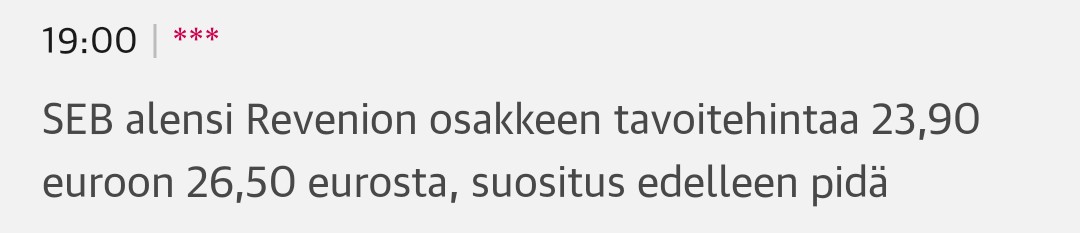
From today’s (26.1) KL feed:
15 Likes
Am I on the right track in thinking that these lowered target prices are largely due to the weakening of the dollar? 12 months ago, EUR/USD was 1.04, and now it is 1.18. Even if sales in the US are strong, the repatriated earnings are shrinking. What other market area could realistically (at least to some extent) offset the impact of this development?
1 Like
They are likely a reaction to the share price. Revenio’s target prices have always followed the share price in hindsight more than the actual market situation. Nothing has really changed, and now that the internal situation in the US is starting to clear up, the market situation is only improving. This was optimism; it’s what the world needs right now.
7 Likes
A study like that has just started, 2026-8.
Comparing the AI results of Optomed and Centervue.
5 Likes
8 Likes
Revenio’s share price is currently at the same level as it was in the spring of 2019. I wonder if the bar for the share price has been lowered so much that it will see a significant rally after the earnings announcement. At least that’s what I believe, as Revenio has continued its steady, albeit slower, growth with healthy margins. Investments have been made for future growth, even though there hasn’t been any news on the M&A front. Nevertheless, the company is growing organically quite well.
12 Likes
Are there any other concerns here besides the weakness of the dollar? Regarding that, the CEO also noted that the exposure is moderate ( sales, expenses…)
4 Likes
The dollar’s weakness has been ongoing all year and there haven’t been significant changes during Q4. They provide guidance for currency-adjusted growth anyway.
Edit: Revenio’s EV/EBIT based on this year’s forecasts is 14 and, for example, Kesko’s is 17. Of course, they are companies in completely different sectors, but these valuations for growth companies have certainly become quite peculiar. And Revenio isn’t a SaaS company, although they do get software revenue in increasing amounts nowadays too. I would believe their software revenue is quite sticky compared to, for example, CRM players.
12 Likes
Price movements are very difficult to assess successfully; they often seem obvious only in hindsight. Sometimes selling alone triggers further selling; on the other hand, unfortunately, it sometimes feels like someone knows more.
In Revenio’s case, I’ve noticed that many of the Nordic medtech companies I own have experienced significant share price weakness lately. At the same time, I’ve come across news almost daily about the unfortunate TIN Ny Teknik fund. Investors don’t seem satisfied with the fund’s performance, and owners have started redeeming their holdings in the fund.
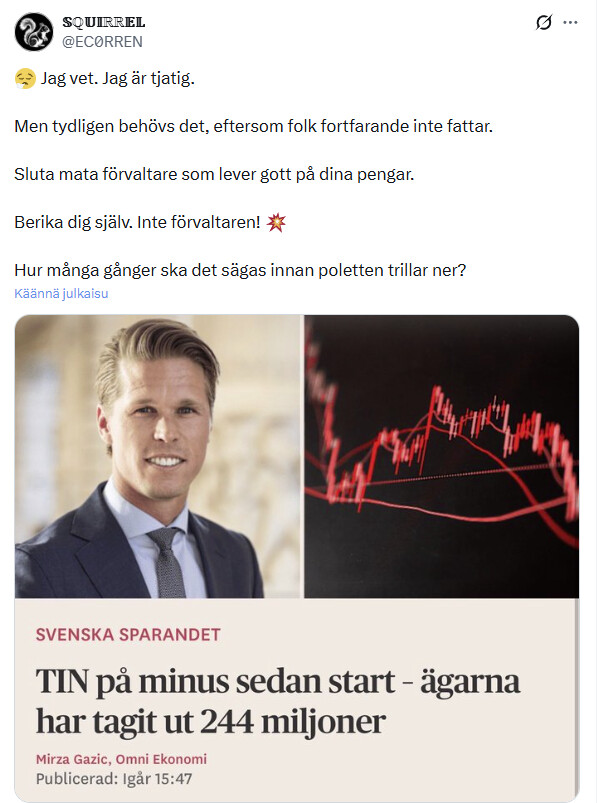
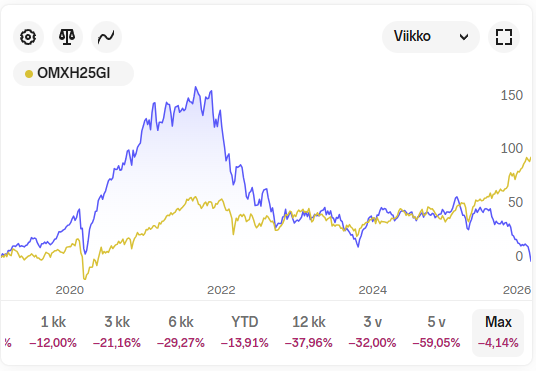
The performance of the TIN Ny Teknik fund has indeed been weak, and the fund’s total return turned negative last week.
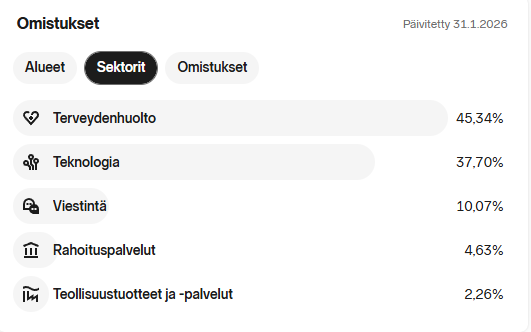
The fund has a significant weighting in the healthcare sector and is focused on Nordic companies.
Tin Fonder is also among Revenio’s largest shareholders, in 16th place. I’m considering the possibility that the fund might have to dump its holdings to cover fund redemptions.
What I find unusual about Revenio’s decline is that the list of major shareholders doesn’t show any significant sellers.
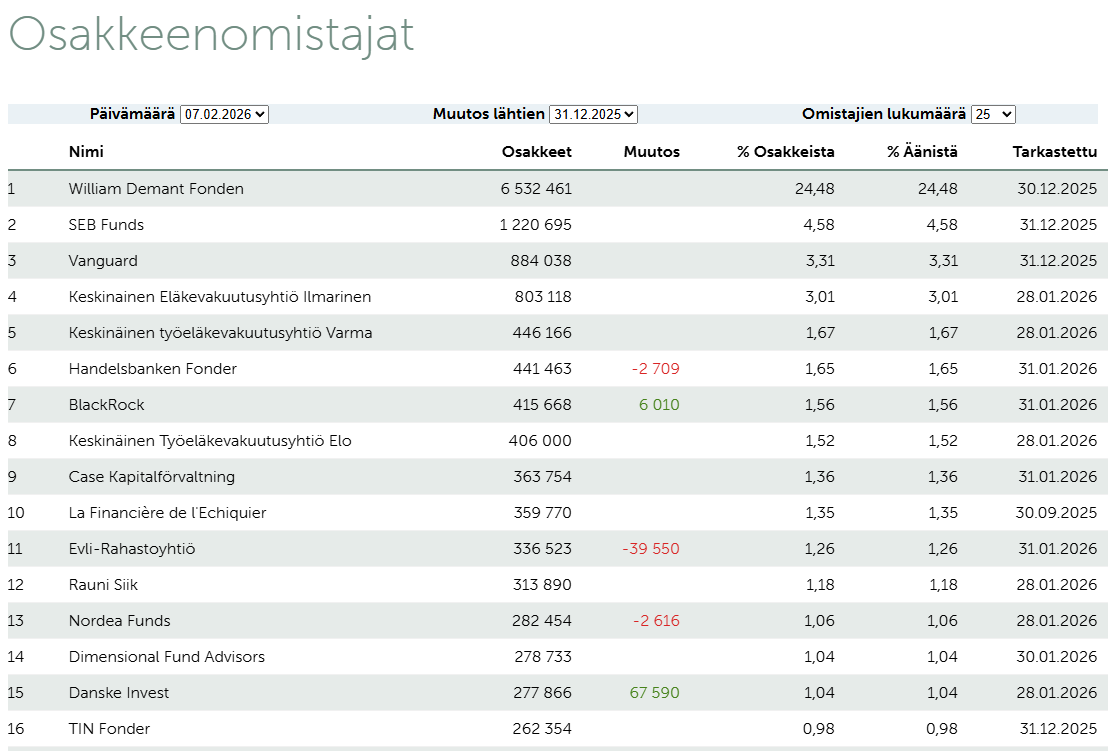
However, it’s good to keep in mind that correlation is not the same as causation. At the turn of the year, the TIN fund had not yet sold any Revenio shares. Before that, the fund had bought just over 4,400 Revenio shares. Another thing is that the fund owns “only” just over 260,000 shares. Revenio’s trading volume in recent days has been over 50,000 shares per day. Of course, if holdings have to be reduced because of redemptions, it weighs on Revenio’s price, but would the consequence be this dramatic?
What I’ve been missing during the share price drop is some kind of opinion from an analyst. There’s quite a long way to the current target price; is it still relevant, and is the view the same as before? Knowing that no significant changes have occurred in the outlook would also be helpful information for my own thoughts.
Next week it’s time for the earnings release…
31 Likes
Hi everyone!
I thought I’d remind you of the opportunity to ask questions to Revenio’s CEO. The earnings release is this coming Wednesday, and I’ll be chatting with Jouni then as usual.
Good questions are welcome – if none come in, I’ll come up with some myself 
PS. I’ll return to the pressure on the share price on Monday in connection with the earnings preview.
36 Likes
A few questions came to mind!
-How does the company measure its strategic goals in practice? The current main goals do not include numerical targets, so I assume the company has internal KPIs linked to these goals below? Can you elaborate on these?
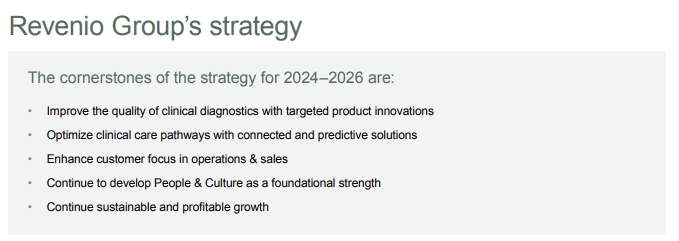
-The company has stated it focuses on creating a foundation for growth during its strategy period; now that we are moving into the final year of the strategy period, how does Jouni assess the company’s success, and what will the focus be during 2026?

-How sensitive are Revenio’s customers in the USA to uncertainty? Some of the medtech companies I follow have already reported their results, and the figures are very varied. For some, government shutdowns have made a significant dent in sales because the customers are public labs, etc. Others, on the other hand, have accelerated growth in the USA. How would Jouni assess how customer behavior changes as uncertainty increases?
-What kind of pricing models does Revenio have for its software solutions? Does the new iCare ALTIUS, for example, generate new revenue, or are these provided for the customer’s use alongside product purchases?
-Is a decline in multiples observable among potential acquisition targets?
I assume Juha will inquire about how the recovery of Private Equity-driven customers is looking, and if there are changes from the previous quarter .
Jouni referred to R&D projects in the pipeline during the Q3 interview that might increase FDA costs. Any possible additional information regarding these would be interesting.
A question for Juha: are APAC sales direct or through a partner?
23 Likes
Hi Juha,
I hope that it is ok that I write to you in English. Some suggestions for questions:
- Carl Zeiss recently flagged weakness in the US due to investment hesitancy. Do you see similar trends, or is your new strategy targeting corporate accounts, supported by your recent senior hires, helping you decouple from this sentiment? I’m particularly interested in whether you see a divergence between CAPEX investments versus your more OPEX-oriented solutions.
- Regarding the AI screening rollout in the US: Can you provide an updated timeline? Specifically, are you seeing any signs that customers are delaying hardware purchases because they are waiting for the full “screening-as-a-service” approval to be in place?
- Given the current share price and a strong balance sheet, what’s the most efficient use of capital right now considering share buybacks vs M&A?
- Regarding the macro outlook: Could you comment on your ability to mitigate potential tariffs and FX headwinds? Do you see room to pass these costs on to customers to protect your gross margins?
Keep up the good work Juha, and have a nice w/e. Thanks!
34 Likes
Greetings to the thread,
I went ahead and released the report already this Sunday, as there is no point in waiting for the Monday morning rush. At the same time, I promised to return to the assumed reasons for Revenio’s recent decline. The following is technically Premium report material, but there is no need for me to rephrase it here when I can just use copy-paste from the report.
So, below is presumably the biggest reason for the recent pressure on Revenio’s share price. This is certainly not the only reason. Whether it makes sense or not, Revenio seems to react negatively to the strengthening of the euro (EUR/USD), and at times earlier this year, it looked like it might even break the 1.2 level. Additionally, there are long-term reasons: the underlying long downtrend in its own way creates constant selling pressure, and buyers may already have bloody hands.
I personally raised the recommendation to a buy level, and I still believe in Revenio’s long-term story. Of course, this is a risk, as the Q4 report is due on Wednesday and the results/guidance could disappoint if there are broader industry challenges. But in my assessment, this is clearly a bet with a positive expected value. We won’t have to wait long to find out if I was wrong about this.
Here is a link to the report, and below is the excerpt regarding Zeiss:
Zeiss’s challenges are also a risk for Revenio
A significant player in the field, Carl Zeiss Meditec, published a nasty profit warning at the end of January, which has had a negative ripple effect on the entire industry. Zeiss’s Q1 (Oct–Dec) revenue (EUR 467 million vs. EUR 490 million) and especially profitability (EBITA EUR 8 million vs. EUR 35 million) fell sharply below the comparison period, and the company simultaneously withdrew its guidance for the entire fiscal year. Most of Zeiss’s challenges were related to China, in our understanding (significant for Zeiss but small for Revenio), and the IOL (intraocular lenses) business, which Revenio lacks entirely, but the decline in investment willingness in the United States mentioned by the company is also a direct risk factor for Revenio. Revenio’s comments on market demand development in the US will once again be one of the main points of interest.
While we consider Zeiss’s significant difficulties a potential risk for Revenio, we would not draw direct conclusions from it. The companies’ product portfolios differ clearly, and their demand has fluctuated significantly in recent years. When Revenio had its “weak period” in the US and the company had to issue a profit warning in August 2023, Zeiss reported good numbers thanks to its strong order backlog. Since then, the situation has clearly turned in Revenio’s favor, and Zeiss’s problems have deepened.
An interesting report is coming on Wednesday! Thank you already for the questions for the CEO; I will be gathering them together tomorrow.
79 Likes
Questions for the CEO interview, seemingly quite focused on tonometry:
Regarding the US, FDA approval is required for AI screening of fundus images. Apparently, approval already exists in the EU. What kind of progress has been made in the EU region; could Toijala elaborate more on the current situation?
How have sales gone for the ST500 tonometer designed for ophthalmologists? Does it seem like those ophthalmologists who have wanted to use the older measurement method have adopted the ST500? (Some ophthalmologists have previously also performed measurements with Revenio’s handheld tonometers).
Has there been any progress regarding sales of the Home tonometers? Have these been sold more to private individuals or to eye clinics (e.g., to be lent to patients when starting glaucoma treatment)?
14 Likes
Thank you for the opportunity; below are a few questions I’ve been pondering;
How large a share of Revenio’s growth currently comes from the existing installed base (software, services) compared to the sale of new devices, and is the intention for this emphasis to increase in the coming years?
The German care pathway-based model is a new initiative for Revenio. Do you see this more as a local solution or as a model that could also be utilized in other markets, and what factors determine whether the model scales more broadly?
Revenio is speaking more and more about software and AI. From an investor’s perspective, what would be the first concrete financial metric or change in the reports that would show this transition is underway?
18 Likes
I was going through the questions, so let’s answer this one. From the comprehensive report:
“iCare products typically have country-specific distributors for each target group. For human tonometers, there is typically one distributor specialized in ophthalmologists and one distributor specialized in opticians. Veterinary tonometers have their own distributors.”
As far as I understand, the aforementioned model applies to APAC countries, as the only major exception, in my view, is the United States. In the United States, iCare has built its own sales organization based on independent sales representatives, and the company does not have a distribution partner, except for VET products.
8 Likes
Optomed’s report today also highlighted the continued uncertainty in the US market for 2026.
6 Likes
There is likely some uncertainty, but at the same time, Toijala said in the last interview, for example, that they are doing well in the US. And of course, the numbers have spoken for themselves. It’s definitely something to monitor. Fortunately, Revenio is a geographically well-diversified company, meaning temporary weakness in one market area is often offset by good sales elsewhere, e.g., in Europe.
5 Likes
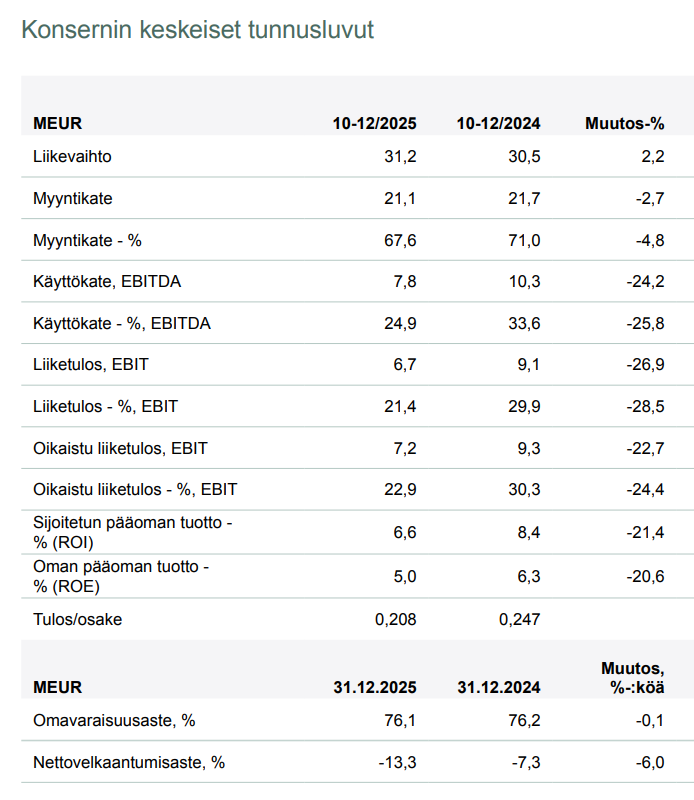
Revenue +2%, compared to +4% expected. Profitability well below expectations due to “delayed price increases”
13 Likes