Here are some light thoughts on the report and webcast. The figures pretty much matched expectations, meaning below Inderes’ expectations, but that was probably quite obvious to anyone following the data and launch closely. However, momentum picked up as player reviews praised the game’s quality, originality, atmosphere, and pretty much everything else. It is unfortunate, of course, that game critics playing on an overly “hard” difficulty and without instructions gave a lot of 8s initially, which ate away at some of the early hype. The main thing, however, is that the key target audience—the players—truly loved the game (as did I, in case that wasn’t already clear).
On the positive side, EBIT turned positive and self-publishing has now been proven viable for the first time, meaning a significant portion comes from game sales and royalties. The localization I mentioned earlier was a great move and supported success, as China (PC) and Brazil (consoles), among others, were clearly stronger (in the top three) than they would have been without full voice-acting. These countries/regions alone in all likelihood brought in a significant number of (potential) buyers as well as new fans, and localization extends the long tail of sales—vital for the entire investment case—far into the future. This also differentiated it from competitors, even if it wasn’t yet fully reflected in the numbers. These markets are discount-sensitive, so the wishlist conversion rate in these countries is likely good. Furthermore, it’s very important that up to 50% of the game’s buyers were completely new players. In practice, that increases the sales expectations and long tail for both future and past games.
Lately, I’ve been reading through comments and the latest reviews regarding Resonant again, and those who liked the game really loved it, even to the point where it became a GOTY contender for many (though GTA6 and Phantom Blade Zero might end up ahead, among others). On Metacritic, user scores have held up very well (players 8.8), and since October 15, player reviews have increased from roughly 990 to 1,340, so it’s pleasing to see that many still take the trouble to leave a positive review.
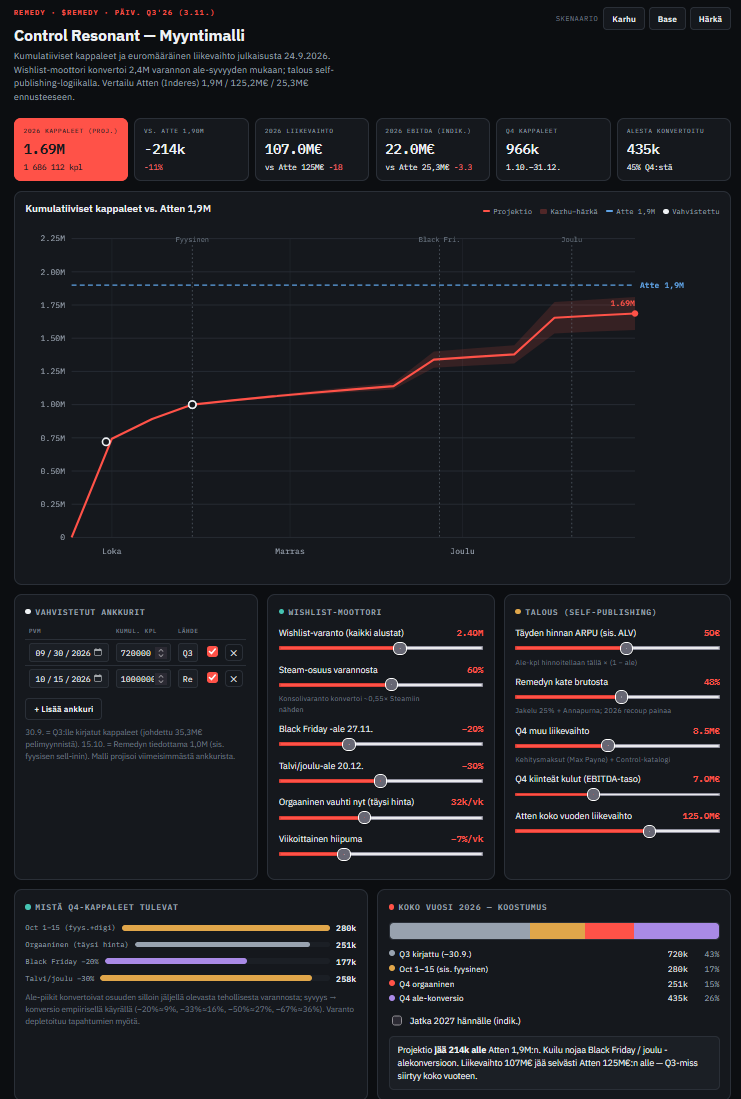
The 2.4 million wishlist figure was confirmed in the webcast, and these are entirely new “bargain hunters”—meaning those who bought the game have been deducted from this number. The long-term conversion rate is likely good, around 20–35%, once the 20–50% discounts kick in over time, i.e., during the next few years at the latest. At a 75% discount, at the latest, the game will sell in large volumes and new fans will appear. At the full €59.99 price, conversion is likely rather small, but discount campaigns alone are estimated to bring in 500k–850k+ new players via wishlists (over the entire 2.4 million wishlist lifecycle), once a discount percentage suitable for everyone’s wallet is eventually reached—plus, of course, those who haven’t wishlisted it yet.
The next major sale, such as Black Friday or probably even sooner, could convert a large number of players, making Inderes’ original target for the rest of the year feasible in principle, though quite tight. I still see the greatest potential in the long tail at discounted prices, and fuel for future campaigns was provided by, among other things, new market areas (China and LatAm), stellar player reviews, and newly acquired fans. My own estimate for the game’s sales this year is 1.65–1.80 million copies, but the long tail and the long-term wishlist conversion rate relative to discount tiers is the key thing to monitor in my books.
Below is what I consider a fairly realistic estimate from my model for Q4 Resonant sales and the full year. Inderes’ revenue expectation might be too high, but the EBITDA/profitability forecast could actually be quite close to Inderes’ expectations relative to revenue forecasts, as development costs are now behind us.