Behind SEB’s nominee register, there are, of course, several different parties who can make trades in different directions.
6 Likes
Update to that Scheels post, now Strikemaster Maven augers of various sizes, 3010 pcs in online store stock (https://www.scheels.com/p/04325312494 stock balance can be seen by setting the quantity to a number greater than the stock balance), Ion Alpha Plus Electric Gen 5 72 pcs and Eskimo E40 Composite 490 pieces. So, about 2000 more pieces have been ordered into the online store’s stock in recent days before the start of the ice fishing season. Not many other augers have been ordered; Maven is currently the 12th most popular product out of 1661 ice fishing items, when sorted by popularity, with all more popular products being heavily discounted. The Ion auger is ranked 31st out of 1661 ice products, and Eskimo is not in the top 100. Since Maven has consistently been “Back Ordered,” it also speaks well of production that, based on this, they have been able to meet demand with larger orders.
Also at Academy Sports + Outdoor, CrushCity products have sold well again in the autumn season; when the lures and baits category is sorted by best-selling, the larger sizes of CrushCity Freeloader launched this year are 1/2189 best-sellers, Mooch Minnow’s larger sizes are 2/2189 best-sellers, Freeloader’s smaller size 6/2189, Mayor 12/2189, Mooch Minnow’s smaller size 14/2189. ( Access to this page has been denied. )
Especially since Q4 of the previous season was clearly the weakest quarter, for example, according to Lars Ollberg interviewed by Inderes in his H2 2024 interview, not even exceptional performance in Q4 is necessarily needed to exceed those comparison figures. The numbers will show, but the direction seems right.
*Edit 6.11.
Now Scheels online store stock has 3625 Strikemaster Mavens of various sizes. In addition, a post appeared on Facebook from a smaller US fishing store in Wisconsin, stating that ordering new Strikemaster augers is not possible for them “this season” (screenshot below). It could just be a sales trick, but combined with the increase in dealer stock levels and the fact that the product has been “Backordered” until now, it could be quite possible. Given Rapala’s significant challenges with cash flow, a situation where everything produced sells, and there’s no need to hold own inventory, would be quite optimal.
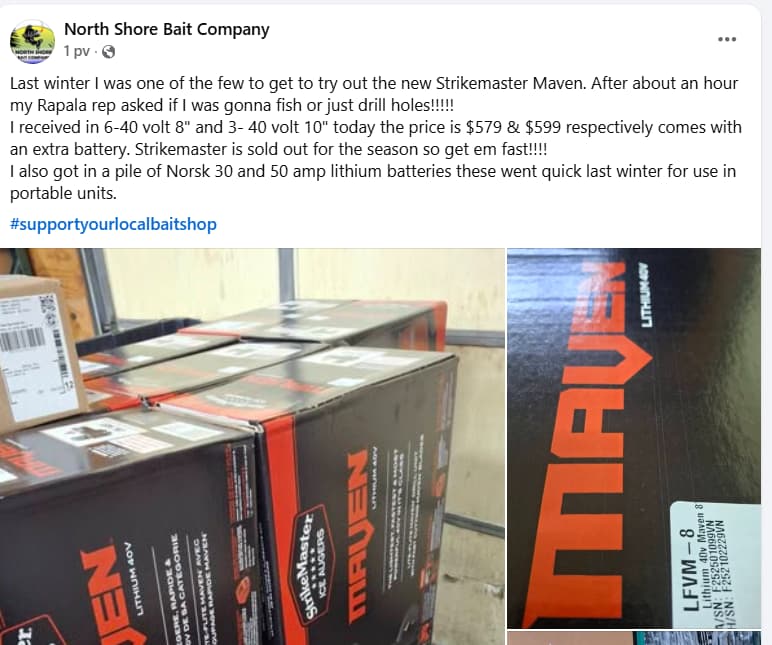
Screenshot of the post from that page:
And now, moving strongly into speculation, I’ll add that I have a lot of Rapala in my portfolio and perhaps sometimes hope to see positive things. I’ve tried to find negatives here too, but it’s been difficult. Perhaps what worries me most is that tariffs are likely to weigh on margins in H2, and since my investment case relies heavily on sales appearing to have grown more than expected, profitability, for example, could of course become a pitfall.
Another thing that cuts the upside is that no positive profit warning has been issued from the current situation “Full-year comparable operating profit is expected to grow from the previous year” to a situation “Full-year comparable operating profit is expected to grow significantly from the previous year”, as was given, for example, in April 2021. At that time, the guidance from which they started was “operating profit at the same level or higher”, so not quite the same situation, but still. Since negative surprises are always possible, and in a truly positive situation, guidance would probably have been raised, I’m starting to worry if I’m missing something.
12 Likes
Perhaps 13 Fishing has still received relatively little attention in writings. A positive aspect of this is Rapala’s direct deliveries to Bass Pro Shop.
Additionally, in ice fishing products at Bass Pro Shop, there are 27 different 13 Fishing rods/reels/combos available, of which 12 new ones have been added to the selection this autumn, so the selection has expanded well. A total of 19 different products from all brands have been added to the autumn selection, so most of the new products are from 13 Fishing.
https://www.basspro.com/l/ice-fishing-rods-and-reels-combos#f-currentoffers=New
Scheels has also added 10 new 13 Fishing ice fishing products to its selection, expanding it to 44 products.
Google Trends data for the search term “13 Fishing” also looks promising, but it’s difficult to say what their true impact on sales is. Filters: last 5 years and region: worldwide.
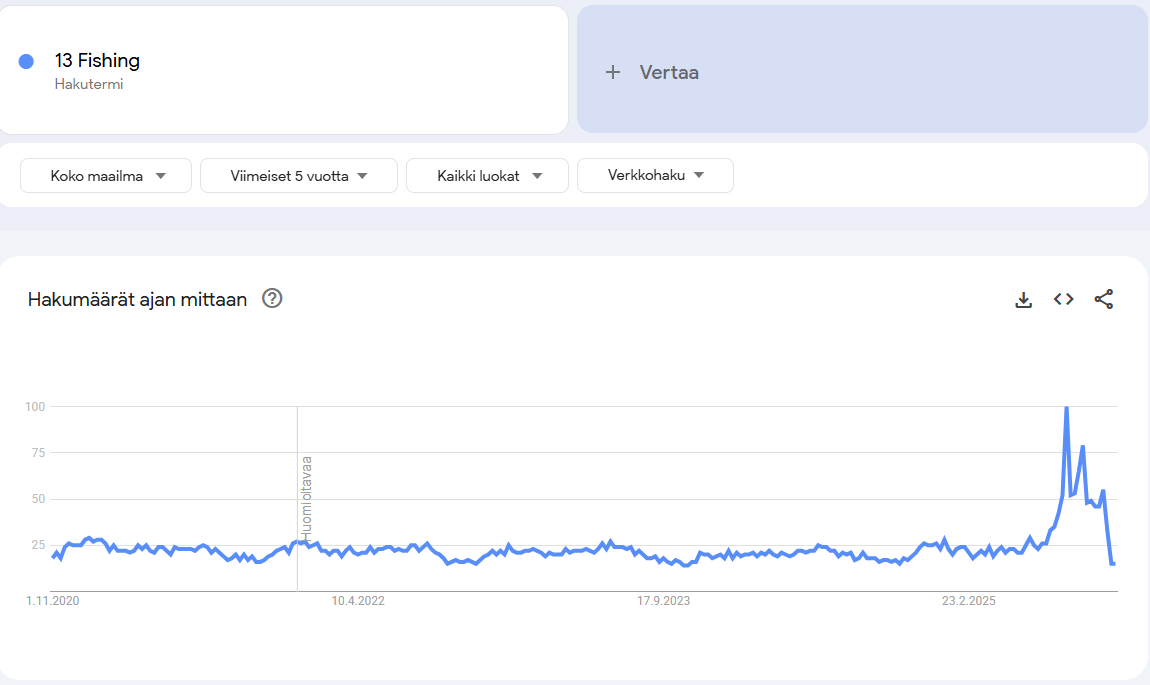
https://trends.google.com/trends/explore?date=today%205-y\u0026q=13%20Fishing\u0026hl=fi
12 Likes
What does the forum think about this? It will decrease at least a little. What about the interest rate?
8 Likes
My wish would have been that the hybrid would have decreased more. Now it’s going from 30 → 25 million euros, but likely financing costs will decrease significantly as interest rates fall at the same time.
If the company can continue to operate profitably, then logically, indebtedness will decrease, and in the future, the hybrid can be further reduced
8 Likes
I also suspect that the interest expenses of the hybrid will decrease by up to 2 million annually; a realistic estimate is likely starting from +1.5 million € in savings compared to before. The interest rate for that 30 million hybrid is 12.5%; a pure guess for the current level could be around 8-9%, and over 10% would be quite a weak performance.
4 Likes
Yes, perhaps the most relevant information is still missing, namely the interest rate of the hybrid loan, and another relevant point is the minimum liquidity covenant in the refinancing terms, which in the old financing package was at least EUR 22.5 million. So now we have to maintain an excessively large cash balance compared to what would actually be needed, and these cannot be used to reduce limits.
According to the half-year report, the group has a financing agreement of EUR 106 million; now the new financing agreement would be for EUR 91.5 million. This, to my understanding, could indicate that the liquidity requirement for cash would decrease, but I certainly cannot claim to be an expert on these matters.
4 Likes
It’s hard not to think that these hybrid loans are just a way to pump money to the main owners. Why not just a straightforward share issue, or a bond?
4 Likes
Not this time.. it was a requirement of the new loan round. When the larger loan was renegotiated, it was a contractual requirement that the hybrid loan be kept. That’s why it’s being renegotiated.. overall, I believe interest rates will decrease nicely.
1 Like
As a requirement for a larger loan. No further reductions could be made. When a 90 million loan was negotiated… more savings can be gained from that as well…
1 Like
Financing is always a whole, and it is most sensible to evaluate it as a whole. It is not meaningful to evaluate just the hybrid in isolation from other financing. And yes, a hybrid loan is generally a more affordable way of financing than equity. Now we just need to get the business rolling.
5 Likes
Here are Thomas’s comments regarding Rapala’s hybrid bond considerations. 
The refinancing of the balance sheet was expected news, as the maturity of Rapala’s current financing package is approaching. We estimate the interest rate of the new hybrid bond to be approximately 8-10%, which would mean a clear improvement compared to the current hybrid bond’s 12.5% interest rate. However, the refinancing of the balance sheet must be viewed as a whole due to the significant size of the secured term loan and credit facility, and the covenant terms related to the financing package.
Rapala harkitsee uutta hybridilainaa taseensa jälleenrahoituksen yhteydessä - Inderes
12 Likes
If this company’s management is ever interviewed, it would be interesting to hear why the company does not provide quarterly results in the usual way. So, if one wanted to improve the company’s image as a listed company, this would be one simple way to build trust with investors. It is an interesting company, nonetheless.
3 Likes
Tax sales ahead for Rapala? How low will the share price fall, or will it fall at all? Trading volume is so low that selling larger blocks will inevitably lead to a price drop. The January effect will then bring smiles.
1 Like
Iikka and Thomas discussed Rapala.
Topics:
00:00 Introduction
00:16 Shareholders have been left with a picked-over bone
02:12 Development over the millennium
06:37 Extensive product portfolio
07:48 H1 development was encouraging
10:14 Consumer product companies have had a difficult Q3
11:16 Recommendation is reduce
11 Likes
A letter from Nordea popped up about Rapala’s hybrid, with an indicated yield expectation of 9.75 – 10%. Interested in this, I spent 1 hour on company analysis, as I haven’t followed the company.
Towards the end, after feeding, among other things, Inderes’ comprehensive report to the AI (chatgpt 5.1), I received a somewhat alarming conclusion after asking: “elaborate further on the company’s current interest expenses, debt maturity, and the sufficiency of cash flows to service debts, assuming cash flow remains at the same level as in the last 2-year period.” I won’t include the full answer here, but below is the overall conclusion:
-
Cash flow does not cover interest → a fundamental problem.
This is the most critical observation for a hybrid investor. -
Debt maturity in 2026 is a significant risk point.
Refinancing is entirely dependent on market conditions and banks’ willingness to take risks. -
Bankruptcy risk is not acute in 2025, but clearly rises in 2026–2027.
-
The hybrid pays 10% interest because it is justifiably risky.
-
Call NC3 2028 is likely only if earnings and cash flow improve significantly.
Is the AI making things up?
According to its analysis, financial expenses are around 10M€ and free cash flow for 2023-2024 is only approx. 6-7.5M€. Cash is only sufficient because working capital has been reduced (inventory → cash), investments have been very low, and banks have allowed the use of limits.
I didn’t go into checking the numbers now; in any case, I made a decision to reject it, I’m not participating in the loan.
11 Likes
9% hybrid with interest, quite clearly lower than initial expectations, demand was strong.
17 Likes
“Our estimate is that the interest rate of the new hybrid loan is about 8-10%.” I don’t know the consensus expectations, but it went pretty much exactly to Inderes’ expectations.
10 Likes
As announced on November 14, 2025, Rapala VMC’s largest shareholder, Viellard Migeon Et Compagnie Sa, had committed to participate in the Hybrid Bond issue by transferring its current holding of EUR 7.2 million to the Hybrid Bond issue. Due to the strong interest from existing and new investors and significant oversubscription, Viellard Migeon Et Compagnie Sa participated in the issue by subscribing to Hybrid Bonds in the amount of EUR 3.1 million.
“The broad support from investors for our refinancing on improved terms is a testament to the positive development of our results and reinforces the relevance of our strategy. We are very grateful to everyone who has shown continuous trust or has now placed their trust in Rapala VMC,” says Cyrille Viellard, CEO of Rapala VMC.
A pleasantly positive statement.
14 Likes
One way to look at the realized vs. expectations is to see how much Inderes’s financing costs decrease in their latest July analysis report for 2026 vs. 2025. For 2025, financing costs in the report are 8.9 Meur, and for 2026, 8.3 Meur, meaning a saving of 600 teur in those expectations.
Now, as the hybrid amount and interest decrease, the annual saving is 1.5 Meur, which clearly exceeds the analysis. Additionally, if covenant terms can be eased, other debt burdens might also decrease, and thus interest expenses could further diminish. It is good to note, however, that in the analysis, interest expenses for 2027 are “only” 6.9 Meur, meaning the saving is, as it were, achieved a year in advance and does not compound for subsequent years.
The target price in the analysis is 1.4 and the share price is 1.235, so the market is not painting a rosier picture than this analysis, at least not currently. Of course, there may be other reasons for this difference than just financing costs, but when compared to this, it could turn out to be a positive surprise.
9 Likes