Raw Materials & Natural Resources - The Economy's Primary Sector

The price of oil has dipped a bit as an OPEC meeting is coming up and an announcement will be made about how much the taps will open for August when there is demand.

https://finance.yahoo.com/news/oil-holds-below-73-demand-001823957.html

While the crude market has tightened, the latest flare-up could play a part when OPEC+ gathers Thursday to decide on output levels in August.

Monday’s oil price drop, “if it continues for a few more days, could make the OPEC+ producer group extra cautious,” said Tamas Varga, an analyst at PVM Oil Associates. “The global economy and oil demand are recovering, oil supply is being effectively managed, therefore dips are probably viewed by ardent bulls as attractive buying opportunities.”

https://finance.yahoo.com/news/opec-expected-move-cool-overheating-051819445.html

The OPEC+ group of oil-producing countries will meet on Thursday and are expected to agree to boost production in August in order to meet demand and dampen recent price rises.

The 13 members of OPEC and their 10 allies in the OPEC+ grouping were rewarded by seeing prices for the two contracts of reference, Brent and WTI, recover to around $75 per barrel, levels not seen since October 2018.

However that strategy has worked almost too well and the group is currently following a policy of cautiously turning the taps back on.

Here are a few links at least under the meeting. We will be wiser about this again over the weekend.

Edit: I guess the Corona Delta virus is also a bit worrying about how quickly society will normalize and thus oil demand.

4 Likes

https://finance.yahoo.com/news/opec-seeks-way-standoff-blocking-091144043.html

OPEC+ allies were locked in a tense diplomatic standoff on Friday amid a dispute that threatens to send oil prices sharply higher.

A day after the alliance was forced to delay its key policy meeting, positions remained entrenched, with the United Arab Emirates still blocking a deal to increase supply, a delegate said. Failure to agree on raising output would squeeze an already tight market, risking a further inflationary price spike.

Most members of an OPEC+ advisory panel backed a proposal to add 400,000 barrels a day from August to December – and extend the broader supply deal later into next year – as OPEC+’s full ministerial meeting finally got under way, though the UAE remained staunchly opposed, according to delegates.

“If OPEC+ fails to reach a compromise, the automatic fallback will be to roll over current quotas into August and beyond,” said Matthew Holland, a geopolitical analyst at consultant Energy Aspects Ltd. “That would lead to sharply higher prices, something most OPEC+ members want to avoid.”

EDIT:
https://finance.yahoo.com/news/oil-markets-dip-opec-discord-190000877.html

Friday, July 2nd, 2021

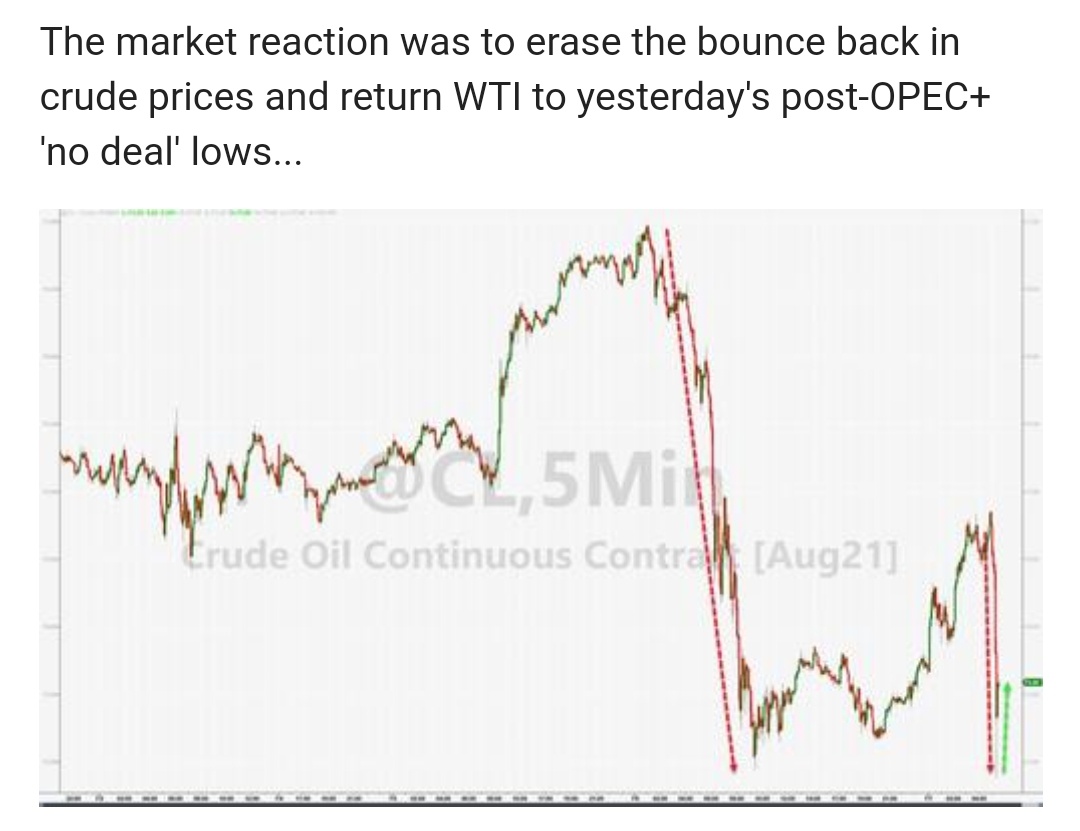
The OPEC+ meeting resulted in some unexpected 11th-hour drama, delaying a decision that was expected on Thursday. Oil prices slipped on the news.

But the outcome could still be a bullish one. The size of the proposed production increase was lower than most analysts had expected, coming in at an average monthly addition of 400,000 bpd, whereas expectations had been for 500,000 bpd. But there is also a possibility that OPEC+ might not add any barrels to production. The group meets again on Friday.

4 Likes

In a normal year, Russia in particular would be opening the taps wide in a situation like this. However, the loss incurred last year has apparently brought a modicum of wisdom to the table, and last year’s losses now really need to be offset with proper profits.

100 dollars is already approaching. As an oil investor, I naturally hope this happens. It would also be good leverage for the Finnish parliamentary elections if a liter of gas cost 2 euros/liter.

1 Like

This also highlights the reason why oil might not be able to stay at such a high level for long, because a €2/liter price would start to slow down the economy, not to mention the indirect effects on other prices. Of course, a large part of that is tax, but even in the US, a price of about one euro per liter would start to be felt in wallets, as cars there tend to consume almost twice as much as they do here.

Right now, by the way, it’s a very interesting situation, as the rise in most other raw materials has stalled recently, but oil has continued to rise. Does anyone remember a similar situation in history?

I myself have gotten burned the worst in history with oil, so I’m being very careful with this one. I halved my oil investments a couple of weeks ago… These raw materials tend to be very difficult, rewarding, and punishing :smiley:

1 Like

It won’t stay up there for long. At $100 prices, everyone capable will start pushing and producing as much as they can.

However, the pandemic might have been a blessing for oil prices, as production requires continuous investment, and those investments were on hold for a year. So, that production can’t just be increased by turning a tap.

As an oil investor, I hope the price increase is steadily sure, but slow. If the price were to rise to $100 in a month, the crash would come sooner.

Even at these prices, oil companies are swimming in money, and large mountains of debt can be nicely melted away.

3 Likes

The United Arab Emirates has approved OPEC’s proposal to increase oil production by 400k barrels per day per month until the end of the year (+2 million). The consensus expected 500k barrels (+2.5 million), so this is very positive news for oil prices from the production side.

At the same time, demand remains very strong:

11 Likes

The plot thickens! The Saudis decided to outdo the UAE by sticking to their demands that the current deal be extended until the end of 2022 without additional production quotas, and even imposed additional tariffs on products passing through them. Just when an agreement seemed to have been reached, the whole thing went awry.

https://www.reuters.com/world/middle-east/saudi-arabia-amends-import-rules-gulf-challenge-uae-2021-07-05/

https://www.investing.com/news/commodities-news/opec-abandons-oil-policy-meeting-after-saudiuae-clash-2549755

The failure of the talks means an expected increase in output from August will not take place, the sources said, helping to drive up international benchmark Brent oil, which was trading 1% higher at $76.95 a barrel.

OPEC still has this month to find an agreement, or they won’t be able to add extra production to the market in August. Without additional production, it is possible that oil prices will skyrocket, as demand currently exceeds supply and inventories are dwindling week by week.

2 Likes

"The dispute reflects a growing divergence between Saudi Arabia and the UAE.

The two nations had built a regional alliance, combining financial and military muscle to fight a conflict in Yemen and project power elsewhere. But the UAE has withdrawn from action in Yemen, while Saudi Arabia has sought to challenge the UAE’s dominance as the region’s business and tourism hub.

The UAE in August 2020 also agreed to normalise relations with Israel, while Saudi Arabia has no official diplomatic relations with Israel."

This is probably the most essential point: these are not easy negotiations​:roll_eyes:. My own attitude towards the matter is a bit difficult. On the one hand, oil prices boost my portfolio quite nicely, but it’s not very pleasant when the Middle East is what it is, and on the other hand, inflation is also putting pressure. Well, it is what it is, it’s nice to follow this plot when I don’t really feel like fretting about my portfolio’s performance in the summer, but politics is always interesting.

2 Likes

A collection of estimates from different analytical houses regarding the situation: Ihre Datenschutzeinstellungen

A quick summary translation, so apologies for any typos:

UBS:
Negotiations are stalling, and the barrel price might rise to +$80 by September. Saudi Aramco (the world’s largest oil company) will announce August prices in the coming days, which should provide some indication.

ING:
A price war is possible but unlikely, as all parties are trying to avoid it. They consider the most probable solution to be an increase of +2 million (400k barrels) by the end of the year, with an agreement on further steps later.

Citi:
$80 will be broken faster than expected, which would hinder the economic recovery from COVID-19, especially in developing countries. There will be immense pressure from major countries to open the pipelines. Believes US production will rebound.

FGE:
If nothing is achieved, $85-90 is ahead. However, some kind of amicable solution is likely within 1-3 weeks, though prices are likely to rise until then. Does not believe the UAE will leave OPEC, as long as they get a little independent maneuvering room instead of strict common rules. Also believes US shale oil will increase next year.

RBC Capital:
Some speculation and skepticism about the UAE’s dedication to OPEC rules. In addition to oil, political issues and taking on a role in the Middle East are also on the scales.

Rystad Energy:
All OPEC countries themselves want to get a deal done, which could indicate a willingness to please the UAE. Over 500k barrels in August → would lead to price correction. Now they are trying to listen for clues from behind closed doors, which will lead to a rally either up or down.

5 Likes

Alright, so the socialist leftist Castillo is rising to power in Peru. During the campaign, there was talk of a 70% mining tax, if not outright nationalization, but now that the dust has settled, a more moderate line has been found. It’s unclear to me what this latest targeted “package” is, but in the words of Castillo’s aide, Pedro: “Pedro Francke, Castillo’s economic adviser, said he expected firms would not oppose a planned review of tax rules after dozens of meetings with businesses.”

The political novice and former teacher has rattled Peru’s elite with plans to redraft the constitution and sharply hike taxes on miners he once said had “plundered” the country’s wealth.

But as he has approached power Castillo has moderated his rhetoric, and Francke has also sought to calm market concerns. He told Reuters he had held dozens of virtual meetings in recent weeks with domestic and foreign investors and some business leaders from the mining sector.

Peru is the world’s #2 copper producer.

6 Likes

A short article about the significance of U.S. shale oil, then and now.

1 Like

Well, the plot thickens again:

“ We want a bigger market share, to monetize as much as we can from our reserves, especially when we have spent billions developing them.”

That is the not-so-subtle quote the WSJ reports from a senior UAE oil executive, confirming the widening split between the Saudis (OPEC) and its long-time ally.

Now we’re wondering if this is a tactic by the UAE and a leaked “rumor” to speed up negotiations, or if they’re really going to open their taps and give the Saudis the finger. I’m already starting to expect a comment from Biden, especially since gasoline is getting expensive even in the US. I read Obama’s book and have a hunch that some public pressure might have been applied from that direction during his term, especially when considering the massive post-pandemic exit that’s being sought.

Has @Pohjolan_Eka calculated any oil price scenarios for different chains of events? I’m mainly pondering what’s a good and what’s a bad thing, like 400k vs 500k, but my own knowledge isn’t enough to assess the impact of different scenarios more precisely, even on next winter’s barrel prices, without guidance from an analyst.

Edit: Let’s link some Tuesday speculations here, as it ties in so nicely if the UAE goes its own way and OPEC fails to create something that producers commit to:
Oil prices could “very easily” hit $100 a barrel in the aftermath of the failed OPEC+ talks, former U.S. Energy Secretary Dan Brouillette told CNBC on Tuesday.

“You could very easily see oil hitting $100 a barrel — potentially even higher,” he told CNBC’s Hadley Gamble.

On the flip side, it’s “equally possible” that prices could collapse too.

“If there isn’t any agreement on production, and countries tend to go off and do their own thing, or do their own production, you could have a collapse of oil prices,” said Brouillette, who was U.S. energy secretary from 2019 to 2021.

(Here’s a link to the quotes from the last paragraph: https://www.cnbc.com/amp/2021/07/06/oil-prices-could-top-100-former-us-energy-secretary-on-failed-opec-talks.html)

5 Likes

I, for one, find it highly unlikely that the UAE would want to start an oil war to crash oil prices. They are, after all, still economically dependent on high oil prices:

https://www.statista.com/statistics/1106015/uae-breakeven-oil-price-by-account/

It’s a bit insane to start calculating an exact price, and oil is very sensitive to various events and news, but I can certainly share my gut feeling Brent target prices for different scenarios :smiley: Take it with a grain of salt, etc.

No deal, OPEC collapses: Oil price plunges to $40
No deal, production not increased: Oil price exceeds $100 by year-end.
No deal, producing countries do not adhere to quotas: Oil price ???
Deal +400k barrels per day every month: Oil price exceeds $80 by year-end
Deal +500k barrels per day every month: Oil price moves in the $75-80 range

11 Likes

As a recap, here are a couple of good Rick Rule videos that are worth watching if you plan to speculate on junior mining companies :slight_smile:

4 Likes

I don’t know if oil people read these otherwise, but I’ll put some information here for the busier ones to pass the time.

https://finance.yahoo.com/news/oil-extends-gains-investors-betting-224520271.html

Oil dipped as traders grappled with the demand implications of a Covid-19 resurgence in several regions and slowing economic growth in China.

“As the Covid-19 variant continues to hit Asia hard, which is really the key swing demand center, that’s a big, big negative for the complex,” said John Kilduff, a partner at Again Capital LLC.

So, what I wrote earlier about tankers in relation to the course speculation, indeed, the corona situation has not gone entirely as in the best-case scenarios for the summer. In the US, there’s also quite a bit of ideological anti-vaccination sentiment in certain areas, even though vaccines are readily available.

Here’s some info from the article for the week:

The OPEC+ alliance abandoned meetings last week after a dispute between members over production cuts, and one week later, no deal is in sight.

“That’s certainly a big uncertainty that the market is facing,” said Fitzmaurice. “We’ve seen volatility increase as a result.”

The International Energy Agency will provide investors with a snapshot of the market on Tuesday with the release of its monthly report, while OPEC will release its own monthly report on Thursday.

So, IEA will release some report tomorrow and OPEC on Thursday.

https://finance.yahoo.com/news/oil-prices-loom-over-biden-060000562.html

This is interesting even for political nerds. What could be a more suitable subject for a dispute between Democrats and Republicans than good old oil? Indeed, Biden and the Democrats are walking a tightrope in implementing strict climate policies from their election platforms while selling it to the public, who are struggling in the aftermath of corona and horrified by rising prices at local stations. Environmental organizations demanded a complete ban on new drilling permits, but Biden’s new proposal is likely something along the lines of “limited and with higher royalties for potential clean-ups.” According to the news, the White House draft is indeed ready and set for release.

But the efforts would still fall short of the permanent leasing ban that dozens of environmental groups have said is necessary to address the climate crisis, according to two of the people familiar with the administration’s approach.

“We’re out of time for tinkering around the edges to address the problem of a climate crisis,” said Randi Spivak, public lands program director for the Center for Biological Diversity. “The science is so clear that there is no room in the carbon budget for any new investment in new fields, so the idea that we will give taxpayers their fair share is just anathema to the climate emergency we face.”

An Interior spokeswoman declined to comment on the matter. But Haaland was direct with lawmakers last month on the topic: “I don’t think there is a plan right now for a permanent ban.”

Some coastal areas (and “sensitive areas,” whatever that means - near national parks?), may be completely restricted, and a working group will be established to study environmental impacts. Leasing is currently on hold, and oil lobbyists are probably all in Washington. The Gulf of Mexico is a separate issue. The younger generation may not remember, but Biden was indeed Obama’s vice president when BP’s Deepwater Horizon(?) had a massive accident during Obama’s first term. Although the man is old, I’m quite sure the matter has not been forgotten.

The tightrope walk underscores how the Biden administration faces political risks in any moves to quash leasing on federal territory in New Mexico, the Gulf of Mexico and other regions that collectively supply roughly a quarter of the nation’s crude production – especially as oil and gasoline prices rise.

Indeed, a barrel of crude has risen from a crisp $50 to a crisp $70 during Biden’s term. To this must be added the expiring stimulus packages, so the public may be somewhat annoyed by the rising price of gasoline. The Biden administration has tried to put some pressure on OPEC, but you can only imagine what happens when voters leave their homes after quarantines and the price of gas is what it is. Republicans don’t need much of another hobby horse. The article also features the argumentation of a few Republican senators about the predicament into which the Democrats’ and Biden’s “ideology” is driving the nation.

Athan Manuel, director of the Sierra Club’s Lands Protection Program, however, is optimistic about the public:
“Traditionally gas prices have been the big X factor,” but the public seems to care about it less in comparison to the consequences of climate change they are experiencing now, Manuel said. “If they do make decisions under that frame of climate, we think they’re going to get to a drilling ban – maybe not in this report but eventually.”

15 Likes

https://mobile.twitter.com/JavierBlas

Someone asked earlier where to follow commodity news, and Javier has had a lot to say about oil recently, so it’s worth following him.

5 Likes

Let’s continue to be bullish on oil when we get some bullish news!

However, OPEC+ seems to have locked in the current production level for August. So, oil production will not be increased! The greatest oil autumn of all time is coming?

https://www.bloomberg.com/news/articles/2021-07-12/opec-locks-in-tight-supply-for-august-with-stalemate-unresolved

At the same time, the oil bears’ favorite bogeyman, Iran, looks less and less likely week by week:

https://www.bloomberg.com/news/articles/2021-07-09/u-s-frets-that-time-is-running-out-to-revive-iran-nuclear-deal?sref=lGIy6Jfd

The IEA warns of a tight oil market. Although such a warning is completely useless, as nothing can be done about it anymore! :cowboy_hat_face:

The group’s impasse threatens to inflict a “deepening supply deficit,” with “the potential for high fuel prices to stoke inflation and damage a fragile economic recovery,” the IEA said in its monthly report. Brent crude is trading close to a two-year high above $75 a barrel.

https://www.bloomberg.com/news/articles/2021-07-13/iea-warns-of-much-tighter-oil-market-unless-opec-boosts-supply

6 Likes

Relatives visiting, and I have to entertain them, so I don’t even have time to glance at anything but the headline, but those in a hurry can read up on the fact that OPEC has just reached some sort of agreement.

https://www.investors.com/news/oil-prices-opec-meeting-production-quotas-july-2021/

4 Likes

I’m copying the main points here:

The UAE will now have a new production quota baseline of 3.65 million barrels per day, up from its current quota of 3.17 million bpd, an OPEC+ delegate told Bloomberg. That resolves the main obstacle to the oil group boosting oil production for the rest of this and extending a broader deal to limit growth through 2022.

The agreement still needs approval from the rest of OPEC+. The delegate said a full ministerial meeting will be planned soon.

So, an agreement to increase oil production to 3.65 million barrels per day. Someone more knowledgeable can say whether this was the expected increase or if it was larger/smaller.

2 Likes

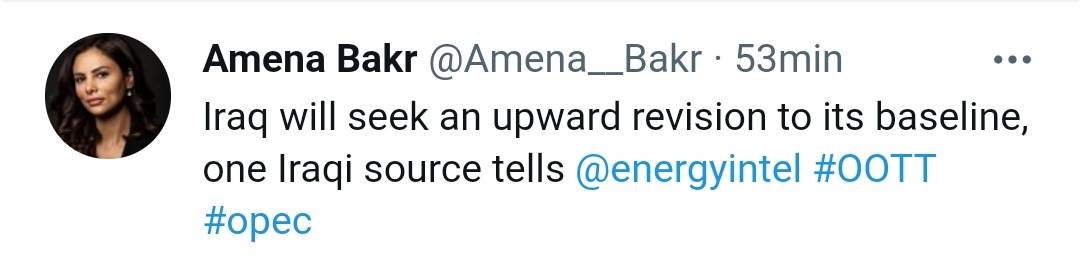
I guess the question now is whether other countries will start raising their baseline levels following the UAE.

2 Likes