Semiconductor giants: AMD, Intel, NVIDIA, TSMC, TI, Micron, Broadcom, Qualcomm, ASML etc.

ASML is definitely a quality company and has deep moats. I have been looking into it myself lately, but I haven’t placed a buy order yet.

Here is one article about ASML:

https://www.hcp.fi/blog-posts/maailman-tarkein-yritys-jota-et-tunne¨

It seems that preview doesn’t work, so here are a few highlights:

ASML:

  • specializes in developing and manufacturing advanced photomask and lithography equipment solutions for the semiconductor industry
  • its mission is to develop and deliver lithography machines that enable the production of even smaller and more efficient semiconductor components
  • ASML’s innovations are essential in the manufacturing of modern electronic devices, such as computers and smartphones
  • Chips are needed in electric cars, wind turbines, mobile phones, etc., where the aim is to reduce wasted energy. The smaller the chip, the more energy-efficient it is.
  • The need for electronics is growing due to the energy transition, electrification of transport, AI, etc. → the demand for semiconductors is increasing.
  • The explosive demand for AI has significantly increased the demand for graphics processing units (GPUs), while creating a positive impact on ASML
  • Strong pricing power helps keep the company profitable, allowing it to allocate greater resources to research and development (R&D), which keeps it technologically ahead of its competitors.
  • Pricing power also binds ASML’s partners into even closer cooperation agreements, which are financially beneficial for both parties
  • ASML currently has over 90 percent market share in the EUV lithography market, and a single machine costs up to 100-300 million dollars.
  • ASML also dominates the market for older lithography technology, DUV (Deep Ultraviolet lithography), with approximately 70 percent market share
  • in addition to equipment sales, ASML offers maintenance and upgrade options for its systems, which brings the company stable cash flow regardless of economic cycles and currently accounts for just over a quarter of the company’s net sales
  • A lead of several years over competitors, though the situation can of course change
  • Regulatory and geopolitical risks are worth noting, but conversely, it may benefit from deglobalization and the shifting of production around the world
12 Likes

Having followed this thread for a long time and being an engineer working in lithography, I recommend those interested to also broaden their horizons beyond lithography when it comes to semiconductor equipment manufacturers. ASML’s stepper is part of the massive semiconductor industry and is an important and undeniably superior piece of equipment. However, it must be remembered that ASML’s stepper is just one tool among many. A photosensitive resist film still needs to be applied to the wafer surface in some way before exposure in the stepper, and this does not happen in an ASML stepper. If the uniformity of the resist film varies too much across the wafer, it won’t matter how fancy an ASML stepper you have. Variations in film thickness directly affect linewidth, or CD (critical dimension).

After lithography, the next process step is typically plasma etching, and this stage is not performed by an ASML stepper; without these precise plasma etchers, not a single 4nm node chip would be produced. Metal films grown on the silicon wafer surface in an ultra-high vacuum also occur outside of lithography.

Yield inspections, which check the wafer yield—how many good chips are found on a wafer—are usually performed using equipment manufactured by KLA.

The semiconductor industry thus consists of several sectors with their own experts, companies, and subcontractors. While ASML has a tremendous moat, so do other semiconductor equipment companies, and that’s why it’s worth digging a bit deeper into the field.

34 Likes

Is it the same or different companies that supply the equipment for manufacturing power electronics semiconductors? Meaning thyristors, RF power transistors, and the like.

Since the news coverage has been heavily focused on microchips and related products and services, I’m wondering if there might be some hidden gems in these less-reported corners.

For simpler components such as capacitors etc., ASML’s high-tech equipment is not required; instead, KLA etchers (formerly SPTS) or TEL (=Tokyo Electron), and Canon/Nikon steppers can be used.

3 Likes

What could those other high-moat semiconductor companies be? Maybe Applied Materials? BE Semiconductor? Disco? LAM Research? Taiwan Semiconductor?

3 Likes

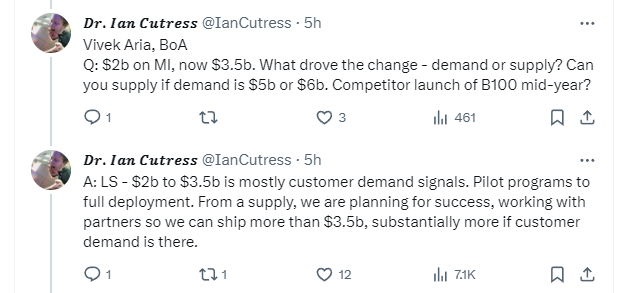
AMD’s conference call Q&A section as a Twitter thread:

https://twitter.com/IanCutress/status/1752475077453443077

Long thread, so it’s a bit difficult to copy here.

TLDR: Seems the market got a bit ahead of itself with its expectations. AMD continues in its usual style like a train, delivering what it promised (with a slight beat) and providing conservative guidance. Full-year guidance wasn’t provided, which is naturally a disappointment for some, but the AI business is growing rapidly and they left room for even significant growth if demand suffices, meaning it won’t be held back by production capacity.

image

In the short term, the stock will probably dip some because analysts’ spreadsheets already had such AI hockey sticks that it would make the faint of heart shudder, and guidance is only for “strong growth” in this regard, which isn’t enough for the market. Compared to Intel, the advantage is that they at least have AI hardware to sell, but otherwise, expectations are that the next quarter will be a bit “meh” for processors. It’s uncertain whether the market cares about such things when everyone is chasing the AI hype train.

Semi-custom took a major dip, which suggests that for consoles, supply has met demand and there is plenty of stock on the shelves, so manufacturers are likely cutting their orders from a “give us everything you’ve got” situation to a more normal pace. This segment can also be bouncy from quarter to quarter. For example, if the rumored PS5 Pro appears, its ramp-up could be seen as a spike in the Semi-custom segment again — and the quarters before it as weaker ones, as Sony might unexpectedly ramp down production of the base model if a new model is coming soon.

16 Likes

Strange, After Hours shaved quite a bit off AMD’s share price (about -6%), but now analysts are hiking their price targets in a completely different direction in the wake of the earnings report:

Advanced Micro Devices Inc : Bernstein raises target price to $140 from $120
Advanced Micro Devices Inc : Jefferies raises target price to $200 from $130
Advanced Micro Devices Inc : JP Morgan raises target price to $180 from $115
Advanced Micro Devices Inc : Piper Sandler raises target price to $195 from $165
Advanced Micro Devices Inc : Wells Fargo raises target price to $190 from $165

It remains to be seen what the market reaction will be today once the US market opens.

12 Likes

Exactly the same thing happened with the previous NVDA earnings release. In after-hours, I believe it dropped as much as five percent at worst – while analysts raised their targets with 100% consensus.

From Nvidia’s perspective, the AMD report certainly promises sweet times ahead. GPU sales were the absolute highlight of the report. At this point, it’s almost certain that this implies super-strong growth in the GPU market, where even the crumbs falling to AMD are massive. I give a 0% probability to the scenario where AMD’s GPU growth would stem from gaining market share.

Another positive signal is that margins haven’t weakened in the data center segment. So AMD is apparently not entering a price war against the man in the leather jacket. It’s starting to look to me like Nvidia’s earnings are going to be staggeringly good.

Does anyone else see the signals for Nvidia through different lenses?

6 Likes

I personally also predict a strong result, but a neutral share price reaction like last time. We have risen nicely from that $500 wall, and the market will probably not be satisfied with anything on report day. On the other hand, the compression of multiples is welcome, as is the rise in the meantime.

2 Likes

AMD Partners with Raytheon

8 Likes

Raspberry Pi CEO Eben Upton told Bloomberg at the end of January that Raspberry Pi is planning an IPO once the IPO market reopens. More on the topic in Jeff Geerling’s article:

Raspberry Pi IPO: Selling out? | Jeff Geerling

An exciting step from a Raspberry Pi enthusiast’s perspective. Hopefully, this will lead to an increase in Raspberry Pi volumes in the long run and, consequently, a decrease in hardware prices. :slight_smile:

6 Likes

This is quite an interesting thought or concern.

If I understood correctly, algorithms could become “lighter,” which would in turn overhaul current Capex forecasts that NVIDIA’s rocket-like growth specifically relies on.

Cf. the acceleration of internet connections during the tech bubble, which made large additional investments unnecessary (while investors and analysts were forecasting them far into the future).

https://x.com/gavinsbaker/status/1752353697441386496?s=46&t=2ioRmPR9E06CY7pIWMMRqA

This could have also been linked in the NVIDIA thread; maybe I’ll quote my message there tomorrow when I’m at work. :joy: Unless someone else posts it there or dismisses this concern.
Addition: considering how much money has to be (in NVIDIA’s case, “gets to be”) invested in computing power, you would think there is at least plenty of motivation for optimization.

8 Likes

In order to algorithmically reduce computational requirements, a complete shift in the algorithmic paradigm is indeed required. For example, the SSM mentioned by the Twitter user above still relies on deep learning, for which generating results (not to mention the training phase) requires a staggering amount of computing power.

Anyone who has ever dabbled with neural networks knows how quickly a CPU becomes unusable. In practice, even basic tasks like classifying 200x200 grayscale bitmap images with a CNN network—which is used as a component in those SSMs, for instance—already requires a machine with a GPU if the network and/or data volume is even slightly larger. There are simply just that many calculations being performed. The same goes for feed-forward networks if there are even a few more hidden layers.

For example, in deep learning courses at universities, after the first basic exercises, students are almost always funneled into using CSC’s supercomputers so that simple exercises can be run through in a decent amount of time at all. Computational capacity is a must—otherwise, even fairly simple tasks won’t amount to anything.

Thus, a change in the algorithmic paradigm is needed for the entire field—not just for transformers, which operate within the limits of the Chinchilla Scaling Laws. Of course, the way it works is that if an algorithmic breakthrough is made in any deep learning domain, it will likely be replicated elsewhere, such as in LLMs, quite quickly and with a high probability.

I’m not saying that algorithmics couldn’t be revolutionized, but at least for now, as far as I know, there is no model architecture under the surface that would challenge the deep learning paradigm. A completely separate issue is that tens or hundreds of thousands of data scientists would still need to be retrained away from the current paradigm. If you think about paradigm shifts elsewhere in technology, they have tended to be rather slow transitions toward new, more efficient ways of doing things rather than “overnight elimination” type changes (especially when it comes to human expertise).

From Nvidia’s perspective, I see a much more central paradigm challenge in the potential shift of the GPU paradigm toward a processing paradigm that is more logical for linear algebra and other computational optimizations that benefit from parallelism (DPU / TPU or something entirely new). After all, GPUs are by no means optimal for the purpose for which they are used in AI computation.

19 Likes

Here is an excellent recent (2023) MIT lecture series focused on improving ML efficiency. Highly recommended if you are interested in the topic.

https://youtube.com/playlist?list=PL80kAHvQbh-pT4lCkDT53zT8DKmhE0idB

Edit: efficiency = watts/inference. So it includes topics such as sparsity/pruning, quantization, neural architecture search, distillation, LoRA, …

6 Likes

Thanks! The topic is really interesting – I’ll have to study the whole lecture series. Based on a quick look through the intro lecture, it seems the focus isn’t exactly on “improving efficiency” but rather on cost-benefit optimization.

In ML models, as in other areas of life, the concepts of marginal benefit and marginal cost are strongly present, and in many use cases (especially with Nvidia’s pricing :slight_smile:), one can quickly reach a point where the marginal cost exceeds the marginal benefits gained from output accuracy.

From a semiconductor investor’s perspective, the reassuring message from the first lecture is that larger models, which require a lot of computation, lead to better results. The same can be observed, for example, with LLMs on various Leaderboards, where the correlation between ELO ranking and the number of parameters is around 0.7–0.8, depending on which parameter count rumors one trusts regarding non-open models (LMArena Leaderboard - a Hugging Face Space by lmarena-ai). Another reassuring message is that even smaller and pruned models require a GPU for decent inference times.

Edit: By the way, this same topic has been debated in this thread: ChatGPT, muut kielimallit ja tekoäly - Sijoittaminen - Inderes forum.

4 Likes

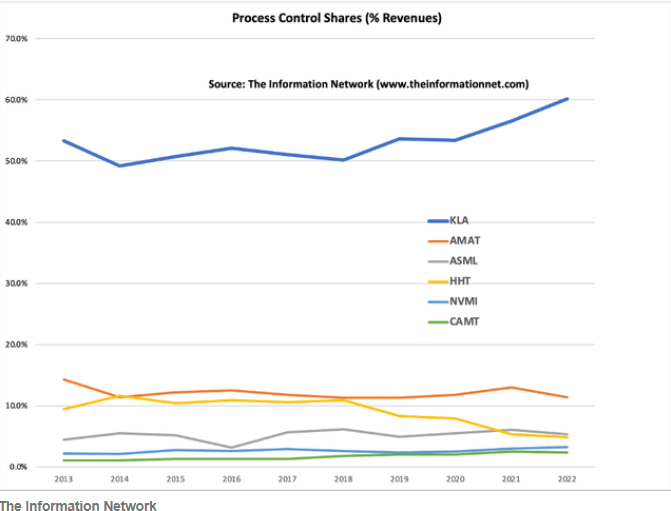
KLA at least has a fairly dominant position in the process control market and has held it for quite a long time:
image

The moats are reflected in outrageously good profitability. It’s just a pity that nowadays much of the upside is already priced into the stock, although you don’t really have to stretch the DCF much to see the stock as attractively priced. On the other hand, the current valuation doesn’t really allow for baking safety margins into the forecasts. The biggest market for the company is China, which isn’t exactly an attractive factor either.

I started a thread for KLA a long time ago, but it didn’t really spark much discussion, even though back then it felt like the company was worth its price even without growth, so you basically got the growth for free.

https://keskustelut.inderes.fi/t/kla-corporation-klac-puolijohdeteollisuudessa-operoiva-kassakone/25490/1

10 Likes

Are there any people here who have followed ARM more closely.. the stock price performance has been staggering, at least so far this year, but on the other hand, how do the company’s products compare to the portfolios of other semiconductor giants, and what factors explain the stock’s performance..?

https://keskustelut.inderes.fi/t/arm-porssipaluu-suoraan-teknologiayhtioiden-kuumimpaan-ytimeen-monopoliasemassa/42933

There is a dedicated thread for it if you use the search function.

5 Likes

There has been some discussion about this in the Arm thread. The way I see it, almost all chip/processor manufacturers use Arm’s architecture as the basis for their solutions. This means Arm receives growing license and royalty income. As I understand it, Arm dominates this chip/processor market as the best design solution (architecture). And in such a hot chip market, it would be a reckless move for a chip manufacturer to start their own architecture path. So, Arm is in Qualcomm, Nvidia, AMD, etc. — not in every chip, of course, but the way I see it now, Arm architectures have nearly 100% coverage in so-called company-specific chips and mobile/edge devices. This is partly because Arm has the capability to quickly produce company-specific or industry-specific chip architectures. Also, Arm is an energy-efficient design solution. So, there is a moat.

What’s particularly interesting is that Nvidia has bought 2 million Arm shares from the market during the fall (there was a mention of this on Seeking Alpha). And hedge funds have been selling, meaning they’ve taken quick profits. It’s possible that we will see some kind of strategic struggle around Arm, specifically among industrial players (chip, edge, and cloud players). So this strategic angle might become even more evident in the future. To me, Arm is a bit like Bitcoin. Arm’s architecture is a scarcity solution; everyone is forced to buy it. The valuation could jump in a potential takeover situation. If we think about what’s in the headlines and what isn’t: chip manufacturers and cloud companies are being talked about. But there is little talk about how everyone is at Arm’s mercy. If I could only invest in one stock, it would be Arm. Because in my opinion, its market position is even stronger than Nvidia’s, and Arm is already benefiting greatly as part of Nvidia’s strategic product portfolio. Diversification is a way to stay on board with these high-volatility companies like Arm, SMCI, and Nvidia. That’s why I’m definitely not all-in on just one.

12 Likes