Ei, mutta viimeisintä huutoa olevia piirejä nimenomaan tässä ollaan hakemassa. Ei Intel valmista mitään bulkkipiirejä, ei itse eikä Foundry-asiakkaille. Nämä Intelin uudet tehtaat ovat järjestään tulevaisuuden prosessinodeille.
Totta kai suuri osa tehtaista on uudelleenkäytettäviä vuosikymmeniksi jos pidetään kunnossa, mutta itse valmistuslinjat vaativat uusimista varsin usein jos halutaan että tehdas valmistaa viimeisintä huutoa olevia piirejä. Niitä, joita tässä ollaan haluamassa jotta maailman täydellinen riippuvuus Taiwanista vähenisi.
Tämä taas toteutuu vain jos tehdas pystyy piirejä tuottamaan voitolla. Se että tukirahaa löytyy seinien pystytykseen on hienoa, mutta pitkässä juoksussa nämä ovat taloudellisesti järkeviä investointeja vain jos piirejä pystytään tekemään kilpailukykyisesti vuosikymmeniä. Jostain syystä aiemmin tämä onnistui nihkeästi ja lähes kaikki valmistus alkoi valumaan Kiina-Taiwan-Korea -akselille…
Minä kun olen etsiskellyt tupakantumppeja ja lypsylehmiä, niin oli taannoin pikkuhiluja kiinni Texas Instrumentsissa ja Marvell Technologyssä. Menin sitten myymään. Saattoi olla virhe.
Vaan mitenkähän valoisa tulevaisuus näillä ei-niin-leading-edge-firmoilla mahtaa olla? Tai Infineonilla ja ST Microelectronicsilla?
Oma työhypoteesi on, että olisi sen verran kapineita, jotka on suunniteltu kauan sitten ja joita ei mielellään kustannusten takia suunnitella uudelleen, että näillä firmoilla olisi suhteellisen tasaiset markkinat, joita ei kiinalaistenkaan kannattaisi erityisemmin hätyytellä, kun kasvu on muualla.
Jauhavat pienillä marginaaleilla rahaa, hieman heiluen piirilafkojen suhdanteiden mukaan. Ongelma bulkkikamassa on että katteet eivät ole kummoisia. Osinkokoneita vailla lätkamailoja.
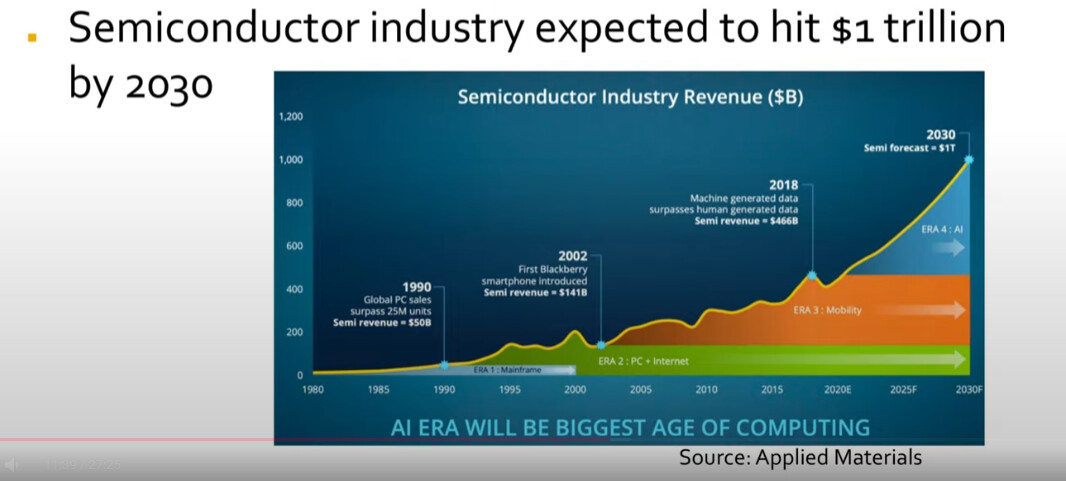
AI-boomista ennustetaan valtavaa kysyntäajuria lähivuosille ja piirifirmat ovat myös kilpaa investoimassa hurjasti tämän kysynnän täyttämiseen. Lisäksi historiallinen trendi jossa piirit aina nopeutuvat mutta samalla ovat halvempia on taittumassa. Piirit edelleen nopeutuvat, mutta samalla kallistuvat koska viimeisin teknologia on niin monimutkaista ja kallista valmistaa.
Tämä efekti selittää osittain ammattilaisnäytönohjainten ja lippulaiva-kännyköiden hintojen karkaamista horisonttiin.
Alankomaat kielsi jo aiemmin EUV (extreme ultraviolet) -laitteiden viennin Kiinaan, mutta nyt rajoituksia on tulossa myös DUV (deep ultraviolet) -laitteiden viennille ja kärsijänä mm. Kiinan ylpeys SMIC. Reutersin artikkelissa puhutaan muuten “ultraviolent” -laitteista. Sellaisiin en haluaisi tutustua tarkemmin.
Sijoittajana ja ihan tavallisena kansalaisena otan Kiinan ympärillä kiristyvät rajoitukset vastaan hieman ristiriitaisesti. En lähde purkamaan kaikkia ajatuksia asiasta tässä yhteydessä. Kokonaisuutena pidän terveenä kehityksenä sitä, että vientirajoituksia tulee ja etenkin sitä, että huipputeknologian valmistus on siirtymässä massiivisesti – ainakin muodollisesti – demokraattisiin maihin. Toivon, että pidemmällä aikajänteellä tämä parantaa myös joidenkin globaalisti toimivien suomalaisyhtiöiden kilpailukykyä epäreilua kiinalaiskilpailua vastaan. Pelkkä sijoittajan hattu päässä kehityksessä voi nähdä myös negatiivisia puolia ja mitä osakekursseihin tulee – ASML:n kurssi tuskin kiittää uusista rajoitteista ja tilanne näkyy varmasti laajemminkin puolijohdevalmistajien osakekursseissa.
Reuters →
The planned U.S. rule, which sources said may be published by late July, will require licenses to export equipment to about a half dozen Chinese facilities, including a fab operated by SMIC, China’s largest chipmaker, the person familiar with the U.S. plans, said. Licenses to ship the equipment to those facilities will likely be denied, the person said.
It is reported that the Netherlands will announce further restrictions on ASML and other companies on Friday, requiring them to It is necessary to obtain a license before exporting deep ultraviolet light exposure machine (DUV) to China. It is estimated that models such as TWINSCAN NXT:2000i of Esmer will be affected, and its older models such as TWINSCAN NXT:1980Di may also be affected. Prohibited for use in specific Chinese fabs.
Kiinalaiset ovat käsittääkseni sellaiset 4-5 vuotta länttä jäljessä näissä koneissa ja ovat päättäneet, että pitää olla omaa tuotantoa. Tässä voi vielä käydä 10-15 vuoden tähtäimellä silleen, että Kiina irtaantuu kokonaan länsitekniikasta ja luo oman ekosysteeminsä, jota myydään sitten kaikkialle kehittyvään maailmaan.
Siitä voi sitten tulla ASML:lle enemmänkin hittiä. Nimimerkillä “Omistin ASML:ää, mutta tunnusluvut tulivat liian suolaisiksi omaan makuun”.
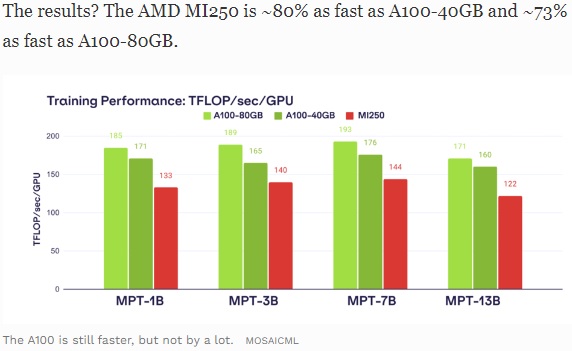
Tuossa vertailussa on yksi ongelma - verrataan A100n joka on kaksi vuotta vanhaa teknologiaa. NVIDIA myy uudempaa H100-pohjaista kiihdytintä nykyään. Siihen ei jostain syystä vertailla…
Kyllä MI250 korteillakin AIta vääntää, varsinkin jos parempia ei saa mistään, mutta AMDkin tarvitsee uudet MI300-sarjan kortit markkinoille (on lanseerattu, mutta toimitukset taitaa vielä mennä ainoastaan suurasiakkaille)
Samaan asiaan liittyvää – ja myös samansuuntaista settiä tältä sijoittajalta – tosin hieman eri vinkkelistä.
Kaverilla on jutussaan ihan hyvä pointti, sillä AMD on chipleteissä kilpailijoitaan edellä. Toisaalta, sekä Nvidia että Intel tulevat jo perässä tässäkin teknologiassa, mutta AMD on tehnyt chiplet-ratkaisuja jo melkein vuosikymmenen ajan. Mitä Nvidiaan tulee, sen voi olla vaikea siirtyä nopeasti täyttyvän rahakirstun ääreltä kannibalisoimaan omaa businestään.
Päädyin myymään Nvidian osakkeeni. Positio ei ollut mikään suuren suuri. Syy myyntiin ei ollut orastavassa kilpailussa. Ei vaan kertakaikkiaan riittänyt pokka näillä arvostuksilla. Pari kertaa olen jo missannut hyvät myyntipaikat puolijohteissa ja pari viimeistä ostostakin tein ihan liian aikaisin. Varmistin, että tällä kertaa ei jää harmittamaan. Yhtiössä ei ole mitään vikaa, mutta AI-kuumeen laskiessa markkina saattaa hieman viilentyä.
$AMD is set up to take a lot of market share from $NVDA for 2 reasons:
Much of of $NVDA ´s moat stems from CUDA, which enables developers to interact with $NVDA GPUs seamlessly when coding. However, Pytorch has become the dominant framework for deep learning (AI) and now, $AMD GPUs work out of the box on Pytorch.
This opens the veil for $AMD to disrupt $NVDA ´s software moat and levels the playing field.
$NVDA ´s chips are monolithic, while $AMD ´s chips are chiplet based. Chiplets have enabled $AMD to disrupt $INTC by yielding high performing but cheap chips.
This is because when you make a chip out of chiplets, if one of the components goes wrong you don´t have to throw the entire thing away. Hence, yields are much higher than in monolithic architectures.
I believe the same is going to happen on the GPU side.
Chiplets have lower margins and so pivoting to this would hurt $NVDA ´s financials: a clear case of the Innovator´s Dilemma. $NVDA has a fantastic business and will hardly find the incentives to disrupt itself moving towards chiplets.
Potentiaalisesti mahdollinen skenaario, mutta henkilöhtaisesti en usko tapahtuvan ihan lähitulevaisuudessa (ts. seuraava vuosi-kaksi) vaan lähinnä AMD saa markkinaosuutta sillä että NVIDIA myy aivan kaiken minkä tehtaista irti saa ja kun se ei täytä kysyntää, jokainen etäisesti kilpailukykyinen vekotin AMD:lta menee myös kaupaksi, vaikka sitten hitusen huonommalla katteella ja vain asiakkaille jotka ovat valmiit näkemään vähän lisävaivaa sen eteen että saavat lisää rautaa linjoille.
Onko mahdollista että chiplet-GPUilla AMD nykäisee yhtäkkiä kaulaa NVIDIAn tuotteisiin nähden varsinkin ammattipuolella? Ehkä, mutta tuskin ainakaan vielä seuraavassa sukupolvessa. On myös todettava että NVIDIA on myös huhujen mukaan vääntämässä chiplet-pohjaista tuotetta mutta on vielä epäselvää milloin moinen kenties kaupallistetaan. Varmempaa tietoa seuraavan sukupolven AI/laskentakorteista odotellessa…
Päivän puheenaihe maailmalla on Kiinan vientirajoitukset kahdelle tärkeälle (puoli)metallille, galliumille ja germaniumille, joita käytetään puolijohdekomponenteissa, aurinkopaneeleissa, ledeissä, infrapuna- ja kuituoptiikassa jne. Näiden lisäksi Kiina kertoi asettavansa rajoituksia yli 30:lle muulle edellisiin liittyvälle metallille ja materiaalille.
Tämä ei ole ensimmäinen kerta, kun Kiina käyttää raaka-aineita painostuskeinona eikä tule kenellekään yllätyksenä – paitsi Saksassa, jossa maan kriittinen infrastruktuuri rakennetaan mieluiten autoritääristen maiden toimittamien laitteiden varaan, kun niistä saa jostain syystä aina huippuhalvan diilin eli “Handelnin” . Monissa muissa maissa ymmärretään, että jos Kiinalla on joku painostuskeino, se tulee sitä varmuudella myös käyttämään omien tavoitteidensa saavuttamiseksi.
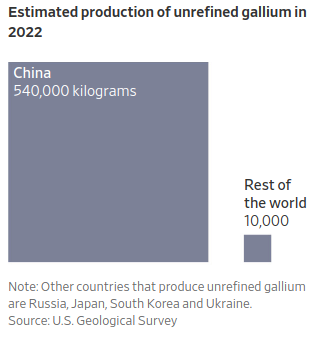
Tällä kertaa kyse on USA-Kiina -väännön seuraavasta luvusta. Kiina vastaa USA:n vientirajoituksiin omalla tavallaan, jotka se katsoo tasavertaisiksi itselleen asetettujen rajoitusten kanssa. Kiinalla on erityisesti galliumin suhteen vipuvartta (kuva WSJ:n artikkelista) →
Seurauksena tästä on tietenkin kustannusten nousu, joka on valitettavan huono asia juuri nyt – monella tapaa ja monelle yhtiölle.
WSJ:
“This measure will have an immediate ripple effect on the semiconductor industry, especially with regards to high-performance chips,” said Alastair Neill, board member of the Critical Mineral Institute who has nearly 30 years of experience with China’s metals industry.
Ohessa CGPT:n “management summary” WSJ:n hyvästä artikkelista.
Kiina on ilmoittanut vientirajoituksista galliumin, germaniumin ja muiden niihin liittyvien materiaalien osalta, jotka ovat välttämättömiä puolijohteiden, ohjusjärjestelmien ja aurinkokennojen valmistuksessa.
Toimenpide nähdään voimannäyttönä ennen Kiinan ja Yhdysvaltojen talousneuvotteluja.
Elokuun 1. päivästä voimaan tulevat rajoitukset tähtäävät kansallisen turvallisuuden suojaamiseen ja vaativat tulevaisuuden vientihakemusten tarkastusta maan hallinnossa.
Yhdysvallat on myös asettanut vientirajoituksia kehittyneelle puolijohdekalustolle ja painostanut liittolaisiaan tekemään samoin.
Molemmat maat pitävät näitä toimenpiteitä välttämättöminä kansallisen turvallisuuden etujen suojelemiseksi.
Rajoitukset galliumin ja germaniumin osalta voivat vaikuttaa merkittävästi puolijohdealan erityisesti korkean suorituskyvyn siruihin.
Kiinan pyrkimykset kehittää puolijohdeteollisuuttaan ovat kohdanneet esteitä, kun Yhdysvallat on asettanut rajoituksia ja varoittanut sotilaallisista vaikutuksista.
Yhdysvaltain geologisen tutkimuskeskuksen mukaan gallium ja germanium kuuluvat kriittisten mineraalien luokkaan niiden tärkeyden vuoksi Yhdysvaltain taloudelle ja kansalliselle turvallisuudelle.
Galliumia käytetään puolijohteiden valmistuksessa, ja galliumarseniidi on laajalti käytetty korkean suorituskyvyn siruissa.
Germaniumia käytetään kuituoptisissa järjestelmissä ja aurinkokennoissa.
Vientirajoitukset näihin hyödykkeisiin muistuttavat aiempia rajoituksia harvinaisille maametalleille, joita Kiina myös tuottaa pääasiassa.
Kiinan vientirajoitukset mahdollistavat kohdennetut toimet yksittäisiä yrityksiä ja sektoreita vastaan geopoliittisia näkökohtia silmällä pitäen.
Toimenpide voi antaa Kiinalle valtaa tulevissa keskusteluissa Yhdysvaltojen kanssa vientirajoituksista.
Galliumin ja germaniumin rajoitukset nähdään osoituksena Kiinan hallinnasta toimitusketjuissa ja sen vahvuudesta korkean teknologian teollisuudessa.
Jos pitää paikkansa, tarkoittaa että Intelin huolet valmistusprosessien kanssa jatkuvat.
Tämän piti olla se ensimmäinen “Uuden Intelin” viimeistä huutoa olevalla nodella valmistettu prosessorisukupolvi läppäreihin ja työpöytäkoneisiin, tulossa 2024 lopussa. Viimein Intel kilpailukykyisesti ottamassa erää TSMCn kanssa vertailukelpoisesti.
Paitsi että maalitolpat ilmeisesti taas siirtyivät ja plan-B on valmistuttaa piiri TSMC:llä.
Jo aiemmin tarkoitus oli että Compute-tiili olisi Intel 20A, GPU olisi TSMC 3nm ja lisäksi mukana olisi muita tiiliä jotka olisivat Intelin vanhemmilla nodeilla, mutta nyt tuo Intel 20A olisi siis ilmeisesti kadonnut sisäisistä roadmapeista tämän tuotteen osalta.
Muutos tulee myös aika myöhään jos tämän on tarkoitus olla kaupoissa Q4 2024, joten nostaa riskiä että koko tuote viivästyy. Tosin emme voi tietää missä vaiheessa tämä on päätetty, tiedämme vain että tieto valui nyt epävirallisesti ulos. Jos tuo on jo päätetty 6kk sitten, tilanne ei tällöin ole yhtä kriittinen.
Ja vuosi jolloin Intel on ehkä kilpailukykyinen valmistuksessa TSMCn kanssa siirtyi taas hamaan tulevaisuuteen. 2025? 2026?
Mitenköhän TSMC:llä riittää 3nm valmistuskapasiteetti jos siitä 2024 kisaavat NVIDIA, Intel ja AMD…
Tämähän tarkoittaisi, että Arrow lake olisi kokonaan TSMC:n valmistama (Intel 3 TSMC Compute/TSMC 3nm GPU/TSMC 3nm IO & SOC) eikä vain 2/3. Aiemminhan tätä 2/3 ratkaisua myös avoimesti kyseenalaistettiin. Jutussa muuten kerrotaan, että vielä ei olisi tietoa siitä koskisiko tämä vain yhtä segmenttiä, vai kaikkia.
Miksi luulet, että tällä huhulla toteutuessaan olisi jotain tekemistä kaiken kilpailukykyisen valmistuksen ja sen siirtymisen kanssa?
Jos 20A olisi toimiva prosessi, miksi tämä tuote siirrettäisiin kokonaan TSMC:lle?
Okei, teoriassa mukana voi olla jotain muitakin syitä jonka vuoksi tämä on se ratkaisu, mutta tämän piti olla ensimmäinen 20A-prosessilla tehty lopputuote joka viittaa siihen että ko. prosessin kaupallinen käyttö siirtyy myöhemmäksi tai se on kokonaan peruttu. Olikohan 2025 kun piti tulla jo 18A-prosessilla tuotteita…
Vielä ollaan huhujen varassa, mutta näillä on ikävä taipumus vahvistua myöhemmin.
Päivän epämääräisiä Intel-huhuja: Battlemage-arkkitehtuuri, jonka piti alun perin tulla 2023 lopussa (uusi Intel GPU-sukupolvi) on siirtynyt vähintään 2024 jälkipuoliskolle. Sivuvaikutuksena tämän vuoden lopussa tulevien Meteor Lake-läppäriprossujen iGPU ei ole Battlemage-arkkitehtuuriin pohjautuva, vaan käyttää nykyisestä Alchemist-sukupolven grafiikkaytimistä lievästi jatkojalostettua versiota.
Eli GPU-suunnittelu on edelleen vaikeaa ja tämä myös voimistaa sitkeitä huhuja että Intel olisi harkitsemassa dGPU-puolen osalta luovuttamista. Toisaalta kun katsoo AI-hypejunaa, tämä näyttäisi kovin lyhytnäköiseltä, mutta…
Tämä juttu ei varsinaisesti liity mahdollisiin vaikeuksiin valmistuspuolella koska Battlemage alun perin oli ilmoitettu käyttävän TSMCn prosessia - 4nm dGPU-korteissa, 3nm Meteor Laken GPU-tiilessä.
Miten luotettavina pidät tässä vaiheessa noita huhuja? Aikaisemmin mainitsitkin tyyliin että Intelin osalta niillä on ollut tapana osoittautua oikeaksi. Mutta kuinka paljon tässä on sitä mentaliteettia että kerran epäonnistuja aina epäonnistuja, vai perustuu huhut vuotaneisiin tietoihin yhtiön sisältä. Yhtiö ei kuitenkaan vamastikaan hyödy siitä että tällaiset huhut lähtevät liikkeelle.
[quote=“Lexus, post:1272, topic:2300, full:true”]Mutta kuinka paljon tässä on sitä mentaliteettia että kerran epäonnistuja aina epäonnistuja.
[/quote]
Sanoisin että erittäin paljonkin kyse on juuri tästä. Markkinoiden epäluulot eivät väisty ennenkuin yhtiö A) ylittää muumalalla perättäisellä kvartaalilla konsensuksen, B) saa kireimmän viivaleveyden prosessinsa kuntoon C) eriyttää yhtiötasolla valmistus- ja suunnitteluosastot toisistaan.
Itse kyllä uskon ja luotan Inteliin, koska yhtiöllä on nyt myös Washingtonin tuki takana. Mutta tuskin Intelin osake jatkossakaan on mikään Nvidian veroinen To the moon -osake, mutta vakaa ja pitkällä aikävälillä kasvava kuitenkin. Intelillä ei ole AI-aikana oikein varaa menettää myöskään osuutta GPU-sirupuolella. Katsotaan nyt rauhassa miltä Battlemage tulee näyttämään.