Currently, the only entity obligated to provide postal services nationwide is the state, so the state can pretty much dictate the price at which those services are bought, or at least keep them afloat. Now that service prices must actually be disclosed, as Posti is a publicly listed company, I see that these services are sold according to costs. As a taxpayer, I wouldn’t demand anything else. So yes, I accept the service in sparsely populated areas, provided that Posti receives appropriate compensation for it. Of course, some other company can provide that service if it’s able to. That’s what competition is.
3 Likes
The allocation from Posti’s IPO is now visible at least in Nordnet’s service. It seems not many got a very large slice from that; I got a little over 900 shares, plus a good 50 more shares should land in my mailbox in a year.
Guesses for tomorrow’s opening and closing prices? I predict that by the end of the day, we’ll be over 8, but under 9 euros, just guessing by gut feeling. You smarter ones, please give more well-reasoned predictions for this; it would be interesting to see how the price is estimated to be determined and how it actually is determined.
3 Likes
This is complete nonsense that this would be the biggest question. Letter mail has, in my opinion, been a thorn in Posti’s side for a long time. This also involves state obligations, or at least it used to. I don’t know the exact current situation.
The clear quantitative decline in letter mail has been seen in the development of the 2000s from the very beginning. Parcels are what bring something to the bottom line for a logistics company like Posti. If another 50% of this letter mail now melts away, in my opinion, there’s no need to panic about it, because the whole ship certainly won’t sink because of this. The same discussion was held when invoices started moving to electronic services and the price of a paper invoice was €5/piece for the consumer. But Posti still has its nose above water.
Statistics on this can easily be found. 
Perhaps this could even be considered for acquisition with dividends in mind… I missed the IPO myself, but I’ll probably be able to get it from the marketplace soon.
5 Likes
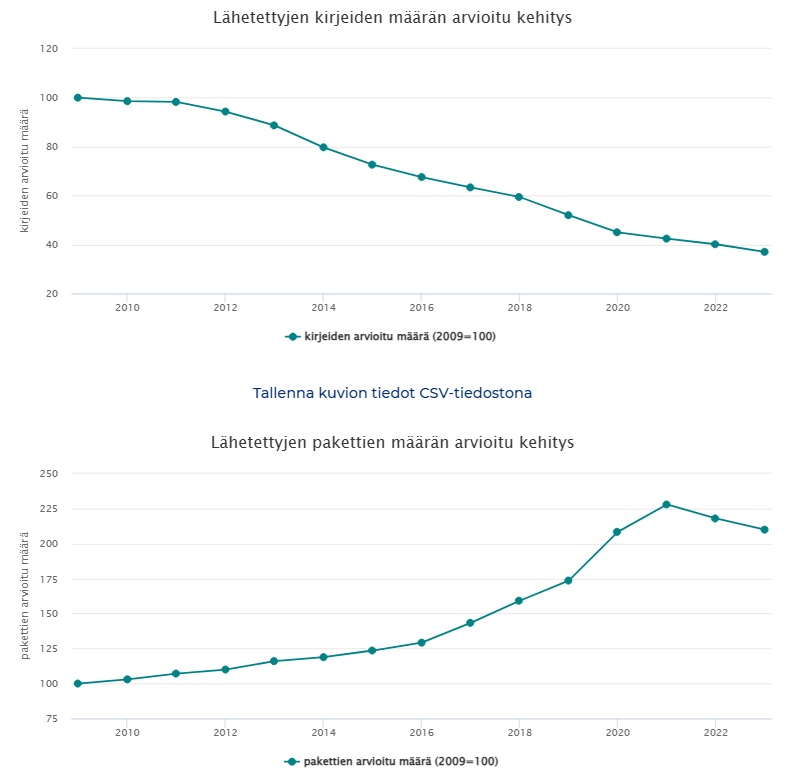
Number of letters and parcels sent | Traficom Data
That’s great, but I couldn’t find a newer graph, but based on news articles, the number of letter mail has continued its approximately 10% annual decline even after that.
5 Likes
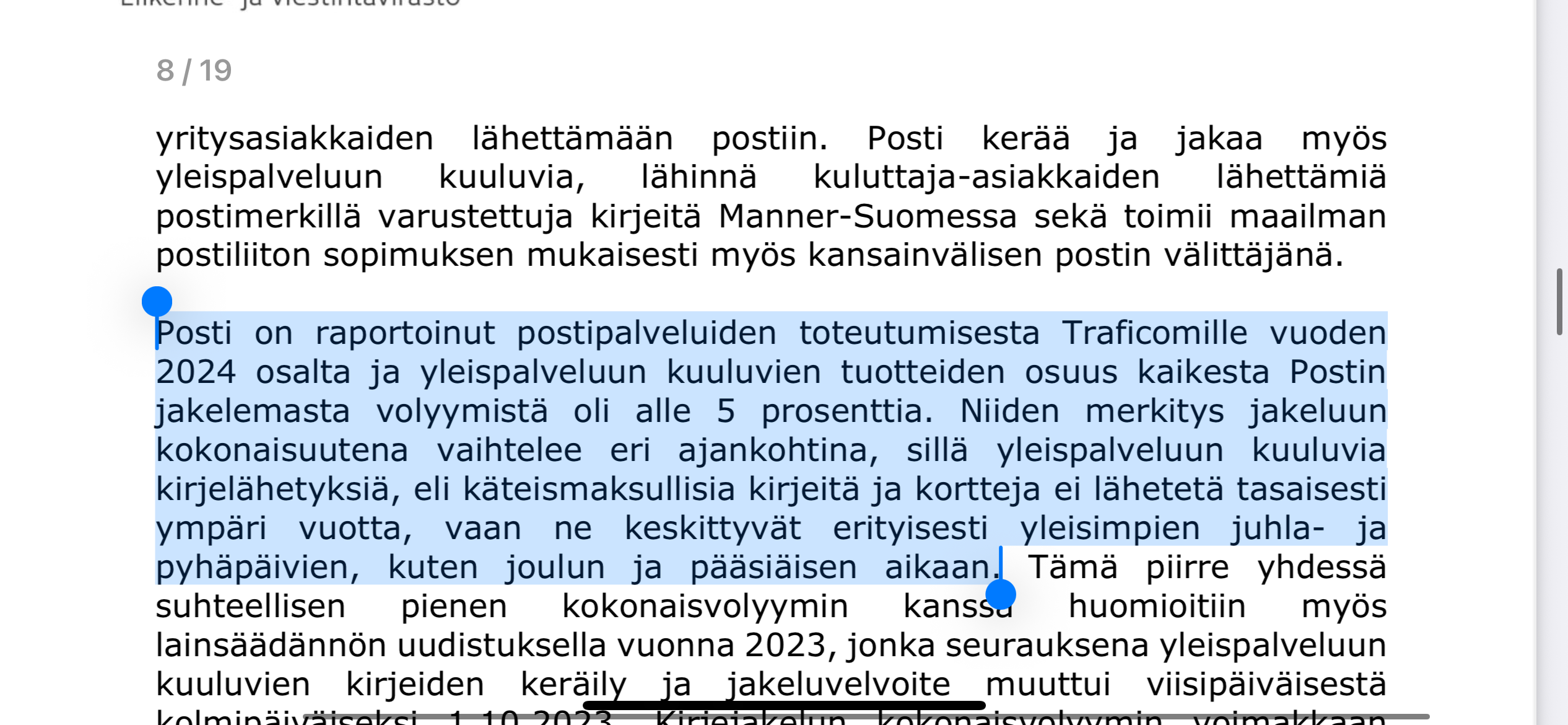
Your screenshot says that the 5% concerns cash-paid letters and cards, which are sent mainly around Christmas and Easter. So we are talking about Christmas cards, etc., sent with stamps.
From Posti’s website: “The share of universal service in all Posti’s print shipments is approximately 3 percent. As for letters, universal service includes those letters that have been paid for with a stamp.”
I am now talking about letters sent by hundreds of authorities, the number of which will collapse in 2026, as they move to digital. Millions and millions of letter shipments will disappear at once from there. I won’t argue about this any further; let’s look at the statistics a year from now to see what the letter delivery volumes look like. Is it the calm before the storm or not.
1 Like
In the relevant government proposal, I quickly couldn’t find any mention of letter volumes, but it calculates how much money the public administration saves, meaning this money is essentially taken away from Posti (?):
the total targeted savings for the entire public administration are estimated to be approximately 40 million euros per year. Of this sum, 30 million euros would be allocated to central government, 6 million euros to the Social Insurance Institution (Kansaneläkelaitos), 2 million euros to well-being services counties, and 1–3 million euros to municipalities.
and a little later:
Pursuant to Section 33 of the Postal Act, the universal service provider (Posti) must be compensated from state funds for the portion of the net costs of universal service that constitutes an unreasonable financial burden for it. According to the Act, the Ministry of Transport and Communications decides on the compensation of costs based on a net cost calculation prepared by the Finnish Transport and Communications Agency (Traficom). Compensation for costs is applied for from the Ministry of Transport and Communications, and compensation is paid retroactively for a maximum of one year from the submission of the claim. The targeted savings for central government may not materialize as presented if, as a result of the partially proposed changes, the state has to support the implementation of universal service secured by the Postal Act from state funds. So far, Posti has been able to handle the distribution of letters and parcels belonging to universal service without the need to compensate the costs of universal service from the state budget. The disappearance of tens of millions of letters from the market has a significant impact on the allocation of costs for distributing paper mail and thus on the unit costs of universal service. On the other hand, Posti’s operations are also affected by other digitalization developments than the changes proposed in this proposal.
2 Likes
These savings will hit the pockets of Posti’s competitors more, who handle letter delivery in larger cities and have been doing so for years.
3 Likes
Additionally, only a small portion of these savings are distribution costs. A small side note that has no significance whatsoever for Posti’s business, let alone the development of its share price.
2 Likes
I received a very poor allocation of institutional shares; I only got 1,570 shares from a 50,000
12 Likes
How many of these did one get with a minimum subscription? Just so I know what I missed out on 
edit. Thanks @superg
What about the public offering?
1 Like
Same, 3% of the subscription amount. I dumped the shares. Absolutely terrible communication at the institution; in the morning, the subscription commitments just disappeared from the portfolio and there was no information about the allocation.
2 Likes
440 shares came here with the minimum subscription of 14,001 units from the institutional offering.
17 Likes
That’s how it always goes. Suddenly, some shares just appear in the account. Some subscribers get everything they want. Then they have a nice round number there in the list of largest owners.
I’m going to keep those myself. In a few months, I estimate they’ll be around 12 euros. The only question is how many months this will take.
But the biggest mystery in this offering is why my bonus share subscription for 7000 shares was rejected, even though there was enough money in the account and similar 7000 shares in the public offering and 7000 shares in the bonus offering went through. I have requested clarification on this from Nordnet.
Update: they called and said that due to a SEK-based backend system, there had been a misinterpretation of the sufficiency of euros, and now they are figuring out how to get those 2201 bonus shares into my account.
8 Likes
On the public offering side, a subscription of 14,000 units would have yielded significantly more. 
5 Likes
I don’t remember ever participating in an institutional offering where the allocation wasn’t known before the start of trading. Sometimes I’ve received zero, but usually more than the maximum amount via the public offering. Now I got hammered tenfold – but above all, the poor communication is annoying.
1 Like
In hindsight, I should have participated in both. Well, time to clear out the clutter from the portfolio and move on to new disappointments.
3 Likes
Ha ha ha, the ripping off started immediately
17 Likes
It was already in the prospectus. The purpose is to ensure commitment.
Members of the management team subscribe to Posti shares with the full amount of their IPO remuneration and may not sell them for 360 days.
13 Likes
To my mind, Posti is already a thing of the past. Many have already switched and are switching to services other than Posti’s, or has something ‘more modern’ come along?
When reflecting on these savings, it’s not really significant. Millions and millions of shipments might be a bit exaggerated?
40 million euros in letters could be about 20 million letters at an average price of approx. 2€. If you relate that to the number of households, some businesses probably still receive mail. It probably means a few letters / household / business per year.
Let’s reflect a bit on the starting situation, when in the early 2000s, for example, a company with a turnover of approx. 25-50 million wrote approx. 100,000 invoices per year, which were indeed sent as letters to the customer. Yes, then came e-letters, which still ended up as physical letters, and the supposed death blow to mail, e-invoices. Compared to this, the 40 million in savings is truly a mosquito’s buzz in the big picture, and the adjustment needs are marginal.
I could be very wrong about this. My own thought would be that it would be better for Posti to get rid of letter mail and its sorting entirely. Our own views on these companies and their operations are written here.
Let’s see how Posti’s story develops, hopefully well… 

3 Likes