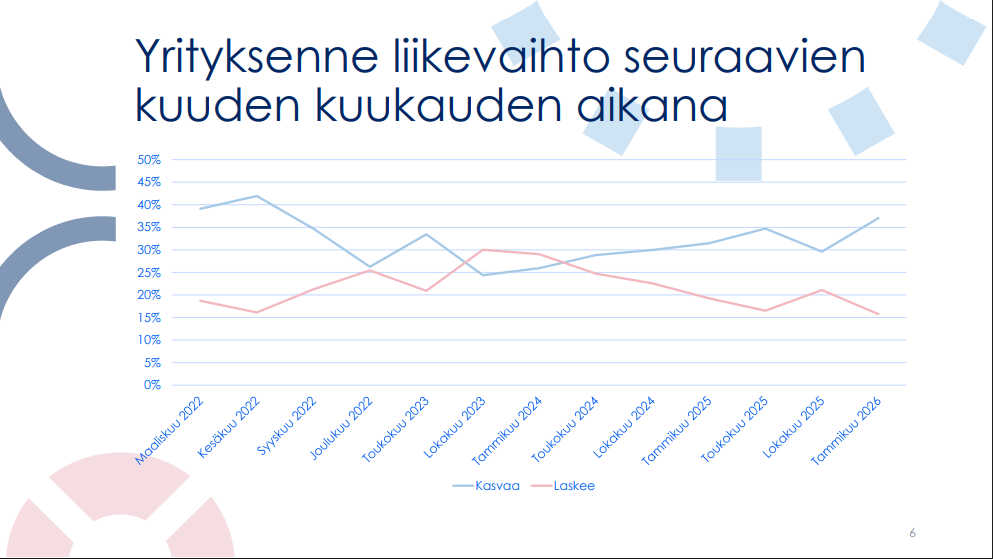
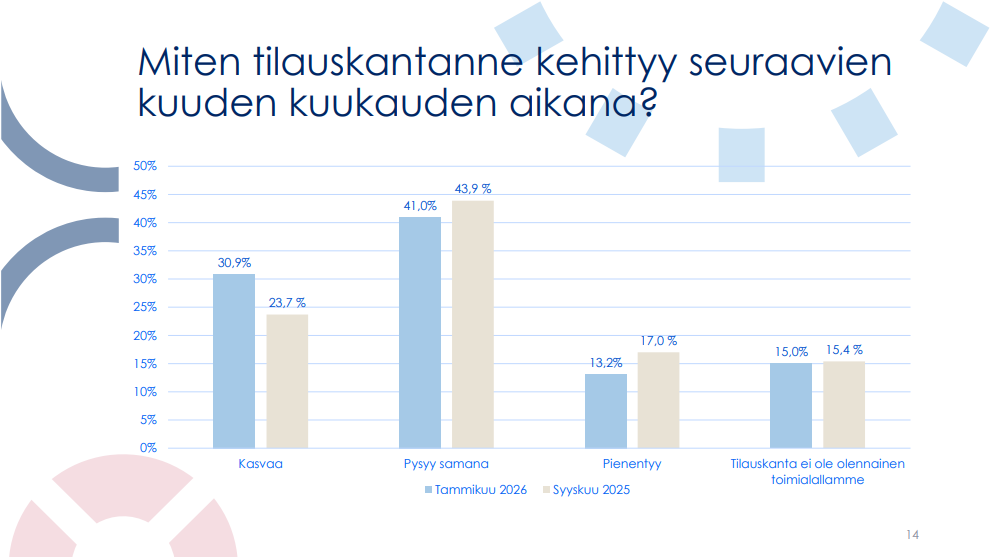
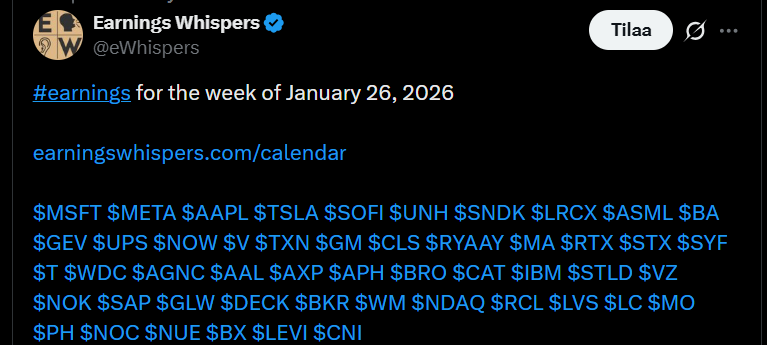
What’s happening next week? ![]()
https://x.com/eWhispers/status/2009633514765877736


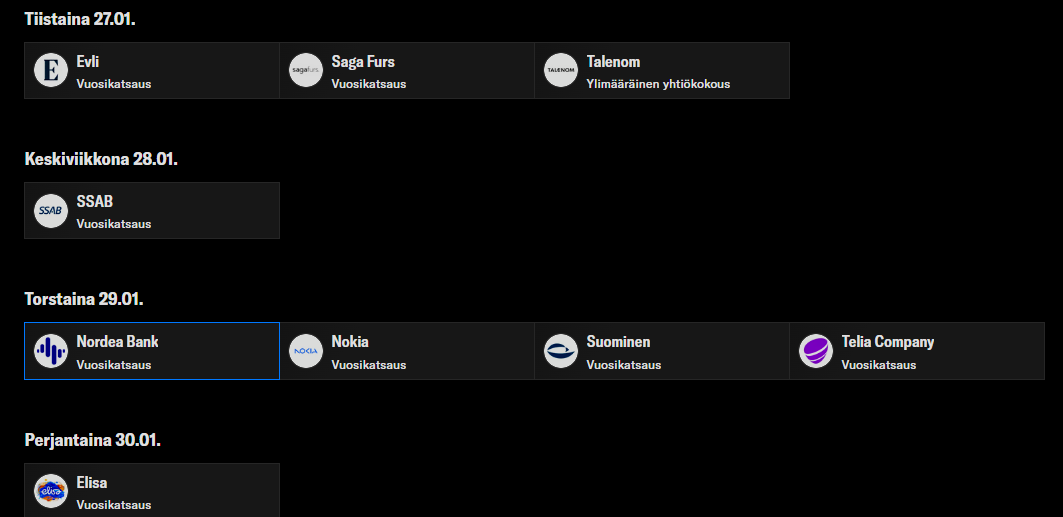
It won’t be too busy in Helsinki next week:

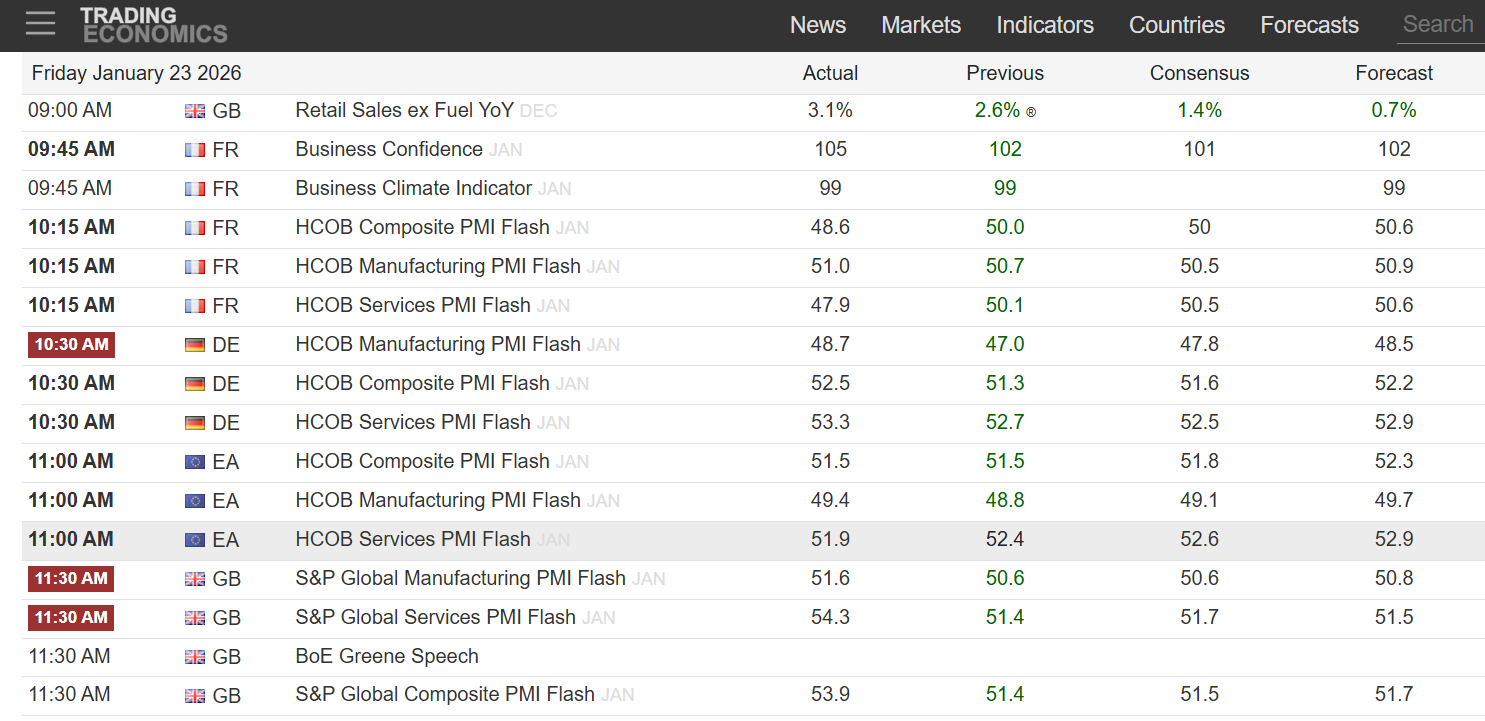
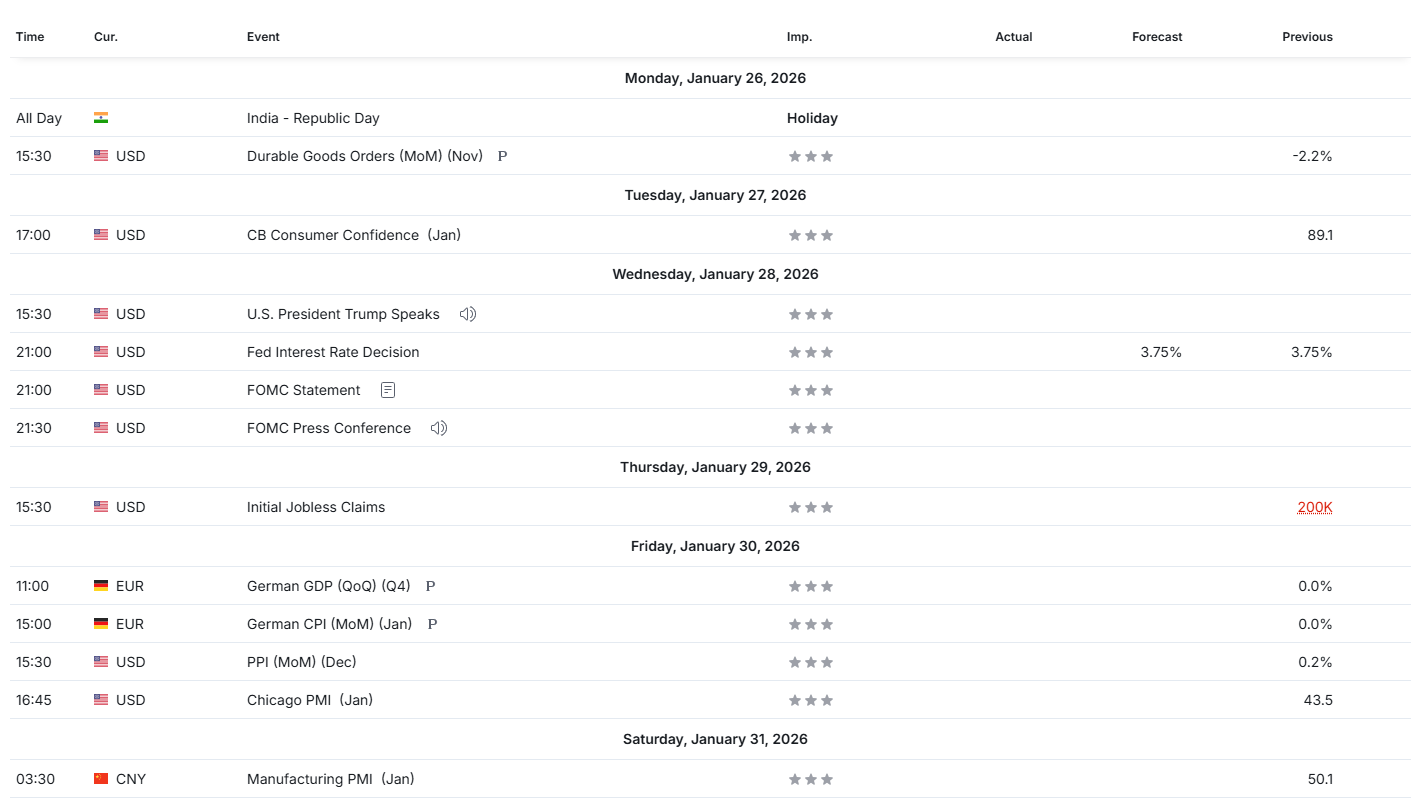
Here is next week’s macro agenda ![]()

What’s happening next week? ![]()
https://x.com/eWhispers/status/2009633514765877736


It won’t be too busy in Helsinki next week:

Here is next week’s macro agenda ![]()

Hussman Market Comment:
"So here’s where we stand. The U.S. equity markets have reached the most extreme point of valuation in U.S. financial market history. Record deficits in the government and household sectors have produced mirror image surpluses that we observe as record corporate profits. While the distribution of these profits has benefited large technology companies that enjoy enormous network effects (a public good for which the public is not compensated), the level of these profits reflects a “K-shaped” economy, with growing insecurity among American families, coupled with extreme wealth at the top.
Meanwhile, investors are paying top dollar for top dollar – extreme price/earnings multiples on record earnings that are quietly dependent on record deficits.
In my view, there’s nothing mechanical about this bubble apart from extrapolative speculative psychology. That psychology can shift in very short order. If history offers any lesson, it’s that a market collapse is nothing but risk-aversion meeting a market that’s not priced to tolerate risk. My impression is that it all ends badly, but nothing in our discipline relies on that, and no forecasts or scenarios are required."
Good morning everyone! The Fed and the White House are at loggerheads again, as Jerome Powell reported receiving a threat of criminal charges based on his Congressional hearing in June. This is yet another sign of the increased political pressure on the central bank, which so far has manifested only as news noise rather than a genuine change in policy direction or interest rate expectations. Also, US employment data in the latest macro comment.
Following up almost immediately with some more thoughts on the Mercosur agreement, also from Finland’s perspective:
The stories in a few Finnish media outlets (incl. Kauppalehti and Iltasanomat) about the Mercosur agreement were on an absurd level: “Meat avalanche threatens Finland” etc.
As you rightly write, this “avalanche” can at most correspond to 2 hamburgers or a few chicken legs. On top of everything, up to €45 billion could potentially be transferred (or at least reduced) from EU innovation funding—the core assets for economic growth—to already bloated agricultural subsidies. And agriculture’s share of the EU area’s GDP is a staggering 1.6%. Meanwhile, the innovation gap (cf. e.g., Mario Draghi’s competitiveness report analyses) compared to the US and China, for example, is only widening.
But still, overall and in the long term, that EU-Mercosur agreement is excellent. However, something even bigger might be expected in the near future.
Germany’s Merz just recently went to accelerate the massive cooperation and trade agreement between the EU and India. It might pop out of the oven while the snow is still on the ground
as a joint response from the EU and India to Trump’s antics.
I couldn’t find this anywhere else without a paywall. I wonder if they’ll address that next, so there would be no need to route goods/services through India or Brazil to a neighboring country.
“Trump’s tariffs are small compared to EU barriers”. It is true that there are far too many barriers within our EU single market, and they are like internal tariffs. In that sense, the comparison to Trump’s tariffs in that X-tweet is spot on.
But you often see — also here on the Inderes forums — the idea that the USA is one big single market and the EU area is a jungle of barriers. In fact, the regulatory barriers between member states in our union are significantly lower than the legal barriers between US states.
If you don’t believe it, you can look into the matter, for example, in the report below. Just a tip
also for @Sauli_Vilen @Marianne_Palmu @Sauli_Vilen, whom I at least recall having spread this notion of smaller barriers in the US internal market.
Vartti is back on the screen in a wintry mood.
A few highlights for the thread:
The Helsinki stock exchange has risen fiercely by +45% from the spring 2025 COVID lows. Recently, the years-long decline in earnings forecasts also seems to have ended. For the sustainability of the market rally, it would be desirable for earnings to follow share prices on a handcar. At least in analyst circles, cautious optimism seems to be emerging regarding changes in earnings forecasts.

For years, I’ve been saying that the Helsinki stock exchange is cheap. Well, it isn’t anymore. You can’t call it expensive either, but the slack has been taken up. This is, by the way, a good example of how an undervalued and overlooked market can quickly produce 50% when the turnaround comes.

The rise has, of course, mainly been driven by the largest companies: machinery firms pulled by the international economy and Nordea, which benefited from the rise in interest rates. The journey for mid-caps, small-caps, and micro-cap firms on the exchange is more painful. For their performance to improve, the Finnish economy would need to pick up a bit.
In the video, I went through the brakes on the Finnish economy in detail, specifically the balance sheet recession. In practice, the fall in house prices has wiped out tens of billions from households’ “plasterboard wealth” – housing makes up the majority of wealth, over 60%!
Even though inflation-adjusted income levels have risen to new records, it’s no wonder people want to save: many have a “hole” of tens of thousands in their personal finances compared to previous years.


In practice, people are now saving rather than investing.

How long can this continue? Until people are, on average, satisfied with their financial situation. But at some point, wallets will be thick enough again. At the same time, it’s worth remembering how Germany is stimulating its economy. Surely a few crumbs will fall from that table into Finnish mouths as well.
Wallets aren’t bulging at the same pace; wealth accumulates for those who have already paid off their homes. Those entering the housing market are either young and/or immigrants. The wealth of neither group is likely growing(?). Studies have been financed with loans due to the poor job market, unemployment among them is high, employment relationships are “atypical”, getting a loan is difficult, and the government just weakened protection against dismissal.
Of course, housing exchanges do happen. The elderly trade their detached houses with a family living in an apartment building, but that doesn’t generate growth or new demand. Aside from the government pocketing a few transfer taxes.
OP’s Jari Hännikänen has once again created a great tweet thread about interest rates
![]()
It would be nice if those incomes were broken down by region. Then I could see if I’m a complete outlier since my income hasn’t risen at that pace.
I understand that at least partly in the public sector (healthcare) there were big increases, and similarly with pensions. For us in the IT sector, it’s been more sluggish.
edit:
Found it on the Statistics Finland website, and maybe that upper chart starting from 1999 is misleading. The index starting from 2015 (2015=100) shows:
So would that mean that, adjusted for inflation, public sector wages have risen 66% more over the last 10 years (index 4 points over consumer prices vs 2.4 for the private sector). Of course, it’s so miserable for both that there’s not much to celebrate.
Greetings! A slightly positive surprise for the markets from US inflation. It’s trending down towards the target.
EDIT. Here is also a quick comment on the figures
Trump’s attempts to bring the Fed under his thumb have been a topic of conversation again in recent days. This time, the legal system has been leveraged to target Powell directly.
A few months ago in Vartti, I went through the history of the Fed’s independence (and the lack thereof). Trump’s actions are heavy-handed, but not unique in themselves.
This episode hasn’t aged a bit—if anything, it has only become more relevant.
Finns’ savings: Inflation is eating away at the value of bank accounts - Ilta-Sanomat
People here (too) have been decrying Finns’ excessive enthusiasm for saving, but based on the article above, the inflation-adjusted value of bank deposits has actually decreased in recent years.
The purchasing power of deposits has shrunk by about seven billion euros.
Another factor reducing the amount of money in the economy is the contraction of debt:
When old debts have been paid off more than new ones have been taken out, it has shrunk the credit volume and at the same time dampened the creation of new deposits and new money into the economic circulation.
A very interesting presentation by Robert Friedland regarding rare (and not-so-rare) metals, energy production, and where everything is headed. The video also made it clear why the United States allowed Nvidia to export advanced chips to China. It wasn’t (just) because Jensen Huang asked Trump nicely. The video is about 53 minutes long and there wasn’t a single dull moment. Highly recommended!
If you don’t have the energy/desire/time to watch the video, below is a good summary:
His message was clear and sobering: The world has an insatiable thirst for metals, from surging military budgets to AI data centers and the greening of the global economy, but it does not have a credible way to supply the metals it intends to consume over the next few decades.
How much copper are we using? We’re consuming 30 million tonnes of copper a year, only 4 million tonnes of which is recycled. That means to maintain 3% GDP growth…..now listen carefully, with no electrification…this is with burning oil and gas. To maintain global 3% GDP growth, we have to mine the same amount of copper in the next 18 years as we mined in the last 10,000 years (combined) .
“As you balkanize what was formerly a just-in-time world economy to a just-in-case world economy, some of these raw materials are going to be of nearly infinite value.”
This is why I think that fretting over people’s savings is pointless in that sense. They will start to be released once people feel their personal wealth is psychologically in balance.
Of course, the faster the better, but that can’t be influenced. Through policy, it can only be delayed if tax-like charges start to be increased significantly.
I myself am among those accelerating debt repayments, even though my net wealth is 2x my debt.
Behind the link is what I find to be a good summary by the Confederation of Finnish Industries (EK) regarding the Mercosur deal, i.e., what it is and its significance for companies. This release also concisely presents the main points of the agreement along with some information and details that you might not have necessarily encountered elsewhere.
EU member states reached an agreement on the approval of the Mercosur trade deal on January 9, 2026. The agreement would open the protected giant markets of Brazil, Argentina, Paraguay, and Uruguay to European companies – 90 percent of tariffs in the Mercosur region would drop to zero. Amidst geoeconomic uncertainties, the Mercosur partnership would also be a major strategic victory for Europe. Heli Siikaluoma, an expert in trade policy at EK, compiled answers to 5 questions.
An international trade breakthrough is within Europe’s reach if the Mercosur agreement, under preparation for over 25 years, soon receives its final seal. A qualified majority of EU member states gave their approval to the Mercosur agreement on January 9, 2026, and the European Parliament will vote on the matter at the turn of January and February.
Below are answers to the key questions:
What makes the Mercosur agreement so significant?
How does the agreement affect companies?
What does Finland have to gain in the Mercosur markets?
Why has the Mercosur agreement been opposed? Is there cause for concern?
How is the process progressing and what will happen in the coming weeks?
A few times a week, I visit the websites of various organizations and similar entities to check for fresh news and press releases. If you are interested in a specific sector, it is worth visiting the website of the relevant employer organization; there is plenty of different statistics and other information there. For example, I visit the pages of the Confederation of Finnish Industries (EK) and the Finland Chamber of Commerce (Keskuskauppakamari) regularly—I have been doing this since long before my “investor career.” ![]()
Sweden just keeps on steaming ahead. Positive development all around once again:
Surely at least that strong Finnish neighbor envy will lift us out of this swamp?
Jussi Ahokas’s latest newsletter declares central bank capitalism dead.