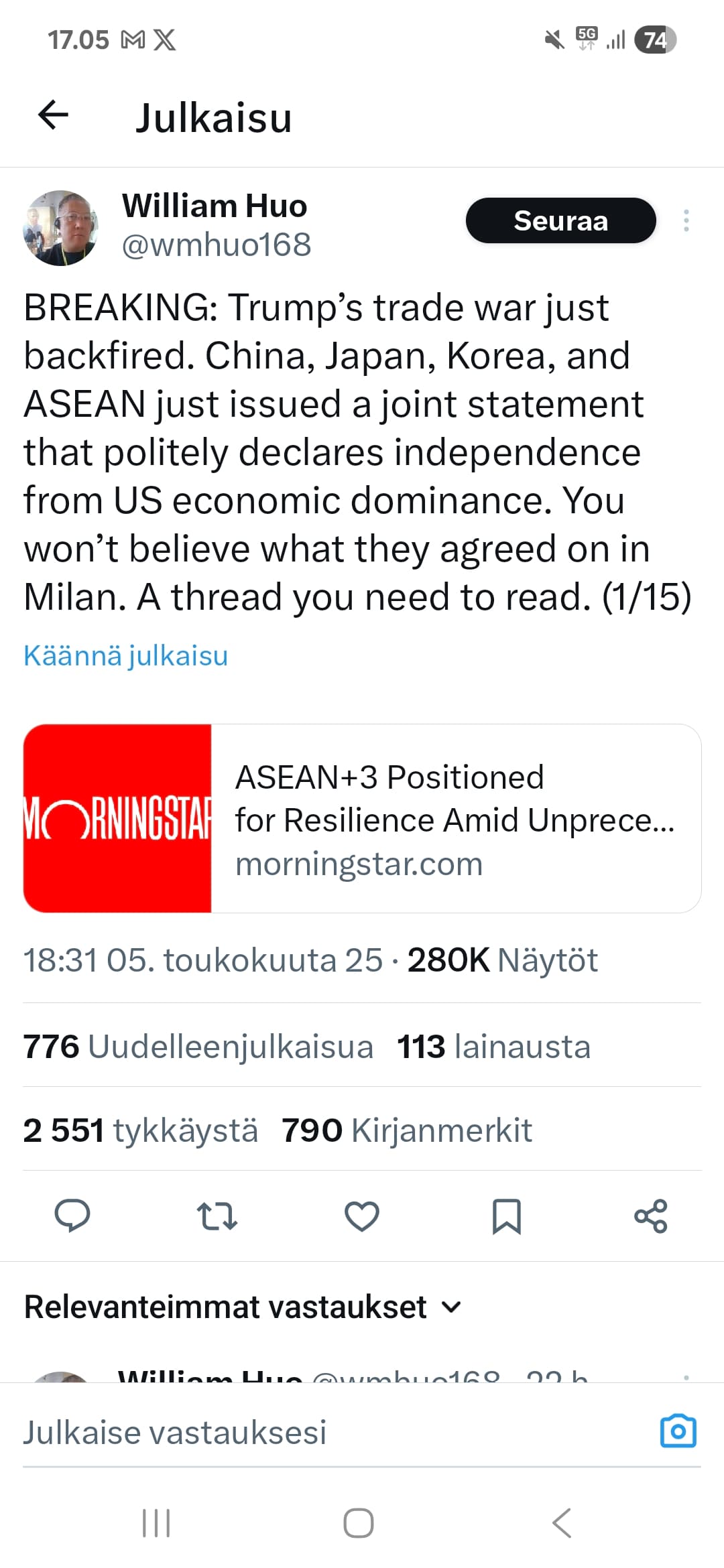
”We haven’t seen anything like this since the disruptions of summer 2020”
https://www.cnbc.com/2025/05/06/trump-tariffs-hit-us-exports-import-covid-level-event.html
A few points for the slide (I’m not sure if they’ve been mentioned here already). “Tariffs even for penguins”, the justification for these tariffs, even for all small island nations, was that, for example, China would not be able to route its exports through other countries and circumvent tariffs. Then there’s the point that all trade agreements must be made in 3 months, which would be an impossibility. Bessett said in an interview that in 3 months, things would be agreed upon in broad terms, and then the final agreements would be refined in more detail later if necessary. etc…
However, the selection came in the second round of voting.
This. The United States’ deficits are largely financed by foreign powers. China and many other countries with a trade surplus relative to the United States invest the dollars they receive from their exports back into America, primarily in debt securities.
However, due to tariffs, export revenues are effectively drying up, and at the same time, the financing Americans receive from their financiers is dwindling. Now, the state’s coffers are exceptionally low anyway due to the debt ceiling. A huge amount of additional funding is needed in a short time. It will no longer come from the Chinese, so a considerable crisis is at hand. Will the FED come to the rescue? Will interest rates rise even further? Will Trump be forced to back down on tariffs?
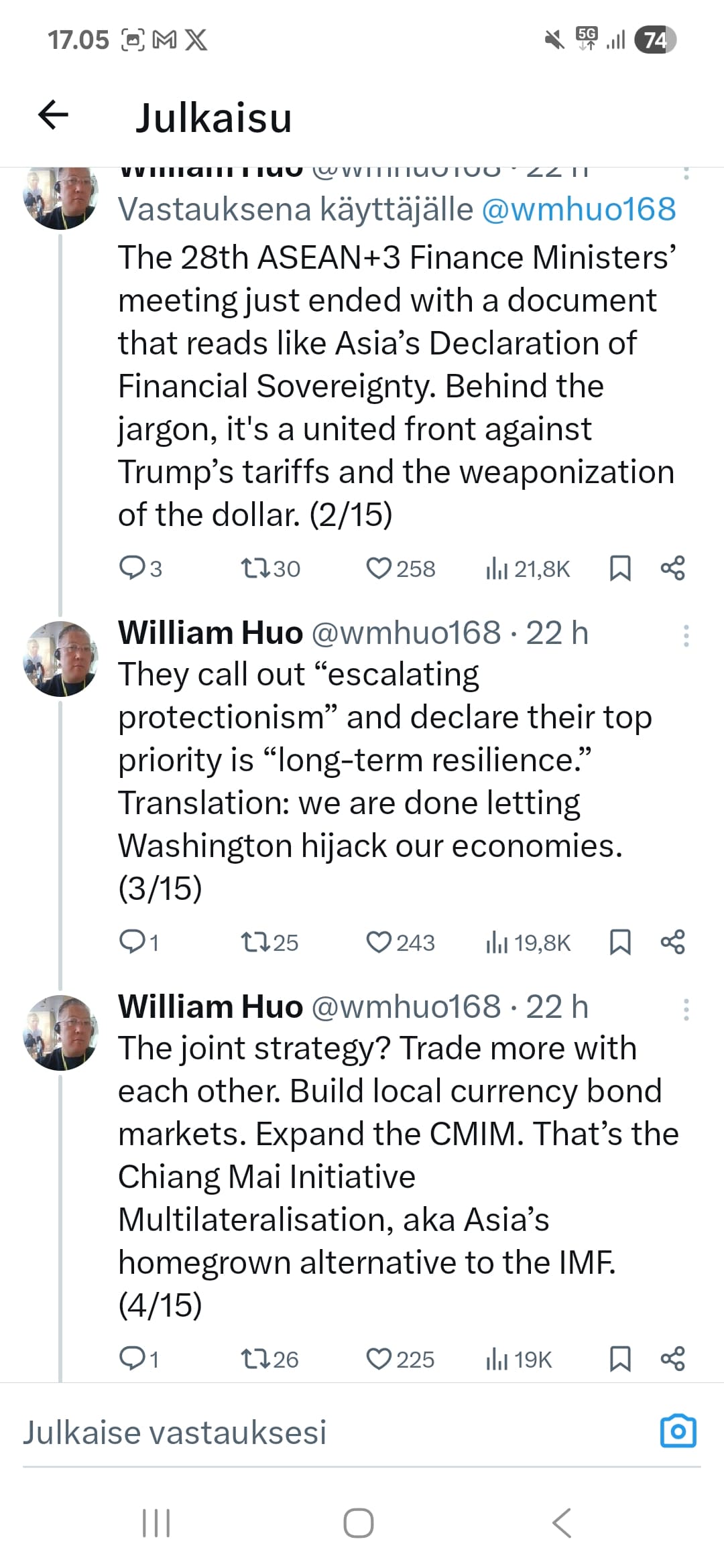
Interesting declaration!
It’s understandable for other countries to converge in trade when the unpredictable gorilla, the United States, is in the room. But time will tell how much these declared intentions, for example, between China, Japan, Korea, etc., will materialize into trade agreements.
The problem is that China’s economic model is partly based on parasitizing the demand of others, which someone else might call “export success.” If one enters into free trade with China without conditions, it will erode the industrial base of other countries. It is difficult for China to replace the United States as an export destination.
Unless China, of course, fixes its own problem and starts consuming more… But that is difficult.
Bessent has emphasized on several occasions that some kind of “understanding” is indeed sufficient on paper. But achieving that can be difficult in a couple of months. Most likely, the 90-day pause can be extended with good reason, or tariffs can simply be allowed to remain at some lower level.
Addition. Cf. e.g. this recently announced deal, which was negotiated for 3 years.
Yep, the debt ceiling hasn’t been in the headlines much, but it’s approaching rapidly again.
https://finance.yahoo.com/news/bessent-says-us-debt-limit-144038350.html
If we consider raising the general tariff level to ten percent from the previous one (if I remember correctly, from a level of 2.5-3 percent), then that base level is already three to four times higher than before. With these outrageous tariffs, Trump makes many imagine that settling for ten percent without significant retaliatory tariffs is a good performance, which it is not.
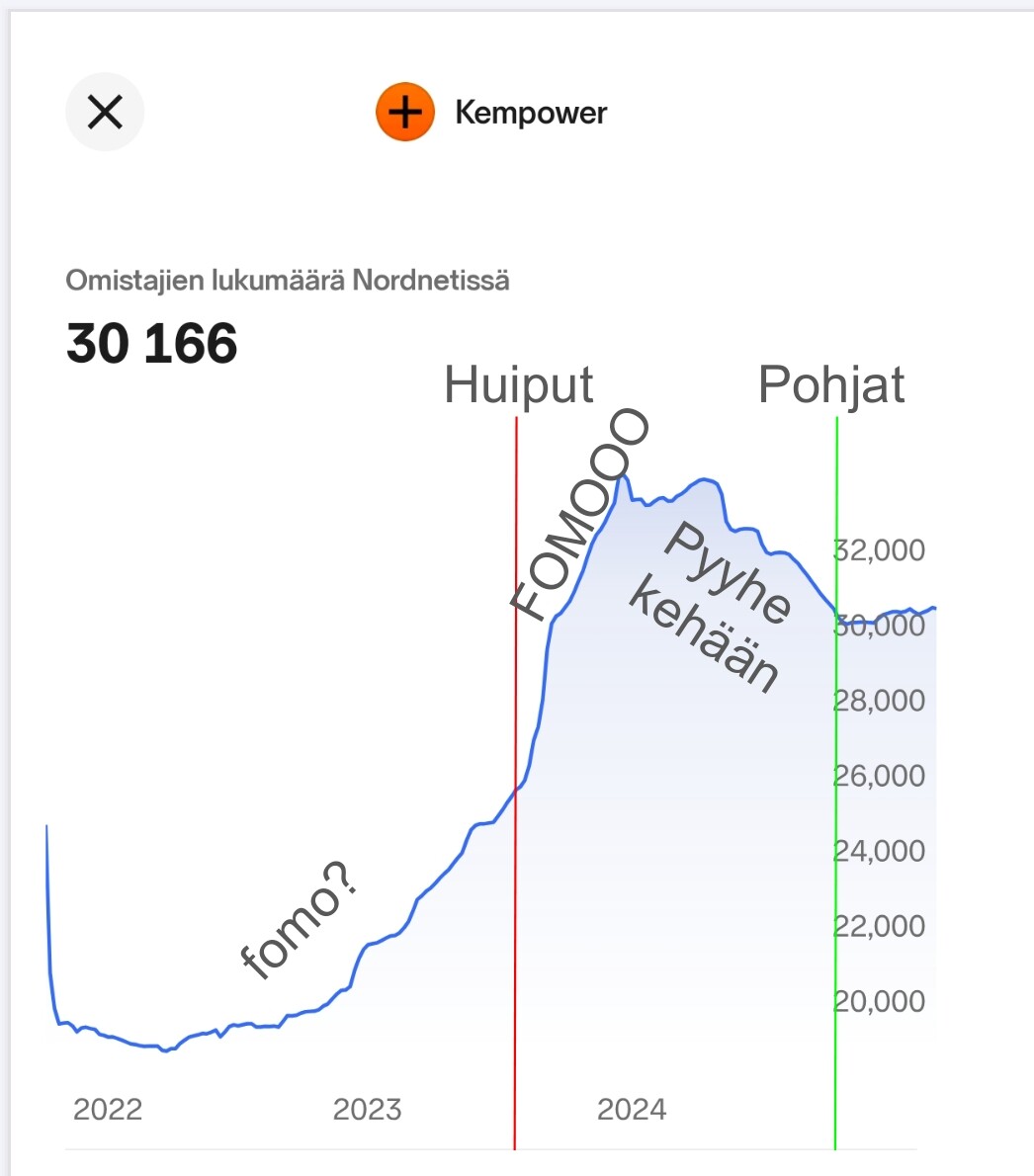
I’m not sure what the right thread for this topic would be. Has anyone else looked into Nordnet’s statistics on “owners in Nordnet”?
In my opinion, these provide a fairly good contrarian indicator for a price reversal.
A few examples. For Kempower, after the peaks, the growth in the number of new owners shifts to a new growth trajectory. When the bottoms were reached, the number of new owners turned upwards.
Then QT. Here too, after the peaks, new owners join in almost a year after the peaks, after which, sharply, with about a month’s accuracy at the bottoms, the number of owners turns downwards.

Of course, it’s good to note that Nordnet’s absolute customer base has also grown.
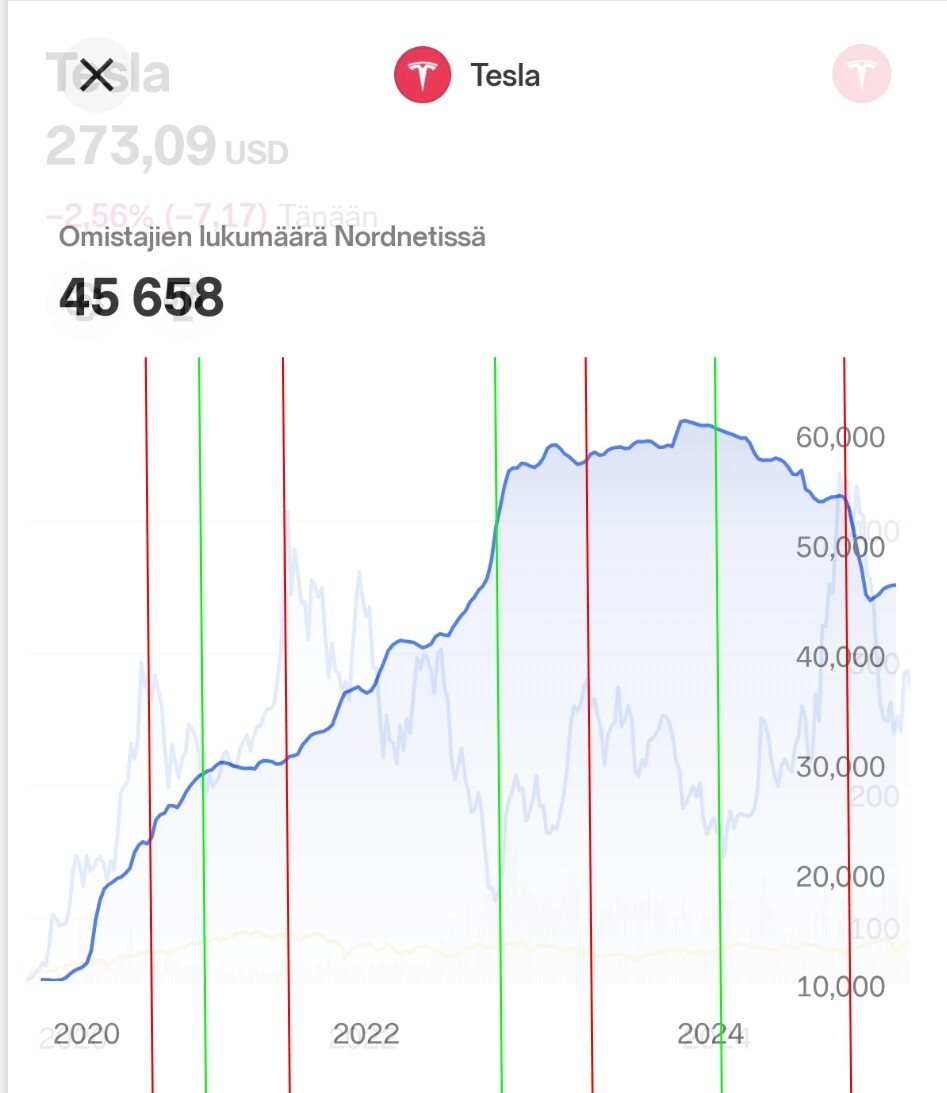
E. Let’s add one more.
So, Tesla. There has been quite a lot of volatility in recent years, so the pattern has worked, meaning that after the peaks, the number of owners grows until it starts to decrease at the bottoms. However, after the most recent peaks, selling pressure was observed, is the reason then Musk Trump🤷
Today, industrial statistics were released from Germany. German factory orders grew by 3.5 percent in March compared to February. Compared to March of last year, growth was 3.8 percent. The growth in industrial orders was already anticipated by the increased order books of previously published engineering companies.
These figures could be a sign of a turnaround in the industrial recession.
Industrial turnover grew by 10.4% in March 2025 | Statistics Finland
Statistical data published yesterday on the growth of Finnish industrial turnover.
Familiar strong content again on where the market has gone/is going!! 
Hopefully, these indicate a turnaround and are not anticipating tariffs!
I’m reading Etteplan’s update (Premium report itself, but there’s a lot of free info there), which talks about a direct investment slump. Etteplan is an engineering consulting firm that is commissioned for manpower in good economic times and less so in bad ones…
Things are so bad now that merely industrial maintenance investments are sustaining demand. This is, in a way… “bullish”.
“However, the company assumes that the market situation will no longer worsen from the current level, as according to the company, we are already in an “investment slump” and only industrial maintenance investments support the current activity level.”
I don’t know how much Etteplan tells about the overall economy, but such company-specific insights from the grassroots level provide an interesting situational picture.
Good evening everyone! Soon we’ll get the Fed’s interest rate decision. It’s unlikely that interest rates will be touched yet; rather, they’ll be pondering what happens next in the economy. But Powell can always surprise 
Indeed, a rate cut is not expected from this meeting, nor is it likely to be seen even at the June meeting, as the 90-day trade negotiation window will still be open then. The central bank is unlikely to make any move until there is some certainty regarding tariff levels.
Rates unchanged
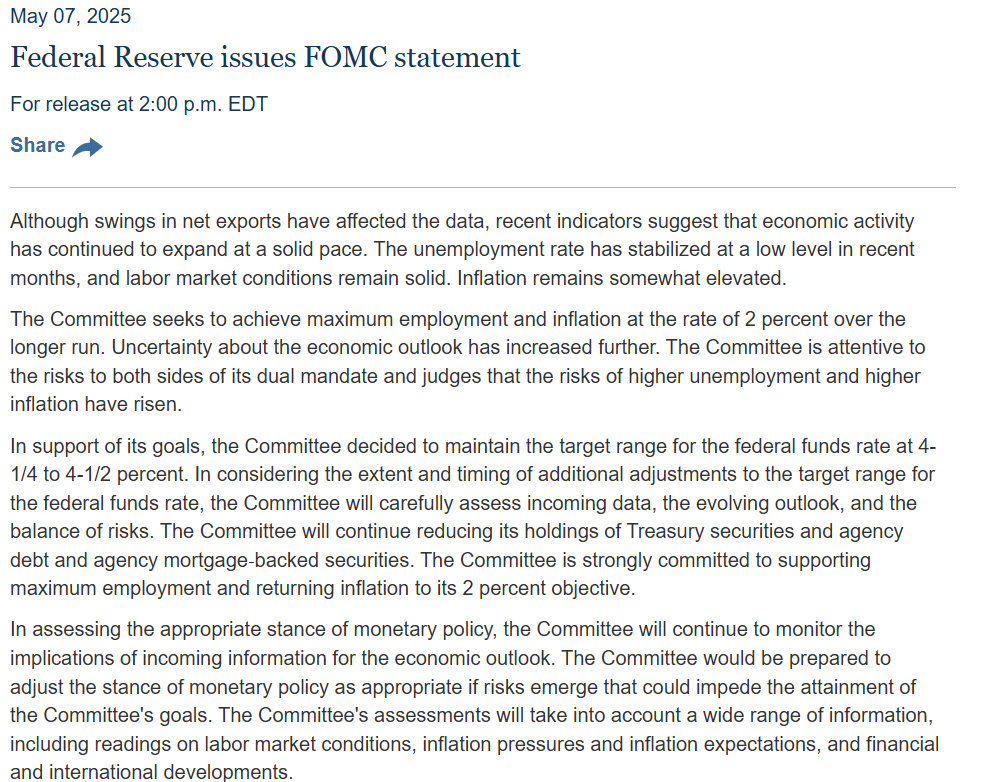
Apparently, stagflation somewhat influenced the decision, to which the bolded words have been added: The Committee is attentive to the risks to both sides of its dual mandate and judges that the risks of higher unemployment and higher inflation have risen. Otherwise, the central bank states that economic growth is still on a strong footing.
Apparently tomorrow morning, the Riksbank will also publish its decision, and the expectation seems to be to follow in the Fed’s footsteps, meaning interest rates would not be changed (?).
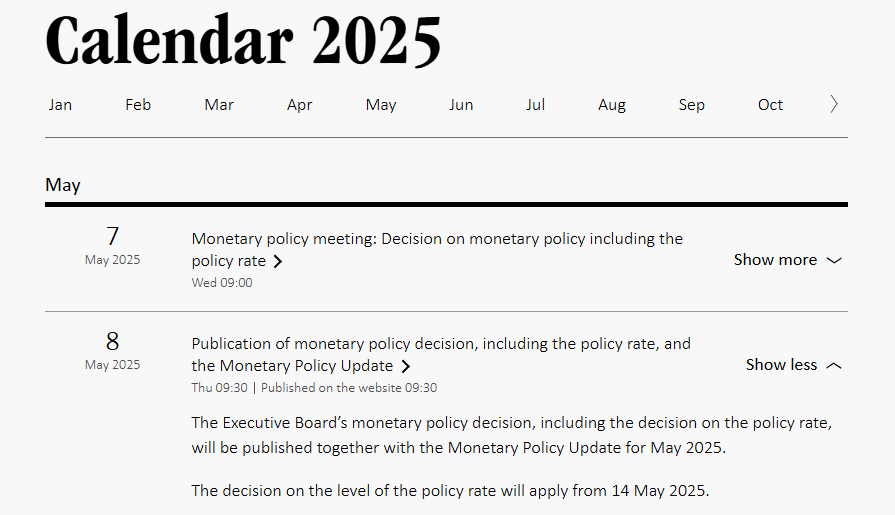
Exactly, no changes to the policy rate are expected from the Riksbank either.
Next, let’s see what Powell says at the press conference. Stock indices were falling, but that is likely due to the White House’s heated rhetoric rather than the Fed.
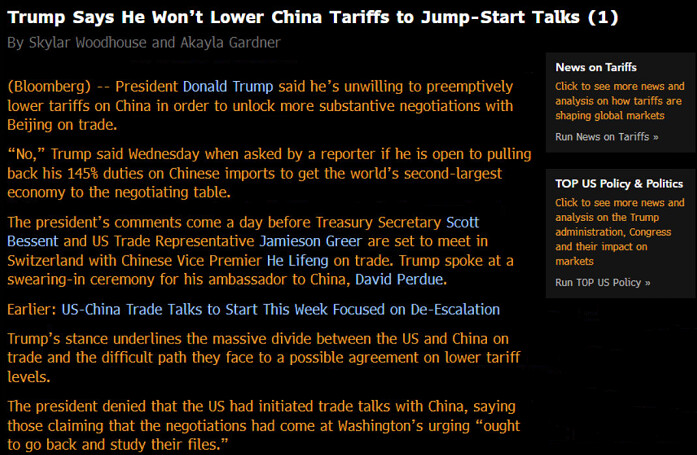
First press question about the mandate: which side needs attention first, employment or inflation. Powell states that monetary policy is now well-positioned, and it is still too early to assess the effects of potential tariffs, as nothing is certain.
From Powell’s speeches, it becomes very clear that everyone is waiting: companies, economic forecasters, the central bank…