Good afternoon to the thread! Tonight (note! already at 8 PM) we will follow the Fed’s interest rate decision, but due to my own commitments, unfortunately, I won’t be able to provide “live coverage” on the forum this time. Hopefully, there will still be plenty of discussion from other macro enthusiasts. Comments will be provided no later than early tomorrow morning. While waiting for that, here’s a preview of central bank expectations.
28 Likes
I think this article by Henri Huovinen fits well into this thread. 
BlackRock’s February report on exchange-traded product (ETP) investment flows provides a clear overview of investor behavior. Particularly, fixed income investments and European equity markets were significant attractors in February, while gold’s popularity continued to strengthen.
Subheadings:
- Gold’s popularity as a safe haven strengthened
- Magnificent 7 is in a bear market
8 Likes
In this session, I try to make sense of the chaos engulfing markets, and while the immediate cause may be Trump’s tariffs, I argue that what we are seeing unfold in politics and markets in the US and elsewhere is the coming together of two major trends. The first is globalization, an almost unstoppable force that has shifted how businesses and consumers behave over the last four decades, but is not facing a blowback that is largely deserved. The other is disruption, a weapon used by technology firms to alter businesses over the last two decades, but now being used in politics and government. I trace out the likely effects on markets, through interest rates and equity risk premiums, and on companies, where government and politics now become part of company stories (and value). I value Tesla with these cross currents playing out.


11 Likes
What the central bank did change, however, was its outlook on inflation and economic growth amid uncertainties stemming from some of President Trump’s economic policies.
Fed officials now see inflation staying higher this year than previously estimated and economic growth going lower than prior predictions.
Policymakers estimate that the core Personal Consumption Expenditures (PCE) measure of inflation will be 2.8%, compared with 2.5% previously.
26 Likes
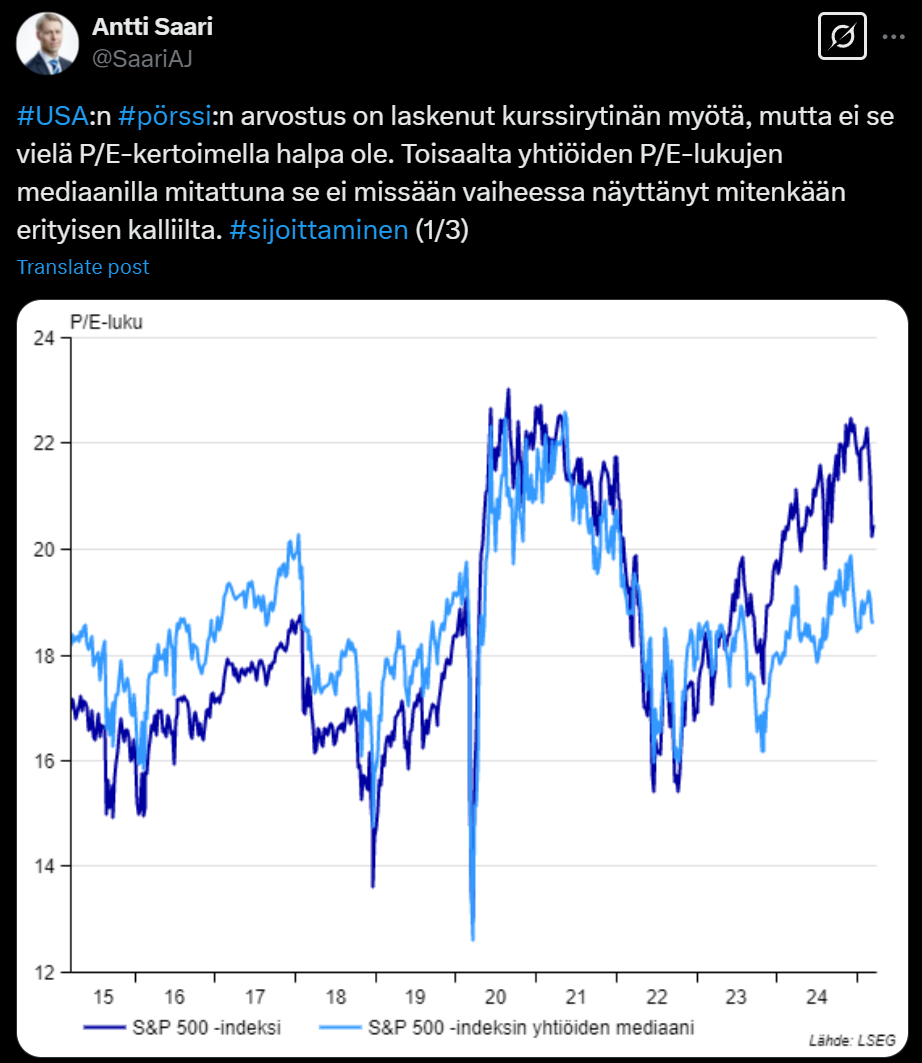
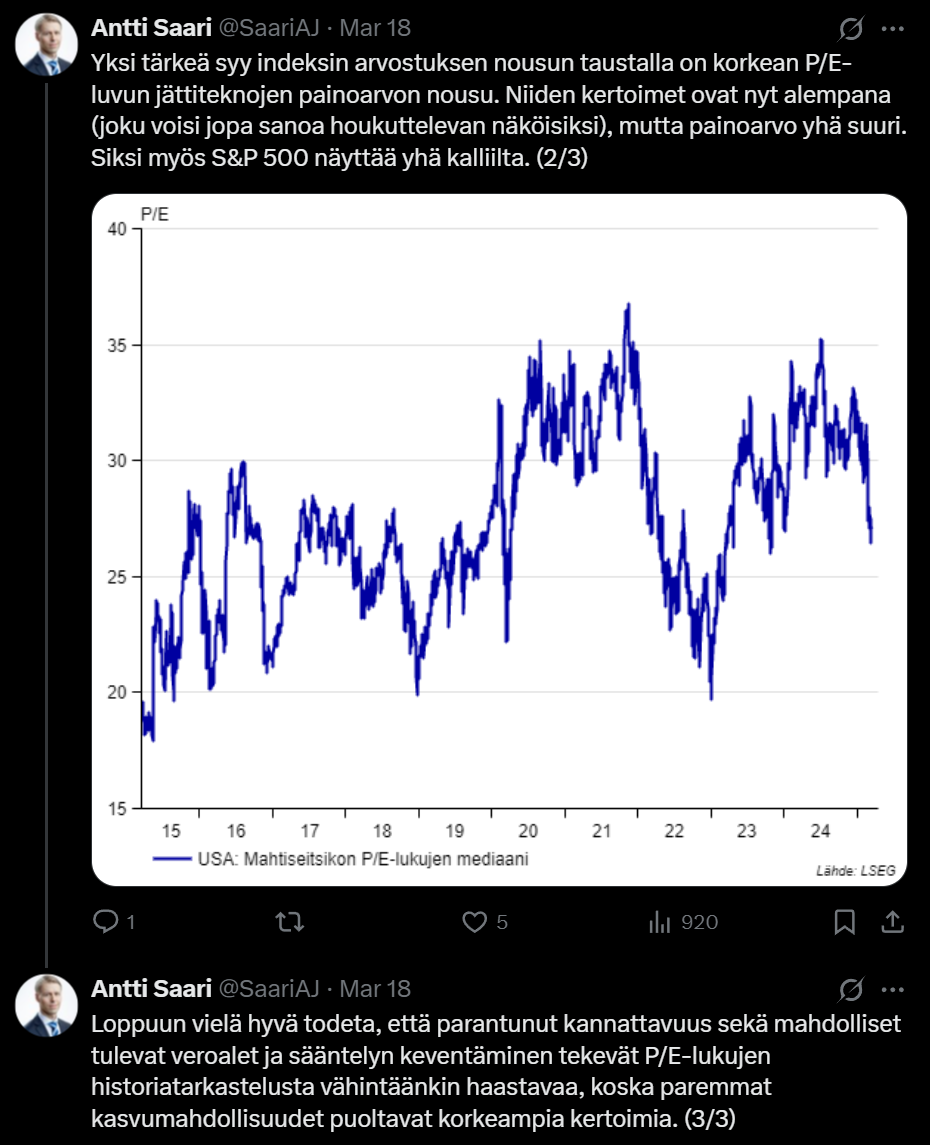
Hey, the SP500 isn’t expensive if you look at the P/E median. The reason for the high P/E is simply the increased weighting of the higher-valued M7 in the index. And even the M7 doesn’t really look expensive over a ten-year review period.
33 Likes
Does that first chart use either forward P/E or some adjusted earnings P/E? When you search for S&P500 P/E ratio online, no source shows a value as low as that chart. These free online sources certainly get their numbers automatically without any deeper analysis of the correctness of the figures, but even so, that P/E of just over 20 is significantly lower than these.
5 Likes
Good evening to the forum. I’ve put together an initial take on the interest rate decision, and it can be found below.
40 Likes
EUROPE 2.0
Throughout history, Europe has had to renew itself so many times that the title could very well have been “EUROPE N.0”, where N can be any positive integer. However, since I assume the majority of forum members have experiences of Europe from the post-World War II era, I ultimately settled on this title.
PARADIGM SHIFT
Over the past year or so, I’ve been writing in this thread about my concerns regarding how wine-marinated Europeans are lazying themselves out of competition. Since World War II, Europe has been built upon the founding values of the EU. These are
Human dignity
Freedom
Democracy
Equality
Rule of law
Human rights
However, the current global situation is such that leaders of major nations disregard these values in their decision-making. This has led Europe to a situation where these values, though noble and cherished, do not serve as assets in negotiations with these crazy characters. Unfortunately.
Germany’s chilling investment package is at the very least a sign that Europe has decided to change its tune. Some might even say, finally. If we had continued to lounge in sunbeds sipping sangria, it might have had consequences that would disturb social peace over time.
THERE IS MONEY - BUT WHERE ARE THE WORKERS
The situation is not easy even now. Instead of celebrating large investments boisterously in markets and squares, I believe it’s time to focus on how these investments will be implemented. These hundreds or even thousands of billions are such vast sums that before we start shoveling coal into the furnace en masse and letting the lame cackle, we need to consider which capabilities and parts of the production chains are in a state to receive these enormous investments without, for example, inflation getting completely out of hand.
Even though there’s money now like robbers have chiefs, someone also needs to do the work. Aging Europeans in their wine fumes are unlikely to do it alone. Although artificial intelligence, robots, and AI agents are making rapid progress, as @Sijoittaja-alokas clearly explains in the GTC summary, I believe that labor will also have to be sought from outside Europe. This, in turn, brings challenges to social order, and the integration of new employees becomes key. Germany already learned this the hard way starting from the 60s and 70s when they began bringing workers from Turkey for low-wage sectors.
TRUMP’S PLAYBOOK
I spoke with a NATO employee yesterday, and before getting to the main point, it should be noted that they are reportedly quite disheartened, as the previous 3 years were dedicated to everything for Ukraine, and now there’s suddenly a complete turnaround. They seem to lack a mission at the moment.
However, he offered an interesting perspective on whether there might be a common thread in Trump’s seemingly erratic bouncing around concerning Europe. This topic has surely been discussed in the USA thread or other politics threads, but since I’ve decided not to go there for my own mental health, these thoughts come as they are.
Generally, I am under the impression that Trump’s ultimate adversary is China. That would explain the fraternization with Putin, as well as the tariffs on Canada and Mexico, through which he tries to prevent China from accessing the US market with its products.
This NATO man, however, brought an interesting perspective on Trump’s attitude towards Europe. The former carrot-top has apparently been frustrated that while Europe has cherished its aforementioned values during its long summer holidays, the USA has had to foot the bill by taking care of Europe’s security. Of course, Europe has somewhat assisted the USA in the China competition, for example, by preventing ASML from doing business in China. In any case, Trump was already yelling during his previous term that Europe should increase its defense budget, and now he seems to have succeeded. At the same time, this strengthens Europe, and China gets even stronger combatants.
What I don’t understand in Trump’s erratic tantrums, however, is that because of his behavior, Europe is now quite reluctant to make acquisitions for its defense industry from the USA. We’ll have to see if this ever changes.
Europe will still need the USA, at least according to Pekka Toveri, in the leadership of combined armed forces. I recall him talking about this during his last visit with @_neuvottelija_Sami_M.
(It would be advisable to continue the Trump discussion in the USA thread if someone wishes to do so)
INVESTOR’S MOVES
Although the market, judging by yesterday’s reaction, seems to think that all investments will flow to Rheinmetall (Of course, today there seems to have been some kind of ‘sell the news’ phenomenon), it is clear to me that investments will spread very widely across the European economy. Investors now have interesting times trying to guess when investments will start to show in results, and classically 12-18 months before that, in stock prices.
I strongly resonate with the ideas presented by user @Jackfin in the German Stocks thread. When Germany’s investments eventually begin, companies that derive their revenue from Germany will certainly benefit. These seem to be found more among smaller German companies across the board. Additionally, it’s worth considering which industries and parts of the supply chains will be the first to be capable of receiving these large handouts.
Also, the hesuliitat© will join the party at some point. 
72 Likes
It does.
…
1 Like
The good thing about Forward P/E is that if actual results make things look expensive, by just adding more earnings growth to forecasts, the Forward P/E can be made to look cheap and people will buy. You can even make it P/E 10 now if you want.
The S&P500 is predicted to be, on average, 6600 points at the end of the year, with the most bullish expecting 7100. I somewhat suspect that forecasters are consistently too bullish. My own forecast, which is based on nothing but a gut feeling, expects 5000 points at the end of the year. This probably won’t be accurate because forecasting is difficult, if not impossible. If it hits, it’s luck.
24 Likes
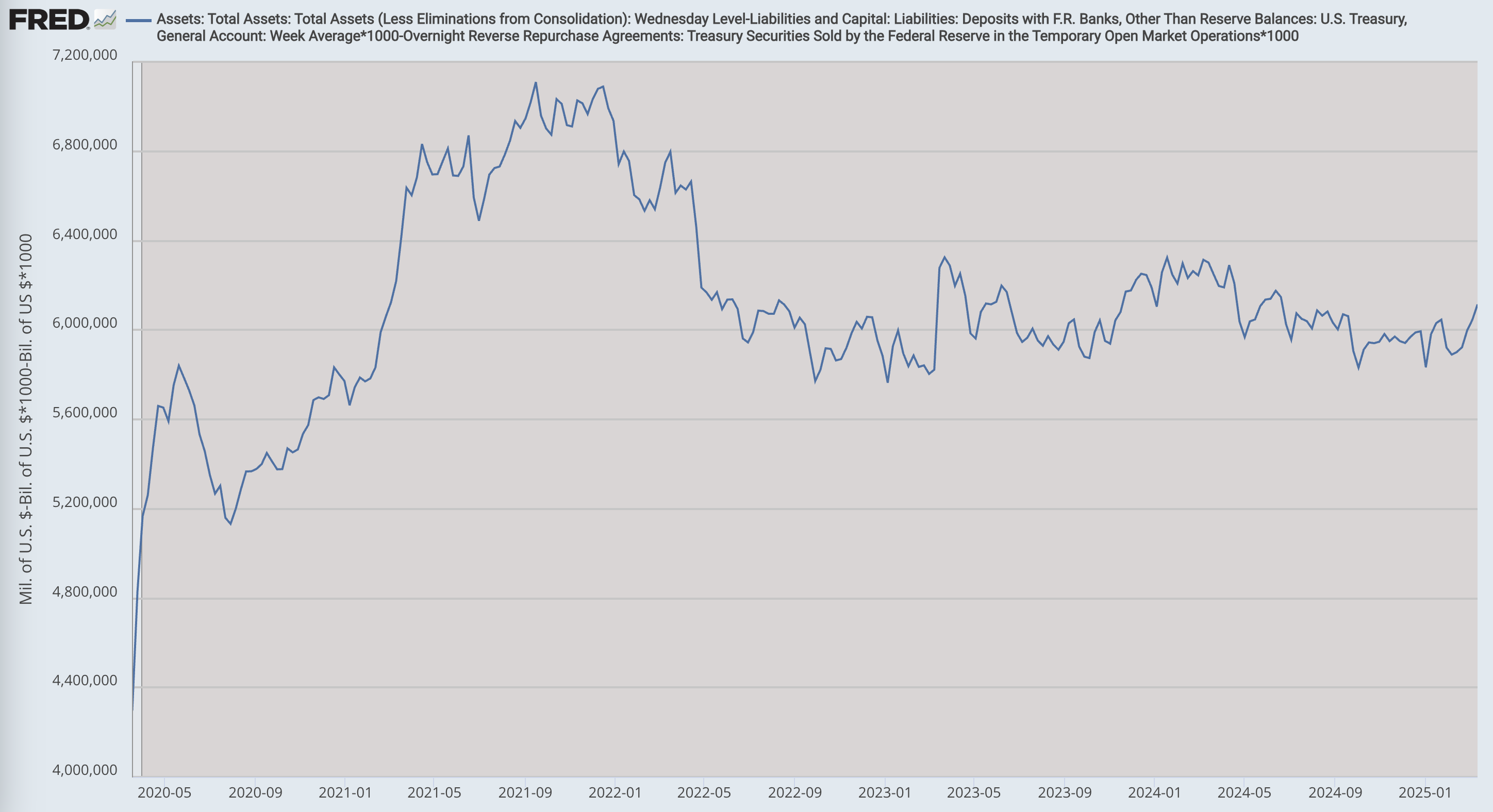
The Fed’s interest rate decision has already been discussed here, but I don’t know if people noticed how QT was slowed down there. I have been repeating for a long time in Vartit that the slowdown of QT is some kind of official forecast for this year, even in the forecasts of the Federal Budget Office. 
The Fed’s net liquidity has developed favorably for the market, but with the current pace, this would have turned downwards again, tightening market liquidity.
Good liquidity = better sentiment for stocks, especially in the United States.
42 Likes
Jukka’s and Tuomas’s latest market review!! 
12 Likes
I don’t know if this is the right thread, but soon there will be an opportunity to listen to Puttonen’s views on InderesTV: Säästöpankkiryhmän Markkinaluotain: Mihin sijoittaa vuonna 2025? - Inderes
36 Likes
In contrast to the joy of Europe’s awakening, competitive pressure from China continues to grow.
The German automotive industry is a known pain point, but the Chinese are challenging increasingly sophisticated sectors such as chemicals.
"There has been less awareness, however, of China’s growing threat in other economic sectors. Chinese chemical giants, for example, have significantly increased their output in recent years, particularly in polyethylene and polypropylene, leading to a global oversupply that has driven down the profit margins of German producers like BASF.
Even in the European Union, a key market for Germany, China grew its share of chemicals exports in the decade to 2023 by 60%, while Germany’s share fell by more than 14%, according to data from the Handelsblatt Research Institute.
Germany’s mechanical engineering sector, known for its precision and quality, is also facing stiff competition from Chinese rivals. While Germany’s market share of industrial machinery exports declined slightly to 15.2% from 2013 to 2023, China’s share grew by more than half (from 14.3% to 22.1%)"
Massive state subsidies help the Chinese. The Darwinistically fierce competition among Chinese companies at home destroys many of their own firms, but those that survive that competition become dangerous monsters when they set out to conquer markets abroad.
“A conservative estimate found that China’s industrial subsidies in 2019 amounted to around €221 billion ($242 billion). A 2022 report by the International Monetary Fund (IMF) found that the majority of Beijing’s subsidies targeted the chemicals, machinery, automotive, and metals industries.”
The competitive pressure on German and European firms is increased by the fact that if the United States becomes increasingly protectionist and China at the same time does not correct the structural flaw in its economic model, i.e., excessively low domestic consumption, Chinese firms will spread to compete in other world markets.
However, I don’t believe Europeans, Indians, Japanese, etc., want to lose their industrial jobs, so most likely, as this scenario escalates, Chinese firms will start to be blocked with tariffs and by citing security concerns.
44 Likes
Extremely interesting thinking from Russell Napier again. The article was published in December, but I recently came across it in Blumma’s email.
Briefly summarized. Russell believes (still, I’ve occasionally brought up his articles here for years) that states will inflate away their debt in the long run. The current monetary system will fragment, and trade will break down into blocs. It is in the interest of states to bring money invested abroad back to generate returns and strengthen the domestic economy and production, while slowly but surely burning the purchasing power of bond investors and cash.
This trend could have bumpy consequences for an index like the SP500, which has become a kind of parking lot for the world’s excess savings in recent years. This parking lot for foreign money may empty as money is directed back to its own domestic economies.
He believes investors should own gold, but a large part of the portfolio should be in stocks. But not in large American ones!
Which equities should one own?
This is rather tricky. Because if we move into a world where every developed world savings institution has to repatriate assets to buy bonds of their own government, they will need to liquidate the one asset they have all crammed into in the past years: the S&P 500. Over the past years, all the world’s institutional investors have crowded into large-cap US equities. If they are mandated to own domestic assets, they would be forced to sell US assets. So you would not want to own the S&P 500.
But in domestic ones:
What should you own then?
Equities that won’t be liquidated, because they are not overly represented in the portfolios of institutional investors. The unloved, underowned assets: mid and small caps, as well as value stocks. Also, I’d look out for equities that benefit from the global capex boom. Japan offers many of them. The typical fund manager today has 40% in bonds and 60% in equities, of which more than half is in the S&P 500. They’re all crowded into the same assets. In order to do well in the big structural change that I see coming, you have to be radical in your portfolio. No bonds, no S&P 500. Buy equities that no one wants today, and own much more gold. Conventional wisdom will declare the quantities you own of these assets risky while accepting that the assets you own are not particularly risky. This is the position that has always rewarded investors when a major structural change has come along.
53 Likes
This would be a great idea for Finland. Let’s use the money from the Tyel fund to buy back Finland’s foreign-owned government debt, so Finns would no longer be indebted to foreigners. At the same time, a proper reform can be made at the state level.
I don’t know if politics belongs in this thread.
1 Like
The passage was now confirmed in the Bundesrat.
For stocks, this is of course “sell the news” after “buy the rumors”.
I’ve been excited with stimulus glasses on for the past few weeks, as this turn of events should provide solid support and structures for German and European economic growth.
One of Europe’s biggest problems has been a stingy Germany, and now suddenly its wallet is open.
Even though one problem has been removed, other threats can always be painted on the horizon.
The US’s reckless trade policy. Will the waves of the trade war hit Europe so badly that the stimulus will go towards offsetting the damages caused by them?
Or will the stimulus fuel inflation? I would primarily think, however, that defense spending and other stimulus will fuel productivity, as there is already a shortage of labor in parts of Europe. The unemployment rate in the eurozone is relatively low, around 6%.
And what’s happening in China? The country has started to increase its own stimulus rounds, but will there be more competition from there that erodes the margins of European companies in the future?
A kind of über-euro-bull scenario would be that the United States does not fall into recession, but capital gets scared and flees from there to Europe, Europe stimulates and at the same time China also stimulates, which in turn benefits many Eurozone economies that have a lot of business and exports in China. On top of this, if the war in Ukraine ends in some viable way for Ukraine, the “cold war 2.0” continues (forcing Europe to continue a stimulating policy), but gas flows from Russia to Europe again, pushing down energy prices.

51 Likes
And then, if the Eurozone starts getting similar multiples for companies as in the US, we can retire.
7 Likes
And to this could be added that the EU:
-burdens EU companies with its regulations
-the price of energy in the EU is truly burdensome, especially for energy-intensive industries, such as the chemical industry, steel industry, etc.
… whereas China, India, USA, etc. show a lighter level of ambition regarding, for example, environmental costs
… and even ‘enjoying’ Russian energy
Try to compete against imports in relatively open EU markets, and succeed in export markets against environmental free riders.
15 Likes
The price of energy is a clear weakness in the resource-poorer EU, with cheap Russian gas largely out of the picture.
Regulation is ultimately a difficult debate regarding how it affects the economy.
For example, generally speaking, the EU has clearly stricter labor laws and labor markets, consumer protection, and environmental regulation. On the other hand, the United States has stricter banking regulation or pharmaceutical regulation (investors on the forum may have noticed how CE marks are quickly obtained in Europe, but while waiting for FDA approvals, money burns on paper and nails are nervously bitten). In Europe, the general attitude is to regulate harms proactively, whereas in the United States, they look retrospectively at how things splashed and slap on terrible fines if they splashed in the wrong place.
And even if others, for example, do not regulate environmental matters as strictly, I would surmise that this also creates costs for society. In the EU, the construction of a new factory might be delayed because a hundred permit issues need to be clarified and the flight paths of flying squirrels taken into account. But in China, soil and nature might be destroyed in a way that may not immediately show up in GDP but burdens the environment and local population. In a command economy, everything looks efficient, but how well did the Soviet Union ultimately succeed in taking these external harms into account?
There has always been a lot of regulation. For example, this excellent work on Finland’s economic history sheds light on how companies regulate themselves (seeking a monopoly position) if the state does not. A completely regulation-free economy is something that probably has never existed. Everyone has an interest in restricting competition, except for nascent companies that want to challenge old stalwarts.
The common joke ‘USA innovates, China copies, and Europe regulates’ probably holds true to some extent, just as many good jokes contain a credible seed of truth.
44 Likes