Stock Market Direction (Part 2)

Yep, we’ll see. So far, I haven’t seen any news about that (if there were, the UK example would certainly have brought them up). Interest rates have been higher in the US, so the change hasn’t been as drastic.

Here’s a good explanation of how the Pivot would already start yielding returns. Stock valuations still reflect a higher interest rate level, which may not necessarily be the right long-term sustainable level.

https://twitter.com/timmerfidelity/status/1582735367949516800?s=21&t=-DlkPhWGrRKU9SZmdDQxIg

5 Likes

The following is pure speculation: one would think that the average length of pensions there would also be longer than that of loans. That is, the maturity of pensions is clearly greater than that of available bonds. In this case, rising interest rates would make it easier to meet future obligations.

Verifying the above would require suitable data (which one would think would be available).

3 Likes

Bullard is the rogue on the Fed’s board, considered an “out of the box” thinker. He was the first to advocate for large 75-point rate hikes. In a recent Bloomberg interview, he states that rates should be raised proactively early next year, and then they’ll assess based on data how to proceed. The rate can be kept at a high level for a long time, but even he wouldn’t want to go overboard.

https://www.bloomberg.com/news/articles/2022-10-19/bullard-says-fed-must-follow-through-on-anticipated-rate-hikes

22 Likes

German producer prices still rose by 2.3% month-on-month, significantly exceeding forecasts. Year-on-year, it’s 45.8%. The ECB, on the other hand, is proceeding at its own calm pace…

3 Likes

https://twitter.com/LiveSquawk/status/1583073511236464640

Where are the recession and unemployment? The brrrr-device (quantitative easing) is being buried deeper into the FED’s closet again.

Immediately, half a percent of my portfolio disappeared again, at least for a moment, because there isn’t enough unemployment in the US. :grimacing:

23 Likes


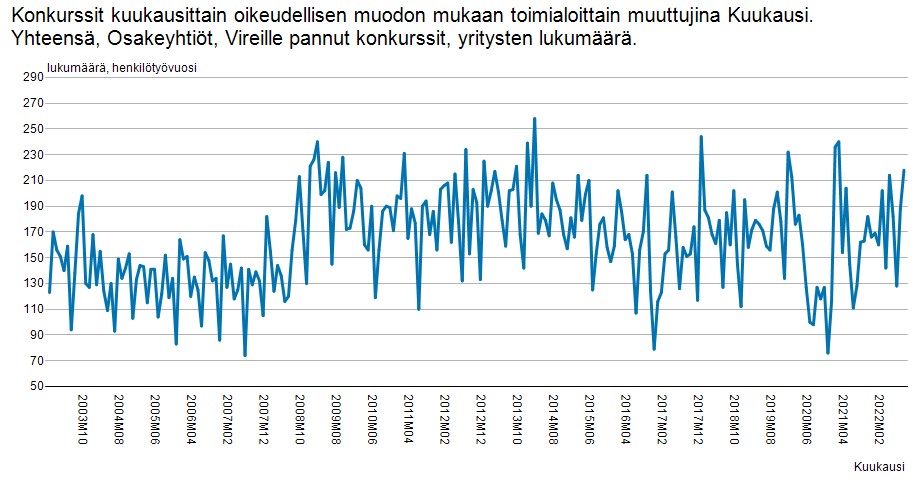
Excerpt from a diagram created by Statistics Finland, no significant change in limited companies in the overall picture.

5 Likes

As I stated, the trend needs to continue for it to be a problem. If this happens, it will be more clearly visible in a 20-year graph like this (cf. e.g., the 2008 financial crisis). Looking at the same issue over a shorter period might give a better picture of the development.

If you look closely, a budding peak seems to be visible already. The graph has been higher only three times in the last 8 years.

2 Likes

The stock market doesn’t seem to be reacting much to that. Of course, my understanding is that earnings usually start to erode first, and then employment weakens, so that too is a bit of a lagging indicator. Initial jobless claims also slightly exceeded expectations.

A recession has been predicted over and over, but what if the US economy can withstand the interest rate hikes for now? This is supported by public stimulus and strengthened balance sheets and earnings after the COVID-19 crisis.

If I recall correctly, last year there was talk of a “growth scare” phenomenon where investors get spooked by a slowdown in economic growth. Then inflation gradually steamrolled that fear.

It’s another matter how the rest of the world will withstand this strong dollar and tight monetary conditions…

Or perhaps we are in an early stage similar to the stock market decline of the early 2000s, where stocks are already falling, but problems aren’t yet visible anywhere else.

24 Likes


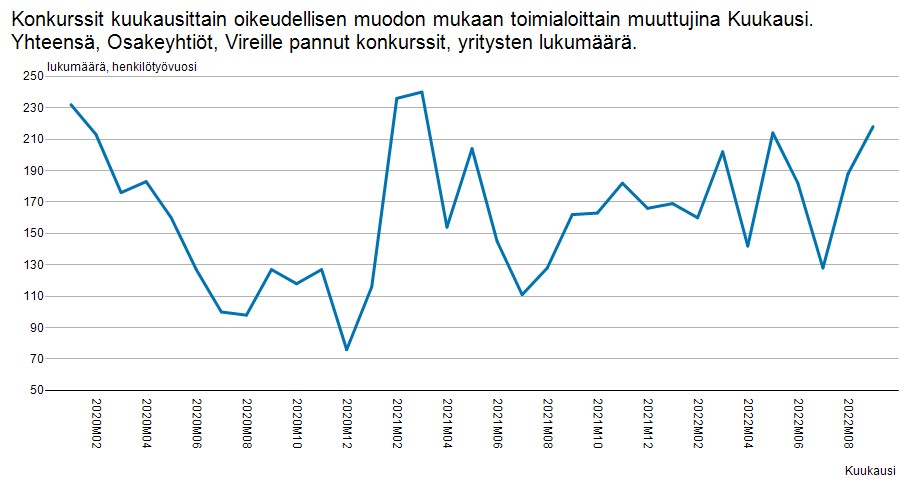
Yes, I agree. Here’s a chart from the beginning of 2020 for those interested.

2 Likes

UBS’s article on the housing market and house prices in selected cities.

Stockholm ranks 12th in the global comparison.

https://www.marketwatch.com/story/ubs-has-released-its-annual-house-price-bubble-report-here-are-the-most-overvalued-markets-11666262185?siteid=yhoof2

You can read it in Chrome’s Incognito mode.

4 Likes

Regarding those increased bankruptcy figures. Wasn’t filing for bankruptcy practically completely prevented during the COVID era, making it quite natural that companies that didn’t go bankrupt for a couple of years are now filing for bankruptcy, leading to an increase in numbers?

Move this to another thread if it’s not a relevant enough comment for the stock market direction thread.

8 Likes

Rising interest rates, e.g., the US 10-year from 4.0% to 4.2% this week, haven’t caused as sharp a drop in indices as, say, the previous rise from 3.8% to 4.0%… just by feel.

Could it be that good earnings reports from the US are now supporting the index and somewhat offsetting the effect of rising rates…?

Hmm, it’s very interesting…

27 Likes

Well, today some loudmouth from the FED opened their mouth again, and interest rates surged, salting the day’s rally a bit.

https://twitter.com/FirstSquawk/status/1583126529466585089

https://twitter.com/FirstSquawk/status/1583126563234930688

https://twitter.com/FirstSquawk/status/1583126602543927296

These statements effectively killed the day’s bounce, and we’re back to square one.

However, the lows still seem to hold, so maybe that’s a positive.

15 Likes

That last tweet’s story sounds a bit like a “cherry-picking” scenario. It would certainly be acceptable as is for the stock market… but it would still be based on a recession.

3 Likes

I’m slowly starting to lean towards the idea that the big tech sector will announce good results and reasonably good outlooks. The Fed will announce a 1% interest rate hike in November, which will send stock prices plummeting. I don’t wish for it, as I have a long portfolio, but the cash portion won’t be deployed until November. This feels like the most likely option. It’s not a forecast, just a feeling.

31 Likes

This strong earnings season so far may not be the problem; Q4 and next year might be…

A good chart from Nordea:

https://twitter.com/mikaelsarwe/status/1583095735121104897?s=21&t=99vCMxRR0Qr19kphwGPNJw

However, at the same time, there are moving parts. For example, if the economy melts down, inflation turns, and interest rates can fall —> that eases the situation, although if earnings fall significantly, stocks usually don’t withstand it.

I was just thinking yesterday during my walk about how chaotic the current situation is. There’s been a massive economic boom, COVID-19 messed things up, there’s a war going on, the inflation paradigm has changed, the direction of economic policy has changed, etc.

30 Likes

What is Nordea’s chart trying to communicate?

6 Likes

It juxtaposes the Philly Fed index, which somewhat describes the economy (slowly changing parts have been dramatically removed from it), and the S&P 500’s earnings growth.

Note: the Purchasing Managers’ Index hovers around 50, but S&P 500 EPS growth has been forcibly hammered in as a % change, which makes them appear to go hand in hand.

The point is that as the economy grows/slows down, earnings do the same, and now expectations have not fallen (red line).

17 Likes

Thanks for the answer, it clarified things. EPS expectations (red) and Philly Fed (dark blue) continue into 2024. Both are expectations. Interpreted this way, the expectations of economic drivers and investors differ sharply. And usually, actual EPS has followed economic expectations quite well. Indeed, the coming year doesn’t look good for results. Is this a “deception market” when EPS expectations look better :wink:

11 Likes

The stock market always looks through both the windshield and the rearview mirror.

How much of the former and how much of the latter there is at any given moment varies.

The market is most astute when it looks through the windshield as much as possible. It receives the least flattering evaluations when it looks through the rearview mirror to an exceptional degree.

Looking Through the Windshield:

Consider, for example, the year 2000. Stocks in the hottest sectors have insane expectations built into them.

An investor hears a juicy anecdote from a friend. The friend works in a hot sector where changes in customer activity are visible first.

The anecdote is that for the first time in a long time, customers have become just a tiny bit less active. It’s not yet visible in what companies report or announce.

The investor sells their shares.

Looking in the Rearview Mirror:

All the latest news flow and data represent this rearview mirror department.

Suppose the economic situation is dire. However, the market’s antennae pick up the very first weak signals that the worst might be over.

The market begins an uncertain, seesaw rally as the windshield and rearview mirror themes vie for dominance day after day.

Lagging data strong, economy likely not yet in recession in September, leading indicators point to recession

The U.S. economy looks quite strong when viewed from the rearview mirror. Through the windshield, a recession is visible, i.e., a situation where…

  • real income generation, adjusted for transfers
  • retail sales volume
  • industrial production volume
    and
  • employment

…weaken in interaction with each other for more than a few months.

A recession does not mean that a “strong” economy becomes “weak.”

A recession means that a stronger economic situation becomes significantly weaker through the aforementioned process.

In most cases, this does not involve tremendous drama.

My recession guess is, of course, just one guess among many, but I still hold firmly to it.

26 Likes