Stock Market Direction (Part 2)

Yep.

The fact that a recession “solves” inflation is not necessarily a gentle path for stocks. At least for most stocks.

And, central banks and governments are unlikely to come to the rescue immediately, as they went overboard last time. :smiley:

Time will tell if we get a 2018-style industrial recession that hits cyclicals and less so tech, which has already been punished quite a bit…

9 Likes

A few picks from this morning’s Vartti.

I tried to explain as simply as possible why persistently high inflation makes stocks practically radioactive waste.

Still, the market’s basic assumption doesn’t seem to be that inflation will remain high, but if it does for one reason or another, stock valuations would be something else.

It’s probably clear to everyone why bonds perform poorly in inflation: a 5% interest yield in 10% inflation is not a good return.

Stocks can be compared to interest rates: an investor buys a share of a company’s equity (either at, above, or below book value. Usually above nowadays, the Helsinki Stock Exchange trades at about 1.7x its book value). The ROE of listed companies in the US has hovered around 13.5% for the last 30 years, and in Finland, it’s been above ten since the financial crisis.

If inflation is 10%, is a 10% “coupon rate” good? No, it’s not. :smiley: And listed companies cannot automatically increase the return on equity.

Stocks are not a good hedge against inflation!


One chart of the day for good measure: industrial orders are melting worldwide.

27 Likes

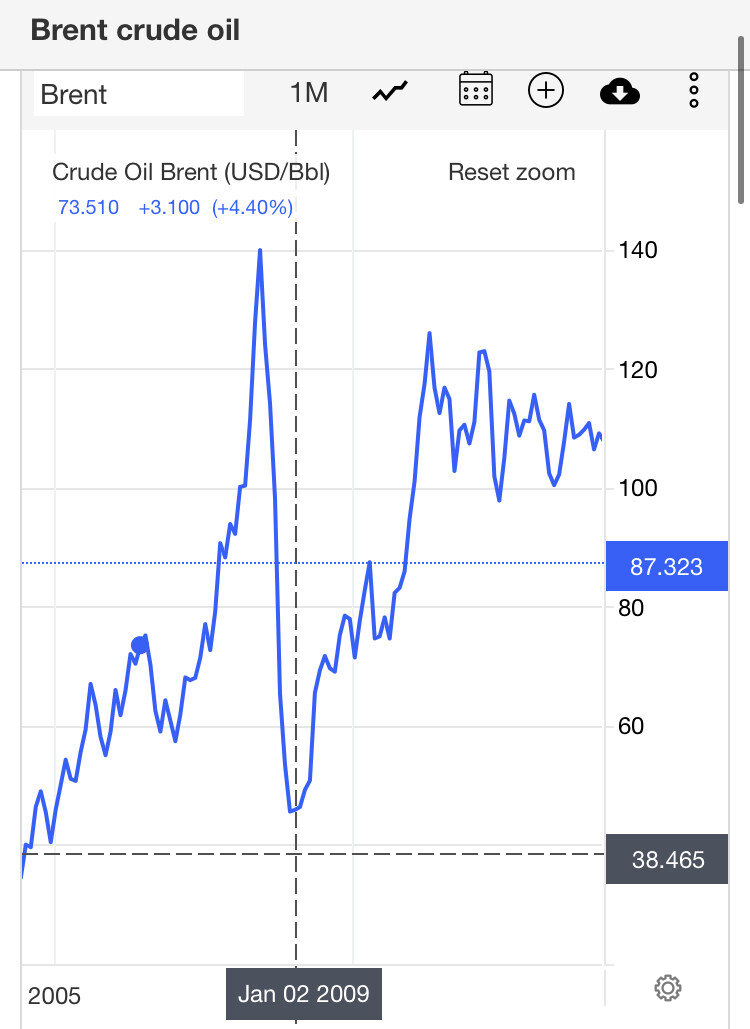
A recession also does not solve the supply-side problems of energy :grimacing:.

So, if we assume that the current decline in oil is due to China’s lockdowns and demand destruction, this could signal to producers to hold their horses on capex. Well, China’s COVID policy will ease at some point, possibly later this year after the elections, and the same will likely happen with the US SPR drawdowns. This doesn’t mean it will trigger a price increase if the recession continues and consumption is contained, but we somehow need to get out of this recession, and at the same time, all industry experts predict rising demand for another 10 years, especially driven by population growth and developing countries.

The same play is on the copper side, by the way. So, inventory data makes it look like we are in a perpetual recession, and what if we are not? The exit from there might not be very smooth in due course if we don’t solve our problems before then.

6 Likes

Thanks for the good summary. We can consider what is a good inflation hedge against 10 percent inflation :slightly_smiling_face:
Different sources have now trashed cash, real estate, forest, stocks, and bonds. Does that leave only things like these?


2 Likes

Thanks.

Real assets tend to float along. The problem with forests and real estate is likely that in a zero-interest-rate world, their value rose ridiculously high (expected returns collapsed).

The same applies to stocks. A growing, profitable (ROE/ROIC >20%) listed company with cheap (P/E less than 10x) multiples will keep your money safer.

But precisely those kinds of companies were in a massive bubble, and their multiples have melted as interest rates have risen. :smiley:

Interestingly, gold hasn’t risen much either, which would suggest that people don’t believe in sustainably high inflation. Of course, gold is a relatively small market.

3 Likes

The market, as I understand it, doesn’t expect any big surprises.
So, if one comes - the reaction could be strong…
… down in a negative message

KL 8.9.2022

European Central Bank Holds Meeting

Market participants have been awaiting today’s meeting of the European Central Bank (ECB), whose interest rate decision will be announced at approximately 3:15 PM Finnish time.

According to economists’ forecasts collected by Bloomberg media, most expect an interest rate hike of 0.75 percent, but some estimate the increase to be 0.50 percent.

Interest rates are being raised to curb inflation, i.e., the rise in the general price level.

In addition to the size of the interest rate hike, market participants are interested in the ECB’s views on future economic growth. In June, the ECB predicted that the euro area’s real gross domestic product would grow by 2.1 percent in 2023.

US Federal Reserve (Fed) Chairman Jerome Powell will deliver a speech today, which will be scrutinized for clues as to how aggressively the Fed intends to tackle inflation.

The good thing about forests is that if there is no acute need to realize profits, the forest can usually grow in peace for another 10 years, waiting for better times, unless it is an overaged forest where growth has already slowed down or rot damage threatens - or unless storm, snow, or pest damages require intervention.

6 Likes

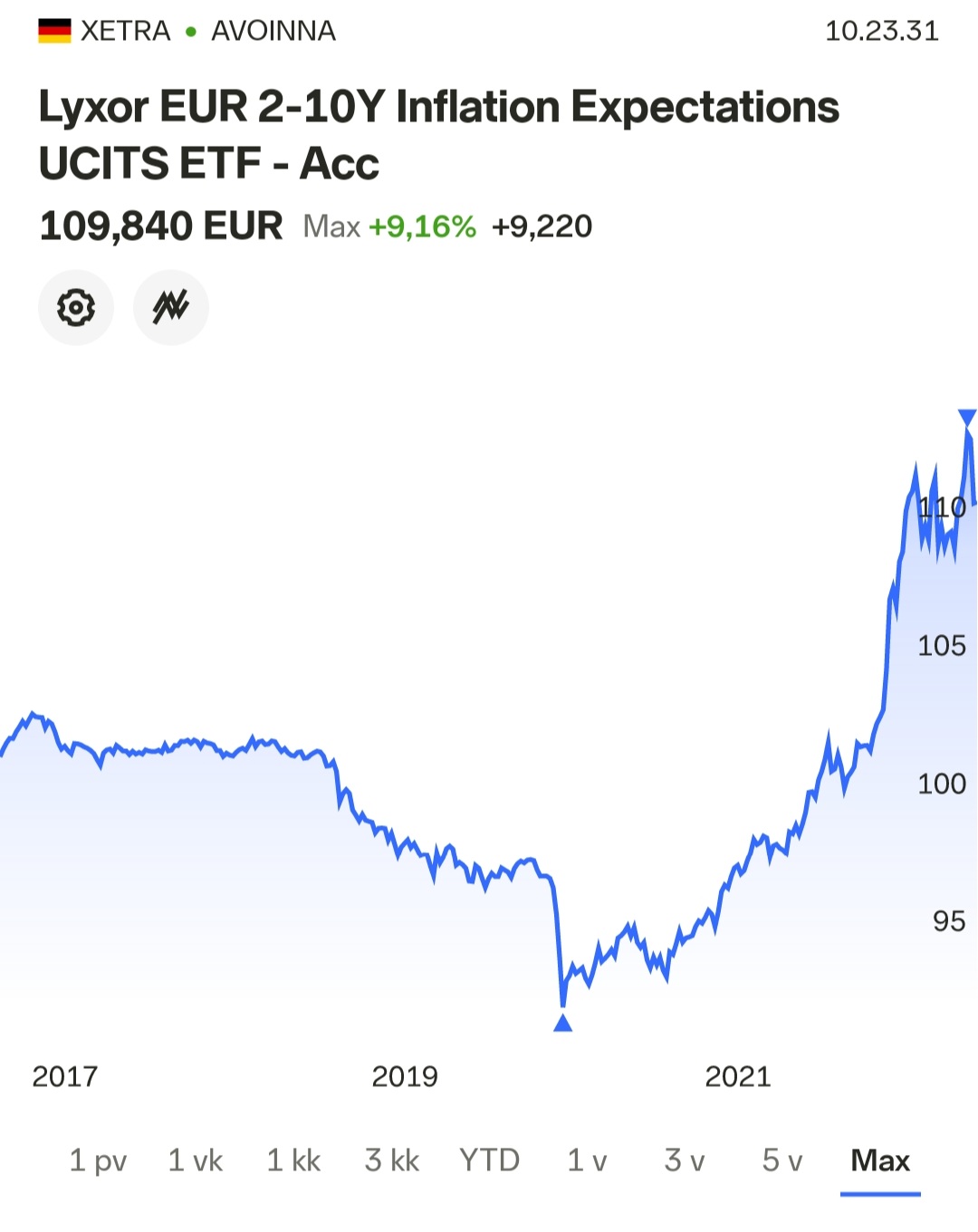
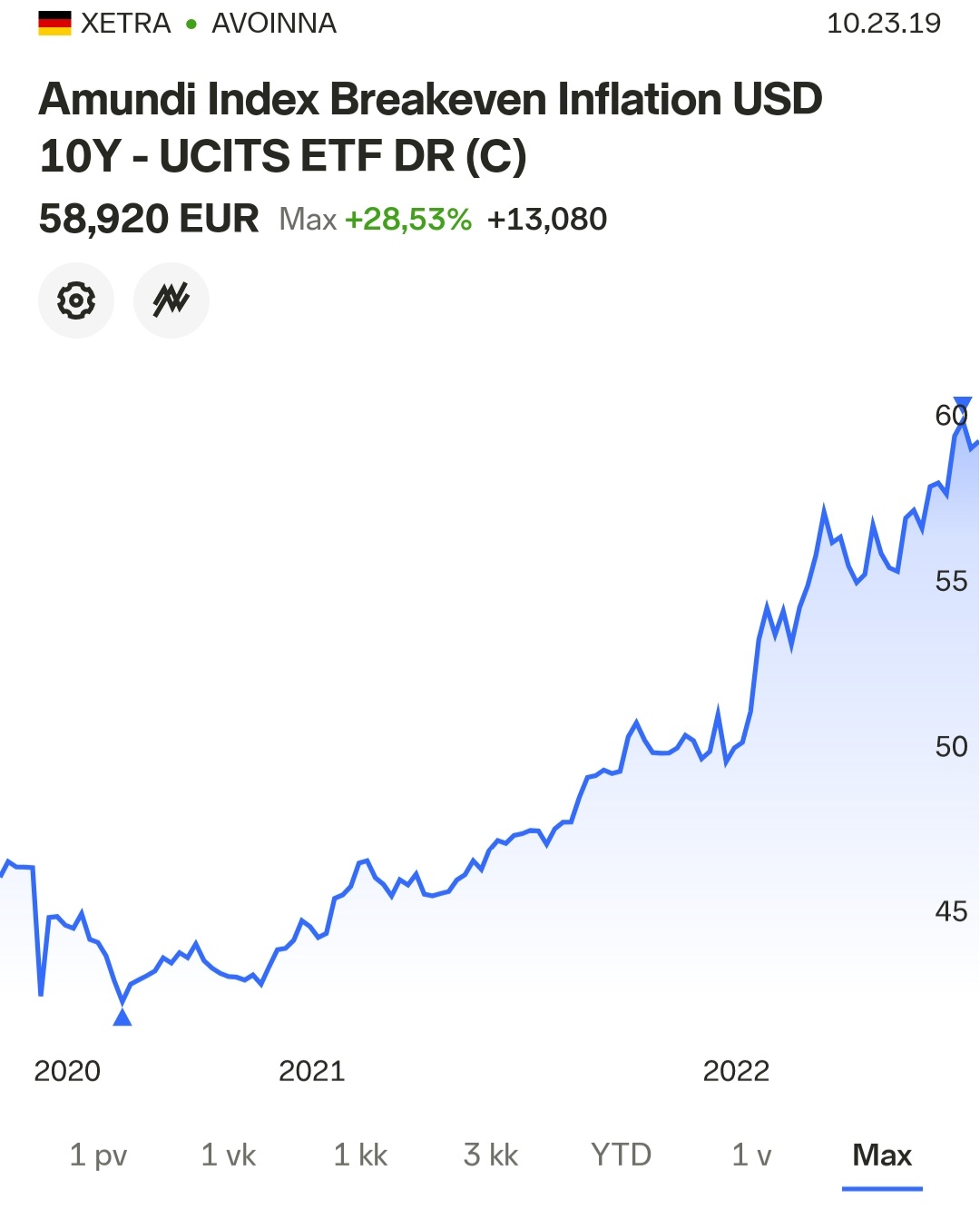
Interestingly, there has been no movement yet in the SP500 earnings yield relative to bonds. Historically, it’s about time for a bigger move in one of them. It’s a shame the chart doesn’t go further back so I could compare it to other crises.

9 Likes

So the answer is to now buy ridiculously undervalued growth companies from the bargain bin that will immediately take off once the economy recovers? Nominally, assets may melt temporarily along the way, but the probable return in the next upswing should cover these theoretical melts many times over?

Of course, with some diversification and strong selection. Speculative hot dog stands might not make it to the finish line :slight_smile:

9 Likes

Right now, in the autumn, raw material companies are finalizing their investments for next year, and in my opinion, many companies have already started to show caution. If you were deciding whether to increase production for next year or pay down debt and build up cash reserves, which would you choose? :disguised_face:

There’s a huge price volatility ahead with sharp movements up or down. History doesn’t always repeat itself, but there is a realistic risk that a recession will first drag prices down and freeze investments, similar to the COVID crisis, and then there won’t be enough production when demand returns.

18 Likes

Yesterday, I was reading speculation that China is filling its reserves because it is simultaneously preparing to devalue its currency. I haven’t yet reached the point in my thought process to understand what that would mean for the rest of the world.

5 Likes

At least the prices of all raw materials would plummet for a while, which would help the global economy with inflation and reduce the need for central banks to raise interest rates. So, it would be really tasty for investors, unless your portfolio is full of raw materials and energy :scream:

24 Likes

I finally remembered the source of that train of thought.
https://twitter.com/PauloMacro/status/1567525141680119819

2 Likes

A recession or depression would send energy prices plummeting, but existing severe production problems would only worsen, effectively slowing down any new economic boom.

Of course, the EU’s socialism craze makes one hesitate to believe that Europe will see any economic growth for a long time.

3 Likes

A well-diversified stock portfolio offers excellent inflation protection in the long run.

In 1969, inflation was insidiously taking hold in the U.S. national economy. There was some bias towards looser fiscal and monetary policy.

Then came the energy shocks starting in October 1973 and a failed monetary policy.

From 1969 onwards, it was enough to wait 27 years and then voilà, both the volume-growth-based and inflation-explained components of revenue growth had been fully incorporated into S&P 500 stock prices.

S&P 500
nominal nominal
year sales/share price
1969 67 100
1996 470 700
9 Likes

Good memories acquired with borrowed money are a good inflation-hedged asset. Of course, they are difficult to exchange for future consumption.

7 Likes

Furthermore, the market’s basic assumption does not seem to be that inflation will remain high, but if it does for one reason or another, the valuation levels of stocks would be something else.

It’s probably clear to everyone why bonds perform poorly in inflation: a 5% interest yield with 10% inflation is not a good return.

Stocks can be compared to interest rates: an investor buys a share of a company’s equity (either at book value, above it, or below it. Usually above it nowadays, the Helsinki Stock Exchange trades at about 1.7x its book value). The ROE of listed companies in the US has hovered around 13.5% for the last 30 years, and in Finland, it has been over 10% since the financial crisis.

If inflation is 10%, is a 10% “coupon rate” good? No, it’s not. :smiley: And listed companies cannot automatically increase their ROE.

Stocks are not a good inflation hedge!

I need to look into that when I have time, but I’ll ask before that. IF we assume that the situation normalizes at some point in the future, couldn’t one assume that things would go something like this: Company X does business with, say, a 10% return on equity and a 5% margin. Inflation wreaks havoc, and multipliers plummet. After N years, inflation returns to “normal levels,” and the company returns to its old return on equity and profit margin. During the inflation period, the value of money has halved, so one could imagine the nominal value of the company doubling. Thus, the investment would not have yielded any real return, but it would have performed better than, say, cash.

Of course, this includes a strong assumption that the inflation situation will return to its old form and that the company in question will again be able to achieve the same real results as before under those conditions. And even in this situation, a skilled speculator would certainly have an opportunity to sell everything and buy back cheaper in the deepest inflation trough.

Mainly, I’m perhaps trying to say that inflation is not a good situation for stocks, but neither is it for fixed-income securities, and with rising interest rates, it doesn’t seem to be a very good thing for real estate, and for some reason, gold and its digital version, cryptocurrencies, also seem to be going pretty much the same way as everything else.

So, one would have to speculate with timing or hit the right sector rotation. If the time horizon is 10+ years, shouldn’t stocks ultimately be a pretty good inflation hedge compared to other options?

2 Likes

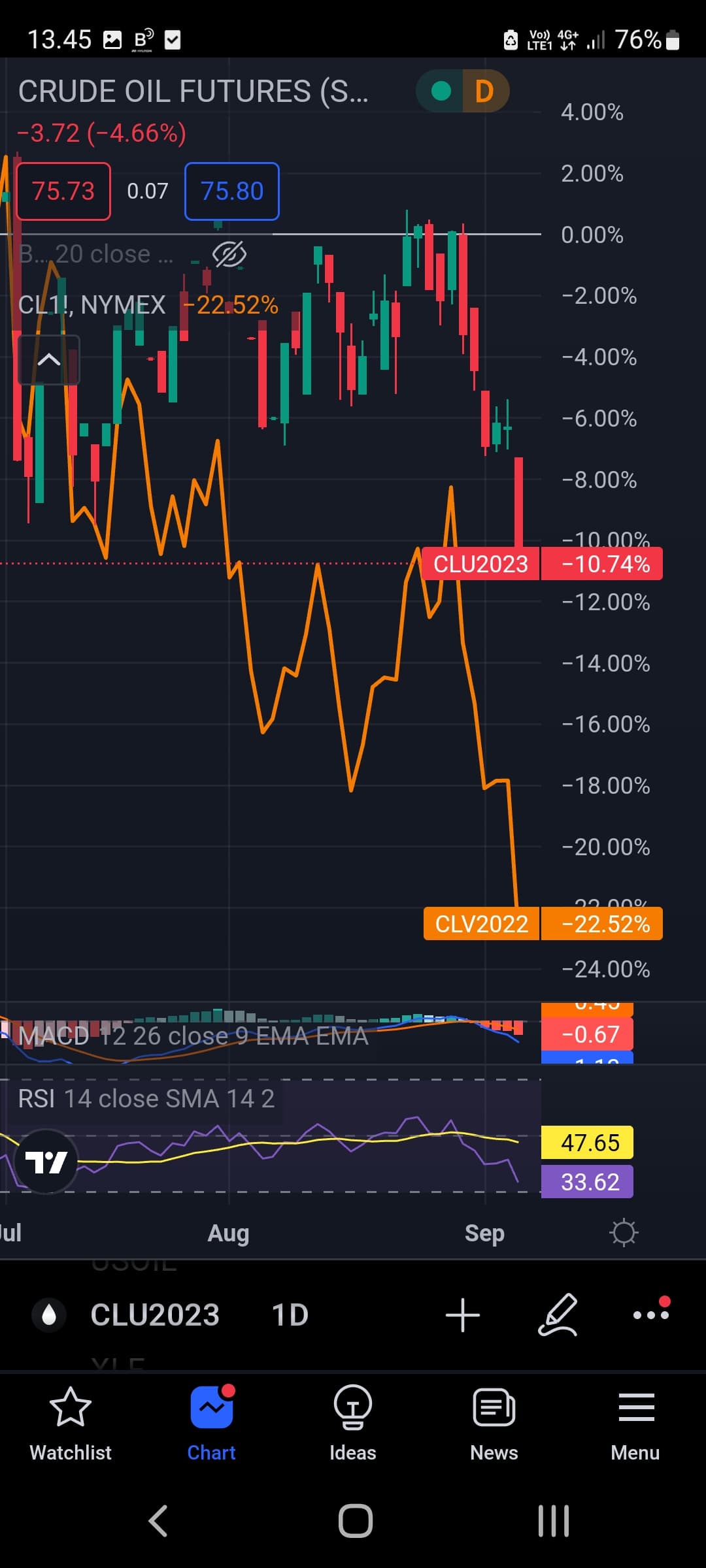
The difference between further-out futures and the continuous? (CL1) futures has continued to narrow.

At the turn of the month, the difference between Sep23 and CL1 was 13 dollars, and now it’s already less than 6. Since the beginning of July, CL1 oil is -23%, but Sep23 is only -11%. The recession signal is strengthening here too.

3 Likes

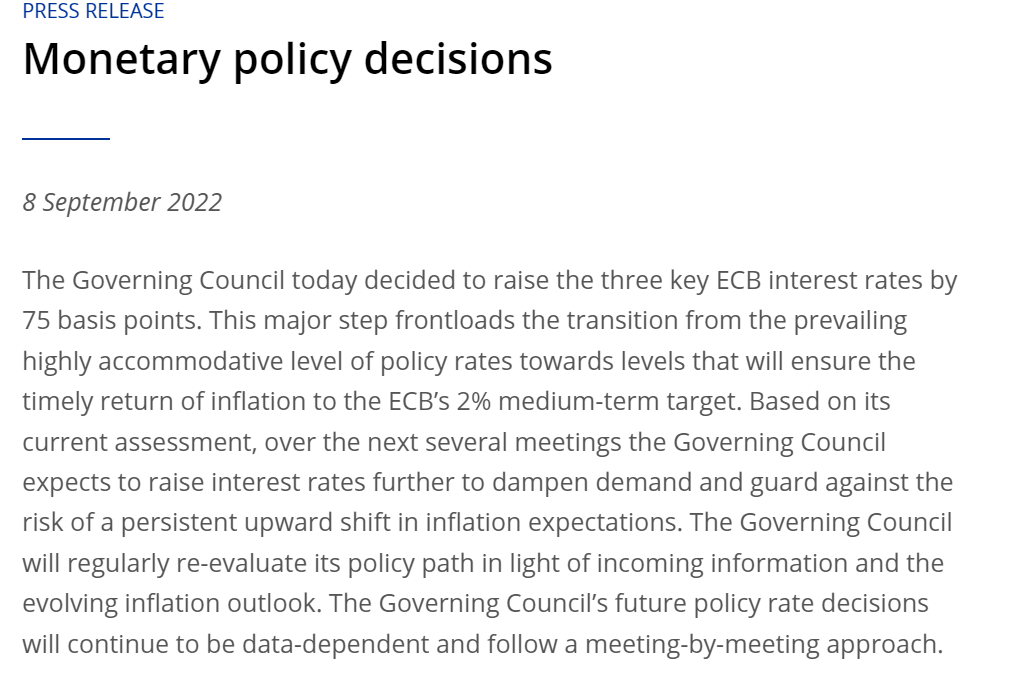
Good afternoon, everyone! The ECB’s interest rate decision came in with a 75 basis point hike.

59 Likes

And almost in the same breath, it should be noted that the decision was expected and the “promise” of additional hikes in future meetings is embedded in the interest rate decision. Inflation is now the number one priority in the ECB’s reaction function, and the central bank is indirectly trying to influence it by dampening demand.

47 Likes