Stock Market Direction (Part 2)

Sometimes situations change quickly.

For a few quarters, starting around spring 2021, investors’ return requirements on OMXH were broadly at an all-time low. Return-free risk was available.

Now, return requirements have returned to their normal range.

If someone has a lot of cash [to clarify, we have more cash than usual, but at the same time, we’ve also fallen off a cliff with our stock portfolio, like many others], it’s irresponsible not to look for something to buy. I’m starting cautiously, but purchases must begin now.

47 Likes

Good points. For us, one lot purchased is one percent of our cash reserves.

The stock market isn’t priced in such a way that I would be aggressively buying.

In my opinion, buying must start at this point if one has more cash than usual.

26 Likes

Remembering the nature of the thread, if you share your own moves, please include a broader justification that others can also benefit from.

13 Likes

Hesari’s compilation of Finnish funds’ Russian investments and the money being stuck (sorry about that). There seems to be a consensus regarding the Russian stock exchange: no investments in the near future, and for some, never again. The reasons are return expectations/value choices.

Nordea:
“IT IS USUALLY said that a stock market crash is the right time to buy shares. However, the situation in Russia appears to be such that Nordea cannot recommend acquiring shares from the country’s markets.”

“It seems that Russia will be isolated from Western markets for a long time,” Eronen says. “In investor advisory, we have not recommended Russia even before this crisis.”

OP: “OP may not open a Russia fund immediately when Moscow again allows trading, but will wait a moment to achieve reliable price determination. After that, investors can do what they want with their fund units. In the future, OP no longer intends to invest in Russia.”

“We will not make any new investments in Russia in this situation, no matter how attractive the prices may be. It would not be good for risk management or value choice.”

S-Pankki: “S-BANK managed to sell all its Russian investments just before the February 24 attack, says Mika Leskinen, S-Bank’s investment director.”

“There are no warm thoughts towards that market. Russia is not an investment-worthy country in any sense in the near future.”

18 Likes

Hesari woke up. There probably isn’t a realistic scenario anymore where relations with Russia would even return close to the former normal. Russia will therefore become a burden for OMX. How significant is still unclear.

14 Likes

This is a good point, and even though the Helsinki Stock Exchange has fallen significantly, the DAX, for example, has also come down sharply. The DJ France, on the other hand, fell 6% yesterday. Even though this is a positive thing, it also means that IF the markets were to start pricing in increasing country risk for Finland, there is still plenty of room for a decline through that.

Be that as it may, I myself have started a cautious return to European stocks from a portfolio that was previously mainly US-weighted. It’s impossible to predict the bottom, but in my opinion, there are now things to buy at a reasonable price, as long as the investment horizon is +10 years. Especially defensive dividend-paying companies are being bought. However, I will continue to try to avoid companies operating only in Finland, simply because the country risk is already too high due to owning a home.

8 Likes

After the storm, the weather is clear…
But when will the storm be over?

8 Likes

It will be called that, or I would assume so based on the fact that it was. :slightly_smiling_face:

6 Likes

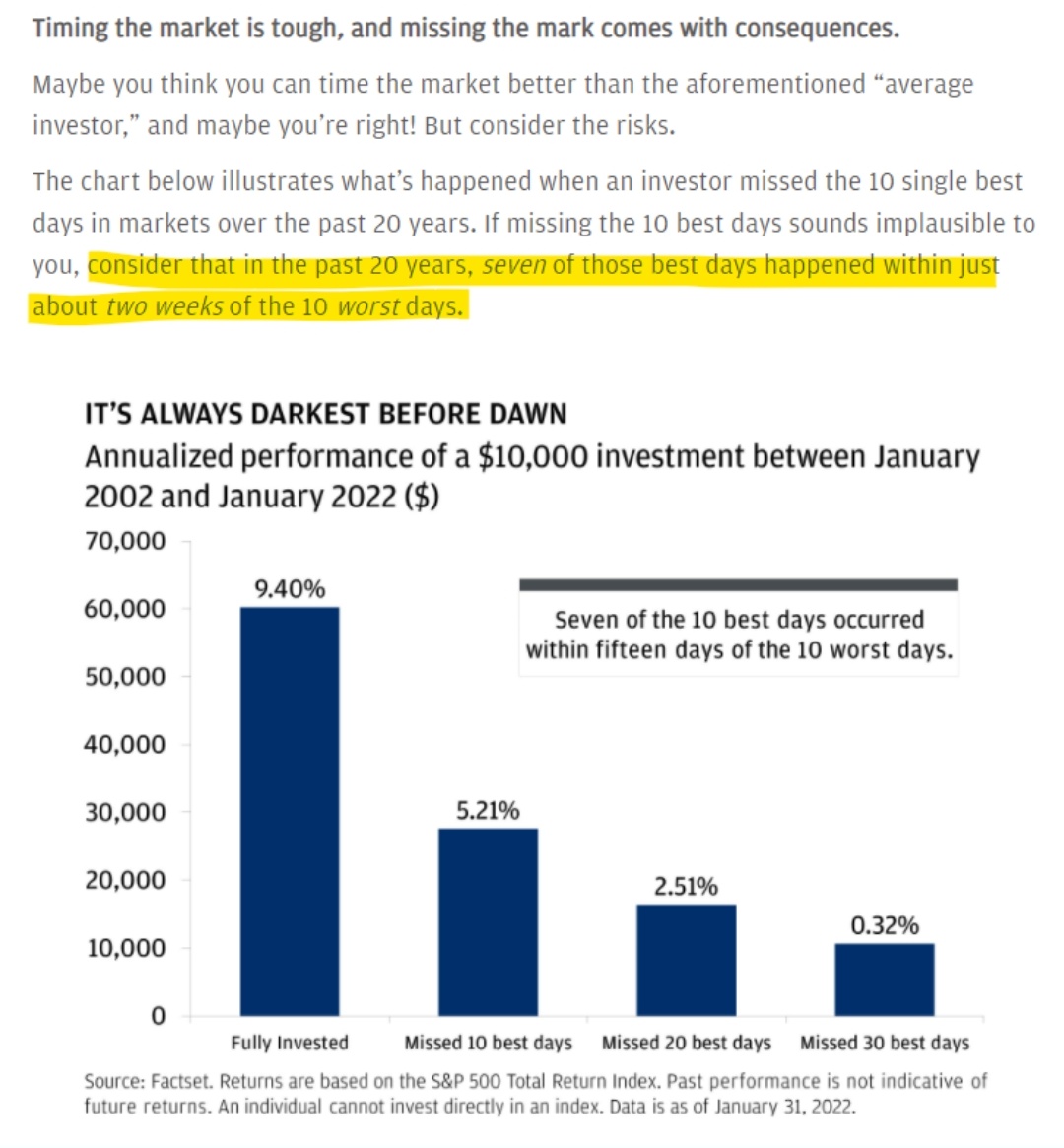
I think this is pretty poor cherry-picking. Generally speaking, the fastest up days follow the worst down days. We could just as easily create a statistic showing how good returns one would have made if one had managed to avoid the 10 worst down days.

An investor who participates only in up days but not in the preceding down days will certainly succeed, but in practice, this is only possible with luck, very successful trading, or a combination of these.

Of course, the statistic can be interpreted to mean that it’s generally not advisable to panic sell at the bottom after a downturn. This is fundamentally true, but again, it depends on the timeframe over which one follows the statistics.

If we look at the OMXH index for this year over a very short period, for example. On January 24th, there was a proper panic day, followed by a temporary upward swing. So, if one panic-emptied their index portfolio at the local bottom on January 24th, it might have been regrettable on February 1st to have missed those up days. On the other hand, if the portfolio is still empty, one could now get the same stocks back cheaper because the gains were quickly negated, and panic selling currently looks like the right decision in hindsight.

Now, this hypothetical portfolio emptier would then need to know whether there will be more gains or more losses next week, and in which direction the trend will continue in the long run. Timing is made difficult by the fact that not only the exit but also the entry must be accurate.

26 Likes

Does anyone here read Doomberg? As the name suggests, they offer a slightly darker perspective:

1 Like

One of my recurring themes here since May has been guessing the economic trend. I have been in opposition to the extremely optimistic consensus of economists.

If the economy is weak this year, it does not prove that I was right last year. Many things can be attributed to the consequences of the war.

How do these affect the economy?

  • supply shocks
  • regressive new inflation tax
  • financial system disruptions
  • damage to general confidence and risk-taking appetite

I argue that the stronger the underlying economy on 23.2., the less damage. The more vulnerable the underlying economy on 23.2., the more damage.

My thesis has been that the economy in Western countries has been more vulnerable vs. the extreme optimism of the economist consensus.

Therefore, the disruptions caused by the war will drive the entire Western world into recession this year.

I would argue that this has already been priced in to some extent in the Helsinki Stock Exchange. Not enough, but a good start.

The S&P 500 has safe haven status and therefore it is still floating detached from the real economy for now.

13 Likes

Hardly anyone will remember the 2020-21 rally in ten years, so there was no “growth company bubble.” Instead, everyone will remember “the return of the dictator”; Russia is the biggest reason for the halving of growth companies’ market value. Many saw already in spring 2021 (spring 2014) which direction Europe’s security situation was heading. I recommend Garry Kasparov’s book (Winter is coming).

Even on this forum, people only woke up to the issue on January 24, 2022, a month before Russia’s full-scale invasion. Finland, as Russia’s neighbor and a European frontier market, has a lot at stake economically.

It’s good to read the basics of economics, but now it feels like history would be a more important subject when making investment decisions.

9 Likes

To me, the growth company bubble seems quite unrelated to the Ukrainian crisis. The bubble formed in 2020, and wasn’t the situation that started in Ukraine in 2014 still ongoing then? The bubble also burst, or at least largely deflated, well before the situation on Ukraine’s borders escalated again. Many growth companies first rose hundreds of percents and then collapsed by 80-90 percent without the situation in Ukraine being in the headlines or discussions.

21 Likes

Yep, the growth bubble started to hiss in early spring 2021 (ARK, hydrogen, Neste, SPACs) and eventually spread to all growth companies by November 2021: coincidentally, at the same time, when the Fed reversed its stance on inflation rhetoric. :wink:

14 Likes

In the spring of 2021, Russia was already attacking Ukraine; many abroad saw it. 42 percent of the owners of these growth companies were from abroad. How hard is it to understand that stock prices have fallen due to the war and will not recover immediately?

Alright, alright… Why didn’t the share prices of non-growth companies fall correspondingly? The S&P 500 is still at a higher level even after the war started than it was in summer 2021.

5 Likes

As far as I understand, the war came as a surprise even to many in the Kremlin.

The war is certainly driving down stock prices, especially in Finland, but globally, accelerating inflation (which the war exacerbates) and tightening monetary policy are probably more concerning. All this while the stock market was at its most expensive since the tech bubble.

Constructing narratives to fit after the fact is too easy. This development could have unfolded in many ways.

57 Likes

Sauli didn’t quite come with security guarantees. There were some half-promises in the air.

Another thing that should support stock prices in Finland is Russia’s poorly progressing military campaign. They are winning, there’s no doubt about that, but it will take a while, and the army might not recover immediately from the losses of this war of conquest.

In the US stock market on Friday, some tech stocks were truly hammered.

2 Likes

It’s quite a narrative to draw conclusions about stock prices from those. If the market were pricing in a significant risk of war targeting Finland, which would fluctuate according to daily events, the government bond yield would not be close to zero. Nor would mortgage holders get loans from international investors at these interest rates.

Currently, the main drivers for the Helsinki stock exchange are the same as elsewhere: economic growth and inflation expectations. Then, of course, the war directly punishes companies tied to Russia. Hopefully, we won’t end up in a situation where Sauli’s security guarantees or similar affect stock prices, but we are certainly not in that situation now.

In the long run, however, I believe that Finland’s geopolitical position as Russia’s neighbor outside NATO has an impact on valuations. There must be a higher risk premium here than, for example, in Norway. NATO membership would lower the cost of capital and raise valuation levels over time.

25 Likes

How much room is left for a further decline in the HGI stock exchange? I personally believe a maximum of 5-10%. The risks of selling are already becoming too high, so I won’t sell now as it should have been done already. I believe a solution to the war will be found within a week or two, and things will start to normalize as much as they can in this situation.

The end of the war and potential support packages could boost stock prices again. On the other hand, rising inflation and disruptions caused by the war and energy prices will keep growth sluggish.

Russia, in itself, does not play a significant role in the revenue of many Finnish companies, and those that do have been hit hard.

I also don’t believe Russia poses a direct threat to Finland. It’s too tough a nut to crack, and their resources are pretty much depleted now. Furthermore, NATO cooperation is underway, and I think Russia has known for a long time that as an EU country, we cooperate specifically with NATO and the West.

The geographical risk bit me in the ankle, but I have to live with it. I’ll continue the strategy of buying cheaper stocks with what’s left and waiting for the situation to normalize. We’re playing the long game, and a year or two is a relatively short time in the stock market, as we saw with the pandemic.

Although these moments cause anxiety and frustration, it’s nothing compared to the human suffering and tragic fates caused by the war.

Ultimately, freedom and security bring happiness and well-being to life and everyday routines, not virtual assets and numbers in a portfolio. I believe that after this shocking war, many will also re-examine their daily lives with new eyes. They will ponder what is truly important. I, for one, will focus on loved ones, outdoor activities, and family for the foreseeable future. Strength to my fellow travelers. Peace and love :heart:

54 Likes