“However, the risk of paying too high a price for good-quality stocks—while a real one—is not the chief hazard confronting the average buyer of securities. Observation over many years has taught us that the chief losses to investors come from the purchase of low-quality securities at times of favorable business conditions. The purchasers view the current good earnings as equivalent to “earning power” and assume that prosperity is synonymous with safety.”
― Benjamin Graham, The Intelligent Investor
It would be nice to know what kind of company is defined as a “value company.” The general perception seems to be that value companies on the Helsinki stock exchange are, for example, Sampo and Fortum. Sampo’s P/E is currently ~20 and Fortum’s P/E is ~15. For comparison, Harvia’s P/E is currently ~21 and Qt, which grows 30-40% per year, has a P/E of ~58.
By the way, the SP500 daily RSI (Relative Strength Index) dropped below 30, for the first time since the COVID-19 bottom (of course, it hasn’t closed there yet). I’m not rushing into anything yet, but I’m starting to get a little excited about some companies I’ll have to check the Q4 earnings reports and outlooks before making any big moves. Since the major indices have “corrected” quite unevenly, you can already find some decent expected returns in the most beaten-down areas, although I haven’t come across any “screaming buy” opportunities for myself yet (which, for me, would mean using leverage).
Somewhat related, I’ve noticed that MSE (Morgan Stanley Europe) has been the biggest seller in my portfolio’s companies for about six months, or at least among the top 3 sellers. Are foreign investors dumping emerging markets again when their hands start shaking? Usually (over the last 15 years), that has meant good buying opportunities are approaching… I’m not commenting on whether the decline will continue, but rather on what it usually does to future returns over a multi-year timeframe
The definition of a value company. Every investor certainly has their own kind of view on it. I don’t personally like the categorization into “growth companies” and “value companies”. It’s a bit of an old-fashioned and shaky classification. Value comes in all forms, and every company has different values. For example, a company’s market value. As a starting point, every company aims for profitable growth regardless of whether it’s a value or growth company. That is, if profitable growth is at all possible for the company.
So why do I myself write and talk about “value companies” and “growth companies”? Because it’s so easy to express a complex matter in one word. Effective, isn’t it!
I personally see a value company as a company that is not the hottest thing of the day and does not operate in the most sexy and trendy industry. It can certainly grow. Preferably, profitable growth without compromising quality. In my eyes, a value company’s P/E ratio should be under 30. Preferably P/E under 20 - and I’m not talking about a rearview P/E but one looking into the near future (forward P/E ratio).
Hopefully, I was now able to somehow justify my own view of a value company and what I meant by it
For example, Titanium… moving like a train, P/E looks cheap, and dividend yield is good. Revenue/operating profit is quite predictable since they publish a report every month.
Not risk-free, but I’m willing to take that level of risk for that return.
Then there’s also price-to-book, which is also considered a measure of a value stock. For example, at Fortum or Sampo, it’s around 2, and for so-called growth companies, it’s usually double-digit.
Sampo’sforward P/E is 18.83 (Nordnet: The forward P/E ratio is the predicted P/E ratio for the upcoming year. It is calculated by dividing the market price per share by the predicted earnings per share.) Pretty okay. And it fits my definition of a value stock
In my opinion, for growth companies, we cannot talk about particularly cheap prices yet, at least not in light of historical multiples. Others have written about this here admirably, and thanks for that. Of course, that’s where the subjectivity comes in again, in how these numbers are interpreted Last time, for several growth companies, a correction and “bottom” were seen in October 2021, on a short-term basis, at much lower levels in a significantly better market climate than we are in now. I would be surprised if we didn’t go at least to those levels now, but the market always manages to surprise
Shouldn’t the buy and sell chain be full of sell orders if people were to believe these “pie in the sky” painters like lemmings? I suspect that the magician will surprise himself this spring…
There haven’t been any panic days yet. Rather, there’s a retreat battle in the market, with the bear creeping behind. I keep telling myself, don’t buy, don’t buy, don’t buy.
When was the word euphoria last heard, and when was it palpable? It’s been a while. Now, one could say the market is in a state of moderate disbelief.
I’ll quote myself from another thread:
Just for fun, google “jeremy grantham” and then a year. For every year, you’ll find an interview with the man predicting fire and brimstone for stocks any minute now. What value does this bring to investors after ten years? Then these gurus are dug out of mothballs when the market shakes a little or a lot. It’s easy to successfully predict every market crash that occurs when you predict a market crash every year.
I’m afraid that when the index level falls another 5-10%, some idiot will dig Tuomas Malinen out of mothballs too. However, he’s probably already so tarnished by all his other antics that he’s only fit for Yle’s “Pörssipäivä” (Stock Market Day) now.
And the bear can be justified. It’s easy to subscribe to many bear arguments about the current market situation. But if you never find any other arguments than those supporting your own view (in any direction), I don’t believe you can be much better than the average investor in the long run.
This is off-topic now, but it always makes my blood boil.
Discussions about stock market crashes are usually quite misleading and often lazily generalized.
In discussions about stock market crashes, it seems to be forgotten that the stock market is not an “intact” entity, but consists of thousands of different companies whose success varies, and success determines stock value. If a stock market crash is predicted, then a decrease in the average market value of companies’ shares is predicted. Within this whole, there are still very successful companies (and very unsuccessful ones).
In other words, with careful stock picking, one can quite safely ignore stock market crash discussions. Of course, those investing in an index, this whole, are interested in stock market crash discussions, but again it must be remembered that ultimately assessing the direction of economic development is more important than assessing a stock market crash. If you feel that the country’s economy may be strongly slowing down, it may be justified to realize some index investments and perhaps move them elsewhere.
Generally, it seems that in these discussions, attempts are made to make this complex whole too simple. My message contains a lot of self-evident repetition, but I thought I would now open up what I always think when these stock market crash headlines flicker in my news feed.
Things are looking up in the stock market, that is, for net buyers. If someone went all in at the peak, I wouldn’t be surprised if their nerves started to fray.
However, valuations haven’t significantly melted down at the index level. If earnings growth and low interest rates continue, valuations don’t seem outrageous either. This is why the observations raised here about growth companies returning after the bloodbath feel exciting.
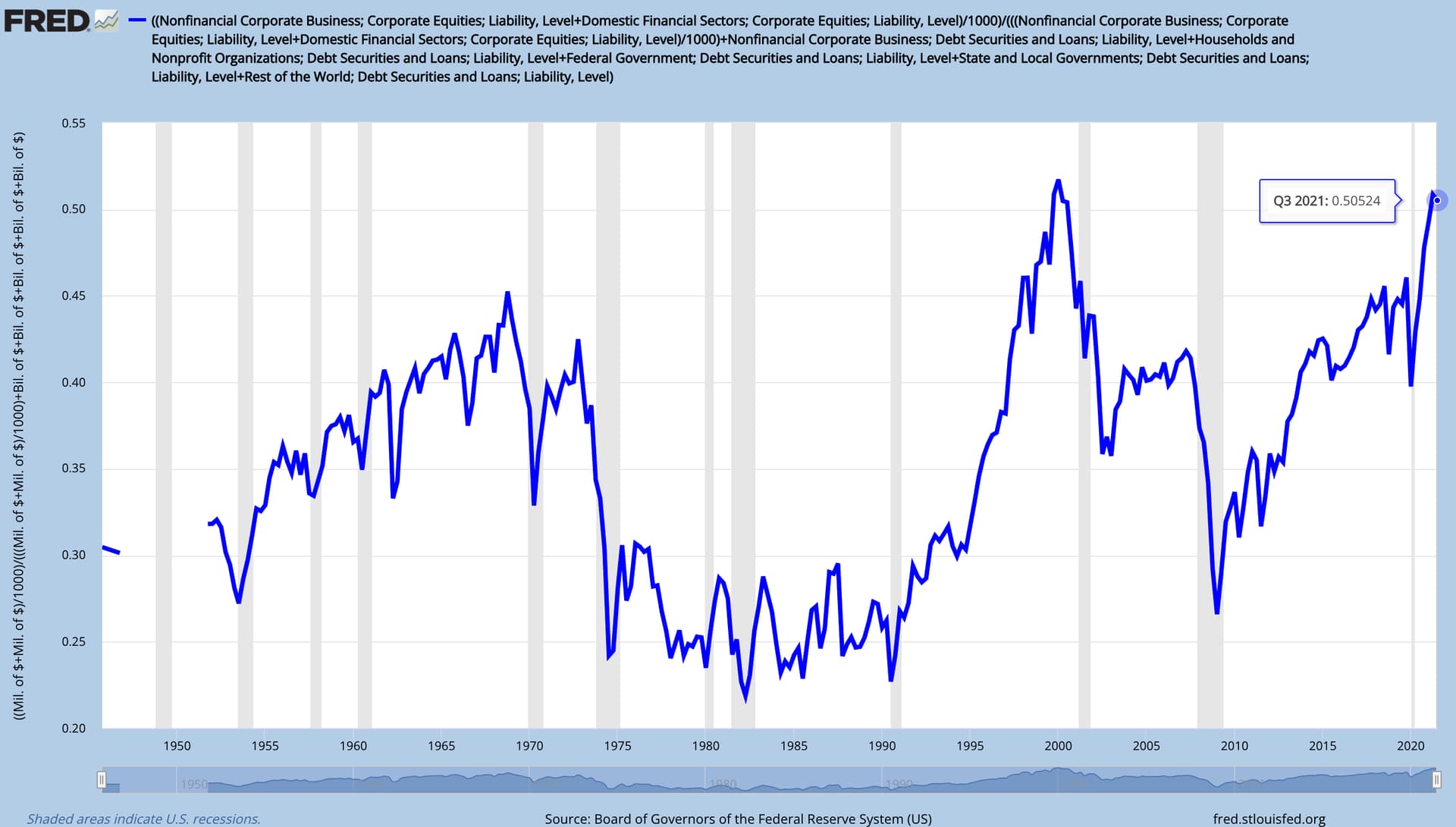
But the stock market doesn’t always look at valuations. An indicator measuring investor allocation at a broad level has been updated for Q3 of last year. As you can see, in the world’s most important market, the United States, allocation is still near record highs. In previous instances, a longer bear market followed as investors sought a new balance in their allocation. The point where the weight of stocks is sufficient has usually been found much lower.
Of course, it’s possible that stocks are structurally overweight, but there are other places in the world to stuff your money…
According to Grantham, the S&P 500 index could lose about 45 percent of its value from Wednesday’s closing figures, dropping to the 2500 level. Currently, the index’s point value is 4482.73. He predicts an even steeper decline for the Nasdaq index.
Today, Grantham has been called a permabear, a rambling old man, and a doomsayer. This is a person who has risen from zero to billionaire by investing in stocks over the past 55 years. These dismissals are likely based on recent years. By the same logic, Buffett and Munger are mediocre stock pickers. This ignores their entire career track record and the general coherence of their arguments.
When this bull market began in 2009, Grantham was an aggressive bull. Before that, he warned early about the housing bubble, so the bubble continued to inflate for a couple of years after the warnings began. So he was too early, while Bernanke was completely oblivious the whole time, in complete denial until the very end. Before that, sometime in 2002-2003, Grantham didn’t warn anyone about expensive stocks because he didn’t consider them expensive. Before that, he started warning about the stock market bubble early, sometime around '97-98. The market rose a lot after that, and he was beaten black and blue. Before that, he warned early about Japan, and was eventually proven right.
This time, he might be early again and eventually right, or it might be a permanently high plateau and he is fundamentally wrong. At the moment, we cannot know. We can only examine his arguments and ponder whether they might make some sense or not. Dismissing him solely based on recent years is, to use a buzzword, “lazy” conclusion-making.
I’m a bit concerned about what kind of impact it would have if, for example, Apple’s earnings disappoint and the index’s largest company takes a -20% hit.


 (of course, it hasn’t closed there yet). I’m not rushing into anything yet, but I’m starting to get a little excited about some companies
 I’ll have to check the Q4 earnings reports and outlooks before making any big moves. Since the major indices have “corrected” quite unevenly, you can already find some decent expected returns in the most beaten-down areas, although I haven’t come across any “screaming buy” opportunities for myself yet (which, for me, would mean using leverage).