Pallas Air (formerly Lifa Air)

Here is Thomas’s preliminary comment as Pallas Air reports its results on Friday, March 27.

Pallas Air will publish its 2025 financial statements on Friday, March 27, 2026. We expect the company’s revenue to have decreased from the comparison period, even though the industry’s VOC (Volatile Organic Compounds) business has developed positively. Our attention in the report will particularly focus on the updated strategy unveiled in February, as well as the company’s critical liquidity situation, which significantly raises the stock’s risk profile and limits the company’s ability to invest in growth projects.

Thomas has completed a new company report on Pallas Air following the company’s H2 results.

Pallas Air’s H2 report fell short of our low expectations, although the company’s cash flow was stronger than we anticipated. With deep operating losses, the company’s cash crisis has deepened to an extreme, and in our view, business recovery requires a significant capital injection from the company’s main owner. As the continuity of the business relies on external factors, we consider the share’s value to remain entirely speculative. Therefore, we do not provide a target price for the share but reiterate our sell recommendation due to a very weak return-risk ratio.

1 Like

A press release from the company after a long time. :slight_smile:

Pallas Air Plc, stock exchange release August 11, 2026, at 13:15 EET

A non-prosecution decision has been made in a matter previously announced by Pallas Air Plc

Pallas Air Plc has been informed that the Southern Finland Prosecution District has made a decision not to prosecute in the matter that the company announced on March 21, 2024.

The company’s former CEO and members who served on the company’s board in 2022, who are no longer on the board, were heard in the capacity of suspected of a crime. The matter related to the communication of Lifa Air Plc’s (the company’s previous trade name) earnings performance during its IPO and before the publication of the 2022 half-year report.

The Southern Finland Prosecution District has made a decision not to prosecute regarding all persons who were suspected in the matter.

Pallas Air Plc will not comment further on the matter.

Pallas Air Plc

Board of Directors

Thomaksen comments regarding the above announcement :slight_smile:

Spotted on X. This doesn’t look strong, but I suppose it doesn’t surprise anyone who has read through the Pallas Air thread. It’s puzzling that this isn’t bankrupt yet.

14 Likes

Inderes quite rightly notes that the conclusion of the criminal case regarding the old Lifa Air’s 2022 disclosures does not change Pallas Air’s current situation: the company still faces an acute cash crisis. At the same time, Inderes limits the scope of the concluded investigation to the time before the Genano merger.

Therefore, I believe the essential question now is what happened in connection with and after the integration of Genano.

I have been raising the issue of Genano’s leasing and maintenance structure since 2021. In 2023, I also reported the matter to the financing company. Following this, the structure of subsequent agreements changed.

Furthermore, this is not an issue that has only been raised after the current crisis. The leasing and maintenance question was raised no later than June 25, 2024, at the Annual General Meeting of Pallas Air Oyj, and the question has been documented.

Since Genano’s own financial situation was already difficult at the time of the corporate restructuring and old contracts involved future maintenance obligations, it would be justified to clarify:

what was known about these matters when valuing Genano and incorporating it into the listed company, how were they accounted for, and how was the leasing and maintenance issue handled once it became public?

Another still-open question is who or which party brought the matter concerning the 2022 disclosures to the attention of the police, when this occurred, and on what documentation it was based.

I am not claiming there is a proven connection between this and the Genano matter. However, due to the timing of events, it would be justified to investigate why it was specifically the events of the old Lifa Air in 2022 that became the subject of an investigation at that time, while questions related to Genano’s 2023 corporate restructuring, financing model, and future maintenance obligations received significantly less public scrutiny.

Now, the old Lifa Air matter has concluded.

The questions related to Genano have not.

2 Likes

Where were the obligations related to Genano’s future maintenance recorded?

I have reviewed the financial statements of Genano Oy Ab for the years 2020–2024 as well as certain financing agreements used by the company.

In the agreements I examined, the price of the device included several years of maintenance services, and the financier paid the entire financed purchase price to the supplier upon delivery of the device. Thus, at least in these agreements, Genano also received the portion related to future maintenance in advance.

In the financial statements, advances received were:

  • 2020: 268,572 euros

  • 2021: 28,553 euros

  • 2022: 318 euros

  • 2023: 318 euros

Based on the financial statements, I have not been able to identify which balance sheet item the obligations related to yet-to-be-performed maintenance were recorded under, or what the total liability was. This does not mean that the entries were not made, but rather that their amount and accounting treatment are not clearly evident to me from the financial statements.

In the years 2019–2022, a total of approximately 858,000 euros in dividends and 600,000 euros in group contributions were recorded in the financial statements. These are permissible arrangements in themselves, but to assess the overall picture, it would be important to know whether the costs and obligations of future maintenance were appropriately accounted for.

The year 2023 appears to form a clear turning point.

In connection with the Genano arrangement and merger, the way device and maintenance packages were financed also appears to have changed. Based on the information I received and the subsequent agreements I reviewed, the previous financing model ended for at least one financier, after which the device and maintenance services were handled separately.

This change may have affected the timing of cash flow from sales and possibly also revenue recognition, depending on how the agreements were treated in accounting. By itself, it does not prove the cause of subsequent losses, but it raises the question of how large a portion of previous years’ earnings was related to the upfront financing of future maintenance services.

The gap between the expectations placed on the Genano arrangement and the actual development is significant.

Inderes estimated that Genano would strengthen the group’s balance sheet and provide the new entity with better prerequisites to revive its loss-making financial performance. The report published in December 2023 was titled “Genano mahdollistaa kasvuharppauksen” (“Genano enables a growth leap”). For 2024, Inderes forecasted a revenue of 8.7 million euros and an adjusted operating profit of 0.2 million euros.

The reported revenue for 2024 was approximately 8.35 million euros, but the operating profit was approximately –7.94 million euros and the net result for the financial year was approximately –8.76 million euros. In 2025, the loss grew further to approximately –10.67 million euros.

The forecasted and reported operating profits are not directly comparable, and it cannot be concluded from the figures alone that Genano caused the losses. However, the actual financial development deviated substantially from the expectations presented in connection with the arrangement.

The matter was already brought up at the 2024 Annual General Meeting.

The public minutes of Pallas Air’s Annual General Meeting held on June 25, 2024, recorded that a shareholder considered that the lease provisions transferred as a result of the corporate arrangement implemented with Genano Oy Ab were not apparent from the 2023 financial statements.

According to the minutes, Chairman of the Board Mikael Rentto stated that the financial statements had been prepared appropriately and in accordance with applicable regulations. Auditor Mauri Eskelinen, in turn, stated that any known material deficiency would appear in the auditor’s report.

However, the answers did not reveal the euro amount of potential liabilities, the balance sheet item used, or how they were taken into account in the corporate transaction.

Source: Minutes of the Annual General Meeting of Pallas Air Oyj, June 25, 2024, item 6

The key open questions are:

  1. How much of the financed agreements included future maintenance services?

  2. Under which balance sheet item were the related obligations recorded?

  3. How were the change in the financing model and future maintenance obligations taken into account in the due diligence review and the determination of the purchase price?

  4. Did part of the future maintenance costs remain for Pallas Air to bear, and if so, how large was the liability?

This writing is not an allegation of an accounting offense or other unlawful procedure. It is a set of questions raised based on the financial statement data, the agreements I examined, Inderes’ assessment, and the public AGM minutes.

For the sake of transparency, I disclose that I own one share of Pallas Air Oyj. This writing is not an investment recommendation.

Pallas Air’s next report is scheduled to be published on August 31, 2026. Perhaps in connection with it, more detailed information will be obtained on how the revenues and obligations related to future maintenance have been recorded and how large the total liability is.

5 Likes

Here are Thomas’s preliminary comments ahead of Pallas Air’s H1 result on August 31st. :slight_smile:

Pallas Air will release its H1 report on Monday, August 31st. We expect the company’s revenue to have decreased from the comparison period due to the wind-down of the face mask business. We expect profitability to have improved from the weak level of the comparison period, supported by efficiency measures implemented by the company, but to have remained clearly loss-making. Our attention in the report will be focused particularly on the company’s extremely tight financial position, the progress of the new strategy, and the impacts of exiting the face mask business.

In this morning’s preview, Inderes quite rightly highlights Pallas Air’s acute cash crisis, noting that net debt and short-term liabilities have risen to an unsustainable level relative to the company’s debt-servicing capacity.

But in my opinion, this leads to an even more pertinent question:

How did we end up in this situation?

The preview focuses on the wind-down of the face mask business, the cost structure, rental expenses in Espoo, and the financing of the new AI/robotics strategy.

However, in my previous post, I brought up the Genano entity, the financing arrangements related to it, and the question of how several years’ worth of maintenance-related revenues and corresponding future obligations have been recorded.

Inderes also notes regarding goodwill write-downs that they have no cash flow impact. Precisely for this reason, I believe it would be justified to examine the other side as well:

through what arrangements has money entered and left the group in previous years, what liabilities have arisen in connection with them, and are these liabilities properly reflected in the financial statements?

The acute cash crisis is a consequence. From an investor’s perspective, it would also be important to understand its genesis.

Hopefully, Monday’s half-year report will provide more visibility into this.

2 Likes

Thomas Westerholm / Inderes assessed on November 2, 2023, following the merger of Lifa Air and Genano, that:

“The merger removed the acute financing risk.”

At the time, Inderes also estimated that the new entity would offer better prerequisites than before for achieving sustainable profitability. In a comprehensive report published in December 2023, it was further stated that Genano had strengthened the group’s balance sheet and provided better conditions for reviving a heavily loss-making earnings profile.

Now, a little under three years later, Inderes is once again raising the issue of an acute cash crisis and an unsustainable debt level.

In my opinion, this raises a question that should not be glossed over by merely looking at the current cost structure or the financing of the upcoming strategy:

What actually happened to the company’s financial position during the Genano arrangement and the years following it?

According to Pallas Air’s 2023 pro forma figures, the operating loss of the combined entity would have been approximately 6.4 million euros and the net loss for the financial year approximately 5.7 million euros, had Genano been consolidated into the group from the beginning of the year.

In my previous post, I also raised the question of multi-year maintenance revenues received in advance via Genano’s lease financing and the corresponding future maintenance obligations.

When the 2023 corporate transaction was described as a solution to an acute financing risk, but the company is now once again in an acute cash crisis, I believe it would be justified to also review the transaction itself in hindsight:

What did the impact that was estimated at the time to strengthen Genano’s balance sheet and financial position consist of, how sustainable was it, and how have the cash flows and liabilities associated with it evolved in subsequent years?

This is not Monday-morning quarterbacking regarding Inderes’ forecast at the time. Forecasts can naturally turn out to be wrong.

Rather, the point is that the current situation provides, in my view, a very good reason to go back to the starting point and examine what was actually transferred to Pallas Air in the 2023 arrangement – both in terms of assets and obligations.

2 Likes

Good questions, but getting answers is difficult or impossible. Retail investors have no visibility, and Inderes probably doesn’t either. We are all dependent on public information. You can ask, but the answer is likely formulated in the company’s interest, not objectively. Usually, in crisis situations, the negative underlying factors affecting the big picture are omitted or downplayed.

On a general level, not related to Pallas Air:

If you want objective information about the problem situation of a company in a financial crisis, you can usually only get it through a special audit, and not even always then. An investigator may state that the documentation is at such a level that an outsider can only make educated guesses about what happened years ago.

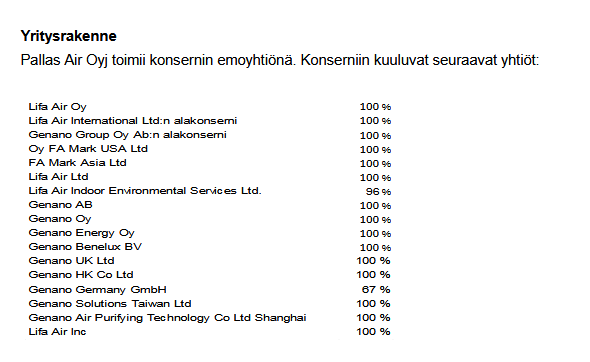
The image shows an example of Pallas Air’s corporate structure according to the 2025 financial statements. Subsidiaries all over the world. How much money has been transferred abroad and on what grounds during the mask deals or later – that is work for an investigator for a month if they want to do the investigation thoroughly. Have new subsidiaries been established, old ones shut down, merged, or sold to outsiders and are no longer visible in the financial statement data? And have the foreign subsidiaries bought goods or services from other outside companies, which are in turn owned by someone belonging to the inner circle, etc.? After all, the former CEO also made this famous consulting agreement, where, with the help of a newly established auxiliary company, they started billing money from the company’s cash flow for themselves. This was later disputed, as detailed earlier in this thread.

Raising one more thing from the time of the IPO:
The then-CEO and main owner was asked if they were selling their shares in connection with the IPO. Answer: I am not. Did they leave something unmentioned in the interview? Only such a “small” detail that if the IPO goes through, using that money Lifa Air will buy Lifa Air subsidiary shares owned by the CEO for over a million euros… This is an example of how a good question can be answered in such a way that an outside listener gets a false impression of the situation. Of course, this arrangement was mentioned in the IPO prospectus if one bothered to read it through. Anyone just listening to the interview simply got the wrong impression.

7 Likes

Good point, and I largely agree. With public information, an outsider cannot verify the big picture, especially in such a complex group structure.

Precisely for this reason, I find one point in the timeline particularly interesting: the criminal report filed against Vesa Mäkipää.

Looking back at the whole situation now, it would be interesting to know why things escalated right then, what had happened in the company before that – and what Mäkipää might have learned or brought up before the criminal report was filed.

I don’t mean by this that there was anything inherently wrong with filing a criminal report. But from the perspective of a special audit (erityistarkastus), the timeline would be interesting:

What happened before → what Mäkipää knew or brought up → why the criminal report was filed → what the official authority process ultimately showed → what happened after that.

Here I agree with you:

An outsider can raise questions using public information, but the answers would likely only be found in the original material.

1 Like

Now that H1/2026 has been published, I’d like to return to the Genano question.

In its half-year report, Pallas Air states that its liquidity is weak. Genano Group Oy’s €1.8 million loan has matured, and the company notes that a failure to restructure matured loans could jeopardize the adequacy of its working capital for the next 12 months.

At the same time, the group’s cash assets were a mere €287 thousand, net debt stood at €8.6 million, and the equity ratio was -229.5%.

At this point, I believe the question is no longer just whether Pallas Air will secure new financing, but also:

how did we end up in this situation?

In 2023, the Genano transaction was estimated to remove acute financing risk and strengthen the group. Now, Genano Group’s matured €1.8 million loan is part of the very financial problem that the company itself highlights when assessing business continuity.

That is why I feel the question remains highly relevant:

What actually transferred from Genano to Lifa Air in 2023—assets, liabilities, cash flows, and future contractual obligations—and how were these valued and recorded?

I am still particularly interested in the treatment of deferred revenues related to multi-year maintenance agreements and their corresponding future obligations.

In my view, the half-year report does not make this question any less relevant.

Quite the contrary.

5 Likes

Here is the report from Thomas on Pallas Air regarding their H1 performance.

Pallas Air’s H1 revenue declined more sharply than we expected, as a tight financial position limited the company’s ability to invest in working capital and meet demand. Operating profit slightly exceeded our forecasts, but remained firmly in the red despite cost-cutting measures. Given the deep losses, we estimate that restoring the business to health will require a substantial capital injection. As the continuity of the business relies on external factors, we view the stock’s value as entirely speculative. Therefore, we are not setting a target price for the stock, but reiterate our “sell” recommendation due to the very poor risk-reward ratio.

The adjustment process of Pallas Air’s 2.7 million euro debts raises questions about investor protection, customers, and oversight

On September 3, 2026, Pallas Air announced that the board of its wholly-owned subsidiary Lifa Air Limited has initiated a process to reassess debts of approximately 22.9 million Hong Kong dollars, or 2.7 million euros, recorded in favor of former CEO Vesa Mäkipää. According to the company, the intellectual property rights forming the basis of the debts belonged to Lifa Air Limited. The final impact will be resolved through legal assessment and auditing.

If the basis for the debt proves to be incorrect, it is of course right that it be corrected. But the timing raises questions.

In Pallas Air’s half-year report published on August 31, liquid assets were only about 287,000 euros, net debt was 8.6 million euros, and the equity ratio was -229.5%. In addition, Genano Group Oy’s loan of 1.8 million euros had matured, and the company stated that there was material uncertainty regarding business continuity.

Therefore, it is reasonable to ask:

If the intellectual property rights underlying the debts already belonged to Lifa Air Limited, why are their legal and accounting bases being reassessed only now?

When were the rights acquired, from whom, and under what agreement? On what basis was the 2.7 million euro debt created? And what connection does it have to the 2.7 million euro capital loan arrangement announced in 2024?

Retail investors and customers

Investors make their decisions based on information published by the company. Customers, in turn, make agreements and financial commitments based on the premise that the company’s contracts, financing arrangements, and service obligations are in order.

How can retail investors and customers be protected in practice if the bases of significant historical debts, intellectual property rights, or other transactions have to be investigated years later?

Genano

I reported my suspicions regarding Genano Oy’s leasing and financing arrangements to the police back in 2022. The matter is currently being handled by the Western Uusimaa Police Department under the number POL-2026-46608. I am making this case number public for reasons of transparency and verifiability.

In addition, there is one important, concrete fact:

When I informed the financing company about how Genano’s leasing and service arrangement was structured, the arrangement was subsequently changed.

Regarding Genano, the core question remains:

How much of the future years’ services were included in the financed amounts, how were they recorded in the accounting, how were future service obligations handled, and what happened to the funds received in advance from the financiers?

Pallas Air’s current announcement does not prove that there was any illegality in Genano’s operations. But in my opinion, it makes it even more reasonable to ask:

Has the entire historical totality of the Genano–Lifa Air arrangement ever been actually and thoroughly investigated?

And if not, why not?

This is no longer just a question about a single company

When the same entity involves significant historical debt items, questions related to the ownership of intellectual property rights, Genano’s historical financing and leasing arrangements, the extremely difficult financial situation of the current Pallas Air group, and the matter POL-2026-46608 currently handled by the police, it is also reasonable to ask the authorities what has actually been previously audited regarding similar historical transactions.

How can retail investors and customers be protected in practice if the legal or financial basis of significant historical transactions has to be reopened only years later?

And if such a review is necessary now, what does this say about what has actually been previously audited and supervised regarding similar historical transactions?

In my opinion, this is an issue that no longer concerns only Pallas Air or Genano, but the credibility of market surveillance, investor protection, and customer protection.

This will not be resolved by opinions, but by documents:

contracts → ownership rights → invoices → cash flows → accounting → obligations.

7 Likes

According to the Finnish Financial Supervisory Authority (Finanssivalvonta), the company provided investors with “incomplete, misleading, and untrue” information when it went public during the late stages of the pandemic in the early spring of 2022.

In addition, the FSA considered that shortly after its stock exchange listing, the company delayed issuing a profit warning and provided misleading information in connection with the profit warning.

7 Likes

Pardon my French, but doesn’t this pretty much mean that the management of a listed company can shit all over investors’ faces completely scot-free, since window-dressing figures or hiding the truth carries no consequences?

T: This is one reason why I don’t invest in First North, there are others too.

Addition: Wasn’t it the case here that the management received a substantial financial benefit from the IPO?

16 Likes

But here it is also worth looking at what happened after the 2022 listing.

The merger of Lifa Air and Genano brought a new dimension to the whole entity.

Even before the merger, Genano had background financing and leasing arrangements that also involved future service and maintenance obligations.

It is also interesting to note the role and responsibility of the finance company toward customers: what was financed, what was told to customers, and how the payment obligations were structured?

The current main owner and chairman of the board has shifted the blame to the previous management. However, he himself answered a question regarding Genano’s leasing arrangement at the Pallas Air general meeting on June 25, 2024.

Perhaps we should look a bit further than just at the old management.

Follow the cash.

Agreements → financing → leasing → service obligations → customers → accounting → merger.

There might still be another, completely unexplored side to this.

1 Like

At the end of a prospectus, there is always a section called Risks and Uncertainties. When you read through this long list, you can summarize the points in your own mind like this: almost nothing stated in this prospectus may hold true if any of the 100 risks or uncertainties materialize later, or if management’s estimate is overly optimistic.

Several companies have joined the First North list at an IPO price of, say, €4–€6, even though the true value of the business would have been €0.40–€0.60 based on today’s knowledge. Around the time of Lifa Air’s IPO years ago, for example, Alexander Corporate Finance (which brought Lifa Air to the market) pondered aloud at an investor event whether the threshold for listing on First North should be lowered to make it easier for companies to go public and raise money from retail investors. That assessment backfired completely in the case of Lifa Air.

The retail investor scene will wither away entirely once their money has been vacuumed up in IPOs like this and vanished into thin air. Nowadays, many won’t touch the First North list with a ten-foot pole when the price of their investment targets is down -90% compared to the IPO price. The money is gone, and trust and interest right along with it.

Interesting and sad indeed that, in the opinion of the Financial Supervisory Authority (Finanssivalvonta) (industry expert), Lifa Air’s actions were clearly reprehensible, but the threshold for prosecution is nevertheless not met and there will be no consequences.

4 Likes

Vesa Mäkipää, former CEO of Lifa Air, which gained attention during the corona crisis, is facing enforcement for 1.7 million euros in tax debts;\n\nMaskiyrityksen johtaja poseerasi ministerin kanssa koronakriisissä, nyt verottaja vaatii 1,7 miljoonan velkoja | HS.fi

8 Likes