A pilot in seven localities is starting in India. I wonder if a few Optomed cameras have also found their way into the pilot phase? 
16 Likes
Didn’t some post just mention Optomed’s sales management being in India, and in another, an Indian spoke about starting cooperation?
6 Likes
Juha has made a new report on Optomed, in which the share issue and its effects have now been updated:
We reiterate our Buy recommendation for Optomed, but we revise our target price to EUR 4.8 (previously EUR 5.2) due to the dilution caused by the share issue and our slightly lowered forecasts. In our opinion, the company’s directed share issue was carried out below fair value, but the EUR 6 million raised was particularly needed for Lumon’s FDA process together with AI. In our view, the overall outlook remains unchanged, and we made only minor changes to our forecasts for the coming years.
30 Likes
““““““““
In our forecasts, we assume that Lumoa with AI will not be significantly sold in the United States before 2028. Therefore, in the coming years, growth will primarily depend on Aurora AEYE, according to our assessment.
““““““““
How did you come to that conclusion? In my own thoughts, Lumo Aeye could receive FDA approval by the end of 2026. In the previous video, the CEO mentioned that image data is already being collected. I understood that he meant the Lumo Aeye combination. There is a good benchmark on which the FDA can compare the results. So, this should be a so-called lighter exercise. I have a hunch that we will be at the finish line by the end of 2026; image data, analyses, papers for the FDA, and 90 days of processing. Lumo Toku Clair is another story, which is a more demanding matter.
But what do I know… just asking.
Regards, an ordinary layman
10 Likes
In 2026, AI will normalize and become established in clinical routine
The value of companies like Optomed will no longer be based on hype or technological appeal, but on real evidence and adoption. Success requires that products like Lumo and Aurora AEYE integrate into electronic health record systems and provide clinical value, such as improved patient monitoring and more efficient diabetes or neurology screening
11 Likes
Optomed has stated that it will conduct extensive clinical trials with Lumo in cooperation with an AI partner. At the same time, this will also secure 510k for Lumo, as there is now PJZ. One would think that the start of these trials would be announced. I would assume they will start in early 2026. As I wrote, my best estimate is that they will last 1-2 years. A year is usually the absolute minimum, but theoretically, the combo could be on the market in early 2027. Perhaps “best guess” could now be summer 2027, but even then, early 2028 is not dramatically off. Experience, however, tells us that few of these hit the mark. With Aurora AEYE, too, we waited for years, even though the outcome was good.
There is a positive possibility here that with AEYE Health, we could gain a head start by having Lumo considered a similar device to Aurora, and thus leverage that research. This is, as I understand it, a second path, and both are being pursued. This could enable a shortcut, but let it be a positive surprise if it comes.
On the other hand, when the Lumo + AI comprehensive solution arrives on the US market, Aurora AEYE sales are presumably cannibalized significantly, so from a forecasting perspective, the “cut-off” point for these is not ultimately a very dramatic situation. It would be if Aurora AEYE sales stalled with customers waiting for Lumo, but that process dragged on. Fortunately, this is not so black and white either, as those annual contracts can certainly be converted to Lumo if it comes down to that.
It should also be noted that the FDA has apparently just made changes to what data is accepted from outside the actual clinical trial. This could be a positive thing, but I am investigating the possible effects of this change. Still, generally, I think it’s wise to be moderate in assumptions, especially if one is generally positive. You probably are, and I also have a buy recommendation in play. Positive surprises are then gladly welcomed.
39 Likes
A small comment on this: if I recall correctly, the FDA returned Aurora AEYE’s permit application papers and demanded additional evidence, i.e., more image data. This is why the process with Aurora AEYE took years. With Lumo AEYE, I don’t believe in such a thing… experience teaches.
12 Likes
An interesting article caught my eye, stating that oculomics is moving from research to practice. Oculomics is no longer just a single AI use case but an evolving care model. AEYE Health is positioning itself from an algorithmic solution to clinical infrastructure, and Optomed is one of the few physical platforms that enables oculomics scaling in primary healthcare. Together, these perfectly address payer pressure, the need for preventative care, and the 2026 healthcare transformation.
Edit. The second part will be even more interesting. In Part Two of our Insight Media Oculomics series coming soon, we will look at how some vision care providers are already successfully putting oculomics into practice—and how this field represents an opportunity for growth.
28 Likes
CVS Health’s Investor Day material is interesting reading. They will be an AI-native company going forward; it would be strange if they weren’t also that in diabetic retinopathy screening. Volume and resulting efficiency gains would be available at Minute Clinics and especially in Signify Health’s home visit business.
14 Likes
Appiukko writes next door:
Here is a recent interview where Optomed board member Leana Wen interviews CVS Health’s Chief Medical Officer, Amy Compton-Phillips.

The Beat Executive Video Series: Dr. Amy Compton-Phillips
The Beat Executive Video Series: Dr. Amy Compton-Phillips
11 Likes
And how timely, Signify Health announced something like this (likely requires an FDA-approved portable?);
13 Likes
There is, however, a hint in that picture: an older Optomed camera, the Optomed Smartscope.
12 Likes
Northwestern Medicine, with 11 hospitals and 200 locations in the Chicago area, is currently scaling AI-based retinopathy screening across its entire clinic network and its partner network. It’s hard to say if Aurora Aeye is involved, but it would seem like a rather heavy solution (investments, space requirements, etc.) if they were to acquire tabletop cameras for every clinic.

47 Likes
At least you’d imagine the relations are in order 

35 Likes
Apparently expanding quite nicely, and a major insurance player is setting the pace. That’s where those Christmas presents are developing under the surface 
30 Likes
I would like to thank Mr_stock “Penno”. You have found many new links and useful information. Thanks also to Sheikki.
15 Likes
I guess credit belongs to everyone participating in the hive mind… Optomed’s communication is so shrouded in fog that the more amateur sleuths dig for information, the better—and the stronger the impression I get that we are currently in the calm before the storm phase with this case 
38 Likes
Thanks to everyone digging up those nuggets of information. Let’s hope that 2026 will be Optomed’s year and all the hype starts showing in the results as well.
No matter how hard you try to get away from stock market matters during Christmas, it’s apparently not within your control when they inevitably pop up in front of you. While visiting relatives, a familiar-looking camera caught my eye on the TV: Optomed’s Smartscope.
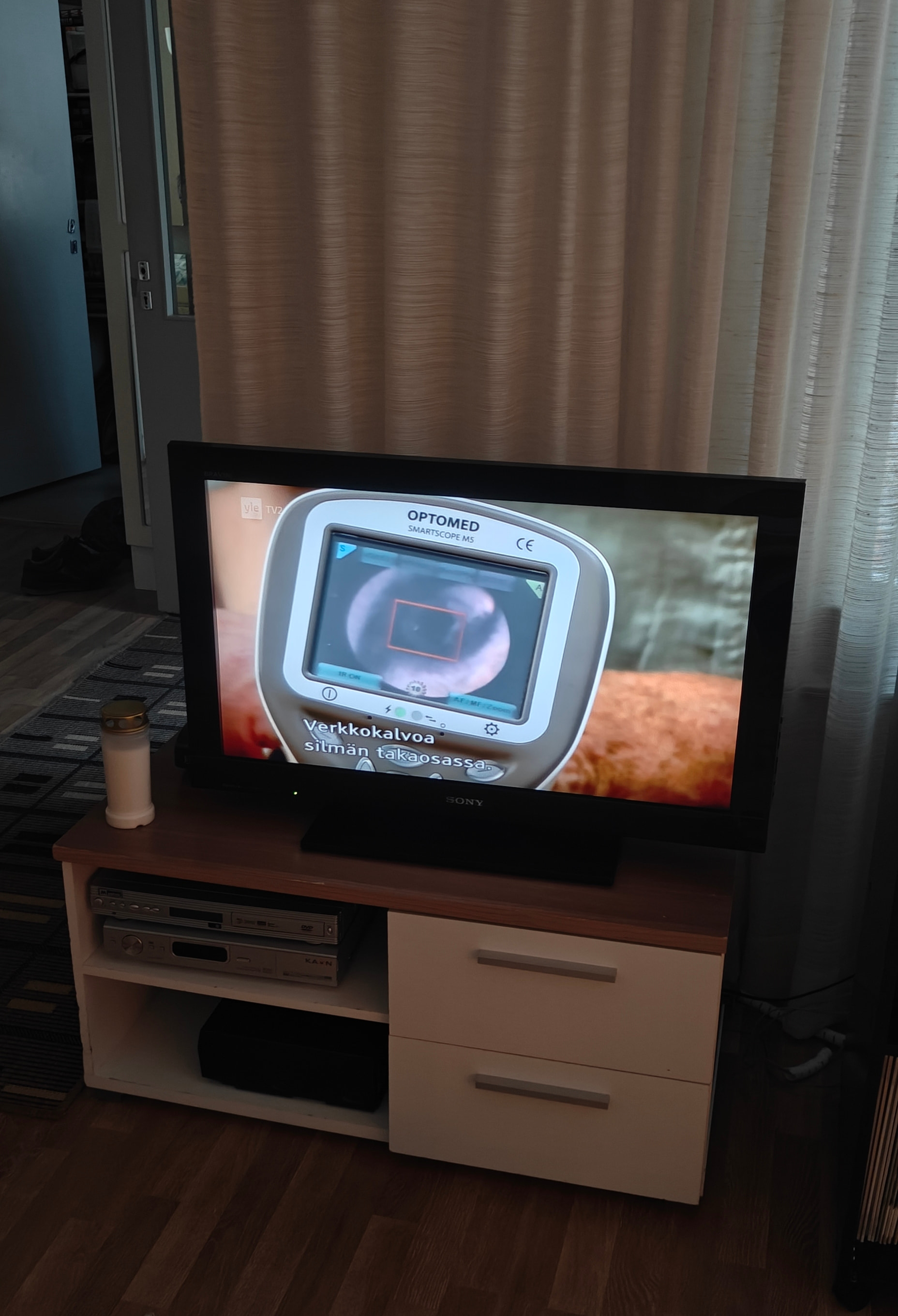
This is an old model, but a funny coincidence nonetheless. The program showed a wounded leopard being imaged in Namibia. If I recall correctly, there has been talk in this thread before about how Optomed’s camera is also suitable for imaging animals, and for that, a handheld camera is often the only option. Animals might not be the most significant target group, but every bit helps!
31 Likes
Optomed – has recurring revenue really started?
Optomed’s 2024–2025 development looks like this:
-
Device revenue is growing significantly (Aurora AEYE, USA).
-
Software revenue is not growing yet.
-
At the same time, deferred revenue is growing quarter over quarter.
In many medtech cases (e.g., Revenio, Dexcom), recurring revenue didn’t show up in the income statement immediately; instead, the device base grew first, then deferred revenue, and only with a 2–3 year delay did software/subscription growth appear in the P&L.
In Optomed’s case, it could be interpreted that we are now in this intermediate stage: devices are sold first, AI licenses and usage appear on the balance sheet, but the euros don’t yet show up on the Software line. Management themselves talk about conversions “over the coming years”.
-
Deferred revenue cannot come from device sales
→ devices are recognized as revenue immediately -
It originates only from either:
-
licenses
-
usage/AI fees
-
service contracts
-
In my opinion, this is an accounting fact, not an interpretation. If Optomed’s deferred revenue continues to grow at the current rate, recurring revenue will start to truly show up on the Software line in 2026 and thus form a significant, earnings-stabilizing component in 2027 => failure would first be seen as a slowdown in deferred revenue growth.
Question: do you think this is a credible interpretation of Optomed’s situation, or is there a fundamental difference compared to previous peers (AI implementation, pricing, workflows) that makes the recurring revenue case weaker (it would be particularly interesting to get @Juha_Kinnunen’s opinion/view)?
8 Likes
The AI image interpretation RR does not go into the software segment, but rather into devices.
4 Likes