Nokia as an investment (Part 3)

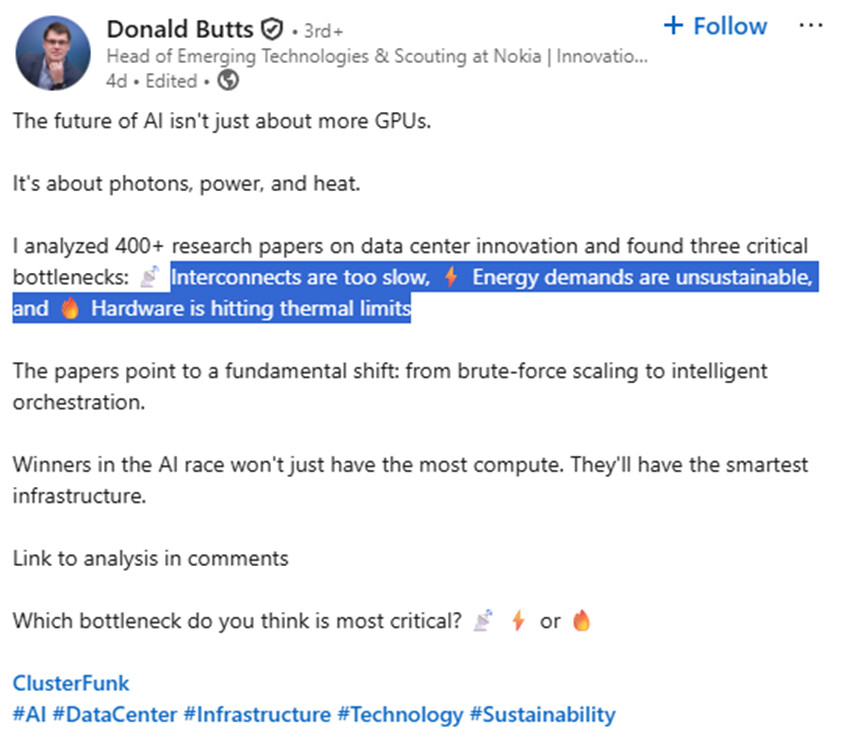
I came across a new post by a Nokia employee. Link to the post behind the image.
image

Summary.

Overview: Solving the Data Center Crisis

The writing discusses the “data center crisis” caused by artificial intelligence (AI), where current infrastructure is hitting the limits of power consumption, heat generation, and data transfer speeds. Butts uses mathematical models (Bass Diffusion Modeling) in his analysis to predict when new technologies will move from research to practice.

The analysis is divided into two main groups (clusters):


Cluster 1: AI Fabrics Operating at the Speed of Light

The research focuses on transforming network structures from static electrical networks into dynamic and optical ones.

  • Photonic Interconnects: Moving from copper to light (photonic rails) is essential for eliminating latency and increasing bandwidth.
  • SmartNICs: Offloading tasks from the server’s main processors (CPUs) to smart network interface cards frees up power for the AI computation itself.
  • Dynamic Topologies: Networks that can change their shape in real-time according to traffic.
  • Timeline: This technology is maturing (81% of the research phase has been passed). Hyperscalers (such as Google, Meta, Microsoft) are expected to deploy these widely over the next 12–18 months.

Cluster 2: Coordination of Energy and Computing

This area is only at the beginning of its lifecycle (only 9% of potential reached), but it is critical for satisfying the massive hunger of AI.

  • Carbon-Aware Computing: Software and architectures that adjust AI workloads in real-time based on the state of the power grid and carbon intensity.
  • TCO Optimization (Total Cost of Ownership): Decision-making is driven by cost-effectiveness over the entire lifecycle, including the use of FP8 precision, which reduces inference costs.
  • Social Impacts: The research considers the strain data centers place on local power grids and water resources (the “Cloud Next Door” phenomenon).

Key Takeaways for Investors and Technology Leaders:

  1. The bottleneck has shifted: The problem is no longer just chip speed, but how chips talk to each other (interconnect).
  2. Optics are a necessity: The research strongly signals that optical solutions (which Nokia and Infinera are developing) are moving from the research phase to the mainstream very quickly.
  3. Energy efficiency is the new currency: The growth of data centers is no longer dependent on money, but on whether they can get enough electricity and manage its environmental impact.
10 Likes

I don’t think that (of course).

But are you then of the opinion that investment costs and the necessity of the investment don’t matter to operators?

Lumentum reports earnings tomorrow. Market cap 28 billion, P/E somewhere around 260, up 350% in a year. So they currently have a CPO laser design-in. I’m interested to see what happens to share prices when Nvidia goes public with Nokia, and it’s not just about a laser.

9 Likes

Alright, I think that’s enough on this topic. Everyone has their own motives for posting here.

2 Likes

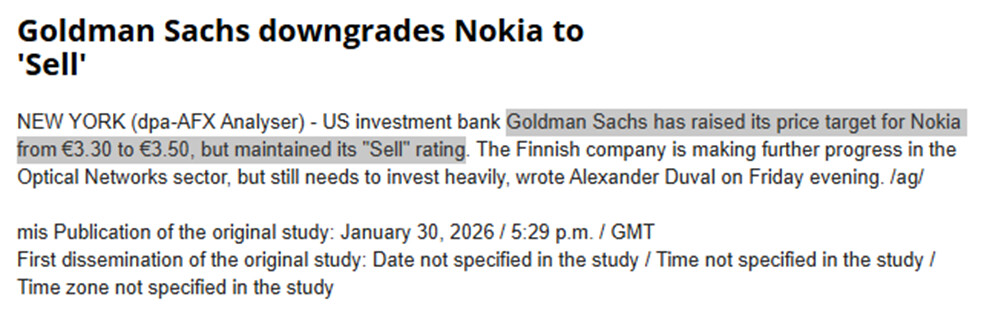
GS remains negative.

Now the latest minimum target is @ €3.50.

12 Likes

GS really has it in for Nokia​:joy:. Since I can’t access it, does anyone have a summary of the core arguments? It’s actually good that there’s plenty of range in the forecasts, with GS and Inde at the lower, more pessimistic end.
5 Likes

oh and as a side note to that, revenue is hovering under two billion dollars :joy:

let’s hope for at least a P/E ratio of 50 for Nokia in 2027

6 Likes

Speaking of a broad range.

Santander raises Nokia to outperform (neutral), target price 6.40 euro - BN

14 Likes

And one more buy recommendation.

23 Likes

An interesting write-up, and it’s closely related to Nokia. According to this, the architecture is not yet set in stone. The supplier’s (perhaps Nokia!?) readiness for component manufacturing must be sufficient – meaning it’s about supply chain readiness and sufficient yields. Nokia repeatedly mentioned, for example at CMD, that “execution” is key – and it would also fit here.

Nvidia’s Vision: Fully Optical Data Center Rack (OIO)

Nvidia’s goal is an “Optical Input/Output” (OIO) architecture, where all GPU and switch chips are equipped with integrated optical engines. This eliminates the conversion steps between electrical and optical signals. Implementation will take place in stages:

  1. Scale-Out Network: Deployment of CPO switches (happened last year).
  2. Scale-Up Network: Bringing CPO switches to NVSwitch units.
  3. GPU Chips: CPO packaging directly into GPGPU chips.

Rubin Ultra and CPO Solution

Rubin Ultra racks use an NVL72 x 2 configuration, where two racks are combined into a 144-GPU cluster.

  • Scale-Up Connection: Adjacent racks are connected using optical fibers and CPO technology.
  • NVSwitch Units: Use a modified Quantum X800 chip. Each chip is packaged together with 4.5 units of 3.2T optical engines (total 14.4T capacity per chip).
  • Hardware Quantities: One Rubin Ultra cluster requires 144 CPO NVSwitch chips, 24 NVSwitch platforms, and 648 optical engines for the Scale-Up network.

Scale-Out Network and CX10

The external network of the rack is also moving to CPO technology:

  • Each CX10 network interface card (NIC) is equipped with an integrated 3.2T optical engine.
  • The total ratio for the rack becomes 5.5 optical engines per GPU.

Alternative Implementation Methods for 2027

Nvidia has two parallel solutions for the 2027 Rubin Ultra racks:

  1. Orthogonal Backplane: Difficult to assemble, low manufacturing yield.
  2. CPO Solution: Mechanically easier, but the challenge lies in the manufacturing yield of the optical engines.

The final choice between these will depend on supply chain readiness and production reliability closer to 2027.


Nokia’s optical equipment and component contract manufacturer Fabrinet (Fabrinet is the factory that turns Nokia’s drawings into physical, high-performance modules) announced its results yesterday. Things are going well, but of course, they also manufacture for other industry players like Lumentum, Coherent, Ciena, and Cisco. Nokia was also mentioned during the call. A few highlights below.

Fabrinet CEO Seamus Grady mentioned in the earnings call that they have been working on these new hyperscaler projects and CPO solutions for “about 18 months” – in other words, since approximately August 2024. Btw. Nokia announced the acquisition of Infinera in the summer of 2024, and Infinera was also already a Fabrinet customer.

Analyst George Notter pointed out that Nokia has stated it is increasing its production capacity for optical networks. He asked Fabrinet management directly if Fabrinet is involved in this expansion.

CEO Seamus Grady did not directly confirm or deny the Nokia collaboration (due to customer confidentiality), but stated they have a “very good pipeline” and new opportunities with both existing and new customers.

CPO (Co-Packaged Optics): Fabrinet is working with three different customers on CPO projects.
OCS (Optical Circuit Switching): Fabrinet sees this as a completely new product category.

12 Likes
9 Likes

A summary of that so not everyone has to translate it themselves.

Dagens industri (Di) news reports on a historic opportunity for Finland’s Nokia and Sweden’s Ericsson to participate in a massive U.S. defense project.

The project is driven by Donald Trump and aims to build a nationwide missile defense system for the United States. It is modeled after Israel’s “Iron Dome” system. The estimated value of the project is approximately 1,300 billion kronor (about 115 billion euros).

Missile defense requires extremely fast, secure, and low-latency telecommunications networks. Real-time detection and interception of missiles are impossible without 5G/6G expertise.

21 Likes

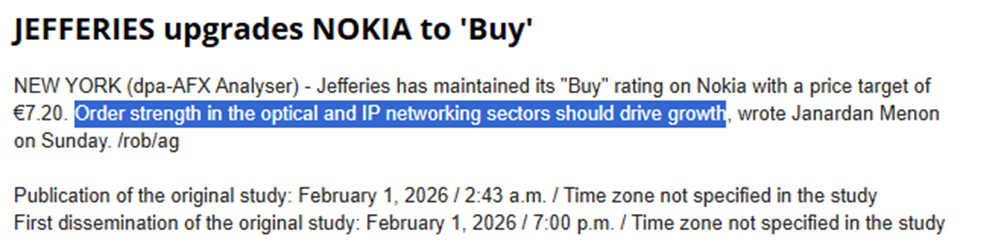
Deutsche Bank lowers its target price for Nokia to 6.50 from 6.75 euros. The buy recommendation is reiterated. (News Agency Direkt)

The new CEO has stepped on the accelerator, wrote Robert Sanders in his commentary published on Tuesday. Significantly higher investments than in the past are evidence of this.

Goldman Sachs: Korkeat investoinnit rasittaa Nokian tulosta. MYY.
Deutsche Bank: Korkeat investoinnit todistavat että Nokian liiketoiminta kehittyy hyvin. OSTA.

13 Likes

Adding Wikipedia here as a reminder. Apparently, there are quite large differences in the price tags depending on who you ask. It would be nice to know what percentage of the money would go toward data transmission. I would argue that Nokia’s radios are a better fit for the project than Ericsson’s, because:

  • programmability is critical, as they don’t want to replace satellites if there is a need for updates
  • multiple Gs in one package (readiness for non-standard 6G already next year)
  • edge AI also included starting from 2027
  • Nokia has 4G on the moon
  • a defense unit already exists, and they have even prepared for quantum threats

“At a White House briefing on May 20 2025, Trump said he expects the Golden Dome system to be “fully operational before the end of my term”"

Trump is apparently a big spender. It would be a really big deal to get properly involved in this, even if the budget stayed within the White House estimates and only scraps were left for the communication side.

4 Likes