Nightingale Health - New Blood on the Stock Market

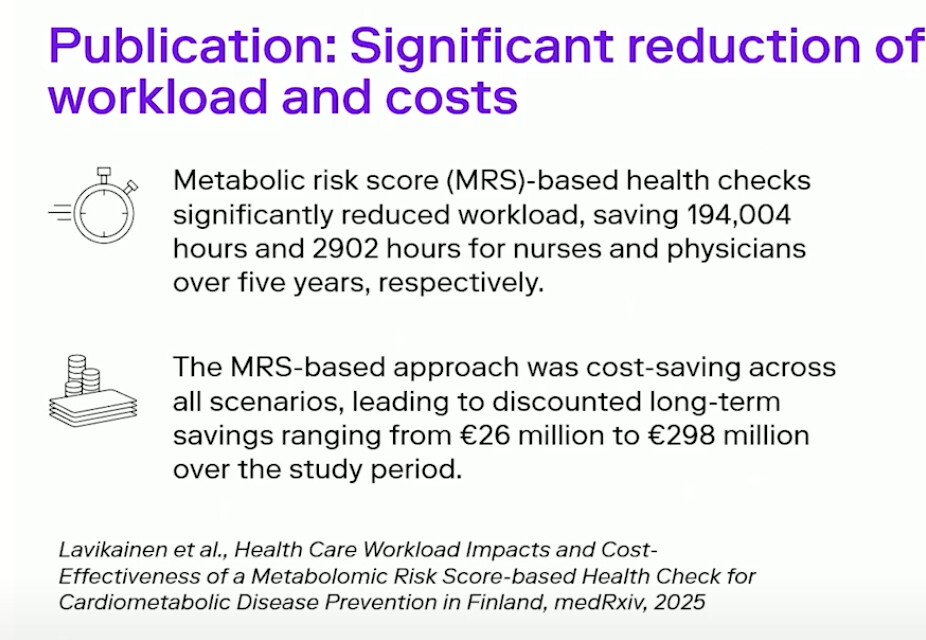
New article related to cost-effectiveness. The achieved savings would be absolutely huge. And this is calculated for CVD and T2D. NOTE! This is a Preprint article funded by NG and has not yet been published in a peer-reviewed journal. Also available as PDF here: https://www.medrxiv.org/content/10.1101/2025.09.11.25335561v1.full-text

Image extracted from Minja Salmio’s presentation at a conference in Germany (https://youtu.be/pqiLqAX7UJI?si=x-1VrauFBOqQoW40)

11 Likes

This is quite an interesting article. It caught my eye that the logistic regression models used by Nightingale in the article were amusingly named “AI models,” which perhaps I should start using in my own publications. In a sense, it’s true if one understands an AI model very broadly.

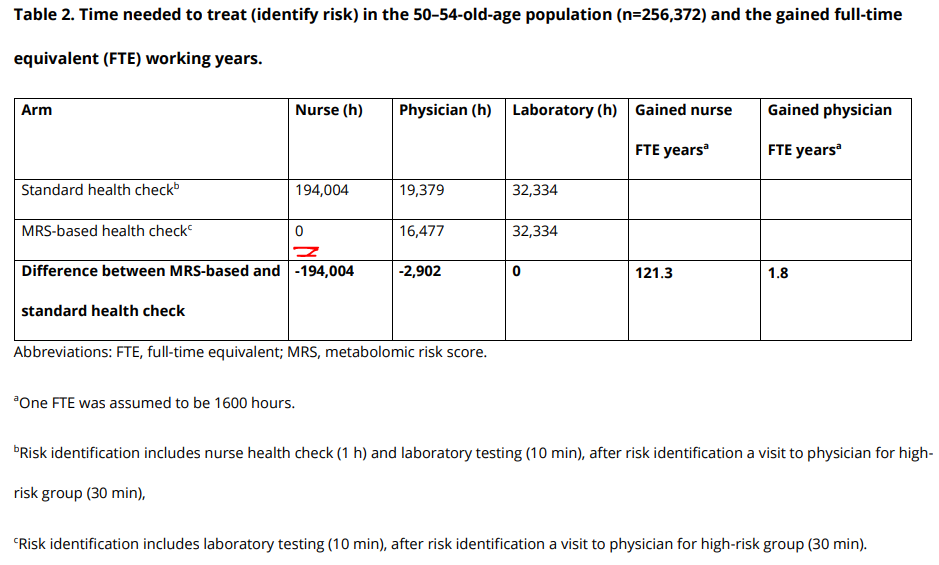
In the publication, health check-ups primarily refer to health check-ups performed by occupational health nurses in occupational health care and the potential intervention chain that might be initiated from them; those at high risk get to see a doctor who can prescribe various interventions. It’s worth noting that almost all savings and cost-effectiveness come from discontinuing the nurses’ work and replacing it with Nightingale’s blood test and risk tests.

In the public sector, health check-ups have largely been discontinued as ineffective, so savings in that regard have already been realized. Health check-ups would not necessarily need to be replaced by anything (e.g., NG’s test); they could simply be stopped, and that in itself would be cost-effective and lead to significant savings. Here, savings have mainly been achieved by automating the work done by nurses, which could, of course, be valuable.

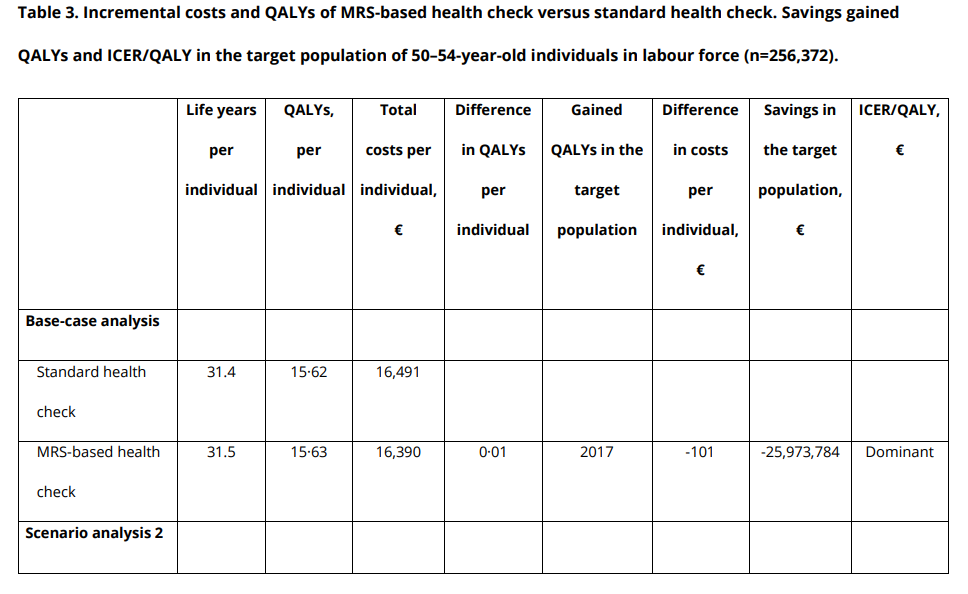
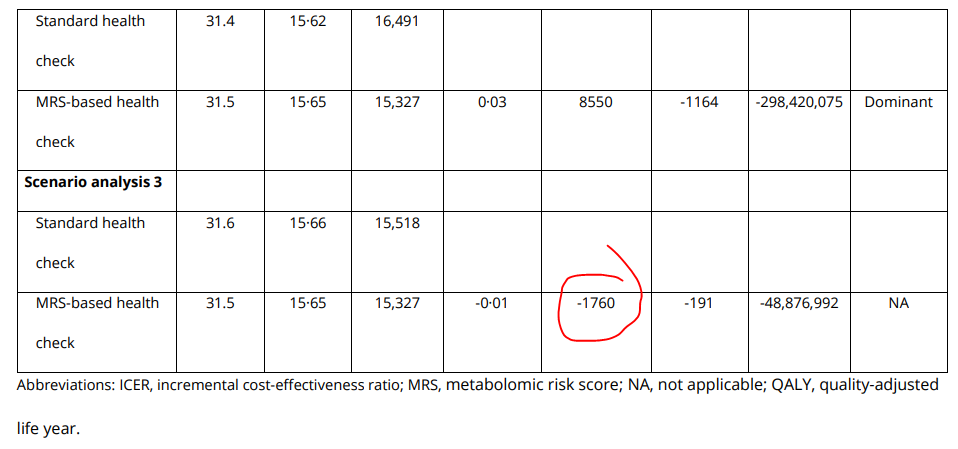
The article’s simulation is quite well done, even though it uses “synthetic data,” which may not always increase credibility. This study has particularly well considered what such risk testing could lead to and modeled various common interventions that could follow from different risk levels (here, for example, intervention to stop smoking, tightening blood pressure or cholesterol targets, weight loss coaching) and given the effects on their realization. Finally, after applying all these to those at elevated risk and replacing current health check-ups with Nightingale’s test, the remaining expected quality-adjusted life years (QALY) for the cohort increase from 31.4 to 31.5 in scenarios 1 and 2, and correspondingly decrease by 0.01 years in scenario 3 :scream:.

At the population level, the changes achieved in quality-adjusted life years are in the order of a few per mille, i.e., insignificant, but the article appears to be the first to consider that testing with Nightingale’s test could also worsen people’s health and life expectancy at the population level, i.e., compared to the current operating model, which involves a nurse’s appointment where FINRISK and FINDRISC are performed.

This, in my opinion, is the most interesting aspect of the article; it’s a pity that the authors do not elaborate on it further in the text or supplementary materials. It is only stated that there are differences in classification compared to the control group, and later there is talk of “inaccuracies” in NG’s metabolomics modeling and classification ability, which is further mentioned to be “slightly weaker” than presented in previous studies.

However, there are also several limitations. First, there are some inaccuracies remaining in the modelling of the MRS risk of individuals and modelled parametric disease-free survival times (i.e. the ability of MRS to recognize the ones in true risk seems to be a bit weaker in our model than reported in previous studies [13,14]). This makes the results presented weaker than they ought to be.

This could have been elaborated on more, but the main focus of this study seemed to be to evaluate the effects of NG’s test on costs and workloads, and it is stated in passing that these are significant and worthwhile despite possible (small) negative health effects. This is one way to lobby for a cause, but one must consider what it means for NG’s investment case if one pivots to talking only about cost-effectiveness and forgets about health effectiveness.

Of course, this study does not actually say whether NG’s test worsens or improves people’s health. The results are vague, within the margin of error, and were generated with synthetic data and a thousand assumptions. Transparency is poor. But the classification ability of NG tests is very poorly described and especially validated, and even here, worrying inaccuracies were referred to.
12 Likes

I’m a bit at the edge of my understanding, so I ask if only the effect of CMD interventions is included in that QALY calculation, and would the nurse’s work with current methods be greater than calculated if other risk assessments were done (more forms to fill out?), but in NG’s test, would including those other chronic diseases as a basis for intervention not increase the cost side, even though it could increase the QALY side?

And also, was it the case that these are not done much now because the nurses’ workload is too great relative to the benefit, i.e., how much would the adoption of NG’s test increase QALY vs. not doing it at all?

1 Like

This included the mentioned CMD interventions and their assumed effects. In the health check model based on NG’s test, the nurse’s working time per patient was cut from 60 min to 10 min, meaning that in those 10 min, there’s not much time for anything else than probably checking the results of NG’s test and booking an appointment with a doctor or other intervention if risks are elevated. This only covered CMD and T2D diseases, so measuring other disease risks could, of course, bring additional benefits or drawbacks regarding NG’s test.

These are done in occupational health and also in the public sector, at least health checks for the unemployed. The model assumed that 15.2% of 50–54 year olds would attend an annual health check. The ‘no health check’ branch would have been an interesting addition to the study; currently, there is no information on the incremental benefit compared to it.

1 Like

Peculiar publication method. It has not been peer-reviewed, the models have been concealed, and the disclosures are brief (who really funded it). Nurses are no longer needed..

3 Likes

The discussion is quiet, but the company is quiet too.
The shareholder update is also quiet; someone from Nordea’s funds has sold a tiny bit, otherwise the top 100 practically hold onto their portfolios with white knuckles.
By the way, I spot about 15 company employees, managers, or board members on the lists, and they likewise hold onto their shares month after month.

Perhaps I can also continue patiently, after all, Rome wasn’t built in a day.

12 Likes
13 Likes

Antti & Antti Co have given their comments on today’s news, as Nightingale has formed a strategic partnership with Alamar Biosciences :slight_smile:

10 Likes

Greetings from the AGM (can one say this for a virtual one?)

Teemu’s presentation was largely a copy of what was held

21 Likes

Here is the CEO’s review of Nightingale’s yesterday’s annual general meeting, mentioned by @Puutaheinaa :smiling_face:

11 Likes

This is a kind of milestone as well. In March, Nightingale Health was listed on the OTCQX International marketplace in the United States. Last Friday, for the first time, there was activity on the marketplace with a volume of 5000 shares:

18 Likes

More trades today, Monday. 3 X 5000 units.

14 Likes

Foreign ownership of shares has risen from 12.30% in 09/25 to 24.23% in 10/2025.

19 Likes

Could I get a link to this information? I can’t find this information anywhere myself.

2 Likes

It would be nice to know where this information comes from. Thank you.

It can be found on the OTC marketplace page I linked, to which Pertti2 replied.

3 Likes

I can’t find foreign ownership changes on the OTC pages. And it probably couldn’t have happened, as such large quantities haven’t circulated on the exchanges.

But otherwise, this company and stock seem to be picking up, the ketchup bottle cap is already wiggling :slight_smile:

3 Likes

@Puutaheinaa The topics are getting mixed up. My answer was to Ossi81, not Passenger1, and it’s visible in the top right corner of the message. :slight_smile:

I’m also interested in where @WilunGi saw that information.

4 Likes

No, it’s not possible. No larger block trade has been announced either.

1 Like

Good things are in the air again. Just yesterday, representatives from Nightingale and the Ministry of Social Affairs and Health held discussions in Qatar with the Primary Health Care Corporation (PHCC), which works closely with the State of Qatar.

I smell money💰

8 Likes