Quite an interesting explanation of what happened in France. Industry has disappeared, and for example, out of an employee costing the employer 60,000, the employee only receives a net salary of 33,000. Finland’s situation is probably exactly the same. France pays more in interest than it spends on education.
Affordable electricity would certainly allow us to compete with Germany in the chemical industry, provided that the permitting processes for building plants are streamlined.
The attractiveness of engineering fields needs to be improved, and real funding must be allocated to education. The machinery industry is still the backbone of Finland, but this is not reflected in the quality of education. Universities of applied sciences spend their funds on trendy projects when the money should be directed toward teaching. Companies also have something to reflect on here. Technical subjects could be taught as early as junior high.
Extending working days won’t help if it doesn’t increase exports.
One of Europe’s highest tax burdens is the invisible brake that slows everything down. Capital is diverted into public sector inefficiency. VAT is 25.5%, and it stifles private consumption. Products are bought from Temu and from abroad during holiday and business trips. VAT should be lowered to 19% as soon as possible to get money moving.
This gets to the very heart of Finland’s lagging economy: companies that lack the will to grow.
Furthermore, when companies invest, on average, half as much in innovation as those in the US, capital markets need streamlining, labor productivity is crawling, and high-level engineering products can’t be commercialized into consumer-friendly ones—this is where we’ve ended up.
Politicians provided the finishing touch: from the 2007-08 financial crisis to this day, there has been only one year (during Juha Sipilä’s term as Prime Minister) when public finances weren’t in shambles.
I’ve been reading through this thread for a while, and I must say, it’s been an excellent discussion. There are many well-reasoned perspectives from contributors with differing views. I thought I’d throw my own two cents in, though my arguments might not be quite as high-quality as some of the others here.
As a starting point, I could say that in my adult life, I haven’t experienced a time when Finland has seen real economic growth. Politics seems to have ground to a halt, and most of the population doesn’t seem to truly understand that decades of tinkering with outdated structures here and there isn’t going to fix the situation. Debt hasn’t been used to create better conditions for economic growth; instead, it feels like it’s been used to maintain current unhealthy structures and to fund consumption. Public money (meaning taxpayer money) seems to be everywhere, and the average person can’t really distinguish between the private and public sectors.
Anyway, enough rambling—here’s my take:
Lowering the taxation of labor. Taxation should certainly be scrutinized in many areas, but the need is most obvious regarding labor. High taxation doesn’t encourage people to do extra work or talented individuals to take on more challenging roles; instead, people settle for less. Tax progression is remarkably tight even around median salary levels, while almost no state income tax is paid on the lowest incomes.
Reforming the Collective Bargaining Agreement (CBA) system. Trade unions have achieved very important things for employees, which have perhaps corrected the naturally unbalanced negotiating position between employer and employee. Today, however, employee organizations especially seem to stubbornly defend the interests of their current members and those already in the workforce. The extremely rigid wage formation of the CBA (TES) system means that many people lacking work experience or those with reduced work capacity for other reasons do not meet the productivity requirements of even the minimum wage, making it unprofitable to hire them. In this scenario, both the worker and the potential employer lose. I’m not an entrepreneur, but I can imagine that making investments is also very risky or at least unprofitable due to rigid wage formation, because the CBA system doesn’t care about the employer’s cost structure. This is likely a reality for companies in the early stages of their lifecycle.
Fixing the pension system. To put it bluntly, the pension system is a “Moloch’s maw” built on the assumption that the working-age population will always increase. Because the population is not growing for one reason or another, there is constant pressure to raise pension contributions. If they aren’t raised, taxpayers have to cover the deficit. Even if the system worked as designed, it should be moved toward a more fund-based model where everyone saves for their own retirement within certain limits, rather than through the current pay-as-you-go system managed by pension companies. In the long run, this would eliminate the pressure to hike contributions and the burden on taxpayers. Depending on the implementation, it could even lower contributions, creating a competitive advantage through lower labor costs and/or better purchasing power for workers.
Scrutinizing and dismantling publicly owned companies. By this, I specifically mean companies operating in sectors where a private market and demand already exist. One example is municipal-owned companies providing accounting services. There are plenty of accounting firms in the market, and pricing is efficient due to competition. I see no reason why the public sector should provide services and compete in fields where private activity already exists. Private operators have much better incentives to provide services more productively and efficiently and to make profitable investments. These public companies hold a lot of human resources that could be released to the private sector.
Changing corporate taxation to resemble the Estonian model. Corporate tax is a tax that creates a negative incentive to invest. Investments promote productivity, which generates growth. Investments, of course, mean acquiring labor, either by direct hiring or using subcontractors. Economic activity also creates value-added, from which the taxman gets a share. Are these the much-discussed “dynamic effects”?
Reforming the healthcare system. This is such a large part of the state budget that something must be done, although I’m not entirely sure what. In the current system, however, public healthcare takes on far too large a role for even the smallest issues, which we all pay for. The system encourages people to go to a health center for minor back pain or a common cold, even when the only sensible recommendation is a few days of rest. If you’re sure you need a doctor for a cold, you could pay for it out of your own pocket. In practice, a large part of primary health center services could be privatized so that everyone takes more responsibility for their own well-being with their own money. Expensive specialized care, and perhaps children’s doctor visits and maternity clinic services, could probably remain within the public service offering so that the birth rate doesn’t drop any further because of this.
Reforming the social security system. This consumes a huge amount of money, and social security competes with lower-paying jobs. Without going into individual benefits, I’ll state generally that by combining several benefits, it’s possible to achieve largely the same standard of living as with low-paid work. For example, housing allowance makes it possible to live on social security even in the more expensive areas of cities, where someone in paid employment might not be able to afford to live. Social security must, of course, enable a humane life, but it cannot be an alternative to paid work. Child benefit is also an odd subsidy that is paid whether you are completely penniless or a millionaire.
There are some thoughts at the end of the Christmas abundance, though there’s nothing particularly new in them. Nor do I have any detailed proposed solutions for these. But the core of the problem and my thinking lies largely in the fact that high taxation has shifted responsibility from citizens to the state, which I believe underestimates the ability of citizens to make sensible decisions in their own interest. Instead, we have to pay for each other’s lives and the challenges that arise—furthermore, high earners carry a progressively larger share of this, both relatively and in terms of labor taxation. We don’t seem to understand that we no longer live in a closed economy, but compete with the whole world. In much of the world, a welfare state system is completely foreign, and the high taxation it requires is not a pull factor for the international talent we so desperately long for. The same incentive problems are present in our native population, as those with high earned income start seeking more leisure time in the name of tax optimization because the tax system encourages it.
Unfortunately, political realities and the weak state of public finances prevent radical changes because there’s probably no room to lose tax revenue even for a short time. On the other hand, can we afford to just wait and see what happens to us if no action is taken? We are between a rock and a hard place.
There are certainly specific challenges to this ambitious plan:
Loss of tax revenue of €6-8 billion/year if taxation shifts only to profit distribution
The Estonian model has been accused of capital sitting idle in companies, not circulating
Subsidies can lead to unprofitable investments and outright scams
Market support for a 1% interest rate (e.g., 4->1%) is direct support, accumulating national debt/expenditure
The one-country principle doesn’t work when countries compete for companies in the EU. Germany or France will not allow a company to operate in their country that functions under a lighter model and set of regulations than their own domestic companies
But it is true that ambitious plans are needed and reforms are essential to improve our country’s situation. For some reason, there isn’t even a dialogue about this kind of concrete action in our country.
A problem with lower wages would be that, for example, at the lowest wage levels in industry, making a living is already quite challenging as it is if you have to drive to work from any significant distance. The same applies to the cleaning sector and other lowest-paid jobs.
Costs should also be brought down at the same time, for example, the price of electricity and the taxation of driving. The change should be implemented in stages. I would rather not increase subsidies.
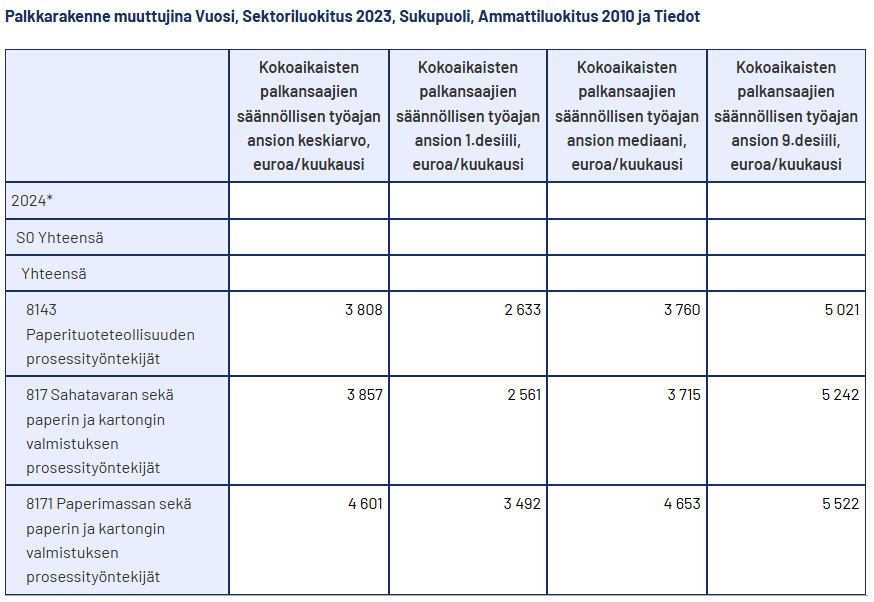
It is certainly the case, but I believe that, on average, wages in the manufacturing industry are quite good, and that is thanks to the labor unions. High wages have likely at least accelerated the inevitable reality that lower value-added production is gradually shifting to countries with cheaper labor and other costs. At least in the paper, sawmill, and paperboard industries, the averages and medians for regular working hour wages are commendable, according to Statistics Finland.
Wages in the lowest deciles are such that one can get by quite well. The averages are already considerably higher. Median levels also still seem to exceed the median income of all wage earners. The actual net take-home pay in that lowest tenth is also decent, as it is compensated by lower taxation and the fact that many jobs in the sector are in cheaper areas, like where I live myself—outside Ring III (Kehä III). I haven’t looked at other statistics more closely, but those wood industry sectors have stuck in my mind from stories told by relatives, for instance, regarding the “sauna bonuses” (saunalisä) paid on Saturdays. I don’t fundamentally see long commutes as a justification for raising wages, as everyone must adjust their standard of living to fit their own expenses. Relative to the required education and skill level, wages are somewhat high, although I don’t believe there should be a direct link between high education and high salary levels.
The problem you mentioned regarding the cleaning sector and other lower-paid industries is real, especially when full-time work is not available, as I understand is often the case. In such situations, supplementary social security must be paid, which in turn discourages taking on extra work if it becomes available, leading to an incentive trap.
Since Finland’s weak economic growth and the growth of the public sector can be fully explained by the weakened dependency ratio, see e.g. 1 and 2, all efforts should be focused on improving it.
Short-term solution: a person coming from abroad to work in Finland pays zero euros in income tax for the first five years, after which the tax progression is capped at 30 percent for the next five years, followed by a gradual increase to the level of the native population. The same tax incentive also applies to Finnish expats.
To boost investment, the Estonian corporate tax model.
A long-term solution cannot be achieved through politics alone, but Finnish culture should take a leaf out of the Israeli family-oriented model, as the country has managed to keep the birth rate above 2.0 even in secular circles, which in my view most closely resemble the native Finnish population.
If the birth rate cannot be fixed, the weak dependency ratio will be a chronic problem for us. Therefore, all solutions should be directed towards fixing it.
It seems those wood industry wages are really good compared to what is paid in the metal assembly industry.
In practice, an entry-level mechanical fitter earns roughly €2,400 gross in assembly and a more experienced one €3,100, depending of course on the factory. In heavy machinery workshops, you can easily add €500 to those wages.
The birth rate crisis should be resolved as soon as possible. It is difficult to see the tide turning in the long run otherwise. I read somewhere that, for example, in Israel, the society funds infertility treatments very readily from public funds, and they are indeed performed frequently. In Finland, the criteria are much stricter. During the last government term, the Marin government removed Kela reimbursements for private-sector infertility treatments. There was plenty of money for everything else (read: money is available), but not for this. I also believe there is a moral and ethical question here. For example, a 40-year-old male-female couple cannot receive infertility treatment in the public sector, but a lesbian couple can.
At least the current government restored Kela reimbursements for infertility treatments in the private sector.
Another aspect is medical. Medical treatments are developing very rapidly, and their prices are also rising. Hardly any public prioritization discussion has taken place yet. How are expensive cancer treatments funded and for whom? Is an expensive cancer treatment given to, for example, a 90-year-old, or is infertility treatment funded for a 40-year-old woman?
At the current rate, the situation will only get worse. The elderly are being treated more and more with the most expensive methods. Of course, they should be treated, but I think some kind of prioritization discussion would be necessary. I understand that for a politician, this is a very difficult topic to bring up. They would likely lose their seat in Parliament immediately—unless they were labeled a Nazi in the press first?
Modern society also does not encourage having children. Young people do not have the money to have children; they simply cannot afford it. One concrete proposal: by having a child, one could, for example, get a lower income tax percentage for five years. Would that be a good incentive? As I understand it, index increases for child benefits have been quite minimal and/or frozen. Other subsidies have increased more.
In a previous post, the writer vilkar wrote that:
How does the system encourage going to the health center for a common cold? I do not think it does. What are these incentives? The writer says that health center services could be privatized so that everyone takes responsibility for their well-being with their own money. The writer has likely not worked in a health center and does not know what kind of patients go there. Most patients are elderly seniors, the unemployed, people with substance abuse issues, those with social problems, the multi-ill (= treatment in the private sector is not possible and/or costs a fortune), the depressed, and the low-income. Additionally, of course, small children, maternity clinics, school healthcare, primary healthcare wards, substance abuse treatment, and military conscription physicals. How would this be privatized in practice? Privatization also generates additional costs, unnecessary laboratory tests, and unnecessary examinations in general. In the private sector, these often seem to be billed to the insurance company.
Vilkar’s message had a lot of good points, but the healthcare commentary and claims remained quite superficial remarks.
Summary: Pensioners are paid a lot and treated a lot. Infertility treatments are being skimped on. Not enough children are being born. The ship is sinking if the course is not turned.
Joint replacement surgeries are performed very, very rarely on 90-year-olds so-called electively, i.e., in a planned manner, without a hip fracture or similar.
So, it was either a hip fracture treated with a joint replacement, or a 90-year-old who was otherwise in very good health and sharp-minded (there are some of those), where the risks were assessed to be much smaller relative to the benefits.
All in all, patients are not referred for joint replacements or surgeries in general unnecessarily in the public sector. Of course, there may still be some old-fashioned staff in some parts of Finland where the “screening leaks” compared to the general policy. The reason why the number of joint replacements, among other things, has still increased is that the number of people at “joint replacement age” is at its peak and people’s lifestyles are such that joints wear out at a world-record pace (obesity, poor diet, inactivity).
I agree. In fact, policies aimed at increasing the birth rate were already practiced in Finland during the last century. After the wars, about 101,000 settlement farms (asutustila) were established for the landless population, and their inhabitants were given loan concessions for each child. If a farmer had three children, the loan was reduced by 5-15%, and each additional child resulted in a repayment-free year. Nothing similar existed in other European countries after the wars, and Finland’s population growth was higher than elsewhere in Europe. The direct connection to loan concessions could be studied more, but settlement farmers had significantly more children than other families (writing on the subject). Certainly, for instance, living in more spacious conditions than in cities increased the desire for a larger family. But perhaps a modernized version, such as mortgage relief based on the number of children, would be worth trying?
As speculated by Risto Murto and others, due to economic necessity, Finland may in the future have to transition to a system where children have some kind of obligation to support their parents. Much has been said about the immediate effects of this on the economy and people’s daily lives (e.g., parents living far away), but less about the long-term effects. If pension security or care is no longer provided by the state in the future, will people start having more children to provide for their old age? The bankruptcy of the welfare state would then return society to an old model, where the responsibility for care shifts more toward becoming an internal matter for families and kin. It would certainly be a painful transition phase.
Sounds like the kind of business typical for a Finland flirting with tax socialism, where after heavy taxation, one would still have to cover their parents’ care costs.
Once again, this “tax” would hardly replace anything, but would be an extra for the so-called “rich.” Naturally, for everyone else, the state would pick up the tab.
Regarding their own pension, an elderly person in a care home should be left with about 170 EUR for personal use until the care fee of approx. 5,000–6,000 EUR is settled. That gap would then presumably have to be covered/supplemented by the children—that is, by the few who would have the so-called capacity to pay.
I’d be interested to know what exactly is included in that €5,000–€6,000 cost. For example, is it just about living in a nursing home, or all costs to society?
I mean, those seem like fairly high costs if it’s just for the bed, nurses, meals, etc.
And there’s a challenge with that idea: the majority of nursing home residents don’t come anywhere near covering their costs. If there is a private nursing home where every elderly person actually pays that €6,000/month, you can certainly get more nurses and better food there.
And why is that a problem? Because it really is an option for everyone with the means to pay, and then the public sector will only have those who can’t afford it.
Let’s bring up (again) the abolition of inheritance tax from the perspective of a family-owned company.
For a family-owned company, growing is a challenge because the company’s value also increases. In the event of a generational handover, there are no means to pay the inheritance tax other than by selling shares, which dilutes the family’s majority ownership.
For this reason, the current model encourages distributing profits as dividends rather than investing in the company’s growth.
If Gemini is to be believed, in Vaisala’s case, when you inherit 50% of the company’s ownership in a generational handover, you pay approximately €12.5 million in inheritance tax, including reliefs. It can be paid over 10 years, by which time the taxes have almost been covered by dividends, even if the dividends are quite small.
Half of a €1.5bn company for €12.5m. Quite cheap. Or did I fail to take something into account? Please feel free to correct me if I got it wrong

 companies invest, on average, half as much in innovation as those in the US, capital markets need streamlining, labor productivity is crawling, and high-level engineering products can’t be commercialized into consumer-friendly ones—this is where we’ve ended up.