These procurements, based on public sector budgeting, have been a complete joke for decades, and should have been addressed ages ago. Several things bother me, such as the excessive influence of price on decision-making criteria at the expense of quality, but let’s return to the discussion above.
Of course, I cannot generalize everywhere, but based on my own experience and discussions, do you know what those responsible for these procurements get if they come in under budget? Nothing, and in fact, the truth is quite different. They lose next year’s procurement budget. The system actually encourages spending and acquiring equipment that may not be needed and using the entire year’s budget, so that next year at least the same amount is available, should there be any need.
At its most brutal, this was personally evident to me back when, in December during the interim days, I was selling new projectors for classrooms, a refrigerator, and a television to a school (the latter hardly for student use). It could be that everything just happened to break down, or perhaps they just had to secure next year’s budget…
Can someone explain to me how Finland gets economic growth by school radiators and floorball goals being bought preferably from Prisma rather than Predatory Company Ltd.? Isn’t the effect rather contracting the economy?
Yes, I agree that public procurements are handled very poorly, as unnecessary conditions in tenders usually already exclude SMEs. But they don’t grow the economy.
EDIT:
Corruption is criminal activity, and since you still have evidence of this, I warmly hope that you file a police report about it. That’s the least you can do for the matter.
I’ve become a bit critical about the construction of those data centers. The idea is mainly that so far, the electricity tax collected from companies has probably been 0.05 cents, something probably accumulates from it when a lot of energy is consumed, and now it’s probably being raised, while simultaneously planning state compensations to attract data centers. Behind these centers, all sorts of Chinese and Dubai billionaires seem to be operating, for whom even the Finnish state budget is probably a mosquito’s fart in the Sahara. It really feels very wrong if a low-income Finnish electricity consumer has to pay in the future so that some foreign clown can rake in the dough with a sweet smirk on their face, it’s truly sickening. Gullibility is the original sin of Finns, even at the EU level; the way some leeches like Hungary, Italy, Greece, etc., milk money has been annoying for a long time, and Finns humbly split hairs in their own actions.
They wouldn’t come here if electricity wasn’t cheap and stable. They don’t come here for Finnish expertise. They are modern-day banana republic stuff And they will get new support, which is the same size as the previous tax benefit, because the government’s backbone broke as soon as Google called.
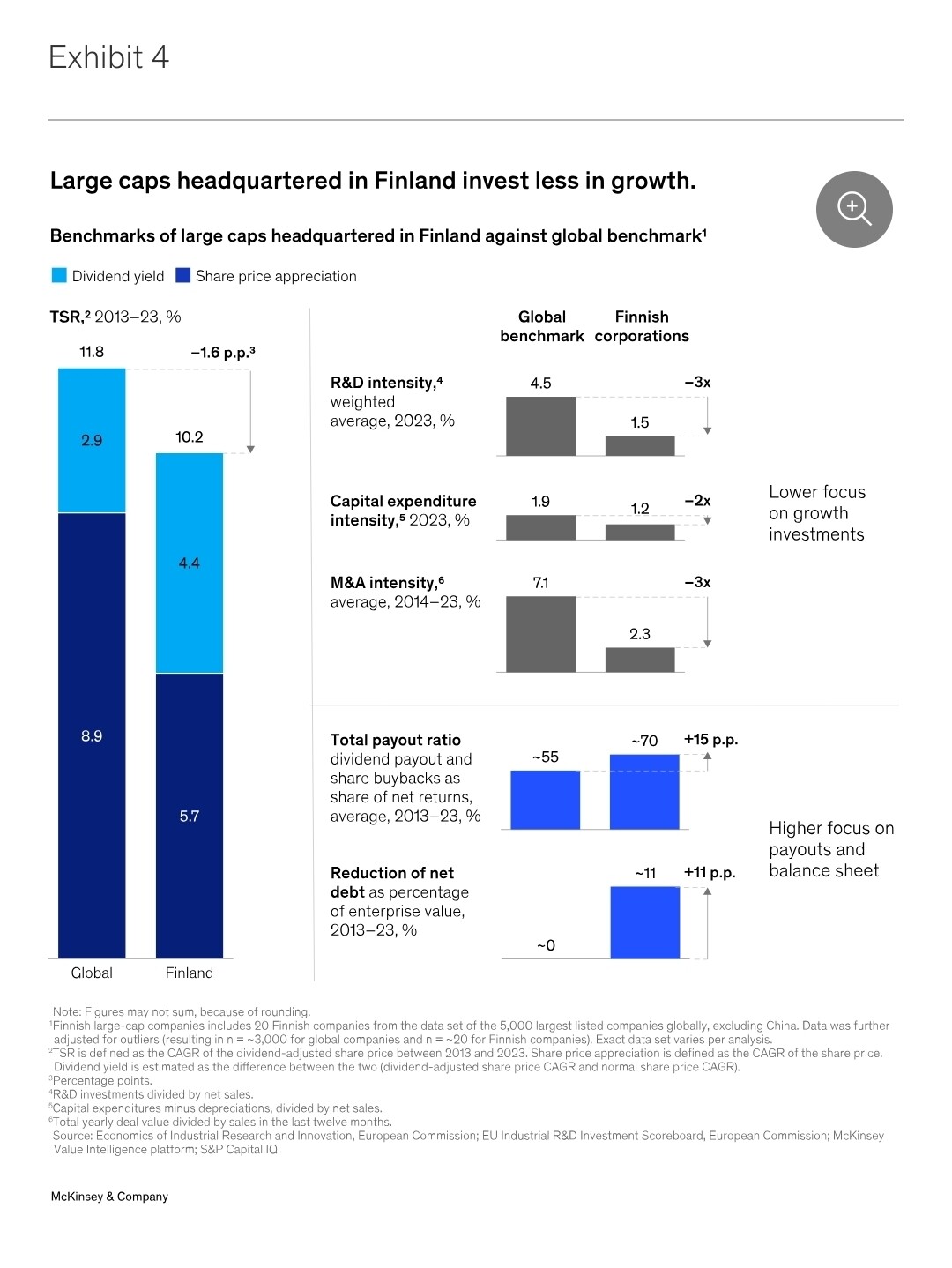
”Key reasons why large Finnish companies have not grown at the same pace as other Nordic countries, for example, are found within the companies themselves”
Or could it be that the industry structure in Finland is different. Finland has many large companies and industries that lack profitable investment opportunities.
Nordea recently acquired Danske Bank’s Norwegian operations, but where else could acquisitions be found?
Kone has somewhat increased its R&D and process investments. But large elevator companies are not for sale at a reasonable price.
Valmet makes acquisitions, but also wants to keep its balance sheet healthy. Now it might take another 1-2 years to digest old investments, reduce debt, and implement organizational changes.
Sampo can certainly invest in acquisitions, but its market area is very limited. Are there any interesting opportunities?
Fortum invests according to how electricity demand grows.
UPM. Heavy investments underway.
Nokian Tyres. Significant investments underway.
And so on. Companies invest if there’s a reason and returns are available.
Despite some differences, Finland and Sweden have quite similar economic structures. There’s a lot of engineering, forestry, finance, etc. Nevertheless, Swedes have found “reasons and profits” to grow, invest, and innovate broadly. For example, productivity growth in Sweden has been up to three times higher than in Finland. In Sweden, the Wallenberg-like business philosophy of continuous development and promotion yields results, while in Finland, a more prevalent start-and-stop mentality likely dominates.
When comparing larger Finnish companies to international counterparts, the average growth has been around 3%, meaning close to zero relative to inflation. For international counterparts, it’s 8%, almost triple. Finland has a promising startup scene, but it is still narrow. Finland generally doesn’t produce AI stars, and for example, in robotics, Finland’s relative development has been declining for years. Throughout this millennium, the forest industry has talked about new innovation factories. The result: Stora Enso’s lignin projects in Kotka are on ice, Metsä’s wood textiles are gathering dust on drawing boards, and UPM’s BioLeuna has so far only seen cost and schedule overruns, and now the EU is being called upon for regulatory assistance. Why has a large gap emerged in the productivity development of service sectors in Finland and Sweden (it’s not hard to guess in whose favor)? Etc.
In Finland, excellent exceptions include parts of the engineering sector and certain individual cases. However, this does not change the overall picture of growth avoidance. The mentality of Finnish business life is that the culprits for development are sought elsewhere, and the company’s management and board do not consider whether the need for development lies fundamentally in their own thinking and operations. A change is needed here.
Non-profit foundation tax at the same 1% again brings significant sums to the state treasury.
Progressive taxation, for example, if over 1 million goes to a certain cause, the tax rises to 1.5%.
Development aid tax (Kehitysapuvero)
At least a small portion of the money going abroad would be returned to Finland.
Use of Funds
Sote 2.0 Fund
For example, 1/3 of the revenue from these taxes would be collected into the Sote 2.0 fund.
Money from the fund would be distributed to the entities that treated patients, based on the number of patients treated (regardless of whether they are public or private).
Road Repair Debt Fund (Teiden korjausvelkarahasto)
1/3 to the fund, which would be allocated to road development projects. The money would be distributed by region according to reported new jobs.
Roughly calculated, about 38 percent (12/31) of Kela benefits are taxable. For example, disability benefits still enjoy tax exemption, so there’s still work to be done there. Regarding business subsidies, it seems to be quite well in order already; if a company generates profit, it becomes taxable.
For the foundation tax, at least the Left Alliance (Vassarit), Social Democrats (Demarit), and National Coalition Party (Kokoomus(?)) have already given the green light at least once. The Swedish People’s Party (RKP), less surprisingly, has offered strong resistance, as the Swedish-speaking foundations are likely so poor that they cannot afford to pay the tax. So, would (taxed) subsidies for Swedish-speaking foundations be a solution to this problem
Nothing that promotes economic growth. For example, if everyone is charged a 20% tax and various tax deduction schemes are removed, the need for work for the tax authority would significantly decrease, and costs would drop from systems and so on.
I can give a practical example from yesterday. My 82-year-old retired father had received a notification that a tax card would not be sent to him. So the tax authority itself had deemed the work unnecessary, hadn’t it? He had been told the notification had been sent to OmaVero. Well, he couldn’t find it in OmaVero. I helped with the matter. I went under ‘Tax Cards’ where it wasn’t found. There was also an instruction below on how to find the tax card. I read the instruction, and my father had read it. Neither of us found the card using the instruction. Then I looked for messages he had received. By chance, I found a message there that contained the tax card. It was printed for my father. I asked if he needed to send it to Kela for taxation, and he replied that he didn’t. Presumably, the tax authority still has someone sending tax cards, and Kela has someone receiving them. Someone creates those messages, and I see it as quite unnecessary bureaucracy. At the same time, my father also received an invitation to join the Suomi.fi portal. If the Tax Authority has a message portal and Kela has its own, why does there still need to be Suomi.fi? Or perhaps I understand Suomi.fi, but then not Kela’s and the Tax Authority’s own.
My answer to the question in the title: Let’s launch a massive investment program that brings jobs and capital to Finland. Let’s make investing a superior alternative for companies to distributing capital as dividends or buying back their own shares. This requires a complete mindset change across the entire Finnish business landscape, which is quite dividend-oriented. It is many times easier for company management to take the path of least resistance, i.e., distribute money as dividends, instead of striving to invest it in a sensible and productive way.
Measures:
All investments are tax-exempt in principle. (Main principle)
Following the Estonian model, capital is taxed only when it is withdrawn (as profits) from the company.
A condition for receiving business subsidies in the future is that the subsidy funds are fully used for domestic investments (production facilities, R&D).
Let’s start keeping a list of companies that have made the most domestic investments, somewhat like a national tax day. Let’s “celebrate” investments.
Let’s cut down on bureaucracy that hinders the launch of business operations, especially for start-ups.
Let’s enable starting a business, for example, while receiving unemployment benefits, without immediately losing the support.
Let’s make hiring the first employee cheap by completely exempting companies from employer contributions for the first employee, 50% for the second, and so on. (Finland is full of one-person small businesses where the entrepreneur’s own resources can be quite exhausted when they should be growing the business, etc.)
Let’s strive to implement the so-called “single country principle” in the EU. That is, when a company is registered in one member state, it is automatically recognized in others under the same conditions. Now is a favorable time for this change.
Let’s create conditions for start-ups to get loan capital cheaply, for example, with a special start-up loan with a fixed interest rate of 1.0%. Let’s promote cross-border capital investments like Slush and Invesdor, for example, with tax breaks.
Let’s strive to attract highly educated professionals from abroad to Finland by creating incentives. For example, if you establish your company in Finland, you are exempt from paying income tax for the first year.
If you take a risk and succeed, you get nothing; if you take a risk and fail, the downside is more or less the same as in all other Western countries. The incentive system in Finland is absolutely top-notch!
My thinking starts from the premise that Finland has not had economic growth for almost two decades, and something needs to be done so that the welfare state can continue to be funded. So, there is an acute (financial) crisis."
The Ministry of Finance must be tasked with conducting cost-effectiveness and impact assessments for each point. Then, adjustments to the state’s revenue and expenditure sides must be considered in the same way as in normal budget framework drafting.
How can VM make profitability assessments? VM does not believe in dynamic effects, meaning that by doing otherwise, i.e., by lowering taxes, we could get more revenue.
The best way to do this is to lower taxes. And specifically, the capital gains tax for owners. Capital is meant to flow from mature companies to growing companies. To those that need capital. And with light taxation,
 And they will get new support, which is the same size as the previous tax benefit, because the government’s backbone broke as soon as Google called.