These claims simply aren’t true.
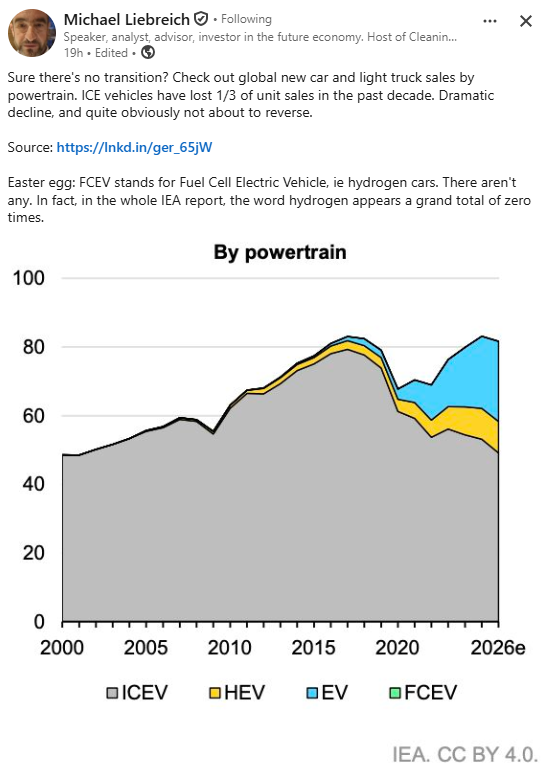
And yet, the electric vehicle market is growing quite rapidly. An interesting equation.
Please justify, what are these requirements then? Among new cars sold in Finland this year, electricity has been the most popular power source.
Various threat scenarios and fear-mongering narratives, but it is clear beyond a doubt that
I belong to the last group, and as I understand it, there is also a desperate demand in the market for affordable used electric vehicles – and new ones are also selling well in relation to total sales.
Needs and preferences always differ among car users – there is no single right solution. One weakness of the electric car is, for example, construction site visits, i.e., range, if the driving involves short, fragmented trips and the car is being heated in between.
I’ve started to get fed up with the high cost of repairs on new cars. It’s incomprehensible if a car is designed so that a single headlight burning out costs thousands of euros because the entire headlight assembly has to be replaced, whether it’s an electric or a dinosaur (gas-powered) car. It’s not much comfort when people say that those don’t break down often when it happens to you personally. If I could get a “no-frills” version of an electric car with three-phase charging at a reasonable price without all the unnecessary gadgets, I’d buy one immediately; a winter range of 120-150 km without any fuss would be enough for me.
I have a 2015 diesel passenger car. At the time, it was a sensible choice. Now, for the last few years, I’ve had to pay an annual “propulsion tax” just for the joy of being able to buy fuel that is at times more expensive than 98-octane gasoline.  My only consolation is that the diesel engine is relatively robust and will probably last another 10 years if I take good care of it—unlike those 1-liter gas hybrids they’re selling now; I wonder if that kind of engine can handle the same mileage as a good diesel?
I’ve been thinking that if I were to buy a new car now, I would definitely go for an electric vehicle. Sure, the range is half of what I currently get on a full tank, but there are charging points in every nook and cranny now, so that wouldn’t be an issue even on longer trips. Most of my driving is short commutes from home to the office and back, so the range isn’t that critical. If it can do 500 km, that would be enough for me, even if it’s not optimal.
The car’s mileage is starting to reach the point where the major repairs will soon begin. But since there are no capital costs involved and it has been extremely reliable, the threshold to take on another 5-10 year car loan and pay several hundred euros a month for the pleasure is still high. I don’t know about others, but I don’t have the cash to buy a new one without a loan. You’d have to repair the car quite a bit before switching to a new one becomes financially viable.
Then there is the fact that the development of solid-state batteries is tickling my mind; it promises not just higher capacity, but also more charging cycles—and I don’t just mean “donut batteries”—as well as battery capacity staying original without degrading over time. I personally wouldn’t want to buy a new battery pack after 10 years and pay tens of thousands for it. Compared to that, not refueling with gas or diesel would be smaller expenses, at least with my driving habits and current battery pack prices.
So, without having done any deep research, I’ve been thinking that if I could get another 10 years or so out of my current car, electric vehicles might by then be equal to diesel cars in range, and with any luck, the price of battery packs will have dropped so much that they are no longer the most expensive single component in the car. And that the battery pack would then last the lifetime of the car or even longer without any issues.
So, the summary of this confused rant is perhaps that an electric car is interesting, but the utility value of my current one is still so good that it’s not worth switching just yet, and battery development is moving forward so fast that significant progress will happen in just a few years, which will likely play into the buyer’s hands if you can just wait a little while. Well, time will tell if I was far-sighted or if I’ll be cursing 4-euro-per-liter diesel prices next year when the closure of the Strait of Hormuz reaches its first anniversary. 
That certainly turned out to be a comprehensive list of inaccurate FUD, spewed forth with very obvious zero knowledge and zero experience
I would buy one immediately as a second car, too, if it had decent ground clearance and maybe some kind of all-wheel drive. And it wouldn’t even need fast charging; even 230V would be enough.
I noticed the same thing. It’s downright irresponsible.
I switched to an electric car a year ago, and there’s no turning back. Since I can charge at home overnight/when spot electricity prices are low, the mileage costs practically nothing. I used to spend about €80 a week on gas; last year, I drove 10,000 kilometers in my H2 for €20. That includes public charging. I don’t even bother calculating the cost per kilometer anymore, as it’s become just a matter of cents.
The biggest source of anxiety for me was long-distance trips and charging on the road. Now, I’ve spent this summer cruising all around Finland, and range anxiety is history.
I have to challenge this a bit. If your consumption was, conservatively estimated, an average of 15 kWh/100km, then the price per kWh comes out to about 1.3 cents, right? Even if you had charged exclusively using free spot-price electricity, wouldn’t the transmission fees + taxes alone already be significantly higher than that? And that’s without even considering that you said you also used public charging stations.
Or am I misunderstanding something or calculating it completely wrong?
My car consumes 15 kWh/100 km in fair weather. There have been zero-price days on the spot electricity market every week, except during the coldest winter months, and I keep an eye on those zero-price days to charge the car accordingly. But true that, I haven’t factored in transmission fees, as that would require quite a bit of effort. Still, I might have the dishwasher/washing machine set on a timer to run at night. The point is that compared to the weekly consumption of my previous contraption, we’re now talking about cents and a few euros. And last year, I only dared to charge the car away from home once 
Driving an electric car is definitely affordable if you have a charging station at home. I just made a ~500km day trip to an amusement park, and with one restroom break, I added a little over 10kWh from a fast charger, and I had 7% battery left when I got home. That fast charge cost about €4.40, and if I calculate 75kWh x 5.0 cents/kWh (incl. distribution fees) for home charging at about €3.80, the electricity for the trip cost around €8.20.
In winter, of course, it’s not this cheap or easy, as the range is worse and spot electricity prices fluctuate wildly (unless you lock in a fixed-term contract for the winter).
Status update. It’s probably about time to close this power line thread, right?
Electric Car Markets in a Time of Uncertainty: An update to the Global EV Outlook 2026
mielenkiintoinen sähkörekoista, by PWC.
BETs reached about 8% of global truck production in 2025, driven almost entirely by China, which accounts for 95% of volume. Europe is ramping up slowly, and the U.S. has stalled