So if the widow moves to another apartment (and the right of occupancy is transferred to this other apartment), does it automatically mean relinquishing the right of occupancy → the tax authority interprets it as a gift? So even if the will stated that the right of occupancy can be transferred to a new apartment, from the tax authority’s perspective, it isn’t possible without having to pay gift tax in between?
Transferring a surviving spouse’s right of possession to substitute property—meaning another apartment—without tax consequences is possible under the terms of the Code of Inheritance, but the apartment must be roughly the same price or more expensive. If it is cheaper, funds are released from the scope of the right of possession, which can be interpreted as a gift to the heirs, as @Opa correctly mentioned along with other practical perspectives. You can find basic information täältä. Remember also that a report on the matter must be submitted to the Tax Administration.
Sometimes the apartment purchased in its place is significantly cheaper than the original object of the right of possession. In this case, the surplus funds may be released from the right of possession and, as a result of this action, may come not only into the ownership of the heirs but also into their possession. To the extent that the right of possession does not transfer to the substitute property, a taxable gift is formed.
Otherwise, the impression is that in certain circumstances, the tax outcome you described could be possible. As individual matters in the general picture, taxation can go exactly so that inheritance tax is imposed on the heirs, taking into account the surviving spouse’s right of possession deduction (and other deductions), and the inheritance tax value forms the acquisition cost for the heirs’ subsequent capital gains calculation. Transferring the surviving spouse’s right of possession to another apartment is often possible (taking the above comments into account). Additionally, no tax consequences are imposed when the surviving spouse’s right of possession ends due to death.
But individual circumstances have a significant impact, and I personally wouldn’t dare say anything about the overall situation. I believe that if you are considering a real-life case, it might be good to consider discussing it with an expert who can familiarize themselves with the background. Some cases go by the book, while others do not. Insofar as inheritance taxation is strictly tied particularly to the distribution of the estate and civil law legal acts related to marriage, individual circumstances always have an impact, and it is difficult for an outsider to take everything necessary into account exhaustively. Even the interpretation of testamentary provisions is not always self-evident—meaning what rights have been given to which party. Alongside other humanly unpleasant features, there are many formalities in the distribution of an estate and inheritance taxation that should be handled correctly so that the effect of the legal act and the taxation go as intended. A lawyer/attorney involved in the distribution of the estate might be a suitable contact.
3 Likes
A very comprehensive answer and a reference to exactly the tax authority’s guidance that I have been trying to find. How did I manage to not find it myself 
This might be a bit off-topic, but I’ll ask since there seems to be a lot of expertise here. Can a deceased person, through their will, obligate direct heirs to pay for a surviving spouse’s living expenses? Based on my own research, no. Under the right of possession (hallintaoikeus), the surviving spouse is responsible for running costs (maintenance charges, electricity, water, etc.). And the direct heirs, as owners of the apartment, are responsible for other costs (capital charges, etc.).
I’m mainly thinking of a scenario where there are multiple direct heirs and I would personally like us to participate in covering the surviving spouse’s living expenses, i.e., paying the housing company charges, etc. Each person would give a sufficient amount, max €5,000/person/3 years, so that no gift tax is incurred. However, I suspect that my siblings will not agree to this, in which case I would have to pay the surviving spouse’s living expenses entirely by myself (if I so desired). So, can this be made an obligation for direct heirs through a will in any way (unlikely)?
Hi, someone here probably knows the answer to the following question: if a company is listed in both the United States and Germany, which one should I, a small Finnish retail investor, buy my shares from?
And does it matter, for example in terms of dividend taxation, whether I buy the shares for an equity savings account (OST) or a general brokerage account (AOT)?
I can’t say whether such a “burden” can be built into a will (inheritance and probate lawyers are definitely recommended here), but I got stuck on a side note: the maintenance expenses you described are not subject to gift tax in the first place.
2 Likes
The Tax Administration could put more effort into providing instructions for tax types other than income taxation. They are occasionally quite confusing and difficult to find.
Regarding this difficult question, I can state based on my own expertise that a will is a unilateral legal act by which the testator determines the disposal of their estate. If the idea is that the widow’s housing is paid for either from an undivided or a divided estate, covering future housing costs from the assets might be feasible. It may also be possible that when switching to a more affordable apartment, the surplus assets are designated in the will to be under the widow’s control for arranging housing, so that no taxable gift to the heirs arises and there are extra funds for the fees. However, stronger rights must not be infringed upon, and a lawyer/attorney specialized in family and inheritance law is indeed needed to look at the overall situation and the will. My own specific expertise is in the field of tax law and generally outside other legal areas.
If the payment of maintenance fees (hoitovastike) by the heirs were based entirely on assets outside the estate and this were to be a unilateral obligation, my initial reaction is that it would be difficult, as the holder of the property is typically responsible for expenses such as maintenance fees. Capital charges (rahoitusvastike) and renovation costs are typically considered to be the responsibility of the apartment owner. I feel as though I have read about this somewhere before, but it has been so long that I cannot recall the details. My impression is that the division of responsibility is not necessarily set in stone, especially if defined separately in a will, and that there may be case law and/or literature on the subject. It is worth investigating if this is important, and someone else may be able to comment more specifically, but it is a rather specific question, and in my opinion, one should not rely on sources other than up-to-date legal literature or experts in the field.
Regarding maintenance expenses @ljkangas, I would like to clarify that only statutory maintenance expenses are entirely outside the concept of a gift. These typically concern the parents’ obligation to support children living in the same household. Section 19 of the Inheritance and Gift Tax Act (PerVL) contains a provision that likely applies to this case, which I assume is what you mean, but as a reminder, the gift cannot be used for other purposes. The wording has been interpreted strictly. Consequently, you/your @ArjenArvonnousu should pay the management fee (yhtiövastike) directly to the housing company’s bank account so that the requirements are met. However, I recommend that any reader first verify this specifically with the Tax Administration, for example, as most sources specifically concern payments made by a parent for the benefit of a child. Nevertheless, as I understand it, there is no restriction regarding the recipient of the gift in that legal provision.
Gift tax is not paid:
//
2) on what someone has used for the upbringing or education of another or for another’s maintenance, or has otherwise given to another for these purposes in such a form that the gift recipient has no possibility of using the donated amount for other purposes; nor//
4 Likes
That’s exactly what I mean. The maintenance fee in question is the most classic example of applying this. A family relationship is definitely not required. And of course – not as cash to the gift recipient, but as a direct payment to the housing company, as the law requires.
2 Likes
Thanks for the confirmation. I did a quick check on the background of the legal provision in a standard work I had within reach (Puronen 2015), and there was hardly any tax or legal case law from this perspective, which explains the cautious comments. It’s good if it’s general and clear.
The above also brought to mind that one way to stipulate the heirs’ obligations in a will is, of course, to link them to the conditions of the inherited property. Regarding the portion exceeding the legal share, they are of course not valid.
1 Like
Hopefully there are some experts here…
I tried searching for detailed information on this topic online, on the Tax Office’s website, and on the Inderes forum, but I just can’t find a precise answer.
So: in which section of the tax return exactly do I report the home office deduction related to my investment activities?
In my pre-completed tax return, there is a designated spot for this only under earned income, not under capital income. Do I just add it as a figure under expenses for the production of capital income, or do I use the form listed under earned income even though my home office deduction isn’t directly related to earned income?
2 Likes
Other deductions from capital income. That’s where I’ve been putting them.
1 Like
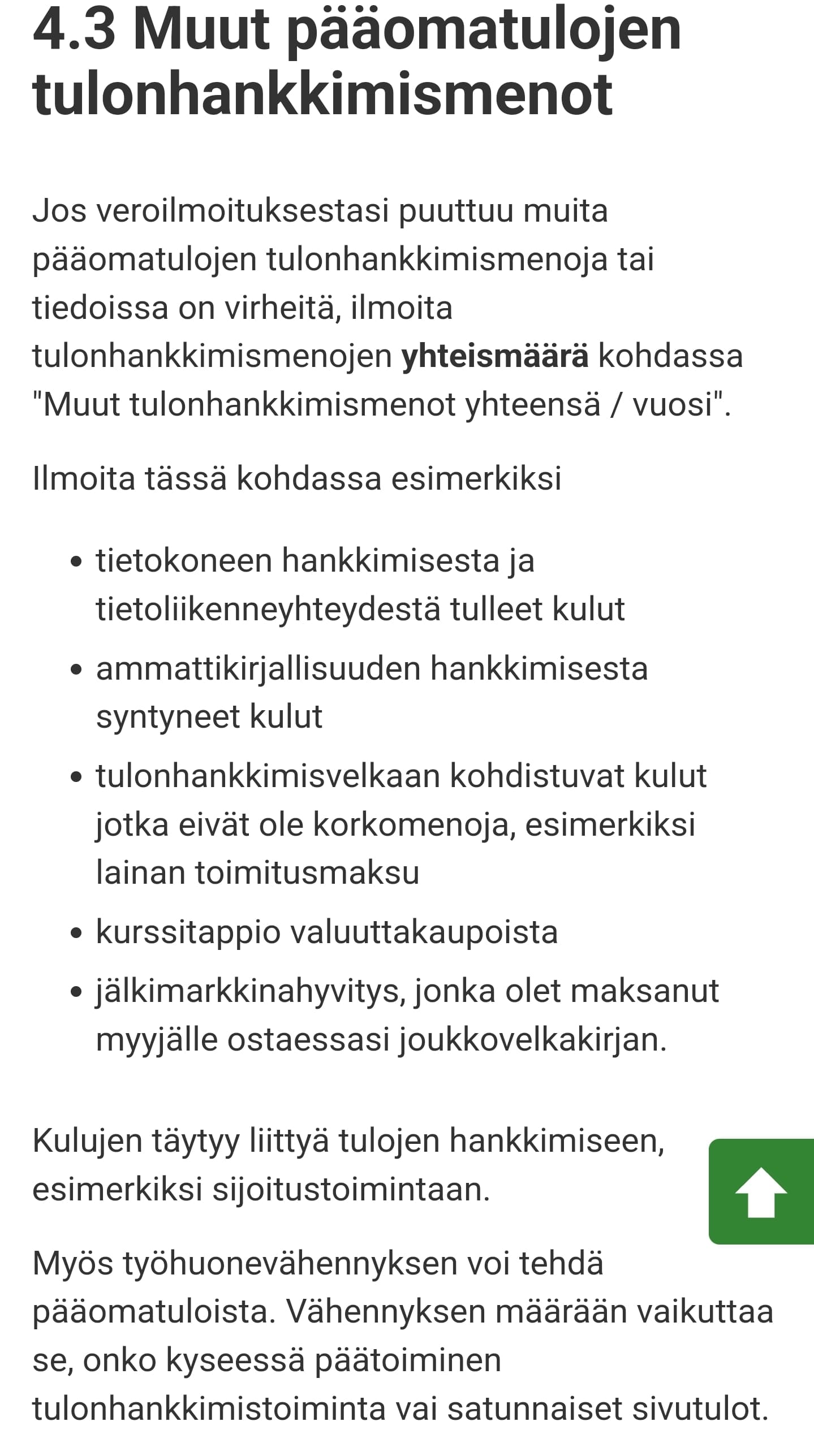
If it’s about capital income, then from there:
I have personally specified the home office deduction section as: significant side income.
7 Likes
Okay, so did I understand correctly that you just added the home office deduction as a figure on top of the others in the section “Expenses for the production of other earned income”? I can’t find any specific way to differentiate these or clarify what the total amount of income-related expenses consists of, or even specify that part of it is the home office deduction.
So right now the “Expenses for the production of other earned income” column for me is 652.90, do I just add that 470e to it?
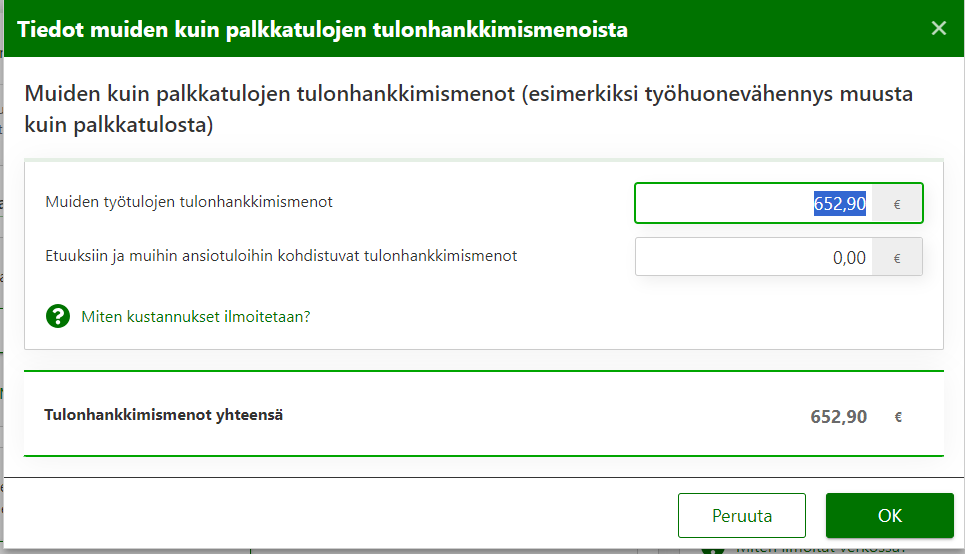
I have personally made the deduction from capital income for several years.
The field on the tax return is “other deductions from capital income”.
The deduction mentioned in the previous message would apply to earned income.

Just as Vero-Kalle instructed, and if I recall correctly, a blank field opens up there where I have added up all the other deductions from capital income.. Professional journals, e.g., half of mobile/internet, home office deduction, etc. (i.e., I’ve broken down in writing what the total I’m deducting consists of)
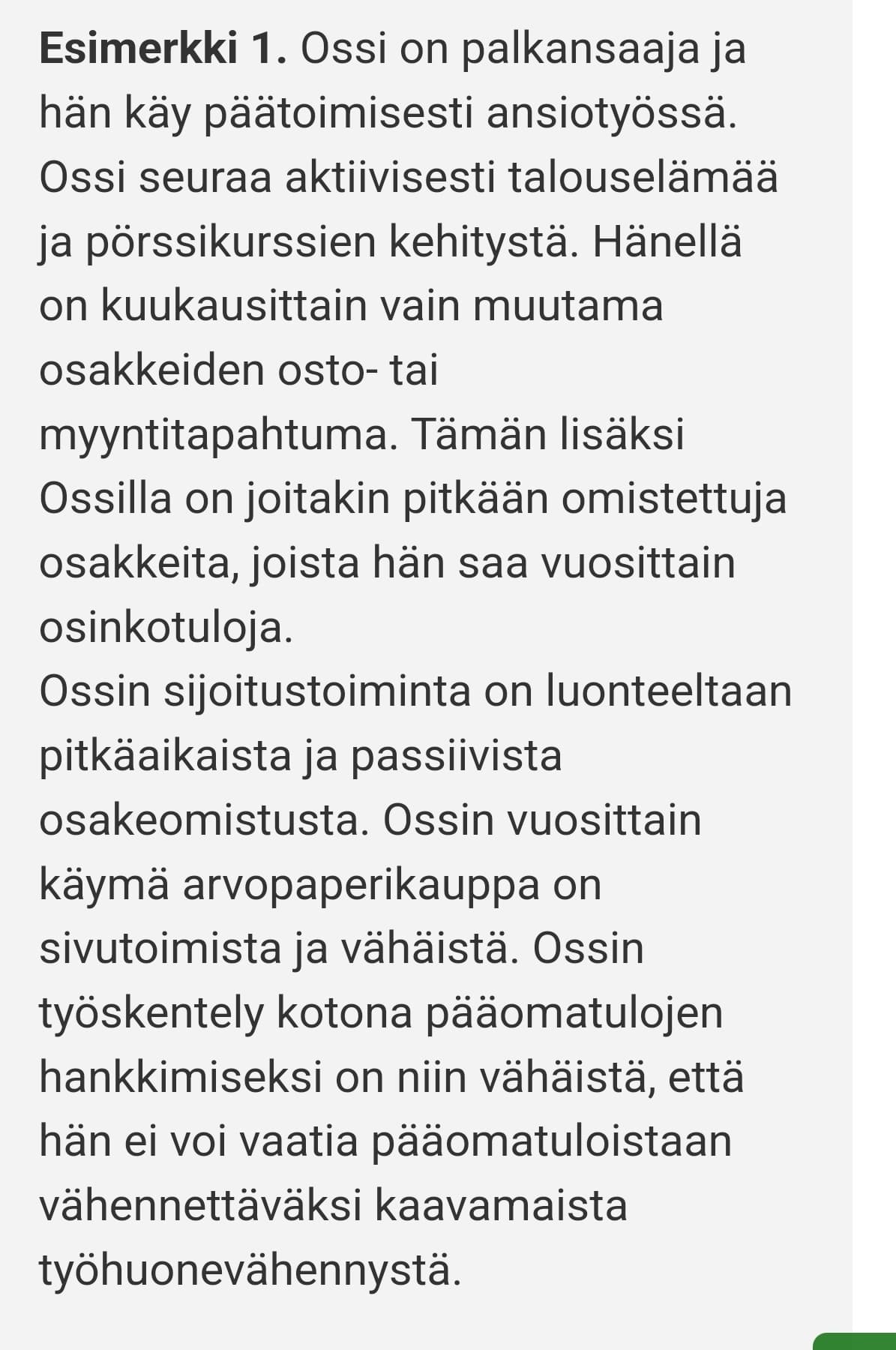
I wouldn’t add €470 (or rather, I didn’t add it myself this year anymore), because the tax authority’s instructions had changed: https://www.vero.fi/henkiloasiakkaat/verokortti-ja-veroilmoitus/vahennykset/paaomatuloista_tehtavat_vahennykse/
So now I entered €235 for expenses for the production of occasional capital income, because the other option would be €940 for full-time activity. It’s worth noting that these deductions are different amounts than for earned income.
6 Likes
Apparently quite a lot has changed.. I don’t think I can get any discounts myself anymore because I’m a holder and I add infrequently but with larger sums.. It doesn’t seem like portfolio size even affects that.. It’s kind of silly that active traders are favored.. Maybe I’ll set the minimum anyway.
10 Likes
Good to know, thanks for that! 
I finally found the section “Other deductions from capital income” further down the page, where there is also space for itemization, and I put all the deductions there with explanations.
1 Like
“Ossi’s work at home to generate capital income is so minimal…”
I don’t know about the Tax Authority’s Ossi, but in my case, analysis & following market info take significantly more time at home than clicking the buy/sell button, no matter how much you churn.
It seems that active traders are the “real” investors in the Tax Authority’s opinion (+ of course those who are full-time or operating with significant sums).
And perhaps it puts investors in an unequal position in this situation as well:
Investor A invests €1,000/month in Nordea, in one go on Nordnet.
Investor B invests €1,000/month in Nordea, in 25 installments of €40 on OP.
One is likely entitled to the home office deduction, the other is not.
4 Likes
Indeed. I should send the taxman the number of hours spent reading the investment forum from the counter on the Inderes site  I guess you could call it a part-time job already..
Personally, I usually make single purchases of 5-20k.
3 Likes
Since the start of the remote work era, I have personally split my home office deduction and fiber optic connection 50/50 between earned income and capital income. I’ve recorded it in the “other deductions” field.
It is a bit tricky, but I personally spend a significant portion of my free time on this activity, regardless of what the actual income ends up being.