I tried Googling, etc., but couldn’t find a definitive answer, so tell me, is Tether/USDT somehow banned in the EU or not? Apparently, in major exchanges, e.g., Binance, you can exchange euros for Tethers, but could this now cause problems at the regulatory level, or could a ban come into effect at some point preventing an EU citizen from exchanging those Tethers into any currency anymore, or something similar? Or was the whole thing just a hoax?
I personally prefer to use USDC coin. There’s probably nothing wrong with Tether either, but there seems to be some ambiguity about what’s in its reserves and where they are stored. The company’s transparency is a bit lacking. I have the impression that Tether is under investigation in the US.
You can also buy normally in the Crypto.com app.
" Tether decided to stop serving individual and corporate customers from the U.S"
Additionally: EU:n uusi stablecoin-regulaatio tulee voimaan 30.6. - Bitcoinkeskus.com
3 Likes
Theoretically banned starting July 1st, but in practice, that new stablecoin regulation has not yet been implemented. One should ask an EU policy expert why these deadlines exist if they are not followed.
However, something is starting to happen, because for example, Coinbase will remove all other stablecoins except Circle’s USDC and EURC next week, starting December 13, 2024. They sent an email about this a little over a week ago. Most likely, other exchanges will follow suit at some point.
So, for now, USDT tokens can still be transferred to exchanges operating in the EU. However, I don’t believe that will be the case in 6 months.
In November, the US-based Paxos acquired Finnish Membrane Finance, which holds an EMI license in the EU. Perhaps Tether will make a similar move, which would then allow them to obtain an EU license. But at least currently, USDT does not comply with the new EU stablecoin regulation.
Among dollar-based stablecoins, USD Coin (USDC) is 100% compliant with EU regulation. If you want to play it safe and not worry, you can use it.
7 Likes
The June MiCA deadline concerned stablecoin issuers (Circle, Tether, etc.); now, at the turn of the year, the regulation will come into force for other players, such as exchanges (Binance, Coinbase, etc.).
The point was that the June MiCA deadline was only on paper, and its practical interpretation remained a bit open. I understood that apparently lawyers were waiting for an interpretation from some EU body on how those paragraphs are actually to be complied with. I didn’t get a clear answer from my own sources on this, nor did I ask in more detail, because no restrictions have practically come into effect.
In addition, the problem was that, for example, none of the dollar-based stablecoins were compliant with the regulation by the deadline, so exchanges certainly didn’t want to shut down the entire stablecoin market from EU citizens.
Circle got approval for USDC right at the beginning of July, but despite this, Tether is also being traded all the time. I haven’t seen any announcement myself that USDT trading will end, for example, in Finnish trading venues.
The regulation coming into effect at the turn of the year affects all exchange users who move crypto in and out. So, in the future, when you transfer from your own wallet to an exchange or out of an exchange \u003e €1000 transfers, KYC will be involved. Time will tell what kind of digital verification will actually be implemented for this. However, there was probably a transition period of a couple of years for that.
1 Like
Coinmotion will discontinue its USDT service on December 30, 2024.
1 Like
Thanks  We’ll see what Tether plans to do regarding the EU.
I always trade in USD myself - just in case.
1 Like
Well… here’s a spoilsport for all crypto folks. Don’t blame me, I’m just the messenger. 
1 Like
Hei foorumilaiset!
I am studying at Seinäjoki University of Applied Sciences and I am writing my thesis on retail investors’ investments in cryptocurrencies. The aim of the study is to investigate the impact of cryptocurrencies on Finnish retail investors’ investment portfolios. The survey collects information on retail investors’ experiences and views regarding cryptocurrencies, as well as how they have affected diversification, risks, return expectations, portfolio management, and investment horizon.
The survey is open until 31.12.2024. Answering the survey takes approximately 5-10 minutes. I thank everyone who responds to the survey in advance! 
Link to the survey: https://forms.gle/DY2HMtBKXDL2xNYn8
(Permission to publish the survey has been obtained from Sijoittaja-Alokas)
-Jere Männikkö
7 Likes
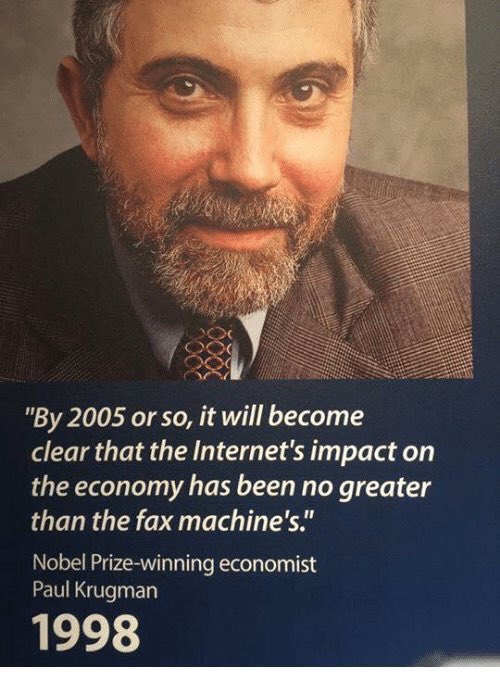
People like that are probably called ‘contrarians’.
17 Likes
Good receipt @Mitani23! Krugman has explained the context of that prediction here. But he has also often been wrong about things and admitted it openly in his writings. This may also be the case with cryptocurrencies, but he has one good argument regarding crypto that I agree with:
One of the (many) odd things about cryptocurrency is that it has somehow managed to maintain an image as something futuristic when it’s actually ancient in tech years: Bitcoin, the original cryptocurrency, which still accounts for more than half of the total crypto market cap, is 15 years old. Over this entire period, monetary economists and banking veterans have asked, what’s this for? What legitimate use cases are there for cryptocurrency that can’t be served more easily without the blockchain rigamarole?
I’ve been in many meetings where this question has been raised, and have never heard a coherent answer.
I apologize if I have annoyed some of you – the message I posted was indeed a bit provocative – without explaining in more detail what I was getting at. But I will make up for it with this message.
I also admit that, just like Krugman in his 1999 prediction concerning the internet or the brevity of the last inflation spike, I too can be wrong, because every now and then something new takes over the world and it is based on some decades-old theory or mathematical model. Sometimes things just take time to mature and for people to adopt them. Blockchains themselves do have their uses in the modern world, but I still can’t really find any other uses for digital currency based on them than as a way for criminals to transfer money outside the banking system. For that, it is perfectly suited. Otherwise, I think it is mainly a speculative product for investors, with nothing concrete behind it, and like all such products, they will eventually collapse. For this reason, I do not invest in cryptocurrencies myself, as I have found my limitations in finding good targets with, for example, Hyzon, Tecnotree, and PlugPower, and they at least have real products.
P.S. Krugman’s Substack is worth following, as he is a really good economist and has been right more often than he has missed. And he has the humility to publicly admit his mistakes when he has made them.
Well, I won’t annoy anyone further in this thread; I just wanted to bring to your attention the thoughts of an economist I respect on cryptocurrencies. All the best to you and I hope these investments end well for everyone! 
9 Likes
In my opinion, that’s a poor argument for anything nowadays, if one states: “I don’t understand what X is used for, and no one has given any good reason.” Finding information about anything has never been as easy and fast as it is now.
It’s a bit like me loudly stating: “I don’t understand what Kempower does, so the company is completely worthless and useless. And I haven’t read a single message on this forum yet that explains it.”
Someone might reply, “Learn to read, clown” (and rightly so). 
No crypto investor is likely to shed a single tear if Nouriel Roubini, Peter Schiff, or Paul Krugman don’t invest in crypto. Innovations move forward with or without these gentlemen.
If one chooses to opt out of any globally popular technology, one only puts oneself in a weaker position. Cryptocurrencies have long since reached a “point of no return” in global adoption. In the next 1-2 years, we could approach a billion users globally (the largest exchanges already serve over 200 million).
Does anyone still remember people who said they would never get an email address? “We’re not getting any damn internet.” “I’ll never do my banking on a mobile phone,” etc. How many people currently resist using AI at work?
Next on the list are probably VR glasses and self-driving cars. “I’ll stand here in the cold for three hours to get a taxi driven by a human, not some robot.” Hopefully, Krugman lives somewhere warm…
As for its age, Bitcoin can be seen as the result of decades of development. Digital currencies alone have been developed since the late 1980s, and many technologies related to Bitcoin’s operation are even older.
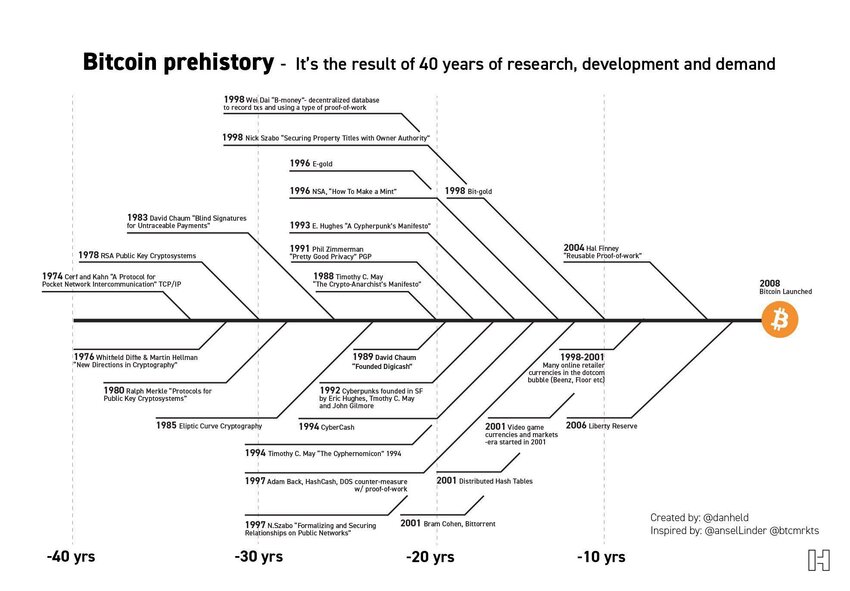
Over the next 40 years, a similar graph will be drawn, starting from Bitcoin and branching out into all new technologies and applications.
Points to Krugman for this. Let’s see if he also admits his mistakes about Bitcoin, as many other economists and investors of the same age and experience have done in the 2020s. I somewhat suspect that Roubini, Krugman, and Schiff will go to their graves with their anti-Bitcoin opinions. In my opinion, it’s a shame for them if that’s the case. But everyone has the right to their opinions.
16 Likes
Regarding that survey, is there a typo in those portfolio size options? I mean, the portfolios in those options are so small that one can’t really speak of anything other than getting acquainted with the investment world.
2 Likes
In 2022:
“The median value of holdings for individuals owning investment funds was 4,600 euros, and the median value of stock holdings for individuals owning listed stocks was 6,600 euros.”
Based on that, these are quite relevant sums.
4 Likes
I don’t doubt the order of magnitude of average holdings at all, but I would suspect the figures are significantly underestimated when considering individuals who actively spend their time in the investment world. As another argument, for example, many have investment portfolios created for their children, in whose investment decisions the children do not participate.
If that survey is only intended for this discussion forum, then I would believe the average portfolio size to be quite different from the average for the entire population.
4 Likes
Actually, it’s quite poorly suited. It’s significantly easier to track money movement on blockchains than in the traditional system. Of course, there are ways to try to obscure traces, but they require separate effort and their use cannot be concealed.
Traditional blockchains always have a native coin with which block space is paid for. These include Bitcoin, ADA, Ether. The value of these coins comes at a minimum from this use value, which of course then depends on the usefulness of that block space. In many newer chains, the significance of this is very small, because very little is charged for block space there – in such cases, even if the chain itself succeeds, the success of the coin is more uncertain.
The traditional coins I mentioned above largely base their value on the decentralization and permissionless nature of their blockchain. They serve as the only possible means of payment on a platform where actors who do not trust each other can make irreversible and undeniable entries without the need to trust any third party (albeit with certain limitations). This is potentially very valuable, and that is why I believe this category of coins will survive and succeed. The success of an individual coin is (like individual stocks) more uncertain. My bet is on the Bitcoin and Cardano axis, but I could very well be wrong.
Then it is essential to note that there are many other types of coins. Each has its own operating logic, and this must be understood if one wants to make fundamental-based investments in them.
5 Likes
That’s an oxymoron. If you find a use for blockchains, then you also find a use for digital currency, because the use of those blockchains is paid for with the chain’s native currency. Amazon’s databases are paid a fixed monthly sum in fiat currency, while on a distributed blockchain, costs are paid according to usage with the chain’s native currency.
5 Likes
For example, Peter Schiff often comments in this style: “Anyone can create a new cryptocurrency by pressing a button, and millions of copies of Bitcoin have already been created in the world that are faster and cheaper to transfer, so why would Bitcoin have any value?”
If after 10 years of arguing, the information is at such a level that one does not even understand the basics of the object being criticized, then the entire criticism loses its foundation.
Even if it were some Ethereum or Solana meme coin that is not actually needed for anything and can be technically cloned, that still wouldn’t be true. You can’t create a coin “Dogecoin 2.0” out of thin air and make it valuable, because it lacks a community of millions of real people on social media, history, etc.
So, the criticism from individuals like Krugman, Roubini, Schiff, and similar often stems from fundamentally incorrect information and a lack of understanding. Therefore, they inevitably go astray.
6 Likes
In my opinion, it would be nice if you, as an expert and “enthusiast,” would answer the question instead of being a know-it-all: What are the use cases for cryptocurrencies that cannot be implemented without a blockchain?
I would be cautious about making statements like these:
Cryptos have long since reached a “point of no return” in global adoption. In the next 1-2 years, we could approach a billion users globally (the largest exchanges already serve over 200 million).
According to Wikipedia, Internet Explorer’s market share was about 95% in 2003, meaning it was practically the world wide web. 10 years later, it had dropped to 34% and another ten years later, it had practically disappeared entirely.
Does anyone still remember people who never intended to get an email address? “We’re not getting any damn internet.” “I’ll never do my banking on a mobile phone,” etc. How many people currently resist the use of AI at work?
This seems obvious in retrospect, but history is full of technologies that have died after an initial boom. Some were just hype, but many have been replaced by technologically more advanced solutions. Examples of the former include 3D movies and TVs, and of the latter, the domestic Symbian.
Unfortunately, user numbers don’t always tell the truth either. Many crypto projects are so complex that ordinary people have no way to evaluate their technology. How can their price formation then be efficient? On the other hand, even professionals can be fooled. Examples include Theranos, whose technology was praised unreservedly. Professionals also lost money in outright scams like Madoff and Enron. On the other hand, 4.5 billion people believe in God and Allah, and there is even less concrete evidence for those. That delusion has lasted over 2000 years, and unfortunately, it won’t break in my lifetime.
With Bitcoin and especially smaller cryptos, one can make an enormous amount of money, but I dare not invest in them long-term for the following reasons:
- The popularity of meme coins. If a Dogecoin is valued at over 50 billion dollars, I believe it questions the rationality of the entire investor base operating in the crypto market.
- The significance of whales. Imagine I am in a boat with a hole in the bottom. I am rowing, and an unknown person is holding their thumb in the hole so that water doesn’t flood the boat. I don’t want to spend any more time in the boat than necessary if that person tries to control me to row at a certain speed or in a certain direction by letting water into the boat.
- Bitcoin has been compared to digital gold and a store of value, but history is full of failed stores of value and currencies. For example, grain, animal hides, etc. I consider gold rather an exception on this list.
- Unrealistic visions. How many blockchain use cases have materialized since the last bull market? Name five projects that are not related to DeFi, games, or casinos?
- Lack of criticism. If all concerns or negative views are dismissed by saying the other party doesn’t understand, how healthy is the foundation? I approach everything that is seen as a solution to all problems without any negative aspects with equal reservation. The cannabis bubble about a decade ago comes to mind, where cannabis and its derivatives were supposed to solve pain relief, increase tax revenues, provide supplements, etc., etc., but without any problems.
It has been proven that enormous fortunes can be made with cryptos, but I don’t like that a significant portion of the capital determining the value of my assets operates on principles I don’t believe in myself. It’s perfectly fine for me if I lose in yield comparison for this reason. I also don’t invest in stocks where the above points are met. In the previous crypto market, I made a small profit, but naturally, I would have achieved better results with a buy & hold method.
Be careful, especially those less devoted crypto investors. No one knows how long the rise will continue, but I consider an overshoot downwards almost certain.
21 Likes