Theoretically, yes. In practice, the most illiquid small-cap stock on the exchange is significantly more liquid than any real estate. Stock prices usually have a fairly solid base based on the company’s business value, the penetration of which attracts enough greedy traders that even a large fund can dump its holdings. Losses will occur, and certainly below “fair value,” but not so much that the entire market would be disrupted. Additionally, exchange-traded goods are much easier to move in block trades – the market certainly has deep-pocketed players who will take a large batch as “wholesale” as long as the discount percentage is suitable.
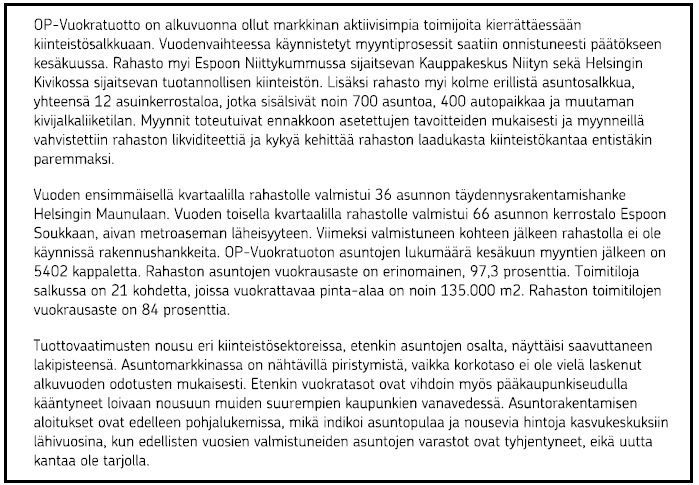
On the real estate side, the problem is that the “goods” are of the decaying kind with continuous running costs, and buying and selling them is a much clumsier process than moving exchange-traded stocks. In this case, the fund has determined that it could not find buyers for its assets in the market at any even remotely reasonable price to continue handling redemptions, and it was forced into a corner. In my opinion, this also reveals worrying data about the price level of real estate in the country. Deep-pocketed “real estate traders” don’t want to buy bulk assets at this market price level (and with a small discount on top of that)? This means the price level is considered expensive.
Edit: Or perhaps the fund has overvalued its properties and cannot realize them in the current market without having to significantly write down the value of the entire property portfolio?
So, while there are similarities, this risk is much smaller in equity funds.
 If these life skills were taught to young people, the nation might not necessarily be capital-poor in 20, 30, or 40 years.



 So I will probably take some kind of break from the forum for the coming weeks and mainly aim to analyze the little girl’s mood and based on that, time diaper changes, naps, and feedings.