I don’t believe the average person thinks about nth roots; instead, they repeat memorized formulas without understanding what is truly intended. Even if we expand to complex numbers, for example, 3√8 = 2 and not approximately −1+1.73205081i or −1−1.73205081i, because it is an operation, not a question about the number of roots. However, the intent wasn’t really to discuss mathematics, but to have a meta-discussion about people’s inability to accept even self-evident facts
Carl Sagan once said quite poetically that if you want to make an apple pie from scratch, you must first invent the universe. All factual knowledge is based on accepting a certain number of basic assumptions as true and building extensions and refinements upon them. This is why understanding the basics—and especially accepting them—is important before jumping to the next level of abstraction, because otherwise, all thinking starts to become skewed, and one ends up being increasingly wrong the more high-flown the thoughts one tries to form.
In internet discussions today, one increasingly encounters people who are not just ignorant of truths but actively deny the existence of truths when facts are laid out before them. Often, they also try to hide behind some higher level of abstraction because lower-level thinking wouldn’t withstand the light of day. I personally feel largely defenseless in these discussions. How do you talk to a person whose thinking is based almost exclusively on a self-created fantasy world?
√4=2
Reality, as we generally understand and perceive it, is three-dimensional.
There are two genders.
The fragmentation of society and culture has already gone so far that we don’t even need to argue about opinions anymore, as we can now spend all our time debating facts. Personally, I suspect the reason is the abandonment of religion. Previously, those crackpots could be locked away in monasteries to engage in endless and fruitless discussions about religious dogma. Today, these people are among us on forums, starting their own sects in the threads of their favorite stocks
Reactively, this is about the difficulty of self-criticism. Proactively, it also provides fertile ground for trolling and manipulation.
And because the algorithm follows hearts and thumbs, you just need to find a divisive, provocative topic, followed by: “A simple puzzle has social media talking - can you find the solution?”
…of which its expansion here is a great example. Props to the forum for how professionally and rationally people are able to discuss the matter!
Is there a dedicated in-depth discussion thread for Rheinmetall on this forum?
I don’t think so, as the search bar suggested all sorts of other things.
Well, anyway, will this company’s valuation stay high for as long as there’s the threat of Putin, or perhaps even longer—meaning the Russian threat to Western Europe?
Below is an interesting interview conducted by the Financial Times regarding AI stocks, among other things, although the AI aspect is the primary focus.
Below is my own summary of the article. It’s possible I’ve misunderstood some points, as the subject is difficult for me and my English is limited. I used translation tools extensively, but I’ve likely still misinterpreted at least something, so you should probably read the article yourself.
The interviewee is businessman and investor Arnott, who warns of various “big market delusions” and uncontrolled speculation. The text mentions—“surprise, surprise”—the dotcom bubble and how narratives drive corporate valuations too much.
AI might not progress in the way that has been expected… and perhaps that is why diversification was also emphasized in the article. One might think that the valuations of these companies are way off track—or rather, in a bubble.
In the article, he notes Nvidia’s success while pointing out that competition is nevertheless intensifying.
Rob Arnott:
I think the same thing is happening now with AI. The narrative with dotcom is this is going to change everything — how we buy goods and services, communicate, research, socially interact, run businesses. All true, but all have happened more gradually than initially expected. Substitute AI for internet, and you have exactly the same narrative today. It’s a classic example of a big market delusion. Not because it’s wrong, but because it will happen more gradually than people expect.
Just don’t confuse your own thoughts with mine or try to understand what’s going on in my head or where the limits of my understanding lie.
I didn’t claim that wasn’t the case. Instead of the answer, I’m more interested in how that four ended up under the square root and what might have happened in the meme beforehand.
You jump to the conclusion that everything started with a thought.
y= √4 = 2
Fundamentally, meme readers start with the basic assumption that it’s a real number.
The meme doesn’t define that, because the purpose of the meme is indeed to provoke commenters into fighting with each other.
Let’s keep the discussion here civil. That seems to have been a great theme at Inderes for the start of the year and has worked really well lately.
Thanks to Inderes. It’s been more pleasant browsing the forum.
In my opinion, convention is indeed very important because it’s a significant part of communication.
We write from left to right, use certain kinds of alphabets and numbers. Certain ways to mark things and a route to proceed in a conversation.
I had a great math teacher back in the day, who said nicely that in math it doesn’t matter whether the calculation proceeds to the right or the left. Whether we go backwards from the convention.
It is just as correct
3 = 1 + 2 = 100^0 + 2^1 = x
As
x =1+2 = 98^0+2^1 =3
Or
x = 3
The equals sign is the one to be careful with.
Otherwise, it’s fine to play quite freely with the different elements of the equation.
The hammer was a funny example. The hammer is held as a basic example of the lever effect for mechanical engineers. The more precisely you try to define the location of the hammer’s swing effect or the generated energy, the more you are off the mark.
In terms of practical applications for the hammer, classical physics is “correct enough”; when diving to the level of quantum physics, the equations no longer hold true. That’s why it’s important to define the correct level of precision relative to the intended use.
In the case of the hammer, we probably just want to get the nail driven and produce a product that is appropriately affordable, easy to manufacture, practical to carry, durable, and uses a cleverly simple lever effect to its advantage.
For the manufacturing of a hammer, classical physics is perfectly adequate.
If we want to capture an ytterbium ion in an electromagnetic trap, we have to abandon classical physics and rely on quantum physics.
Which is not valid at the same time as classical physics, but whose applications make, for example, the communication between us possible.
If we were to start changing the direction of the negative current in electrophysics, the change would cause so much confusion and make all the old, extremely important documents wrong.
Changing the convention to better match what is intuitively more correct would create more confusion than updating all the documents, training the experts, and implementing the new convention.
Even a rocket has managed to crash when miles and kilometers were mixed up. I don’t even dare to think what all changing that would cause.
You’re right.
Some conventions shouldn’t be changed, and I wasn’t going to change them anyway.
It’s good to realize that all these are, in the end, just conventions and tools for making deductions. For professional life, the most important thing is that we have the right mathematical tools for ourselves, which we understand and know how to use at a sufficiently significant level. It is especially important to understand the precision level and weaknesses of the tools we use.
But yeah…
I’m packing today and tuning my own tools, so I won’t have time to participate in the discussion more than this.
That money is already the owners’ money: it is just technically in the company’s account (or accounts).
Let’s imagine two companies in our parallel universe: Oy Osinkolinko Ab (Dividend Slinger Ltd) and the foreign Reinvestment Moat Corp. (henceforth RMC).
The Finnish (Dressmann-suit-wearing) management of Oy Osinkolinko (the correct inflection of the company name causes constant headaches for the company’s communications, much like Sampo’s IR) does not dare to invest in the future because a large part of the shareholder base consists of fundamentalist members of the “Dividend Party” who rant at the Annual General Meeting. Therefore, the company pays out the entire free cash flow (whatever is left over after small mandatory maintenance investments) generously to the owners as dividends. Because the company does not grow due to a lack of growth investments, investors only receive that dividend yield every year (minus taxes).
The company’s cost of capital is 10%, so it trades at a P/E of 10, and the dividend yield is, of course, also 10%. In typical Finnish style, the company also mostly engages in endless cost-cutting and a carousel of redundancy negotiations, which naturally pleases the dividend-hungry owners but at the same time emphasizes the company’s entrenchment in its own market.
At RMC, the shareholder base is more patient and wants competent management to reinvest all profits back into the business. The management is indeed a talented bunch (the executive team surely includes both Swedes and Americans) at finding new growth opportunities, and over the next 20 years, the company’s earnings grow by 15% annually (meaning that when the entire profit was invested, a 15% return on capital was achieved each year). Thus, the company’s earnings increase sixteen-fold.
After 20 years of growth, the owners are satisfied, and the company decides to continue its investment policy indefinitely as long as there are opportunities in the universe to invest such that ROIC > WACC.
Even though RMC doesn’t pay a cent in dividends, surely no one can think the business is worthless? No, its earnings have grown 16x and it makes a clear profit every year: it’s just decided that the profit will be left in the company to compound and make the company even more valuable.
All this time, the owners own the company’s net assets.
Even if the company does not intend to practice profit distribution for a long time in the future, its present value can be calculated through future cash flows, net assets, and the investor’s required rate of return.
In this sense, RMC differs from, say, Dogecoin: you cannot calculate a fair value for Doge based on cash flow and net assets. For RMC, you can.
The owners of RMC’s accumulating pot of value can also eventually sell to another buyer if they wish, who thereby gains access to the company’s net assets, and on the other hand, the old owners realize their holdings into cash that comes from the buyer’s account.
Well, if it really happens that RMC invests for 2000 years and in the final years the company invests so poorly that it zeros out its entire value, and the owners have remained the same (I could imagine, for example, LOTR elves having thousands-of-years-old listed companies with the same owners…) the whole time, then yes, nothing was left in hand. But of course, at some point, every firm starts leaking money one way or another to its owners when investment opportunities start to run out. But for many firms, that can take a very long time, so in practice, we can say that a firm hoarding and reinvesting money in its account is not a shitcoin!
At university, the professor exaggerated a bit, saying the tunnels were only a millimeter apart when they met. The truth, however, was that the deviation was about 35 cm, which I think is quite precise.
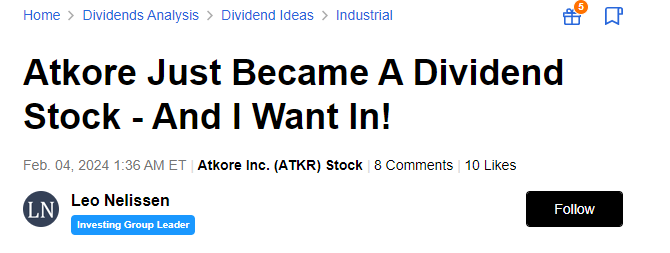
I don’t dare post this in the company thread, but I just have to share this brilliantly titled new SA article.
A 0.9% yield is on offer after all, and I’m sure that’s bound to be of interest
Your way of taking sentences out of context is a fundamentally wrong way to act. And even though you say you are not criticizing me, in reality, you just did exactly that. Few of us particularly enjoy being made a laughing stock.
I didn’t actually subscribe to Seppo Saario’s thesis, but rather argued against it. I agree with Saario to the extent that in order to distribute a continuously growing dividend, a company must be continuously improving its results.
In my previous message in the thread, I stated that I don’t personally value dividends and mentioned that I prefer to invest in companies that do not pay dividends, because their business generates returns better than the market interest rate, making it worthwhile for them to invest in growth. I wrote: “Generally, a dividend is, of course, money paid by the investor to themselves, from which only the taxman benefits.”
I noted that a large portion of Finnish private investors, however, evidently value dividends, especially growing ones. I wrote: “It’s no wonder, since authorities such as Seppo Saario consider a growing dividend to be even their most important investment criterion.”
The discussion thread was pondering why Talenom pays a growing dividend even though there isn’t really any money for it.
We aren’t as naive (bullerot) here as you think, Verneri; in fact, we are much worse
My apologies if you felt that way, I tried to convey in the message that I wasn’t criticizing you (especially considering your other comments about the dividend) but specifically Seppo’s comment. I should have made this clearer.
Yes, but the underlying idea is that one day RMC will be mature and will start paying dividends and/or buying back shares. The basic idea in both, however, is the same: to increase the dividend per share.
Without the concept of dividends, there would be no point in owning a stock. Ownership would have no monetary value. The shareholder would only have voting rights and other basic rights. Because of this, behind all stocks is idea No. 1: The basis for a stock’s price appreciation is growing dividend distribution. It’s just up to the reader how they understand it, because for the reasons you argued, that sentence is indeed silly. Perhaps growing dividend potential would be a better term?
Through share buybacks, profits can be distributed to owners in exactly the same way as with dividends. By splitting the stock before the very last share is bought back from the exchange, the problems associated with a low share count can be resolved.
A dividend is the result of a company manager having succeeded in growing the accumulation of free cash flow over the company’s history. It should be the use of last resort for excess funds, and not something where X percent of profits are target-allocated every year regardless of the company’s situation. This isn’t understood in Helsinki at all. If things go so poorly that a company’s decision-making starts to be driven by dividends first instead of free cash flow growth first, then things are going to hell at full speed.
Perhaps - this is just a suggestion - it’s time for the Finnish investor scene to forget the likes of Saario, who cling to dividends like a meat hook, and turn their gaze toward advocates of free cash flow, such as H. Keskiväli and P. Eko.
In the first verse of our Dividend Party’s manifesto, we demand a growing dividend. In the second verse, we demand a dividend that significantly exceeds inflation.
I’ve shared many post-interim report Nokia dividend coffees with O. Sinko






 Damn, if only there were a more commonly used key figure for this…
