Let Ben Felix explain.
In addition, taxation strongly favors selling versus dividends. This video might trigger all forum members, so it’s better to keep “radio silence” for a while 

Let Ben Felix explain.
In addition, taxation strongly favors selling versus dividends. This video might trigger all forum members, so it’s better to keep “radio silence” for a while
The purpose of my question was to stir up thinking from “is the market right” to a more practical level: how should one manage their portfolio in the current market situation, with the information I have.
Why?
The market is always right, in a way, because the price is what it is, even if it feels “wrong” to oneself. There’s no point in arguing with what is. From a portfolio perspective, the most important thing is to make the right investment decisions. These should be carefully considered. “Does the market currently feel reasonable to me?” is essential information for investment decisions.
“Is the market right?” is an eternal question with no definitive answers. It can be discussed endlessly, as there are endless perspectives. The sky is the color it is. If it’s gray today, should it still be blue?
Yes, one can calculate probabilities. Tomorrow will then come as it comes. Sometimes as expected and sometimes not. The wisest thing is to accept all uncertainty and consider it in one’s investment plan.
It’s a “seasonality effect.” 
Perhaps we’re sweating over the deviation here, as we’ve gone up much more than average, and “could a sharp reversion-to-the-mean happen instead of a long sideways market,” the sharper the higher we go. At least, that’s how I imagine many accustomed to smaller annual returns pondering. “Would the typical autumn turbulence be enough to shake things down this time, since it wasn’t last year?” 
You can tell my age from the fact that my profile picture was taken, if I remember correctly, the winter before last.
But wouldn’t that already be priced in? I mean, the expectations of these vigilant autumn crash anticipators? Passive fund/ETF savers and the “stonks only go up” crowd can, in my opinion, push through anomalies, allowing the seasonality effect to be dismissed with a shrug. Last year, I expected a market crash precisely in September and didn’t grasp the impact of brr-money and FOMO on the stock market. I went 100% cash on my investment savings account (OST) because stocks were supposedly too expensive then. Last year, I was wandering on the wrong financial websites and perhaps slightly overestimated the effects of the coronavirus. Fortunately, I’ve learned from these experiences.
On the other hand, I expect that any small correction could lead to even greater panic. Social media amplifies panic in addition to FOMO.
Thank you! That’s exactly right, Juha has always said that when humility ends, learning also ends.
If “in the courses” refers to “forecasting the near future” of stocks, then this would in turn be “forecasting forecasting.” Therefore, I assume a stormy weather is likely to come, even if it “feels too obvious.” Of course, I could be wrong. Weren’t there still downturns back then last year (even if The Collapse didn’t happen)?
These are indeed wise words.
“Development ends with contentment” is the most important phrase for me. This has been in my toolkit since I was probably 8 years old, from my ice hockey coaches. This helps you get by, because it applies to work, relationships, investing, sports, etc.
No. See the investment loan thread, where the differences between a fixed-rate loan and Nordnet’s Superloan are not understood, and why someone would be willing to pay a higher interest rate for a long-term fixed loan when leverage is available cheaply.
Well, last autumn we did drop 10% from the highest peaks to the lowest bottoms. I personally expected more of a “The Collapse” type scenario, after which the “tracksuit crowd” would rustle their way out of the stock market. According to my playbook, the pandemic was supposed to trigger latent problems (Euro, debt, and zombie economy), but everything went exactly the opposite way. Thanks to the pandemic, latent problems were pushed further down the road.
I’m just thinking that there are countless new traders in the world who are waiting for a September crash. However, the “September crash” has been talked about all summer. Is this a self-fulfilling or self-destructive prophecy, who knows. I think that those waiting for a crash have already increased the cash weighting of their portfolios, meaning they will be passive throughout the autumn. “Dumb money” (monthly savers and Robin Hood) will take care of the rising frenzy, and we bears will FOMO back into the market after some super light dip sometime in a few days/weeks.
Just some gut feeling pondering.
This is very well said.
The problem areas might have even risen to the power of 2.
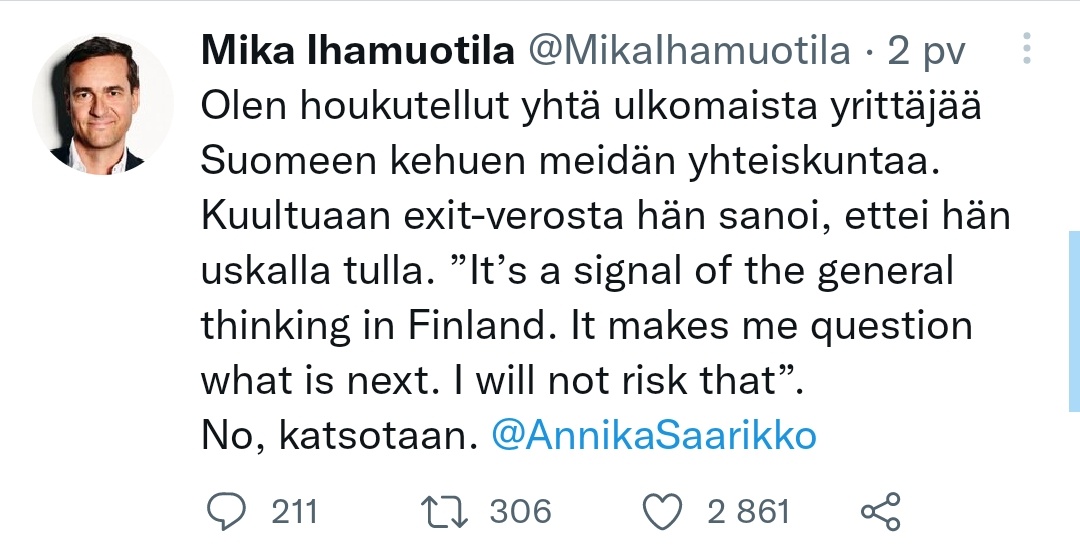
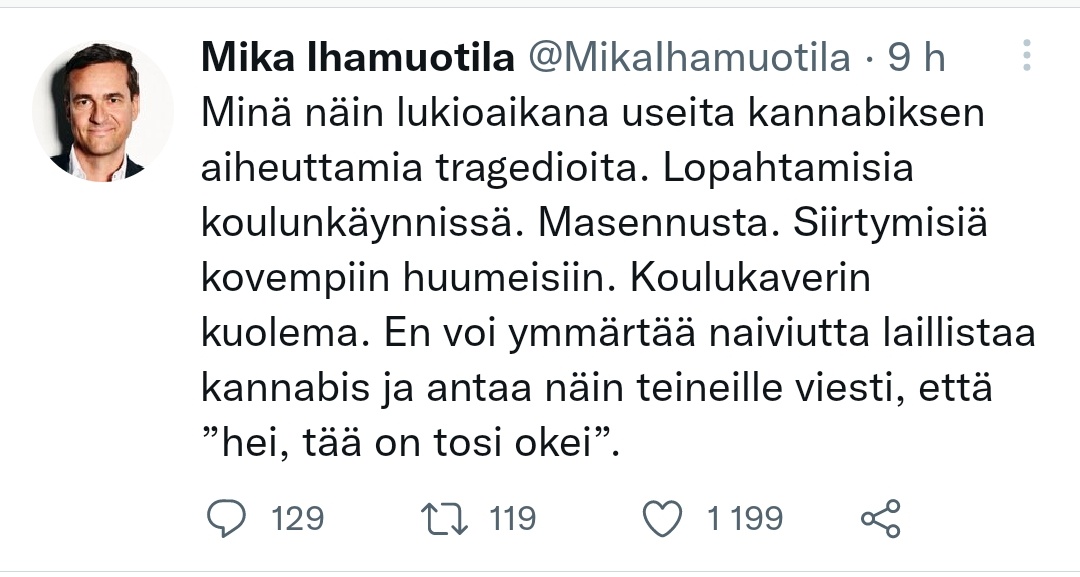
I am in favor of both an “exit tax” and the legalization of cannabis. My personal opinion, of course, doesn’t matter here. I would be quite annoyed if, for example, the men from Harvia started making such comments nowadays.
I don’t know if this has any effect on Marimekko, but it’s certainly not a very positive one. Most of the tweets are just criticism of the government, and somewhere in between, people are welcomed into the Marimekko family. I don’t like it.
Greetings to Ihamuotila; we don’t need freeloaders here to eat our bread. Taxes belong to everyone, and it’s good that the leaky bottom is being plugged <3
Finnish politics have been shocking crap for many years now, so nothing surprises me anymore.
Just a general thought to start the work week
I don’t see any upside, as a starting point, to anyone commenting on hot political topics on Twitter. The outcome is, at most, a “yes-no” debate, or like-minded people will come to the comments to nod in agreement. Twitter as a platform is completely hopeless for any reasonable discussion.
Then there’s the separate question of whether someone in business should comment on politics. It’s bound to annoy 50% of people every time. On the other hand, does such a high-ranking position remove the right to a personal social media account?
I have personally made the decision that if I ever rise to any significant position that requires creating personal social media accounts, I will keep my mouth shut about everything except the original purpose for which the account was created.
I think it would be more sensible to consider and fix the reasons why people take their money abroad, instead of punishing them for it. It feels like politics consistently treats the symptoms rather than the disease.
If cannabis use is perfectly fine, how would you react if, for example, the management of the largest growth company in your portfolio openly stated that they view cannabis use positively, use it themselves, and allow their employees to use it as long as it doesn’t affect their work?
My attitude would be the same as it is with alcohol. You’re rarely drunk at work.
Exactly. Additionally, it must be stated that according to the Ministry of Finance’s report, the estimated tax revenue is a paltry 0-50 million euros. The image damage and negative impact on entrepreneurs, however, are undeniable. And apparently, the law cannot even be properly enforced in Finland.
What bothers me most is the dismal political debate on the topic in social media in Finland. Criticism is not answered; instead, the discussion is just at the level of “greedy capitalists just defending their own.”
Oh well, generally speaking, the level of debate is poor regardless of the political spectrum. Anyway, that’s enough about politics.
Yes, you are right, perhaps there was a touch of sarcasm in my comment, which is notoriously difficult to convey