Inderes Coffee Room (Part 3)

I’ve been sarcastically called a Master, maybe I should have that Master title in quotation marks. :grin:

Something like this happened once, and I won’t mention (again) the company’s name in this context. Let this be a cautionary tale; the company’s story is, however, still ongoing…


:roll_eyes:

38 Likes

Since it’s impossible to say what the value of money will be in n years from now, I’ve tried to think about it more in terms of median salary. I would also assume that if inflation runs rampant, nominal returns will follow suit. If I owned McDonald’s now, for example, then if a basic cheeseburger costs a thousand euros in 2050, the company’s income and stock price would likely reflect that situation.

In Finland, the median salary is currently almost €3000/month, meaning a million euros corresponds to approximately 30 years of gross median salary. If one sets a portfolio target, for example, based on 25 years, or 30 years, or any number of years of median salary, it might be easier to track progress. Another option would, of course, be to add the official inflation figure or the price of a cup of coffee at a local cafe to the next column in the portfolio tracking Excel sheet and always subtract that change from the portfolio’s development.

I personally follow nominal development, but I am aware of the impact of inflation. I don’t really have a specific target for the bottom line of the portfolio; rather, I try to aim for the portfolio’s value to be higher next year* than the previous year, and preferably for that difference to be greater than what the index would show over the corresponding period.

*This is figurative, of course. A year is such a short time in the stock market that, while I do follow annual performance, it doesn’t tell much yet.

4 Likes

Was Harvia considered there, but Hyzon ultimately purchased?

15 Likes

Finnish champion, European champion. At the world and Olympic level, a championship was missed. They say silver is no shame. Here, far from the champion.

17 Likes

I’ll just leave this here.

2 Likes

Something like that, though I did buy Harvia later, and now you’ll see something tragicomic. Use me as a cautionary tale:

“Buy into rising prices”
Hyzon image
“Buy the dip”
Harvia image

Hyzon is indeed a very small position, and I’ve made every possible mistake with it. I’m completely carefree about Harvia, so in that regard, I’m “certain.” I constantly have to stare into the mirror; the culprit is there - always and forever… amen. :slight_smile:

18 Likes

Regarding the master discussion thread… The Inderes forum clearly lives in the moment. Finnish, European, and world champions remain champions, just like master builders, even if new ones emerge annually, but the forum’s memory is short, and mastery is fleeting.

The requirements for a master title are evidently high. I don’t even know how many times I’ve been a master myself, but whenever I’ve needed the rights that title bestows, the mastery has always vanished.

Don’t get me wrong. I don’t need the rights that come with the title right now, and I’ve had enough of everyday titles years ago. I’ve written almost five thousand messages on the Inderes forum during the 931 days I’ve visited it. There’s certainly some trash among them, but I just found out from the settings that my messages have also received almost 55,000 likes.

With my comments, I try to help others and bring new perspectives – to contribute my part to this soup that has been helpful to me weekly. Thank you all for that.

But perhaps the user rights I mentioned could be considered somewhat more permanent for regular commentators who have frequented the forum for years. Whatever the title may be.

53 Likes

I wonder if there’s already a thread on potential M&A targets on the forum?
I didn’t find anything similar with a quick search (:dog:), but if there already is one, I don’t want to create a duplicate.

I’d be interested to hear the community’s speculations on possible acquisition targets in the near future.

4 Likes

The thread exists, but there’s little discussion.

It seems to be busy in Finland too. Perhaps a smaller IT company might end up as an acquisition target from among the listed companies, if I had to guess.

“In 2019, 218 corporate acquisitions were made in Finland between January and August, with a total value of approximately 10 billion euros. In 2020, during the same period, 159 acquisitions were made, valued at just under 5 billion euros.”

“The corporate acquisition market remained active in July–September. Talouselämä’s monitoring accumulated approximately eight percent more deals in number compared to the same period last year.”

3 Likes

Last night, I listened to an episode of Inderes’s podcast featuring an interview with Mikael Rautanen. For those who haven’t listened, Rautanen shared his journey as an equity analyst and imparted lessons learned along the way.

The episode was interesting to me, as I’m keen on a career as an equity analyst, and it’s quite possible, though probably not at Inderes, as performing for large audiences isn’t my strong suit.

While I gained a lot from the episode and found it enjoyable to listen to, one part grated on me. Towards the end of the podcast, Rautanen talks about the importance of understanding a company’s story and how focusing solely on numbers can lead to missing out too early.

As an example, Rautanen chooses Qt Group and says, “You can’t just stay in your Excel, thinking, ‘This is 50 euros, a really high EV/S multiple, can’t even calculate an earnings multiple for this year.’” A moment later, he adds, “You also need to analyze how long the music will play, at what point the sentiment will turn.”

It’s possible I completely misunderstood those statements, but to my ears, it sounded like this: An analyst has built a fancy DCF model with which they can calculate the value of any company, provided they can accurately estimate future cash flows. They diligently research the industry and the company, making their best estimate of future cash flows based on their research.

Now, the analyst inputs their numbers into Excel, and poof, the model gives a company value of 50 euros per share. However, the stock price is 60, and everyone is proclaiming how this particular company will conquer the world. The analyst looks at their model again and thinks, something must be wrong here. They add a few more percentage points to the growth rate and increase the margins. They hit enter, Excel crunches the numbers, and the new fair value is now 70 euros, and the analyst smiles. This cycle continues as the stock price rises, because they can’t afford to jump off the train, and somehow the price must be justified.

In my opinion, this is self-deception, and especially that last statement about keeping an eye on sentiment reinforces my view that this is happening. The stock price or investor sentiment shouldn’t affect the valuation of a company in any way, yet it clearly does, and “independent analysis” feels a bit much to me. There’s no escaping bias, and the most honest thing to do is to acknowledge and understand these biases.

On the other hand, I completely understand why target prices follow the stock price. No one wants to follow an analysis firm that says all companies are overvalued. Stock euphoria can last for years, and one quickly looks like an idiot if they call a stock expensive at 50 euros, only for it to be 180 euros a year later, with momentum only accelerating.

As an example of an “idiot,” Oksaharju comes to mind, who has received his share of criticism on this forum as well. Of course, Oksaharju and I clearly have different views on when stocks are cheap. I easily found buying opportunities in the COVID-19 dip; he did not. However, Oksaharju remained loyal to his own model, and for that, I do take my hat off to him. It takes courage not to jump on the bandwagon when you know that potential top returns might be missed, and on top of that, you might look like an idiot.

Finally, I want to say that I greatly appreciate the work of the Inderes team, and my intention is not to be unkind, but I do see a small point of criticism here. I also don’t know where such a discussion belongs, so I’ll put it in the coffee room.


27 Likes

I understood that, specifically in companies like QT, for example, DCF (Discounted Cash Flow) is such a weak tool for valuation that one should follow the “story” more, meaning the news flow, on how reliably high growth percentages can be extrapolated. It’s a good exercise to do a small DCF for QT and notice that the impact of the next five years’ cash flows is negligible compared to the terminal value (which is built on a long-term growth assumption).

5 Likes

No one can really say at this point what QT’s earning potential will be in five or ten years. We can only make educated guesses. I wouldn’t place too much value on a DCF model here, but rather focus on the following facts that support the share price of companies like QT in the current market environment, looking at the big picture.

  • Zero interest rates directly affect the pricing of strong growth companies, as the present value of their future cash flows is higher.
  • Zero interest rates create a lack of alternative investment opportunities, which in my view leads to potential speculation and bubbles in strong growth companies. Where else would the money go but to strong growth companies as long as their numbers and story support positive momentum? Investors still need to earn a return, and one can always speculate that the company will grow even faster and/or longer, as long as the story remains intact.

I believe Mikael is at least partly referring to this when he says “we need to analyze how long the music plays,” etc.

7 Likes

“It’s better to be roughly right than precisely wrong.” DCF calculations, which I, as a bull, understand almost nothing about, seem to work better for raking in what kind of expectations are embedded in the stock price, rather than determining what the present value of cash flows truly is.

In my opinion, analysts often tend to partly follow the stock price, but a significant part of valuing a listed company is what the market is willing to pay for it. Even though the market is crazy and stupid :slight_smile:

Tesla has one analyst whose target price has been hovering around $75 for the past year. It’s a rather amusing curiosity, but does it ultimately offer any added value? Surely most market participants are aware of Tesla’s challenging valuation.

1 Like

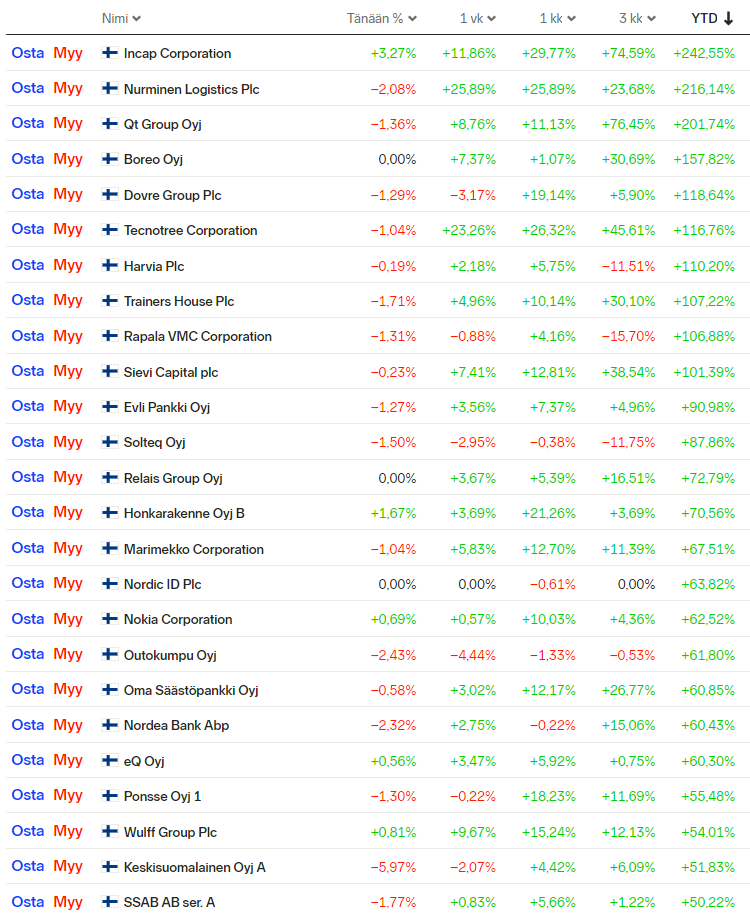
In Helsinki, there have also been hefty returns available this year, with three stocks having YTD returns of >200% and even 10 stocks over 100%. Here is a list of Finnish stocks that have yielded over 50% this year, excluding dividends:

My own portfolio has included Incap, Qt, Harvia, and Sievi since the beginning of the year. How many of these did you manage to get on board with?

edit: on top of this, there are the listed companies, many of which have >50% returns.

16 Likes

None of these are in my portfolio. :muscle:

15 Likes

I understand you’re talking about pricing now. By looking at any company’s current stock price, you can always justify the price, whether the reasons are zero interest rates, stimulus packages, WSB, or whatever. However, if you say you’re doing fundamental analysis, I believe it’s about determining the company’s value, not its price. We’re definitely going in the wrong direction if we first look at the price and then do the analysis based on that.

3 Likes

The worst self-deception is to imagine being able to determine the present values of a company’s cash flows with DCF until the cows come home. The more a company grows, the more inaccurate the DCF is - and that inaccuracy is not in a few percentages, but you can be off by miles.
As I understand it, Mikael’s comment meant precisely that in cases like QT, one must follow the flow of the story, and not delude oneself into thinking that the case can be accurately modeled with DCF.

In cases like QT, one would have been on the “sell” side for a long time if one had tried to justify it very Puritanically with DCF. This would not have served the readers of the analysis. If the DCF showed around 10e a couple of years ago - what did that estimate really achieve then or now.

10 Likes

I was referring to the impact of the prevailing investment environment on strong growth companies like Qt. Yes, the company’s fundamentals are the “core” that must be in order to generate positive sentiment for the stock, but a low interest rate environment and the company’s strong progress so far effectively buff valuation multiples, which improve returns, at least in the short term. If one had only looked at valuation multiples and not understood the impact of interest rates on growth company stock prices, the sell button would probably have worn out a long time ago.

Determining the terminal value of growth companies is a difficult task, and one would have to be quite a fortune teller to accurately predict Qt’s earning power in its mature phase right now. The earnings level of some value stock is easier to determine, as one can assume it will grow by 1-5% per year and not change much from that.

3 Likes

I probably expressed myself poorly. I don’t think anyone imagines this, or if they do, then I agree with you. The development of a company’s story, of course, affects estimates of how the company will perform in the future, and then it is perfectly fine to change one’s own estimates of future cash flows. With my example, I meant that estimates are changed based on how the share price develops, not based on how the story develops.

You are right, and that’s why I’ve tried to stay away from young growth companies, even with the risk of “losing out” on returns.

1 Like