Former Member of Parliament Ano Turtiainen has received asylum in Russia…
He mentions mysteriously that ‘apparently friends on the other side of the border had urged him to leave Finland immediately’. Apparently, and in that case, there is apparently a reason to leave.
Turtiainen has apparently been staying in Russia since October.
He says in a recent video that “friends from the Russian side” had urged him to leave Finland “immediately”.
– Apparently friends on the other side of the border felt that it was now time to leave, Turtiainen says.
I survived the ordeal by bravely seeking out a route to the heart of darkness and defeating the big boss in a long and exhausting battle. After this, Hyzon and cryptos have let me continue my journey in peace.
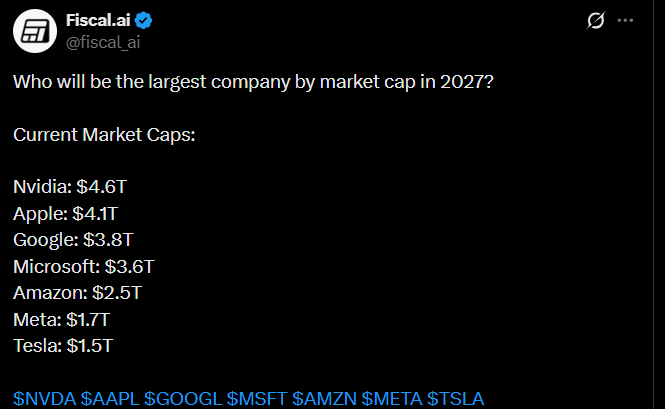
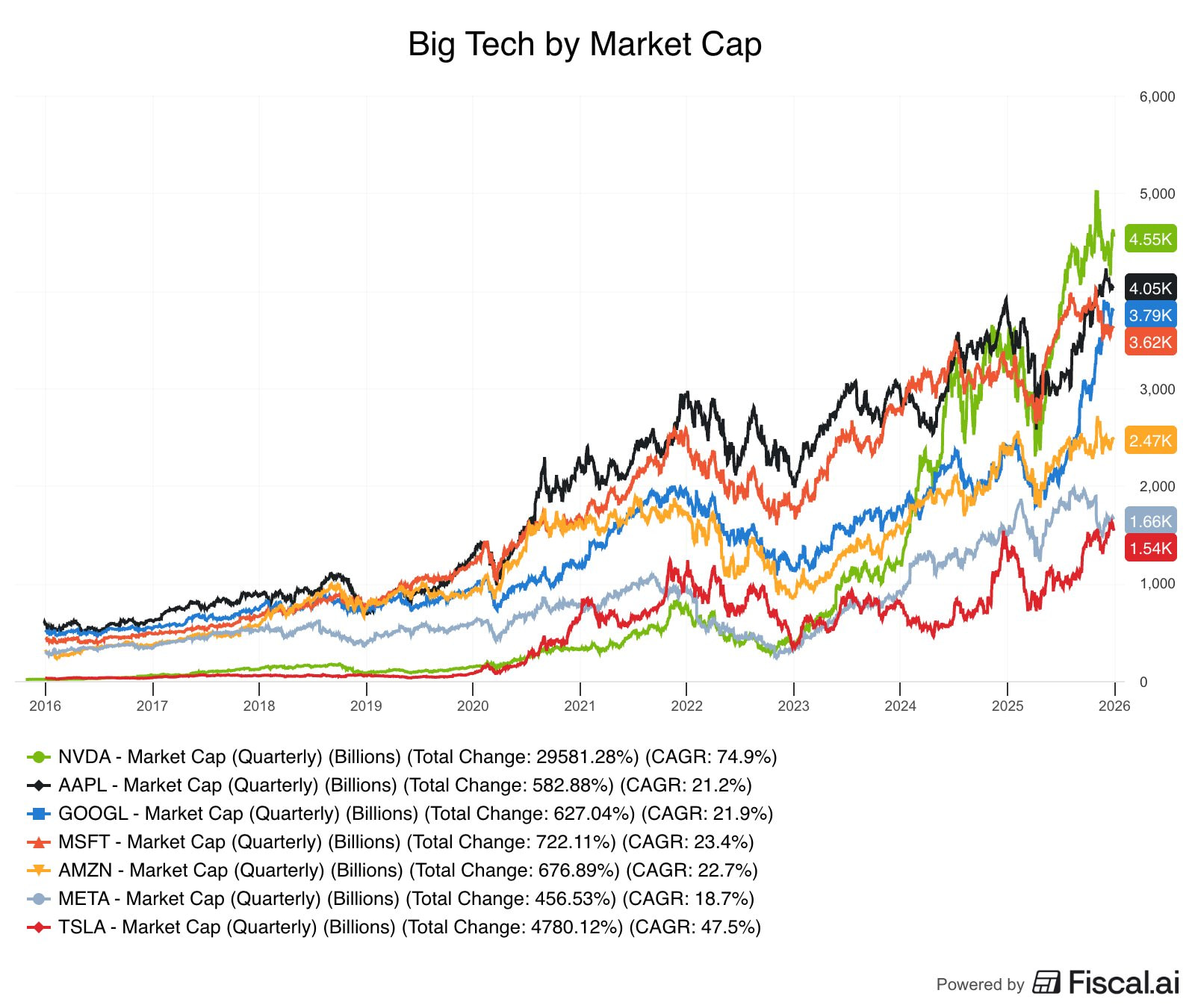
The tweet below contemplates which will be the largest company in 2027, featuring the familiar suspects.
I’m wondering, what about Nordea, which currently has a market cap of 54.6 billion euros, or Nokia (32 billion euros)? It would be surprising if there weren’t any surprises.
I don’t usually like to brag, but over the course of this year, I have accumulated enough investment wealth that I can live off it without working until the end of 2025.
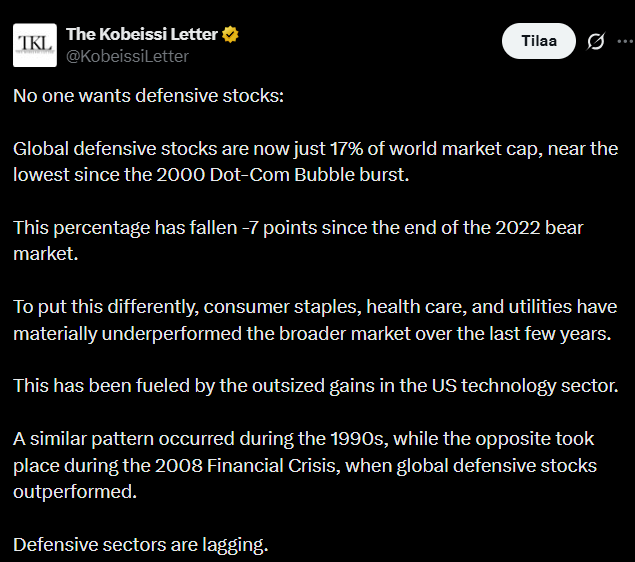
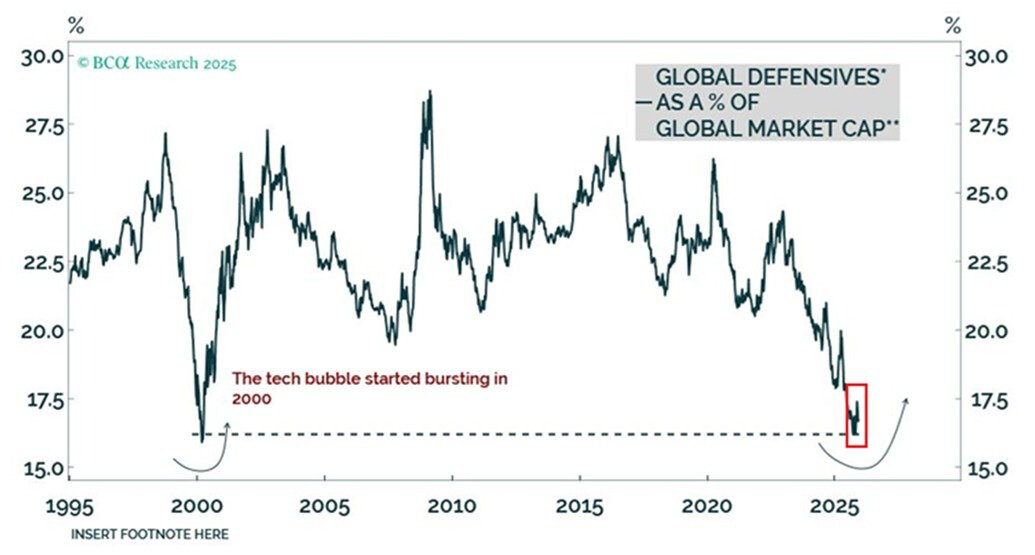
According to the tweet below, investors are currently not interested in defensive sectors.
Their share of the global stock market value is only about 17 percent, which is near long-term lows. Consumer staples, healthcare, and the utilities sector have clearly lagged behind, while US tech stocks have driven the markets upward in recent years.
Finally bought an apartment after a two-year search. I converted all my stocks to cash a year ago due to uncertain times (missed out on some returns), as I knew beforehand that the apartment purchase would require about a 20% down payment. Well, the housing deal will be finalized early next year and I have 5% more money left over than expected; now my eyes are back on the markets and looking towards 2026!
I want these defensive stocks, but maybe I’m just an out-of-touch old-timer. Still, they feel like a good option for me right now, and I have a reasonable amount of them in my portfolio. I could use a bit more energy, though.
The utilities train has actually been chugging northeast for a couple of years now (thanks for the correction @Sfinski) in the AI data center hype. I’m personally a bit wary of that sector.
Same here. Certain companies I’m following are currently in the over 20 P/E category, which is absolutely ridiculous for companies like that. A third would need to melt away for these to even be considered.
Nordea’s credit losses this year are 0.03%. And OP’s corporate credit losses are 0%?!?
Could someone more knowledgeable explain this logic [of the banks]? Why does it make sense for banks to keep credit risk at a zero level? The optimal “return-volume-risk ratio” surely cannot be at zero in a market economy?
Or could it be that this statistic doesn’t reflect reality (lies, damned lies, and statistics)? I mean, housing funds are still closed, and at the same time, financing is on such a solid footing that risk isn’t materializing in even a single (corporate) loan? Something doesn’t add up…?
Or is it sensible for banks to keep this part of the business at zero risk so that in another (more profitable) part of the business, they take really big risks and the bank’s average risk is at a “normal level”? Just like at Prisma, where the coffee aisle might occasionally run at a loss (and with high risk), but the store as a whole keeps chugging along more steadily…
Or does bank regulation nowadays force/incentivize behavior where it pays to operate financing with 0 risk?
Year 20205: Bankruptcies at record levels and corporate credit losses 0%?!?
Regarding bankruptcies, this can be explained by the fact that creditors can, and in practice often do, leave the debts of an insolvent bankruptcy estate hanging. Since these must be pursued through the courts, there is no guarantee of recovering even a single euro through that process when the bankruptcy estate has no money. Such outstanding receivables can be kept at full value on the balance sheet indefinitely, inflating the company’s value on paper even when it is known that the money will never be recovered.
The text from OP does not say that there are no credit losses at all, but rather that there have been fewer than what was prepared for in the form of provisions. Similarly, Nordea reports the net impact of credit losses relative to previously made provisions.
The last trading day of the year is once again almost over. Remember to take a screenshot of your YTD return before it resets.
Once you print and frame that screenshot, you’ll be able to reminisce about your heroic investing deeds of '25 for decades to come.
You can take several different versions of the YTD return screenshot. Just the YTD by itself without a benchmark looks so pretty. You can hang it on the wall. If someone asks whether there wasn’t that one big bull year in the Helsinki stock exchange in the mid-twenties when the whole market rose, another version will help.
Your own YTD looks even better when you pull another version out of the dresser drawer, where First North Finland has been chosen as the benchmark, which seems to be ending the year at a loss of about 1.5% YTD. If you can find the S&P 500 in euros somewhere, that’s also a really good choice for a benchmark. The dollar-denominated index is deceptive, as the USA struggles to shed its debt through its dollar devaluation efforts.
And if that someone happens to remember that First North isn’t the general index for Hesuli (Helsinki), you should also have a comparison between your own YTD and the media’s most-used OMXHPI in the drawer.
If that someone, having followed the Inderes forum, complains that you received those dividends but they aren’t included in that PI (Price Index) index—asking if a corresponding GI (Gross Index) exists?
There is a clever, universally applicable counter-argument for this situation: “but those dividends have already been spent.” That person will likely not realize—or at least, as a polite person, won’t bother to correct you—that in that case, your own YTD should be adjusted to PI form by subtracting the dividend portion.
Happy New Investing Year 2026. It starts from an equal level of YTD 0.0% in every portfolio and bag.
Well, now I’m really interested in Juurikki’s YTD screenshot, I’m eagerly waiting for it… I’ll post mine tomorrow, on the last day of the year… everyone is looking for good returns. Let us be suitably greedy and let others strive to be Caliph instead of the Caliph.
So. The New Year is approaching and isn’t it customary to make a resolution…
As a result of some lengthy contemplation (lying on the sofa, coffee mug on the table), I intend to promise… er… that is…
I promise: I’ll stop following the tabloids online; I just can’t take that Putin-this-Trump-that crap anymore. And I’m not interested in stories about some Erika Vikman. I believe my head will feel better for it.
I’ll try to promise… er…
I promise to try to move more in general. Soon I’m going to open up the bottom of the sofa and find that damn magnet.
I also promise to take better care of my loved ones; they’ve been left in a Finnish national state of neglect; if they don’t get in touch, then I won’t either, god-xxx-mit.
I was in a taxi today with a driver I know slightly, and he told me he’d bought Faron on a colleague’s recommendation. Apparently, the colleague had already doubled his money with some biotech stock, and Faron was supposed to be the next one.
When we arrived, I told the driver that he shouldn’t bet the house on this idea and gave him a ten-euro tip, partly out of pity.