Thanks again, Marianne!
It’s great to be able to conveniently read about the Fed’s antics from one place again, and not have to search here and there for information on what the central bank has been pondering and coming up with again. 
Thanks again, Marianne!
It’s great to be able to conveniently read about the Fed’s antics from one place again, and not have to search here and there for information on what the central bank has been pondering and coming up with again.
Looks like JVG immediately went on the EU’s sanction list:

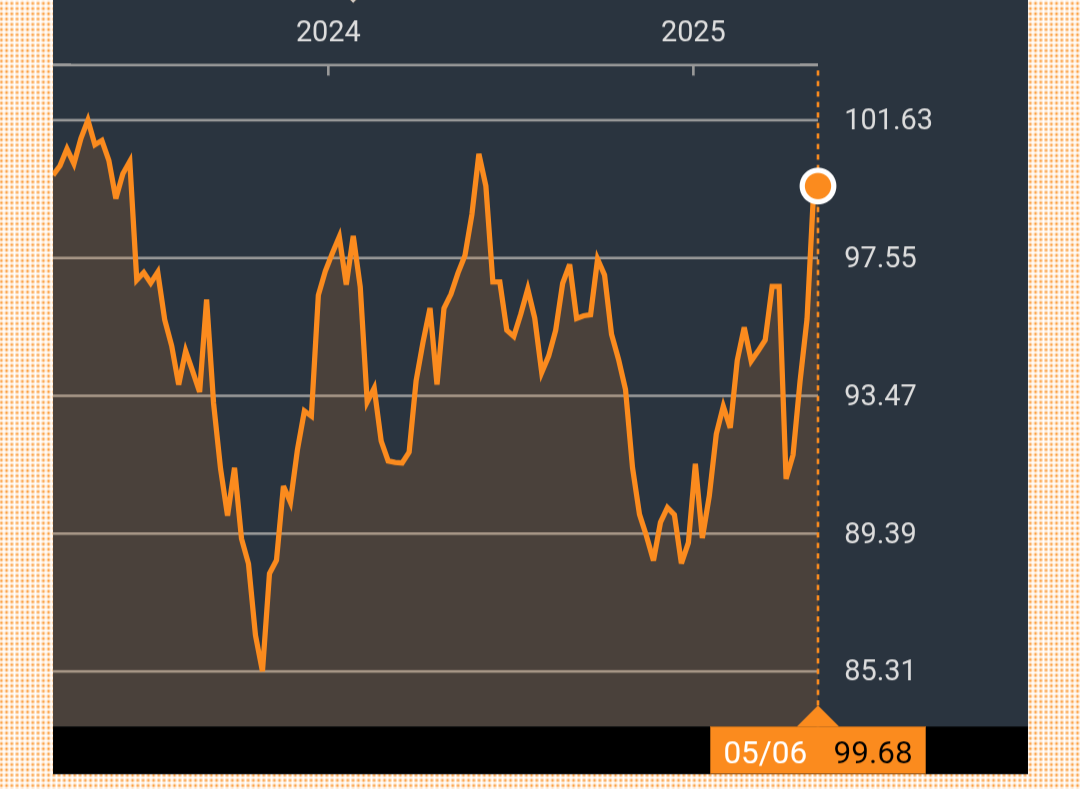
It was noticed some time ago that whenever Proprius’s Micro Finland is finally reaching the ITD breakeven level, the index pulls the rug out and we slide down significantly.
Now we are at that point again🤠
The Papal buzz is on. While waiting for a new Pope, it’s worth watching an approximately 2-hour YouTube video that introduces every single Pope starting from Peter and tells what each Pope is remembered for.
In the Middle Ages, things were quite interesting. A Pope might hire a large number of close relatives, even as cardinals, and otherwise embezzle church funds into the family’s pockets. A spendthrift Pope was usually followed by a frugal and respectable Pope who, with great effort, got the church’s treasury back in order. Frugality didn’t help for long, as in the cycle of Popes, it was the turn of a spendthrift Pope’s return, and the church was in debt again.
Then there was a person who served as Pope three times. He, among other things, sold his position as Pope, but later the buyer Pope was deposed, and the original Pope was reinstated. In the early 1900s, a Pope invested a large part of the church’s funds in the American stock market.
The first time, I got to the 11th century and fell asleep, only to wake up in the 15th century. Then I fell asleep again in the 17th century, and when I woke up, the program had ended, and YouTube’s autoplay was playing a video about quantum physics.  The second time, I got through all the Popes.

This perhaps belongs in a salary discussion, but… I’ve been quite satisfied with my work and, of course, also gotten stuck in terms of salary development, because no one is going to offer a raise. Although, in fact, several raises were offered to me without asking, both in my previous and current company, but exceptions prove the rule. The situation will certainly not be like this anymore when we start to approach the maximum amount that can actually be paid for work, if paid with gritted teeth. The employer will certainly not initiate reaching that limit.
All this came to mind when, at work, I’ve finally started to be genuinely annoyed by both the work community and the content of the work, and now these two dimensions meet in the same place and time. I know the situation is temporary. The frustration is at its maximum, but it will subside in months and be forgotten in years. After years, the payslip will again show a miserable index raise or two.
Such a moment of frustration in life should therefore be utilized before it passes. Can there even be any negative outcomes if one explores other places and tells the employer that such a strong offer came in that it cannot be refused? Whether it came or not, how would they know? A replacement position will be found regardless. I firmly believe that a position with a better salary will also become available, but it’s never entirely 100% certain. My own exploration increasingly supports existing leverage.
Forward with these feelings and thoughts. The thing about salary, when it’s a small worker’s salary like this, is that a salary increase up to the limit should be put into effect as quickly as possible so that time has a chance to accumulate.
Those are probably all 2-10 year old properties, and many apparently with Lakea’s shared ownership model.
Basic information for a large part of them can be found there https://lakea-markkinointihaku.etampuuri.fi/
This alliance will likely at least partially undermine Finnish shipyards’ hopes for icebreaker orders. I guess Trump’s “America First” mentality will, in this matter too, force Finns to scrape for scraps, if even that. The essential information there, in short, is that this merger was made for the purpose of building the vessels desired by Trump, using American resources.
Gulf of America mentioned in the announcement.
shipyards and fabrication facilities across the Gulf of America
Across the entire Gulf of America region (plus the East Coast), a skilled welder can practically name their price right now. Even shipyards handling Navy orders, which have the ability to pay anything for the work, cannot get enough skilled workers.
Regarding this Avocado Pope video, here’s another interesting perspective on the papal conclave. It also covers a lot of the history of popes:

When I once found myself in that situation, I took the risk and went to see if the grass was greener on the other side of the fence, and this time it was. It doesn’t always go this way, and a lot might be salvageable if you prepare your departure well.
Tell your employer or employer’s representative (your supervisor) that you received an attractive job offer from company X and are seriously considering accepting it. Usually, this leads to a discussion about whether something is wrong currently, and that’s a good moment to politely list real or invented reasons like “I like my job, but I can’t manage on this salary because the price of everything is constantly rising and my salary isn’t…” Or “I like my job, but I’ve been doing the same thing for 10 years and I feel like I want new challenges…” Or whatever is bothering you.
If there really is a competing alternative, it’s worth doing your homework well regarding it and finding out if the salary paid there and the workplace are on a stable footing, how things are there… Can you do it? What kind of work community would it be - would you enjoy it?
These are never easy and require investigation and risk-taking ability, just like investing.
The car business is what pays off…
Thank you for a very good and interesting answer.
I will continue to investigate what the salary could be in relation to my skills and the general salary level. Finding this out is quite a detective work. All job postings in the field are of the type “salary negotiable”, even though a collective agreement also exists. In workplaces, everyone is employed with a different salary, and figures are not openly discussed or inquired about. I want a bit more insight before making contact. I haven’t had to think about something like this before. I have only suspected that my own salary is falling behind the general level at the pace of index increases.
That would be exactly the point in life when it would be worth belonging to a union. From there you get salary statistics by industry and job level, career counseling, guidance and tips for salary negotiations, as well as other “peer support”. But for many, those twenty euros a month are just more important, so these things that radically affect the future are then pondered in their own heads and on discussion forums.
I myself aim for jobs where the exact salary is known before applying for the position (fixed salary), so evaluation is easy. One can directly from the announcement gauge whether I would do that thing for that compensation in that organization where, for example, this and that person seem to be working and this person is the boss.
I strongly disagree with union membership. Only those who are below average or worse as a workforce should belong to a union; a skilled person who isn’t completely silent can certainly price their own expertise with the employer…
And for example, the membership fees of engineering unions seem to be about 400€ / year; with that money, you can already get a few hours of legal advice…
Back then, a trade union activist colleague strongly argued, “What if you need legal help in a labor dispute?” I said that you pay about 16000€ in membership fees during your career (or well, 8000€ net, more in the future after tax exemption is removed); with that, you can hire a lawyer for quite a long time. Besides, I, at least, wouldn’t tolerate an employer for very long if I had to go to court; I certainly know how to use the doorknob… Of course, if a person tries to find a “sheltered job” and is incapable of anything else, such thinking can perhaps be understood on some level…
The majority of people, by definition, belong to the “middle class”, so you probably agree that, on average, it’s worth being a union member.
I went and added the word “alle” in front of “keskikastia” 
So, below average. How is this “caste” measured? Are you afraid of being laid off because you know you’re underperforming/consciously underperforming?
By the way, a union cannot raise any case for a dismissal made on production-related grounds (which is usually how lazy workers are gotten rid of) unless the employer is so stupid as to fail to clarify the relevant clauses. So, belonging to a union is not any kind of “insurance” for that. Therefore, I don’t understand why the “worse” workers you refer to would benefit from union membership any more than the independent, skilled elite to whom you clearly feel you belong.
But of course, if you feel you are more capable, then go ahead and do it. Belonging to unions (or funds, which are always confused in these writings nowadays) has not even been “mandatory” in our country for several decades.
I had a somewhat similar situation a few years ago.
I was satisfied with my job, work community, colleagues, company, etc., but the salary was a sticking point.
The company’s policy was and still largely is that salaries deviating from the collective agreement cannot be paid.
I asked my boss for about a 15% pay raise; the answer was negative.
Annoyed by this, I asked a competing company for an “offer” for my skills, resulting in a salary offer that was about 25% higher than my then-current salary.
I talked about it with a few of my closest colleagues and said I might be changing companies.
This reached my boss’s ears within a couple of days, and he asked me to his office.
After a short discussion, he offered me nearly a 20% raise, and I stayed with the company.
That was a good and sufficient raise for me not to change companies. A new place always has its own things, colleagues, and supervisors. You know the ways and friends of the old place, better the devil you know 
The competitor, however, was not very happy with my decision, and it might be that I shouldn’t ever apply for a job with them again…
Tomorrow you can hear about @Mikael_Rautanen’s life and the story of Inderes, as the book Disciplined Anarchy is published! 

On a Monday in October 2021, a slender boy buys a lot of beer from S-market. The cashier asking for ID doesn’t know that the customer is the CEO of a newly listed company, 36-year-old Mikael Rautanen, who is on his way to celebrate his company’s listing.
About 13 years earlier, during the financial crisis, Rautanen was a quiet finance student, bothered by investor insider circles and bursting economic bubbles. As a stock nerd, he began writing analyses of listed companies. His predictions about Nokia’s development were so accurate that high-ranking investor publications began to follow what he had to say.
Based on Rautanen’s and his friends’ hobby, the analysis service Inderes was born, which in a few years grew into a trusted stock market hawk for the general public. However, Inderes is not an ordinary company: its organizational model of disciplined anarchy challenges established notions of working life and leadership and paints a new picture of the style and methods of success.
In his personal life, Rautanen has experienced heavy losses and health challenges. How have difficult experiences influenced his views on company leadership? How to hold on to down-to-earth values when the world around is striving for quick enrichment?
Mikael had also arranged a collaboration with Storytel, whereby everyone is offered the first month for free and the second at half price. More money is left to invest (or lose) in stocks.  So, be sure to grab the offer here: https://www.inderes.fi/articles/tarjous-inderesilta-kokeile-storytelia-ilmaiseksi
I’m not really an expert on this, but I’ve heard that this way it’s possible to burn bridges with both companies. The old company constantly doubts loyalty when one has gone to negotiate behind their back, and the potential new place is disappointed with the decision.
Of course, an even harsher situation could be if one has “threatened” to change jobs at the old place. Perhaps I’m a bit cynical about employers’ motives, and I hope things turn out well for you 