Still, one cannot generalize; many good interviews are available. For example, the CEO interviews conducted by @Juha_Kinnunen are perhaps the best content Inderes produces, with good questions and challenging when necessary
32 Likes
This is indeed true, @Juha_Kinnunen, in typical Kainuu fashion, keeps a straight face even when asked difficult questions.
New analysts could learn from this; CEOs don’t bite even if you ask tough questions, at most they’ll stop following the company. Of course, there’s a risk that Rautanen will turn the juniors into pizza toppings at this point.
40 Likes
I agree! 
Pinging @Antti_Viljakainen & @Sauli_Vilen to this.
I’ve noticed myself that a lot of questions are about wording. You can ask anything, and the other person won’t necessarily get angry if you phrase it well. 
19 Likes
I’ll have to discuss that with the team and the analysts. 
Those are a good basic framework, but many listeners would certainly appreciate a much deeper dive. 
15 Likes
The framework is good, but the problem is that the analyst asks a question, management answers, the analyst picks the next question from the list, and so on.
Nothing needs to change if the analyst would follow up on the answers and challenge/ask for clarification, i.e., have a real dialogue. Now, too many interviews are such that the analyst’s role is merely to read the questions in order without even needing to listen to the answers.
19 Likes
Regarding those company interviews, it’s also important to be critical for the sake of independence: it’s likely that a CEO interview has more viewers than an analysis has readers. Even a “yes yes” attitude in such an interview erodes credibility in the eyes of many investors, even if the analysis itself is “independent.”
19 Likes
Would there be anything like having the three most popular questions from Inderes premium members in each interview? That way, the analyst wouldn’t have to play good cop-bad cop, but could “blame” Inderes members.
3 Likes
That framework referred to analyst interviews, meaning one of our community team members interviews an analyst about a company as an investment target. But I agree with you about the company interviews as well; they should grab onto things more, like @Juha_Kinnunen does.
For almost every issue, the right answer would be: do as Juha does.
20 Likes
Generally, they could be picked from the forum, and the question can always be framed as being “from investors” even if it’s one’s own.
7 Likes
Regarding this, please always point out for each video if something is not pleasing or if something more is needed. It’s easier to give feedback and think about areas for development! 
7 Likes
True, I got different interview formats mixed up, but essentially the same things apply to both.
In a way, these “Inderes internal” interviews could also include forum questions, meaning the analyst is put on the spot without having to grill the client.
Yes. The best Inderes podcasts/chats are Sauli’s and Juha’s model portfolio/market situation/specific topics because the gentlemen’s different personalities complement each other perfectly. Sauli chats smoothly like at the opening of the summer season at Haukilahden marina pavilion after a couple of glasses of bubbly, and Juha is always as calm as a rock and in his peaceful style tells blunt facts, even if he had just come from the backyard after killing a male bear that attacked his property with only a spork as his tool.
48 Likes
My observation: it takes significantly more courage for an analyst to give a reduce/sell recommendation, especially if the stock is popular in the market. In my opinion, Inderes should pay at least a little attention to this. There are small encouraging signs, e.g., Sampo already receives cautious attention from Sauli regarding the difficulty of achieving the required rate of return. I don’t mean Jim Cramers, but rather ice-cold sell recommendations when the time is right.
4 Likes
I just have to add my two cents to this excellent and important discussion, which @Seinakadun_Keisari brought up. In my opinion, @Juha_Kinnunen is exactly the kind of analyst I hope every Inderes analyst takes after. Juha’s interviews aren’t jargon; Juha is clearly on the ball, and it comes across that Juha genuinely understands the relevant matters from an investor’s perspective. This is evident, for example, in the way Juha asks these clarifying questions in addition to a little grilling.
So, all analysts, just observe Juha’s work from up close  It’s not without reason that Juha is a respected and awarded analyst. And Juha, no pressure, just continue to be your critical self, always keeping self-development in mind

EDIT: And with Juha, there’s also the impression that Juha dares and knows how to take a view in a negative direction as well
34 Likes
In my opinion, video/audio interviews are Inderes’ best contribution, and these are what I like the most. For example, at OP, the videos are completely useless as they don’t interview anyone.
So, my opinion is also in favor.
3 Likes
The purpose of company interviews is to serve investors, and of course, we strive to bring forth all relevant angles, whether positive or negative. It’s just as important to be critical of them as it is with recommendations. Of course, no change has occurred on our end regarding this, but we’ll send a reminder to the team about it
As for questions, analysts are happy to receive them, so please actively post questions in the companies’ threads or directly to the analysts (sometimes we also ask for them in the threads).
Edit, you can (and should!) also give direct feedback on the videos if completely wrong things are being asked about a company, just give feedback in the thread/to the analyst!
22 Likes
Thanks for asking, the vacation was very relaxing (excluding the 1.5 weeks of corona for the whole family  ).
I only now had the chance to read through this thread properly, and I must say thanks to everyone who wrote in! There are actually a lot of good ideas here for developing our recommendation policy and analysis. I’ll get back to these in more detail when we’ve had more time internally to chew on them, but here are some preliminary comments in no particular order:
-
Crowdsourcing/swarm intelligence is actually a really interesting idea! Our tools (investor sentiment, etc.) would certainly provide a good basis for building a new kind of service where investors could participate in giving recommendations/views in one way or another.
-
When developing the service, it’s good to keep in mind that we have a very large group of investors as users. Because the mass is large, the service needs to be relatively clear. It’s hard to see, for example, how several different target prices for different time horizons would serve a large mass very well.
-
Investors’ needs are very diverse. One reads a long report like a bible, another uses a long report at most to start a sauna fire. For one, the morning’s earnings comment is important, another can’t be bothered to wake up to read it. Someone likes videos, another doesn’t. Of course, we want to develop the service to serve all investors (which is why we also have different formats on different channels)
-
Regarding the workload of the quarterly report. You are right that an analyst usually gets 80-90% of the work done very quickly, but the last 10-20% takes a lot of time. For example, on Sampo’s earnings day, I usually know immediately after the earnings live broadcast how my forecasts will likely behave and what I will probably do with the recommendation. However, it takes the rest of the day after that, as I read through the report, go through the details, might call IR, listen to the conference call, still look at competitor reports, go through my own older reports, etc. Then I still have to write that report. Is this “last mile” then unnecessary? I don’t think so, because our job is to be experts in these companies, and as part of that, I make sure I haven’t overlooked anything (you’ll give a pretty merciless judgment if there are errors in the analysis
). This gave me an idea: during the earnings season, I could try to make a “day in the life of an analyst” video for some company, where the day’s events from my perspective would be compressed into a concise ~5min package 
-
Target price is a difficult concept, and there are many good aspects to a fair value range. I pondered this a lot during the summer.
-
The time period for the target price is another eternal question. 12 months is a short time, 3 years is an eternity. Too many different time horizons cause confusion (point 2). But 12 months is certainly suboptimal in many ways from the perspective of a long-term investor. We consider this at least once a year, but so far we haven’t found a better answer.
-
The risk indicator still has a lot of room for improvement; it would certainly be a good idea to explain its underlying parameters in more detail.
-
PDFs are from the last millennium, and we have had a dynamic digital report on the drawing board as an eternal project. This is indeed at the drawing board / in Juha’s (Juhan päässä) head at this stage.
Please keep the good ideas coming; it would be great if we could come up with a model to take this industry another step forward
62 Likes
Thanks for the quick response. This image by @Antti_Luiro on the sensitivity of DCF value to the required rate of return is an excellent example of a necessary addition to the analysis.
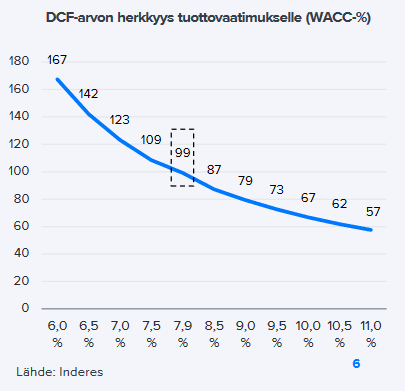
Regarding the 12-month target price. Investors’ long-term perspective varies greatly. Even though everyone wants to be a long-term investor, under intense mental pressure, the practical investment horizon can shrink to months, even if one wants to look years ahead. And sometimes at the same time, the time horizon for company A is 6 months and for company B is 2 years. In these situations, a 12-month target price serves no one. It would be great if the fair value was presented for multiple time periods. It could even be presented in the style of the image above.
21 Likes
You can also write things in the company threads that either concern you in the company report or as an investment case in the company in general. Of course, you can also get a written answer here on the forum, but I personally always check the company thread before the video is filmed, in case there are questions. We gladly include questions/topics from forum members in the videos In the video, it is also easier for the analyst to explain their thought process, at least in some cases.
22 Likes
Is this really how it works @Antti_Viljakainen? How often is the correct level of the risk-free rate examined in Inderes’ analyses, and how does that genuinely function? Shouldn’t the risk-free rate be redefined dynamically every month?
8 Likes
In May, Verneri briefly discussed interest rates in the Qt thread.
"As I understand it, they are vaguely baked into the WACC (Weighted Average Cost of Capital). In many companies, WACC has risen in recent reports, reflecting increasing uncertainty, even though the official ‘risk-free rate’ is at 2%.
Inderes doesn’t really take much of a market view except for cyclical stocks where one is somewhat forced to consider economic development.
That’s why it has been said before, regarding Qt, when the share price was higher, or at least I remember it being said, that if an investor believes in a sharp rise in interest rates, this might not be the most appealing stock in the portfolio."
4 Likes