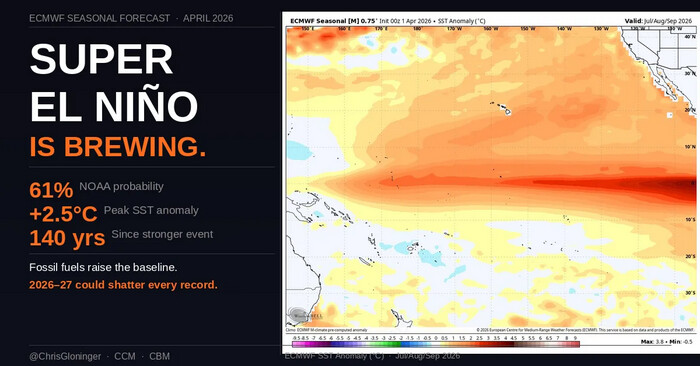
Jotta Vernerin hyvät uutiset eivät jää vaivaamaan lukijoiden mieltä liiaksi, tässä hieman pohdittavaa. Tyynellä valtamerellä on kehittymässä El Nino ja arvioiden mukaan se voi olla mittaushistorian voimakkain.
Paul Roundy, an atmospheric scientist at the University at Albany who has spent his career studying tropical climate variability, examined the same model guidance and wrote publicly that there is “real potential for the strongest El Niño event in 140 years.”
For context, an El Niño is typically classified as “strong” when anomalies reach 1.5°C. The 1997 and 2015 events, the two most consequential El Niño years of the modern record, peaked in the vicinity of 2.3°C. We are looking at a forecast that would put this year’s event above both of them.
Eli tämän vuoden ilmiö voi olla voimakkaampi, kuin aikaisemmat “piikit”. El Nino on luonnollinen osa Tyynenmeren toimintaa. Sen voimakkuus määrittyy vesimassan lämpötilan mukaan. Mitä suurempi + merkkinen poikkeama keskimääräisestä lämpötilasta, sen voimakkaampi ilmiö.
El Niño is a natural climate cycle. It is one half of the El Niño-Southern Oscillation, ENSO for short, and it has been oscillating between warm phases (El Niño), cold phases (La Niña), and neutral conditions for as long as paleoclimate proxies can detect. Coral records and lake sediment cores suggest that some version of ENSO has been operating in the tropical Pacific for at least the last seven thousand years, and possibly much longer.
Miksi El Nino on tänä vuonna niin voimakas? Lämmin vesimassa kerääntyy vuosien ajan, ennen kuin se vapautuu “kertarysäyksellä” El Nino ilmiön muodossa. Mitä pidempään vesi lämpenee ja mitä enemmän se kerää energiaa, sen voimakkaampi vaikutus.
The last eleven years were the eleven hottest years in the instrumental record. And a peer-reviewed study published earlier this year, looking at the rate of change in global mean surface temperature, found that the pace of warming has nearly doubled since 2015. What was on the order of 0.18°C per decade through most of the late twentieth century is now running closer to 0.3°C per decade, and possibly higher depending on which observational product you use.
El Nino on osa Tyynen valtameren lämpöäkiertoa, jossa epäsäännöllisin, mutta toistuvin, väliajoin Tyynen valtameren länsiosiin itätuulien vaikutuksesta kertynyt lämmennyt vesimassa lähtee tuulien heiketessä valumaan itään, kohti Etelä-Amerikan rannikkoa. Matkatessaan itään, se vapauttaa lämpöenergiaa ilmakehään ja sillä on maailmanlaajuisia vaikutuksia.
What happens during an El Niño, in the simplest terms, is that the pool of warm water that normally sits in the western Pacific, piled up there by the easterly trade winds, sloshes back toward the east. When those trade winds weaken, that enormous reservoir of stored thermal energy spreads across the equatorial Pacific and begins releasing heat into the atmosphere on a planetary scale. The atmosphere responds, the jet streams shift and rainfall patterns reorganize. Droughts appear in places that normally get rain and rain falls in places that are normally dry. The global average surface temperature ticks upward, usually by a tenth or two of a degree Celsius for the year.
Eli siellä, missä on kuivaa, sataa ja päinvastoin. Miksi tästä puhutaan? Eikös ole hyvä, että joskus kuivissakin paikoissa sataa? Tällä on suoria vaikutuksia maatalouteen ja ihmisten ympäristöön, jossa ilmiö voimakkaasti vaikuttaa. Paikoissa, joissa sademäärä on kesimäärin pieni, voi ilmetä voimakkaita tulvia. Hedelmällisillä alueilla, joissa tuotetaan paljon ruokaa ja on normaalisti sadetta riittävästi, voi tulla katovuosi.
Mitä El Nino merkitsee käytännössä? Massiivisa vahinkoja alueilla, jotka kärsivät voimakkaimmat efektit.
The 1997 super El Niño caused an estimated five trillion dollars in global damage, according to subsequent economic analyses, including crop losses in Southeast Asia and Australia, catastrophic flooding along the west coast of South America, severe drought and wildfire activity in Indonesia and the Amazon, coral bleaching across the Pacific, and a spike in vector-borne disease in several parts of the tropics. That figure is in late-1990s dollars, against a global economy less than a third the size of today’s. The modern equivalent would be significantly larger even before you factor in the additional warming that has occurred since.
Vakavin ongelma tulee koskemaan ruoan tuotantoa. El Nino yleensä pienentää satoja globaalisti. Kuinka paljon ensi vuonna, ei vielä tiedetä. Yhdistä El Nino vielä rajusti nousseiden lannoitteiden hintojen nousuun - ja ei ole vielä mitään tietoa, pääsevätkö niiden valmistuksessa käytettävät raaka-aineet kohta edes menemään Hormuzin salmen kautta - kun tämän vuoden kylvökausi on nyt meneillään ja ensi vuoteen voidaan mennä rajusti pienemmillä lannoitemäärillä, suuremmilla hinnoilla ja kun vuoden 2026 satomäärät ovat jo varmasti pienemmät kuin aikaisemmin, niin yhteisvaikutus voi olla katastrofaalinen globaalisti.
Beyond the United States, the places I am watching most closely are the monsoon regions of South and Southeast Asia, the Horn of Africa, northeastern Brazil, and the maritime continent of Indonesia and Malaysia. Each of these regions has experienced severe climate stress during recent El Niño events, and each of them is now entering this event with populations, agricultural systems, and water resources that are less resilient than they were ten years ago. The global food system is tightly integrated enough that a bad harvest season in any two or three of those regions simultaneously has the potential to move commodity prices in a way that will be felt at the grocery store in New England.
Samaan aikaan Yhdysvaltojen hallinto juhlii keskeisen lainsäädännön kumoamista, joka on koskenut ilmanstonmuutoksen vaikutusten arviointia ja seurantaa.
Last week, the Administrator of the Environmental Protection Agency stood at a podium in Washington at an event sponsored by the Heartland Institute’s International Conference on Climate Change and told an audience of fossil fuel industry representatives, lobbyists, and allied academics that they should “celebrate vindication.” The specific vindication being celebrated was the announced intent to repeal the 2009 Endangerment Finding, which is the legal determination, based on an extensive scientific record, that greenhouse gases endanger public health and welfare.
Tarkoituksena murentaa kaikki lainsäädäntö ilmastonmuutoksen hillitsemiseksi.
That determination is the foundation of essentially every federal regulation of greenhouse gases under the Clean Air Act. Repealing it would not change the underlying science, which is as settled as any proposition in the environmental sciences gets, but it would eliminate the legal basis for federal action on climate change for the foreseeable future.
Mikä voisi mennä vikaan?
This is happening the same week that the models are telling us a super El Niño is forming. It is happening in the same month that a peer-reviewed study concluded the pace of warming has nearly doubled.
Joten, osta ensi vuoden kahvisi, jauhosi ja puurohiutaleesi ajoissa. Ja katso, että kotivakuutuksesi on kunnossa. Ensi vuonna niillä voi olla hintaa tuntuvasti enemmän. Suomessa ollaan kuitenkin jopa tässäkin asiassa hyvässä tilanteessa. Meillä tulee olemaan vain tuntuvasti korkeammat ruoan hinnat. Ruokaa kuitenkin on. Asia voi olla toisin sadoilla miljoonilla ihmisillä ensi vuonna.