# Global quality companies
**URL:** https://forum.inderes.com/t/globaalit-laatuyhtiot/43190
**Category:** Osakkeet
**Tags:** ulkomaiset-osakkeet, laatuyhtiöt
**Created:** [September 27, 2023, 6:50pm UTC](https://forum.inderes.com/t/globaalit-laatuyhtiot/43190 "2023-09-27T18:50:52Z")
**Posts on this page:** 20
**Page:** 4
### Author:  [@Bjorninen](https://forum.inderes.com/u/Bjorninen)
#### Post date: [November 20, 2023, 8:22pm UTC](https://forum.inderes.com/t/globaalit-laatuyhtiot/43190/63 "2023-11-20T20:22:44Z")
> [@Homeros](#):
>
> Capex has been streamlined to a minimum (3–4% of revenue vs 15% industry average) and the entire cash flow is funneled into share buybacks or acquisitions, and the company has successfully been a serial acquirer.
How do you view the sustainability of that Capex? Is there something so exceptional about Atkore that such a low Capex is sustainable?
Oh, they are also starting dividend payments, $0.30–0.35 per quarter. That is, however, only a small portion of what has been spent on buybacks.
---
### Author:  [@Homeros](https://forum.inderes.com/u/Homeros)
#### Post date: [November 20, 2023, 9:00pm UTC](https://forum.inderes.com/t/globaalit-laatuyhtiot/43190/64 "2023-11-20T21:00:47Z")
Clearly @JNivala, you understand the “big picture” of this investment case, so to speak. I’ve followed this company for probably three years now and owned it for two, so I’m quite deep into my own DD process. If you look at the company’s figures from 2016–2020, its performance was very high quality even then—for instance, EPS tripled. From 2021 onwards, earnings then took off into orbit in a whole new way. The sustainability of earnings and the normalization of margins since then have been a constant topic of conversation in the company’s analyst calls; it’s been debated for a couple of years now, and analysts have likely asked dozens of questions on the subject. The company’s “over-earning” since 2021 is a long story, but perhaps the market and analysts have viewed it a bit too one-dimensionally, just as a passing anomaly or similar. Of course, such long-term profitability, which actually extends back to 2016, wouldn’t be possible without the company’s permanent competitive advantages, pricing power, and continuous development. I’ll have to try to write more about this when I have more time, perhaps in my own thread. There are quite few other sources to follow for the company. There are some mentions on Twitter, and Seeking Alpha has some analyses written by some Americans.
---
### Author:  [@JNivala](https://forum.inderes.com/u/JNivala)
#### Post date: [November 21, 2023, 8:13pm UTC](https://forum.inderes.com/t/globaalit-laatuyhtiot/43190/65 "2023-11-21T20:13:01Z")
> [@Bjorninen](#):
>
> > [@Homeros](#):
> >
> > Capex has been optimized to a minimum (3–4% of revenue vs. 15% industry average) and the entire cash flow is directed into share buybacks or acquisitions, and the company has been a successful serial acquirer.
>
> How do you see the sustainability of that Capex? Is there something so unique about Atkore that such a low Capex is sustainable?
>
> Oh, they are also starting to pay dividends, $0.30-0.35 per quarter. That is, however, only a small fraction of what has been used for buybacks.
In the fiscal year 2023 that just ended, Atkore’s capex is exceptionally higher than in previous years:
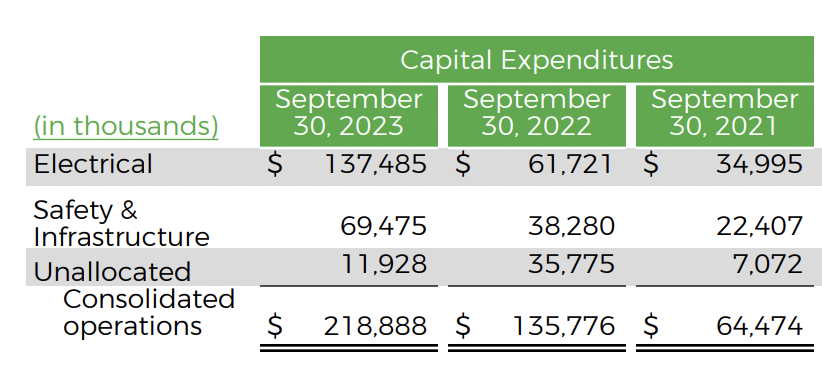
In general, Atkore’s clear spearhead is that overwhelmingly larger “electrical” segment, as its growth has historically been quite capital-light and very profitable (EBITDA \> 40%). In contrast, the other segment is clearly less profitable (EBITDA 10-15%) and it also ties up much more capex relative to the cash flow generated by that segment.
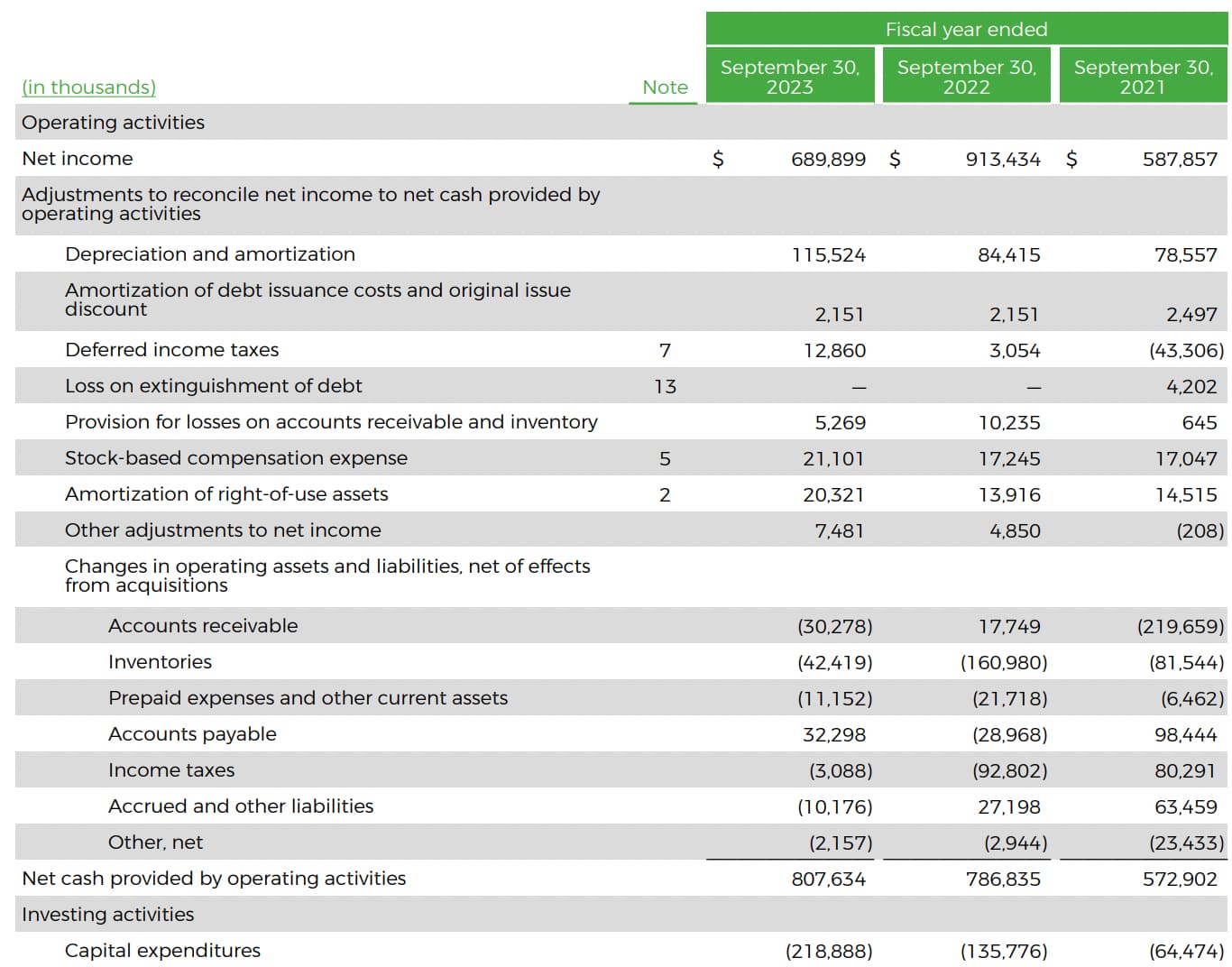
However, in 2023 the company generated very good free cash flow despite the increased capex levels → based on the figures for the fiscal year ending in 2023, P/FCF is somewhere around the 8x level, calculated quickly in my head.
---
### Author:  [@Homeros](https://forum.inderes.com/u/Homeros)
#### Post date: [November 21, 2023, 9:46pm UTC](https://forum.inderes.com/t/globaalit-laatuyhtiot/43190/66 "2023-11-21T21:46:04Z")
> [@JNivala](#):
>
> In the fiscal year 2023 that just ended, Atkore’s capex is exceptionally much higher than in previous years:
Of course, it’s worth noting that 75% of this year’s capex consisted of organic growth investments, and only the remainder was maintenance capex. New factories and distribution centers are coming. Management guided that in the long term, capex will roughly equal the level of depreciation. The company’s manufacturing processes are not very complex; simple equipment, bending sheet metal, extruding plastic. I wouldn’t consider the capex level suspiciously low. Most of the factory properties are leased, which doesn’t tie up as much capital.
---
### Author:  [@naata](https://forum.inderes.com/u/naata)
#### Post date: [November 22, 2023, 2:29pm UTC](https://forum.inderes.com/t/globaalit-laatuyhtiot/43190/67 "2023-11-22T14:29:46Z")
> [@Homeros](#):
>
> Management’s message has been that the company has structurally transformed into a significantly more profitable one over the last couple of years, but the market might not fully believe this yet, which could partly explain the low valuation and short selling.
Thanks for a very interesting highlight, a really fascinating company!
Could you perhaps elaborate on what kind of measures the firm has taken in its transformation? I do intend to dig into what has been done to the structure myself, but perhaps you already have some insight?
---
### Author:  [@Homeros](https://forum.inderes.com/u/Homeros)
#### Post date: [November 23, 2023, 4:22pm UTC](https://forum.inderes.com/t/globaalit-laatuyhtiot/43190/68 "2023-11-23T16:22:21Z")
> [@naata](#):
>
> Can you perhaps explain what kind of actions the company has taken in its transformation?
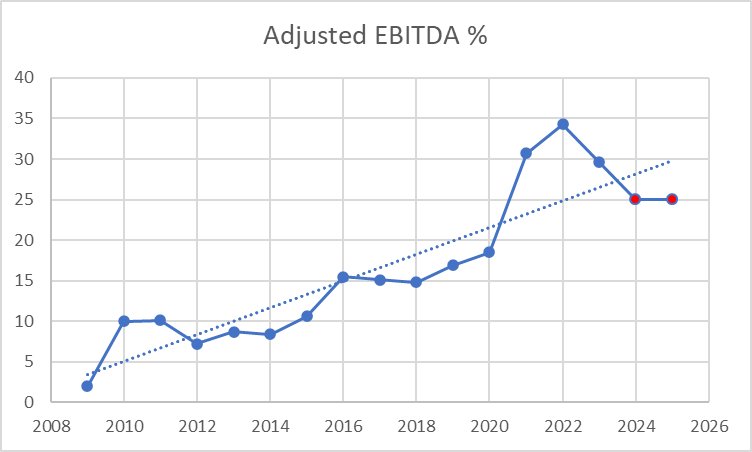
Perhaps my choice of words “structurally transformed within the last couple of years” was poor. Likewise, the company had indeed titled its slide “Structurally Improved Our Business Since IPO” (in 2016). But neither of these is strictly true, because if you look at Atkore’s EBITDA margin since 2009 (in the image below), this transformation has in a way been underway since 2010, when the company’s ownership base and the entire management changed. In this sense, the future guidance of 25% for margins (red dots) is just a consistent progression in the company’s fairly linear profitability growth once the outlier years 2021-2023 are filtered out. (This is not an inherently self-scaling business model). Therefore, it’s a bit difficult to name any single major change behind this profitability growth. Rather, it is the result of small incremental improvements made over the years, backed by systematic work, planning, and strategic execution. When things just work, and perhaps a company has the kind of corporate culture and management that just makes it work. In that case, there naturally shouldn’t be any ceiling for margin improvement.
But I will try to get that longer prose written about the company in the coming days.
EDIT: Atkore’s own thread: [https://keskustelut.inderes.fi/t/atkore-inc-sahkonsuojausratkaisujen-valmistaja/44743?u=homeros](https://keskustelut.inderes.fi/t/atkore-inc-sahkonsuojausratkaisujen-valmistaja/44743?u=homeros)
---
### Author:  [@Bjorninen](https://forum.inderes.com/u/Bjorninen)
#### Post date: [December 25, 2023, 11:39pm UTC](https://forum.inderes.com/t/globaalit-laatuyhtiot/43190/72 "2023-12-25T23:39:42Z")
Visa and MasterCard have already been mentioned in this thread, but after some research, their business model is actually quite interesting. This text mostly focuses on Visa, but almost the same points apply to MasterCard as well.
- Visa (and MasterCard) possess a strong moat, as on a global scale, the business is practically an oligopoly.
- The three largest players control about 95% of the market. Visa has a share of about 40%, the Chinese state-owned UnionPay about 32%, and MasterCard about 24%.
- In Western countries, Visa and MasterCard are the largest, with Visa being the market leader.
- Visa’s market share in the USA is approximately 60%, but there are large country-specific differences even within Western countries. Some countries, such as Germany, have local card companies. However, these also operate on Visa and MasterCard networks, meaning these cards can be used in the same places where Visa is accepted.
- China has local companies (the largest being UnionPay), which are significant factors on a global scale due to the country’s size (approx. 800 million credit cards), yet they are hardly used outside of China. Due to regulation, US companies cannot properly access the Chinese market either.
- Due to the geopolitical situation, I don’t really believe that a Chinese service will achieve a very large share in Western countries or even outside of China in the future.
Quantitative criteria, case Visa:
- Over the last 10 years, ROIC has fluctuated between 13.9% and 29.3%
- Revenue growth over the last 5 and 10 years: 13.0% (10y) and 11.7% (5y)
- EPS growth respectively 16.1% and 13.4%
- Net margin over the last 10 years has been 36-53%
- Visa is supported by a global megatrend (the shift from physical cash to cards). Although card payments are common in Finland, they are still relatively rare in many European countries even today. According to an ECB estimate, last year in the Eurozone, 59% of consumer transactions (referring to, for example, paying at a grocery store) were made in cash (in 2016, the share of cash was 79%).
- The increase in traffic occurring on Visa and MasterCard networks makes the network more valuable. The more users use the aforementioned cards (i.e., the traffic occurs on their networks), the more likely it is that more merchants will accept them as a means of payment. This creates a moat to prevent others from entering the market. If a new company tried to enter the market, the problem would be that it is not accepted “anywhere” as a payment method, and on the other hand, merchants do not offer it because “no” consumer uses that payment method. A competitor’s entry into the market would require both parties (consumer and merchant) to adopt it.
- In financial matters, trust is important; this is why Visa has established its position as a reliable operator. This makes it difficult for competitors to enter the market (this applies specifically to those Chinese companies).
- Visa’s payment traffic network can be thought of as a highway that connects payers and receivers securely. Payments occurring on the network are “tokenized,” meaning the actual card details are safe. If you add, for example, ApplePay to this, it’s like driving a car on the highway. Since Visa’s network already protects the actual data, adding ApplePay to this is like “double protection”: ApplePay creates a virtual “car” with a temporary and unique identifier (token). This identifier represents the payment made without revealing sensitive information.
- Competitors are not just a threat. For example, the [Crypto.com](http://Crypto.com) card is a Visa. Visa actually provides infrastructure to its competitors. You can link a Visa card to GooglePay or ApplePay wallets. In my opinion, payments are not the core business for Google and Apple, so I don’t really believe they would start developing their own payment system; instead, they are more likely to continue as partners with Visa. Due to operating system dependency, that might not even be sensible otherwise.
- The business is inflation-resistant. Part of the fees are percentage-based, so the company’s income rises along with consumer prices. The company’s operating margin is also high, so a faster rise in costs does not damage profitability in the same way as in a low-margin business. Some costs are fixed, allowing the business to scale as the number of payments increases. However, the cost is low enough that it makes it difficult for competitors to enter the market and run a profitable business. And handling cash isn’t free either…
- 40% of revenue comes from data processing fees, 35% from service fees, 20% from international transactions, and 5% from other sources.
Risks:
- Regulatory risks
- Competition; there can always be a new disruptive payment method, and Visa (and MasterCard) could fall behind if their business is destroyed and they aren’t fast enough in their movements.
On the other hand, I don’t currently see competition as a very large threat to Visa and MasterCard. Of course, they could compete each other to death, but I don’t consider that very likely either. Cryptos are not a threat for the time being, as there are no signs, at least in the near future, that people will start paying with Bitcoins in stores. This is also affected by the capacity of these networks. Visa’s network can handle a massive number of transactions, and the Bitcoin network or even the Lightning Network cannot match it.
Valuation:
Visa’s P/E for the last 12 months (TTM) is about 31. For a high-quality and growing business with a moat, one can pay more than for the average company. Compared to MasterCard, the P/E valuation is lower (MasterCard’s P/E is 37), although MasterCard has grown slightly faster in recent years.
- Visa’s P/E based on earnings forecasts for 2024-2026: 26.5x, 23.5x, and 20.8x
- Corresponding EV/S figures: 14.4x, 12.8x, and 11.4x
- FCF Yield: 3.94%, 4.48%, and 4.82%
Using a back-of-the-envelope DCF calculation, I outlined what kind of expectations are baked into the share price: The stock can be considered fairly valued at the moment (fair value $255-260), if a 9% required rate of return is used, EPS growth for 2024-2033 is assumed to be 11.5% p.a., and 2% p.a. from then to eternity. In recent years, that growth has been achieved, and there are no signs of growth slowing down yet.
---
### Author:  [@JNivala](https://forum.inderes.com/u/JNivala)
#### Post date: [December 26, 2023, 6:56pm UTC](https://forum.inderes.com/t/globaalit-laatuyhtiot/43190/75 "2023-12-26T18:56:59Z")
This was a good point overall, as I have also changed my opinion on Kempower to some extent. However, Kempower’s biggest problem and greatest uncertainty is whether their technological competitiveness will be sufficient. The products are indeed excellent. As a daily EV driver, it’s easy to say that Kempower’s products currently wipe the floor with, for example, ABB’s chargers. Tesla’s and Kempower’s products are clearly the best on the market (at least in this part of the world). But there isn’t such a technological moat there that would provide a lot of security; Tesla’s chargers are certainly comparable.
However, I can’t convince myself that there is a moat that would ensure Kempower will be the king of the massive future DC charger market, or even in 2nd or 3rd place. So, Kempower has excellent opportunities for this, and it could indeed provide investors with fairy-tale returns, but in my opinion, it’s hard to argue that Kempower is an absolute quality company as defined by this thread. There are so many uncertainties, and it’s largely a matter of marketing. If Kempower succeeds excellently in sales in the coming years, it will be interesting to see what kind of moats form regarding switching costs and customer retention, among other things.
Kempower is the most interesting company on the Helsinki Stock Exchange, and I’m somewhat excited about it myself, but I still can’t justify the company for this thread. The company could indeed become such a top-quality firm if it succeeds in establishing a high market share and making switching costs high for its customers. Of course, technological expertise also matters, but especially at this stage when the market is still being created, it might not be enough. The best product doesn’t always necessarily sell best if the sales and marketing team isn’t top-notch.
---
### Author:  [@jaska7](https://forum.inderes.com/u/jaska7)
#### Post date: [December 28, 2023, 4:44pm UTC](https://forum.inderes.com/t/globaalit-laatuyhtiot/43190/79 "2023-12-28T16:44:57Z")
Acquired recently had an excellent episode on Visa.
https://open.spotify.com/embed/episode/6DHmmmJX2ATX6MTBEuwbFa?si=PdNSjJsMRAm0Yj4lZvBNxQ&utm_source=oembed
---
### Author:  [@Cacky](https://forum.inderes.com/u/Cacky)
#### Post date: [January 18, 2024, 3:23pm UTC](https://forum.inderes.com/t/globaalit-laatuyhtiot/43190/81 "2024-01-18T15:23:23Z")
As a brief interlude, I’ll bring up Visma, since its majority owner recently visited [Business Breakdowns](https://www.joincolossus.com/episodes/22783855/humphries-booming-business-software). It is a currently privately owned Norwegian company that sells various accounting, financial management, and ERP software ([link](https://www.visma.fi/visman-ratkaisut/)) mainly here in the Nordics and the Benelux countries. Revenue growth has accelerated since the transition to SaaS and has been around 15-20% over the last decade, fueled by acquisitions. Profitability is also in line with scaled SaaS, with gross margins over 85% and operating margins between 10-15% (due to amortization of goodwill; cash flow margins are closer to the 25-30% range). The acquisition strategy is somewhere between Diageo and Constellation Software. Like Constellation in the sense that Visma buys dozens of small software companies every year and lets them continue to operate largely independently. Visma mimics Diageo’s strategy, however, in that they can pay more for acquisitions because they can extract much more from the acquired products when they are plugged into Visma’s broader distribution network. This allows shareholder value to be created through more than just multiple arbitrage (à la Boreo).
The owners were already talking about an IPO in [late 2021](https://www.reuters.com/article/idUSL8N2QC1KW/), when the target was set for 2023. This plan naturally fell through as the market cooled, but even in the podcast, the majority owner hinted at a potential listing this decade. Based on the latest [rumored valuation](https://www.nasdaq.com/articles/visma-sounds-out-sovereign-funds-for-minority-stake-sale-sources), the company’s value would be around 20 billion euros, which would place it in the top 5 largest companies on the Helsinki Stock Exchange and the 3rd largest on the Oslo Stock Exchange, after Equinor (oil+gas) and the local Nordea. Visma’s large listed US peers (ADP, Paychex, and Intuit) have proven that long-term growth with good returns on capital is possible in this industry, so this would be an opportunity to get a new quality company onto the Nordic exchange. I just hope they list in Oslo; then maybe one day I could even dream of buying this at sensible multiples. In my opinion, as a potential listed company, this is much more interesting than, for example, Fazer (highly anticipated in Finland), which has strong brands at least in Finland, but that 3-4% ROCE in recent years doesn’t really appeal to me.
Since Visma isn’t listed yet, I don’t think it belongs in this thread beyond this one post, but I thought it fits best here because the “Potential IPOs” thread is limited to companies listing in Helsinki, and I believe this is a quality company, or at least a potential one. Hopefully, someone also got a lead to look into those other companies I mentioned.
---
### Author:  [@Makko](https://forum.inderes.com/u/Makko)
#### Post date: [January 19, 2024, 8:31pm UTC](https://forum.inderes.com/t/globaalit-laatuyhtiot/43190/82 "2024-01-19T20:31:53Z")
This was an incredibly interesting highlight, thanks! They are on my watchlist.
Personally, I’m really sold on Fair Isaac Corporation (FICO) stock. I’m a beginner, so I might say some silly things.
Fair Isaac Corporation is a company that develops and sells credit scoring systems. These systems use credit data to assess how likely a party is to pay back their debts.
FICO credit scores are a credit scoring system created by Fair Isaac Corporation. They are widely used in the United States (primarily) and other countries, and are used, for example, when deciding whether a person gets a credit card or a loan.
FICO scores are based on several factors, such as a person’s payment history, level of debt, and the age of the accounts. A higher FICO score means that a person is likely to find it easier to get credit and is more likely to be able to pay back their debt.
As an ELI5 explanation, you could say that Fair Isaac Corporation is a company that calculates a number that tells how good a person is at paying their bills. This number, the FICO score, affects how easy it is to get credit and at what interest rate you can get it.
A poor economic situation hardly affects the company’s results, let alone the stock.
**Quantitative criteria:** last five years, Avg.
- Roic 31.41 %
- Revenue growth 11.99 %
- Earnings growth 10.2 %
- Net profit margin 28.4 %
**Qualitative criteria:**
- The next five years: 2018 was a turning point for FICO; FICO changed its pricing strategy by moving from fixed pricing to SaaS-based pricing (Software as a Service). This means that customers now pay a monthly or annual fee to use FICO’s products and services.
The fixed pricing model was based on FICO charging customers for individual licenses for its products and services. This model was expensive and difficult to manage, especially for large companies.
The SaaS-based pricing model is more flexible and cost-effective. It is based on customers paying only for the products and services they use. This model is easier to manage and encourages customers to use FICO’s products and services more.
The change in FICO’s pricing strategy has been successful. The company’s customers have been satisfied with the new model, and it has helped FICO grow its revenue and profitability.
FICO was already a quality company before this change, but now it was able to price more effectively. In practice, FICO’s service price is almost always passed on to the borrower through loan origination costs.

- If I remember correctly, Dev Kantesaria mentioned (or I read it somewhere) that a few years ago, some company in the US switched from FICO to a competitor, and this led to catastrophic consequences, and those cost savings would only be recovered in the third generation. From this example, other firms understood that it’s not even worth leaving FICO, as the risk/reward ratio is very poor.
- As threats, I see competitors (e.g., AI) and changes in regulation.
- The company’s main product is the FICO Score, which is one of the world’s most used credit scoring systems, but it has expanded its offering to other services like risk analysis and decision-making solutions (AI-based solutions, cloud-based solutions, and customized solutions). These have gained momentum.
FICO’s revenue is distributed as follows:
Product sales: 60 %
Service sales: 40 %
- The company buys back shares and pays a growing dividend.
What do you think of the company? This predictable business is deadly boring, but I find it interesting. What’s your score?
Videos for those interested:
Why This Stock Never Goes Down - Joseph Carlson After Hours: [https://youtu.be/btAYyWdcznY](https://youtu.be/btAYyWdcznY)
Dev’s interview: [https://youtu.be/33NBOf-cHNY](https://youtu.be/33NBOf-cHNY)
Buyback capital - deep dive: [https://youtu.be/cR9QAOCdg0g](https://youtu.be/cR9QAOCdg0g)
---
### Author:  [@Taavetti](https://forum.inderes.com/u/Taavetti)
#### Post date: [January 20, 2024, 6:12am UTC](https://forum.inderes.com/t/globaalit-laatuyhtiot/43190/85 "2024-01-20T06:12:03Z")
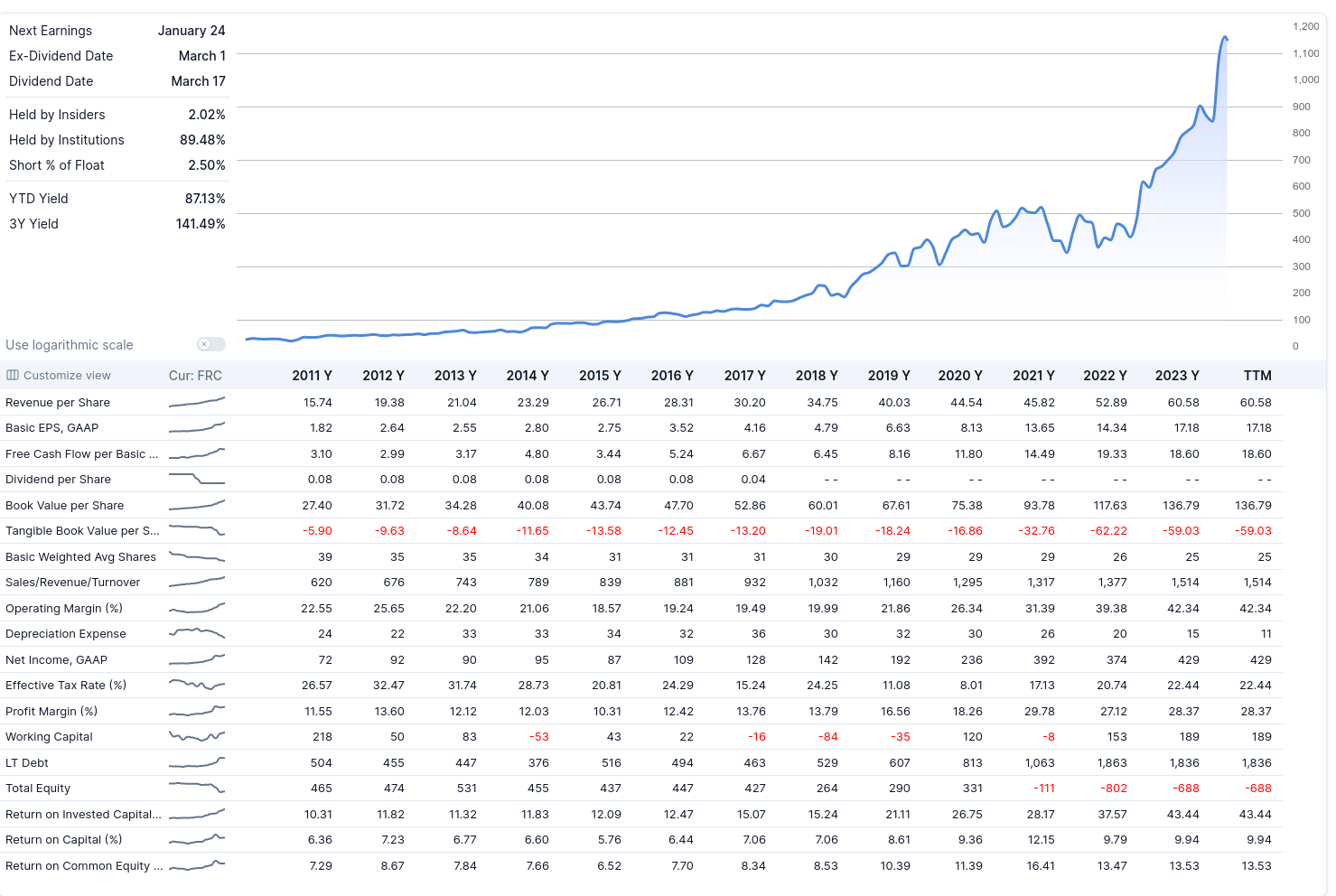
Thanks for bringing this up, this looks interesting. At a quick glance, I don’t consider it a risk-free investment, as the valuation multiples are quite steep. It appears that growth has been financed with debt. I wonder what kind of growth rate sales would need to maintain in the coming years?
---
### Author:  [@Makko](https://forum.inderes.com/u/Makko)
#### Post date: [January 20, 2024, 2:24pm UTC](https://forum.inderes.com/t/globaalit-laatuyhtiot/43190/86 "2024-01-20T14:24:06Z")
Indeed, this leverage was asked about in the comments section of Joseph Carlson’s video.
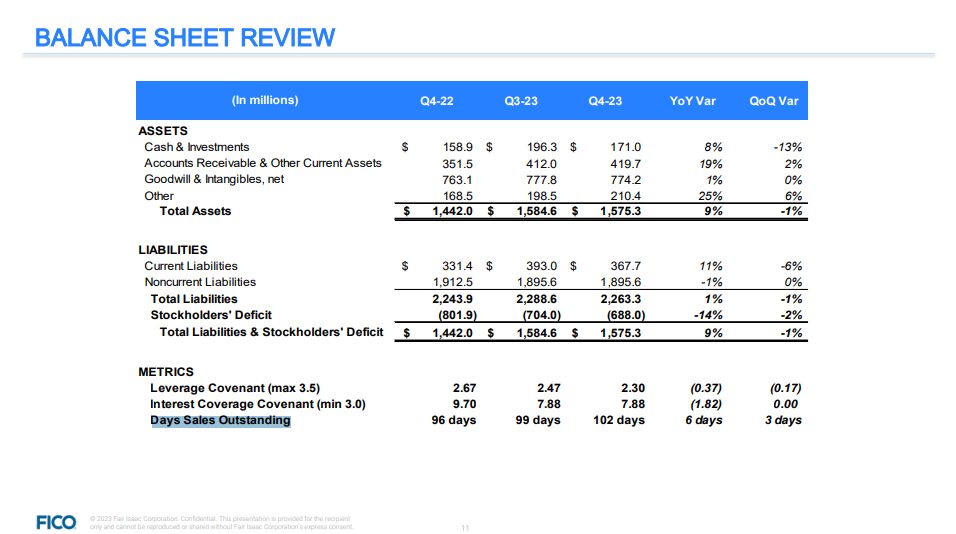
source: [https://cdn.prod.nntech.io/fundamentals-file-proxy/quartr/pdf/b40face7708f1e2233599f7ef397f9a2.pdf](https://cdn.prod.nntech.io/fundamentals-file-proxy/quartr/pdf/b40face7708f1e2233599f7ef397f9a2.pdf)
There is leverage, and it certainly cannot continue indefinitely. Additionally, the market expects continuous growth in the return percentage and SaaS service. I don’t believe the company will face financial difficulties (strong market position and able to price its way out), but I believe the share price will correct.
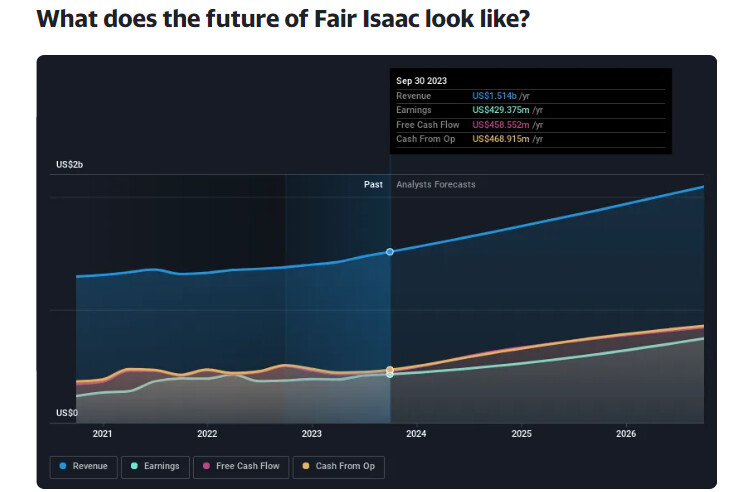
source: [https://finance.yahoo.com/news/now-opportunity-fair-isaac-corporation-161623930.html](https://finance.yahoo.com/news/now-opportunity-fair-isaac-corporation-161623930.html)
So, I have refrained from buying for now, but I’m waiting for a suitable moment to jump on board.
How serious do you consider FICO’s financial situation to be?
---
### Author:  [@jaska7](https://forum.inderes.com/u/jaska7)
#### Post date: [January 22, 2024, 8:57am UTC](https://forum.inderes.com/t/globaalit-laatuyhtiot/43190/87 "2024-01-22T08:57:52Z")
https://open.spotify.com/embed/episode/42MPnbOskwDRGYWf0upXKb?si=_pAoD3rFQIyWakie7rm4EQ&utm_source=oembed
Posting this here too
---
### Author:  [@Makko](https://forum.inderes.com/u/Makko)
#### Post date: [February 22, 2024, 3:06pm UTC](https://forum.inderes.com/t/globaalit-laatuyhtiot/43190/88 "2024-02-22T15:06:13Z")
Regarding Hermes from that same podcast. Does anyone else have similar recommendations for podcast/YouTube/etc. content? 🙂
https://open.spotify.com/embed/episode/3JnXyI5G7umpVWijAvoL36?si=37fbf2f5d1f84fa0&utm_source=oembed
---
### Author:  [@Bjorninen](https://forum.inderes.com/u/Bjorninen)
#### Post date: [March 10, 2024, 2:03pm UTC](https://forum.inderes.com/t/globaalit-laatuyhtiot/43190/89 "2024-03-10T14:03:29Z")
Mettler-Toledo could be added to the thread, which Sifter has also recently added to its portfolio.
Mettler-Toledo is originally a US company, but its headquarters are in Switzerland. The company is a multinational manufacturer of scales and analytical instruments and is the largest supplier of scales used in laboratory, industrial, and food retail applications. Additionally, the range includes various analytical instruments and process analytics equipment.
Slightly over half (55%) of the revenue comes from laboratory supplies, which include weighing solutions, precision scales, pipetting systems, pH meters, spectrometers, etc.
A slightly smaller portion (approx. 40%) comes from industry, including industrial scales and inspection and monitoring systems. These can be utilized, for example, in wastewater quality monitoring at water treatment plants, energy production, and solid waste processing.
The smallest business segment (approx. 5%) relates to weighing and label printing in grocery stores. This covers scales in produce departments, checkout scales, etc.
Approximately 37% of revenue comes from the USA, 21% from Western Europe, 19% from China (+ 13% from the rest of Asia), and the rest from the rest of the world.
The company is a market leader in its field. The market is otherwise fragmented. In addition to a wide product range, the company has one of the world’s largest sales and service organizations among precision instrument companies, which I believe provides at least some form of competitive advantage. The company also makes bolt-on acquisitions when necessary.
In Q4 2023, revenue and earnings decreased due to logistics delays, but this is largely expected to recover during Q1 2024. Revenue fell by 12% and adjusted EPS fell by 22% year-on-year. The company guides for 1-2% growth for this year, which is historically low. The beginning of the year is still a challenging time. Behind this is increased economic uncertainty, which makes forecasting difficult. Regarding EPS, the guidance is for 4-6% growth compared to the previous year.
The ratio of operating cash flow to depreciation was 10.9x last year. ([H. Keskiväli’s Twitter thread](https://twitter.com/hkeskiva/status/1761277728555159918)). Last year’s ROIC calculated from EBITA was approximately 19.0%.
Cash flow is strong and is distributed to shareholders through share buybacks.
Over the last 10 years, revenue has grown (CAGR) at an average of 9.1% per year and EPS at an average of 15.2% per year. The net profit margin has fluctuated between approximately 18-22%.
Based on earnings forecasts for the coming years (2024-2026), the P/E is approx. 34x, 30x, and 26x. EV/EBITDA, on the other hand, is slightly lower: 24.6x, 22.7x, and 21.3x. FCF Yield is at the level of approx. 3%. The number of shares has decreased by a couple of percent per year as a result of buybacks.
Debt is fairly moderate at approx. 1.3x EBITDA. ROIC has been above the 30% level in recent years.
However, quite a lot of growth is priced into the current stock price, and the company should be able to maintain the growth rate of recent years for the investment to be sensible at the current price.
---
### Author:  [@JNivala](https://forum.inderes.com/u/JNivala)
#### Post date: [March 27, 2024, 8:11pm UTC](https://forum.inderes.com/t/globaalit-laatuyhtiot/43190/90 "2024-03-27T20:11:03Z")
Let’s quickly throw the next company into the mix before bedtime: **Zoetis A**. I just noticed that the company is also on the list mentioned by @Uppo-Nalle.
The company operates globally as a provider of animal health services. The business is essentially divided into companion animal and livestock segments. The product portfolio is very broad, with offerings for several different animals. Roughly half of the revenue comes from the US and the rest from the rest of the world (Europe, South America, Asia). There is plenty of material about the product portfolio and offerings on the company’s website. The revenue is, however, nicely distributed geographically. Based on some Googling, the pet market specifically is expected to see healthy growth until the year 2030, so the TAM (Total Addressable Market) is growing at a good pace, supporting organic revenue development.
Overall, I think the business appears quite safe, as at least in Western countries, as birth rates decline, people seem to be replacing having children with pets. And even when the economy gets tight, people will find the necessary medicines and treatments for their pets. Here, if anywhere, scale and economies of scale matter. Of course, the brand is also an essential part. In my opinion, the barriers to entry are reasonable, and this industry doesn’t interest today’s sexy, hype-driven technology giants, yet the field is highly profitable and growing.
Historical figures:
**Revenue development (billion dollars)**
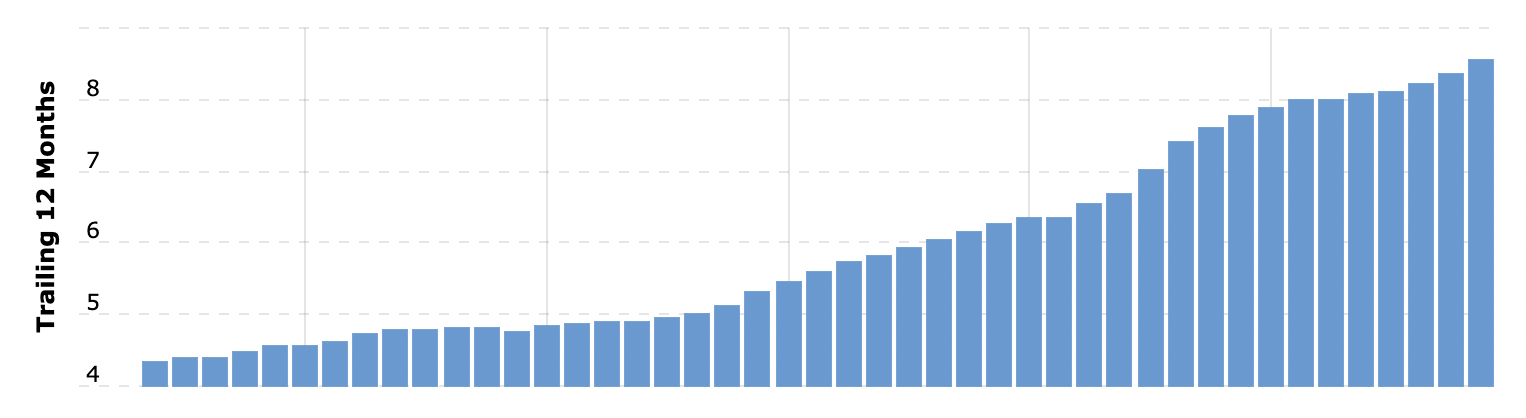
_CAGR for the last 11 years is \> 6 % p.a._
**Profitability development** :
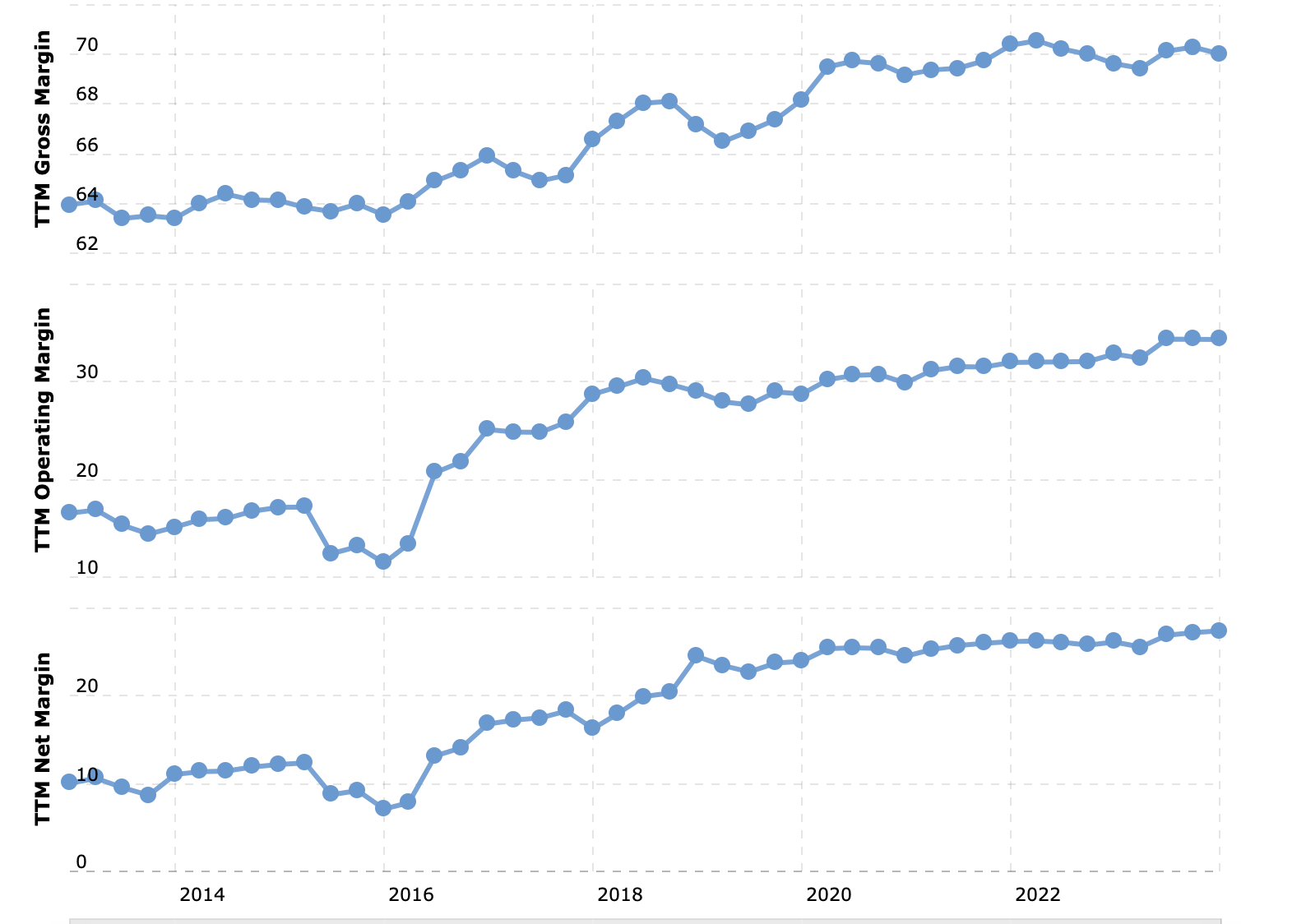
ROI:
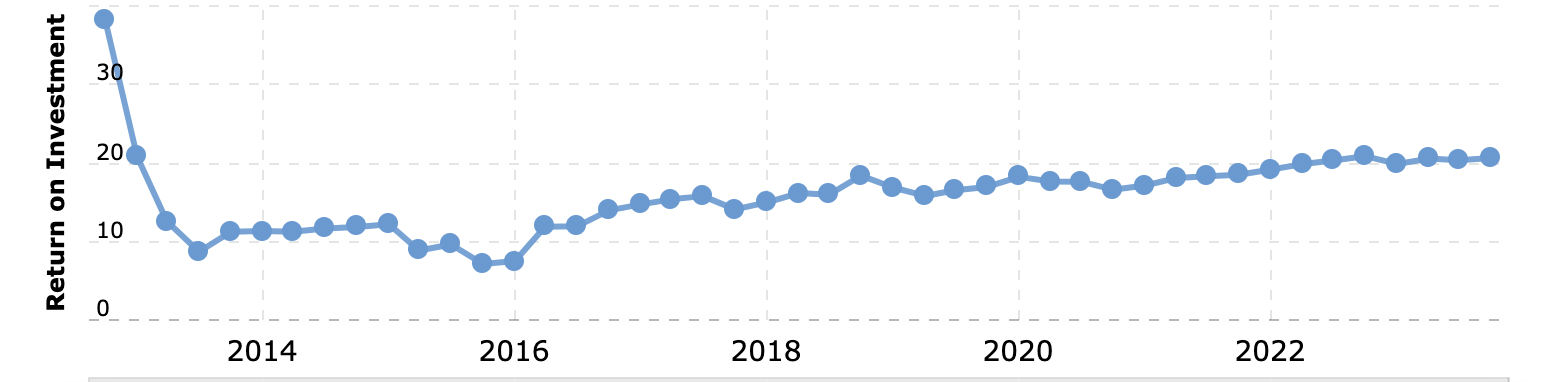
A few scattered comments as well:
- Capital allocation: growing dividend + share buybacks
- The CEO owns a large number of shares. Unfortunately, insider activity has been on the sell side, but we can see, for example, regarding the CEO, that they own approx. 80,000 shares and always sell the shares received from options, keeping the ownership fairly stable. However, I think owning 80,000 shares aligns their interests quite well with other owners.
- Nothing out of the ordinary in the guidance: fairly good profitability and single-digit revenue growth (%).
- “maintenance capex” / net profit = approx. 21%, which is reasonable. Growth investments relative to maintenance investments were around 50% in 2023, so they are definitely pursuing growth—and with these return on capital figures, why wouldn’t they.
- SBC (Stock-Based Compensation) is at a tolerable level (approx. 2.5% of net profit).
- The balance sheet has quite a bit of goodwill + debt, but it should be noted that the debt is practically all long-term debt, and the company is quite transparent in sharing information about it:
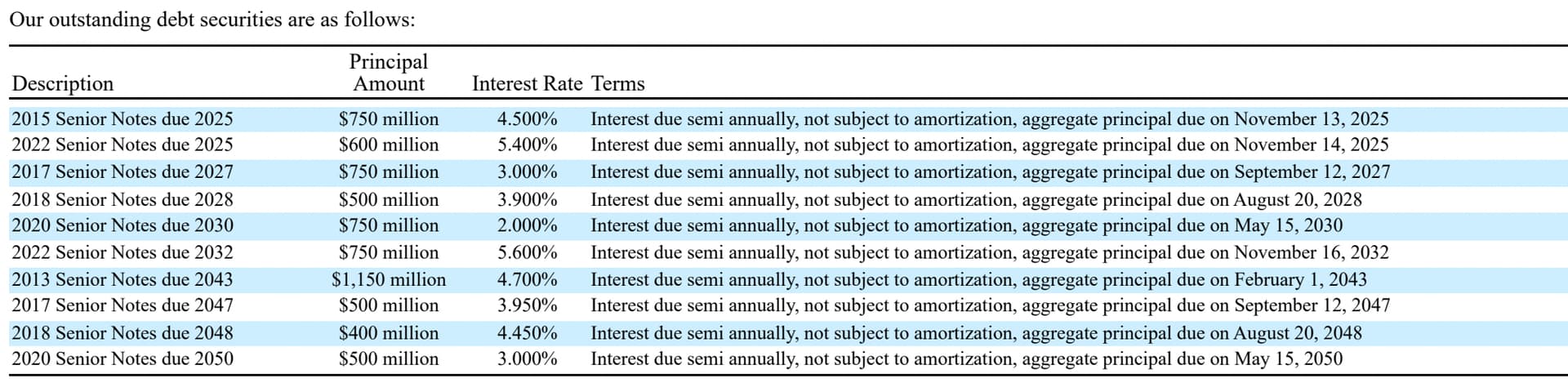
FCF (OCF - maintenance capex - SBC) is roughly at the 1,800 MUSD level with current earnings, so they should be able to handle the debts; they also have a couple of billion in cash. Financial expenses in 2023 with this debt base were approx. 240 MUSD.
---
### Author:  [@Cacky](https://forum.inderes.com/u/Cacky)
#### Post date: [April 15, 2024, 12:19pm UTC](https://forum.inderes.com/t/globaalit-laatuyhtiot/43190/91 "2024-04-15T12:19:49Z")
@JNivala timing is spot on again. A couple of days ago, the WSJ reported on the side effects of two Zoetis drugs ([referencing article](https://www.investopedia.com/zoetis-stock-slumps-on-report-suggesting-its-arthritis-drugs-may-make-pets-sick-8630785)/[original behind a paywall](https://www.wsj.com/health/pharma/dog-cat-arthritis-drugs-bcdddea6)), as a result of which the stock fell ~8% and the EV dropped to the level reached at the turn of 2019/20. Librela’s and Solensia’s share of future cash flows is unlikely to be that eight percent, so the market reaction is probably due to reputational risk, which has increased with the reporting. Pet owners are certainly one of the most sensitive customer groups on Earth. Who would want to give their ”child” a drug that has gained a dangerous reputation? Regardless, there are no competitors for Librela and Solensia, which protects their position. The relatively large market reaction may also be due to the market doubting Zoetis’s R&D, or because the reporting hits the companion animal business, which is valued at significantly higher multiples (growth outlook, pricing power, antibiotic resistance risks on the livestock side, etc.). On the other hand, this is another demonstration of the weaknesses of drug developers. R&D risks are high, and even if a product is brought to market, even a small reputational hit can destroy it because consumers are so sensitive. This can happen to practically any drug and can hardly be predicted. What happened makes me, at least, appreciate companies that manufacture simpler products, such as West, which has already been mentioned in the thread. Developing a new kind of glass or plastic tube is hardly as risky. It’s unlikely anything bigger will come of this, and in 5 years, you probably won’t even notice the whole case on the stock chart.
---
### Author:  [@JNivala](https://forum.inderes.com/u/JNivala)
#### Post date: [April 15, 2024, 12:31pm UTC](https://forum.inderes.com/t/globaalit-laatuyhtiot/43190/92 "2024-04-15T12:31:02Z")
In my opinion, this is a ridiculous overreaction regarding Zoetis. 15% of the 2023 revenue came from the segment to which these injectable drugs belong. Additionally, there are a couple of other drugs in it, so the share of revenue is in the low single digits. Likely very little, as this is more of a new growth prospect.
I think this kind of news is pretty par for the course in the pharmaceutical industry. From what I’ve read of the news, this doesn’t seem that terrible even for these two drugs. Veterinarians are the ones who “sell” these products, and I am under the impression that for the most part, veterinarians still see the product as a good preparation for the right target group.
And on the other hand, you can’t really draw any conclusions regarding Zoetis’s R&D, as failed drugs are part of drug development; there is no strategy that yields only successes. This is due to the nature of the industry.
EDIT: To add to this, according to Zoetis, for example, about 18 million doses of Solensia and Librela have been administered, and regarding the adverse events, Zoetis commented: "It added that more than 18 million doses have been distributed, and it has "continued to see low rates of adverse events with only 0.18% reported for Librela and 0.3% for Solensia."
It is statistically likely that when pet owners seek help for their sick pets, some will die without any causal link within about 2-4 weeks after receiving the medication.
---
### Author:  [@Voimakyykky](https://forum.inderes.com/u/Voimakyykky)
#### Post date: [April 24, 2024, 8:45am UTC](https://forum.inderes.com/t/globaalit-laatuyhtiot/43190/94 "2024-04-24T08:45:46Z")
> [@Uppo-Nalle](#):
>
> **SINTERCAST**
> A Swedish-headquartered company specializing in the production of Compacted Graphite Iron (CGI) developed by “crazy Englishmen.” The largest customers are in the automotive industry, for which engine blocks are manufactured. The customer base is highly concentrated, but with these margins, one can already afford to carry a bit of risk.
>
> - ROIC 30.9%
> - RG 8.3%, EG 6.1%
> - EBITm 29.1%, FCF 25.0%
>
> Here is the latest annual report for this oddity:
Thanks for this, it’s indeed an interesting case. Analyst coverage has recently started, and the target price in the base scenario is 150 SEK (the share is trading around the hundred-krona mark). It’s an interesting report if you are comfortable with the second domestic language (Swedish) or if Google Translate can handle it.
> **[sintercast-initieringsrapport-2024.pdf](https://storage.mfn.se/10ba6ceb-4080-4a36-89ca-a5dd963840a9/sintercast-initieringsrapport-2024.pdf)**
The company itself does not manufacture engine blocks; instead, it sells the technology/license for the production of these Compacted Graphite Iron (CGI) blocks and invoices based on the volumes of blocks produced. Over 90% of the revenue is recurring invoicing, and volumes are in constant growth as more and more heavy vehicle manufacturers switch to this production method because CGI technology offers numerous advantages (better durability, lighter weight, lower consumption, lower CO2 emissions, etc.).
There are indeed risks regarding customer concentration, even though these are very global operations. It has a small market cap and the stock is not very liquid, although the company has a solid track record. Insider ownership isn’t particularly high either; the CEO holds “only” about 400,000 EUR worth of shares. Perhaps this thread is looking for slightly larger companies, but for me, the investment case was easily met, especially at these market prices.
Balancing the risks, however, is a 6% dividend that has grown for 14 years, a strong debt-free balance sheet, and a P/E of 17 vs the company’s 3-year average of 26. The company distributes practically its entire profit as dividends, and visibility regarding growth seems good. Profitability is also excellent and still on the rise, as the company is very conservative regarding expenses.
If anyone is interested, here is the CEO’s presentation of the company from a year ago at a Redeye event.
> **[SinterCast: CEO Steve Dawson presents at Redeye Investor Forum Gothenburg,...](https://www.redeye.se/video/event-presentation/887592/sintercast-ceo-steve-dawson-presents-at-redeye-investor-forum-gothenburg-march-2-2023)**
[Previous page](https://forum.inderes.com/t/globaalit-laatuyhtiot/43190.md?page=3)
[Next page](https://forum.inderes.com/t/globaalit-laatuyhtiot/43190.md?page=5)