OP announced partnerships with JP Morgan, Goldman, and Blackrock  OP Pohjola aloittaa strategisen kumppanuuden kolmen johtavan kansainvälisen varainhoitajan kanssa - OP Pohjola
In the KL article (link below), the company’s management explains the reasons: Porkka says that the new cooperation primarily seeks better investment returns and a wider range of products for customers.
Expanding the product offering is a given, but I think it’s great that the company dares to openly highlight investment returns as well. The fact is that no one can be good at everything in this field, and for example, OP’s average fund is quite mediocre (the majority lose to the index in the long run, etc.). With these collaborations, OP brings new products to its offering, and with high probability, will replace some of its own underperforming products with those of its partners 
In my opinion, this move also reflects a broader trend in the asset management market of continuously rising standards. Index funds have arrived in Europe significantly slower than in the United States due to our bank-centric distribution model, but that ‘index bogeyman’ is increasingly pushing things on this side of the Atlantic too  . If your products are mediocre, the fee pressure on the private customer side will also be even tougher over the next 10 years.
Another interesting point in the KL interview ( OP Pohjolalta liike varainhoidossa – kertoi uusista kumppanuuksista jättien kanssa | Kauppalehti ) is this customer focus: Porkka says that while the field of institutional investors is important for OP Pohjola, the biggest growth potential lies in the bank’s existing customer base, private banking clients, and ordinary savers and investors.
In institutional clients, OP’s market position has been weakening for a long time, as eQ, Evli, and Mandatum have surged past from both the right and left. But this focus on private customers is very logical, due to the company’s superior distribution network and customer reach. Naturally, the company is aware of the ongoing investment boom (trust in the pension system, inheritances, etc.) and the structural growth potential it brings to the Finnish asset management market. 
A third interesting point is the M&A comments:
Porkka does not dismiss the idea that OP Pohjola could at some point acquire a smaller player in the asset management sector.
“The company to be acquired should be a player that genuinely has something new to offer us. It doesn’t necessarily make sense for us to acquire a smaller asset manager just to grow our customer base, as M&A transactions are always laborious. It also wouldn’t make sense because we already have many customers in our existing customer base whom we need to know how to activate for investing in the right way.”
This is also completely logical; it doesn’t make sense for OP to acquire customers (especially private customers). On paper, a stronger attack on institutional clients would have been justifiable through M&A (acquiring eQ or similar), but these ideas are shot down here. Instead, OP could be interested in expanding its product offering with high-quality product houses. Here, OP is in the same queue as practically all asset managers in the city. There is fierce bidding for a good product house.


 What has bothered me about the whole YLVA case is that the media has constantly talked about a “fire sale price” or “selling below fair value”. Yes, the properties were sold below book value, but that is different from fair value. The market still seems to have a strong misconception that there is some magical fair price for properties, which is clearly higher than current prices. No one says when and how this fair price will be reached, but it supposedly exists and is relied upon. This is why, for example, funds have also postponed redemptions, because they don’t want to sell properties below this mystical fair price.


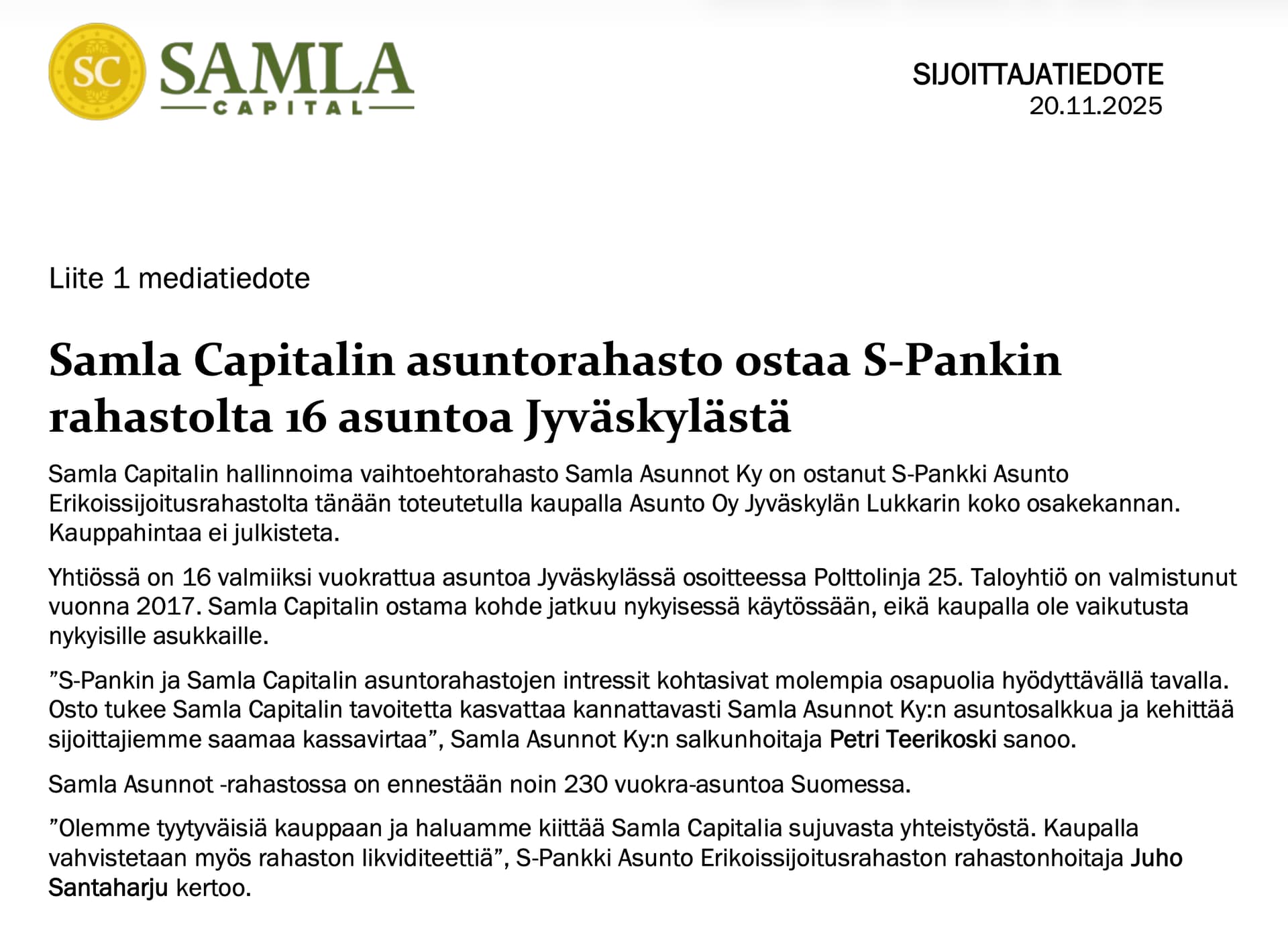

 In theory, it’s possible that the fund only has redemptions coming up, because redemption periods are long and windows are open twice a year. It would feel quite wild to commit more capital in this situation if they knew they’d have to pay redemptions in x months.