Can you say how common minimum purchase guarantees are in these types of contracts in this industry?
The release stated that “The now-negotiated contract, when realized, includes a guaranteed minimum billing that begins from the service launch to the customer.”
And that got me thinking, if the expectations for the entire contract were “only” at the level of the lower limit you highlighted, there probably wouldn’t be a minimum billing clause worth mentioning either?
Is it too simplistic to think that the (potentially) upcoming contract will be significantly more than those disclosure thresholds? Perhaps several times higher?
Ps. Interestingly, the contract wasn’t signed at the end of the year as originally expected. Perhaps it will come yet, maybe even today or in the coming days. There is a risk, of course, that something has gone wrong and it won’t come at all since it’s delayed, but I think that would be strange.
Hi and apologies for the delay in responding due to the holidays.
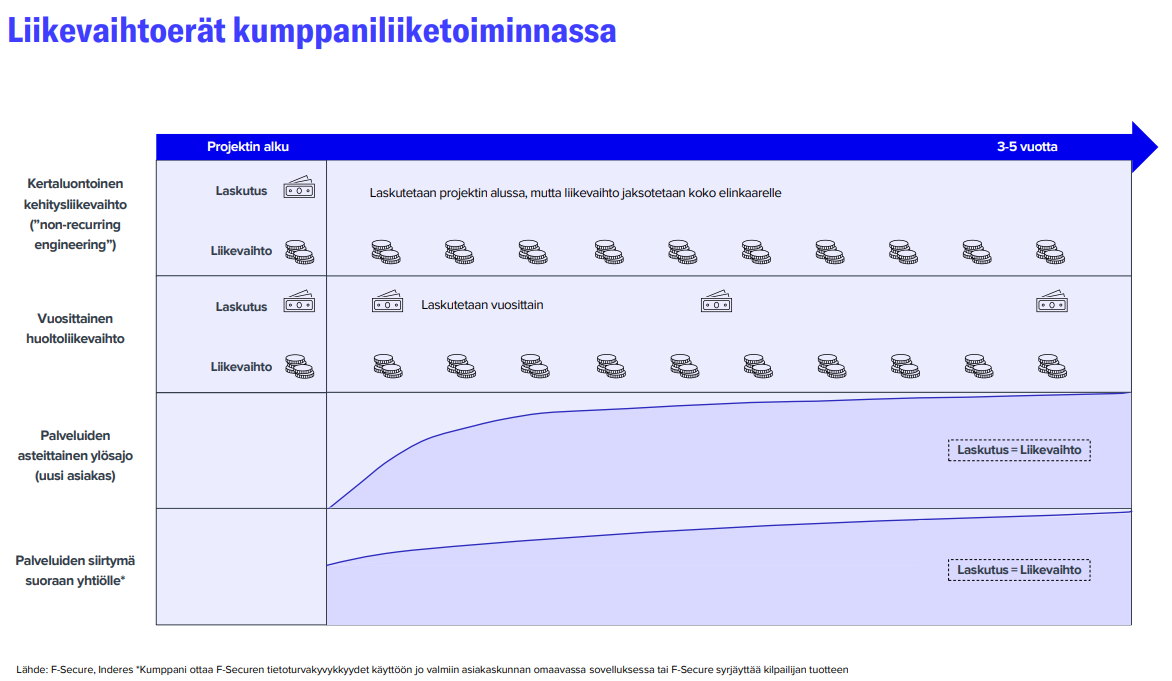
I can’t say directly how often a minimum purchase is included in contracts, as these embedded security agreements can have various types of structures. Personally, I would interpret it such that a certain minimum billing starts immediately from the day F-Secure’s features are integrated into the customer’s service and the service is officially launched. However, I don’t believe this fee would yet exceed the disclosure threshold; instead, I would estimate that it depends heavily on how large a customer base the service is ultimately offered to. The comprehensive report breaks down the revenue formation of this partner business:
I would assume that the contract under negotiation is to some extent a combination of those two bottom charts, on top of which there will presumably be one-time development fees.
Is there a way to see which parties/entities are selling those F-Secure products? I just received advertisements for F-Secure Total from Telia and Danske Bank.
What on earth, messages are being censored here like in a meeting of relaxed feminists. I received a notification that my previous post was flagged.
Tell me, for heaven’s sake, what was so problematic and derailed the conversation so much when I asked for advice in my previous post on where I could find out which entities/parties sell F-Secure products? F-Secure itself publishes these partners whenever a new agreement with a large enough partner is reached (should those posts be flagged as spam too?).
So, I am among the 100 largest shareholders and I would like to get an overall picture of what that partner network is like. As I mentioned in my previous post, in addition to the published partners, I have come across Telia and Danske Bank, among others, who have offered Total, and now I’d be interested to know how many of these “vendors” there are and who they are.
Now, go ahead and flag this post again quickly, since it probably doesn’t belong in the F-Secure section. Damn it.
Oh wow, your message was flagged and removed quite easily. I saw it earlier and intended to come back and reply when I had a moment.
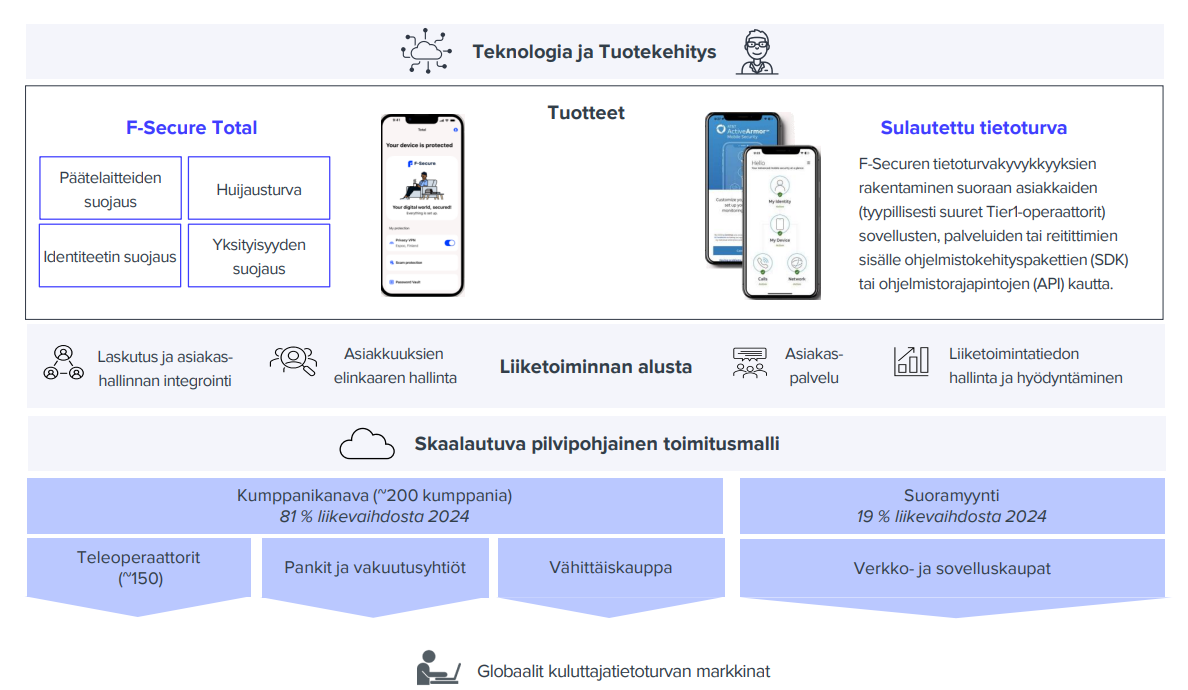
First, here is a chart from our extensive report. There are a total of about 200 partners worldwide, and about 150 of these are telecom operators. In Finland, Telia, Elisa, and DNA, among others, are F-Secure’s partners.
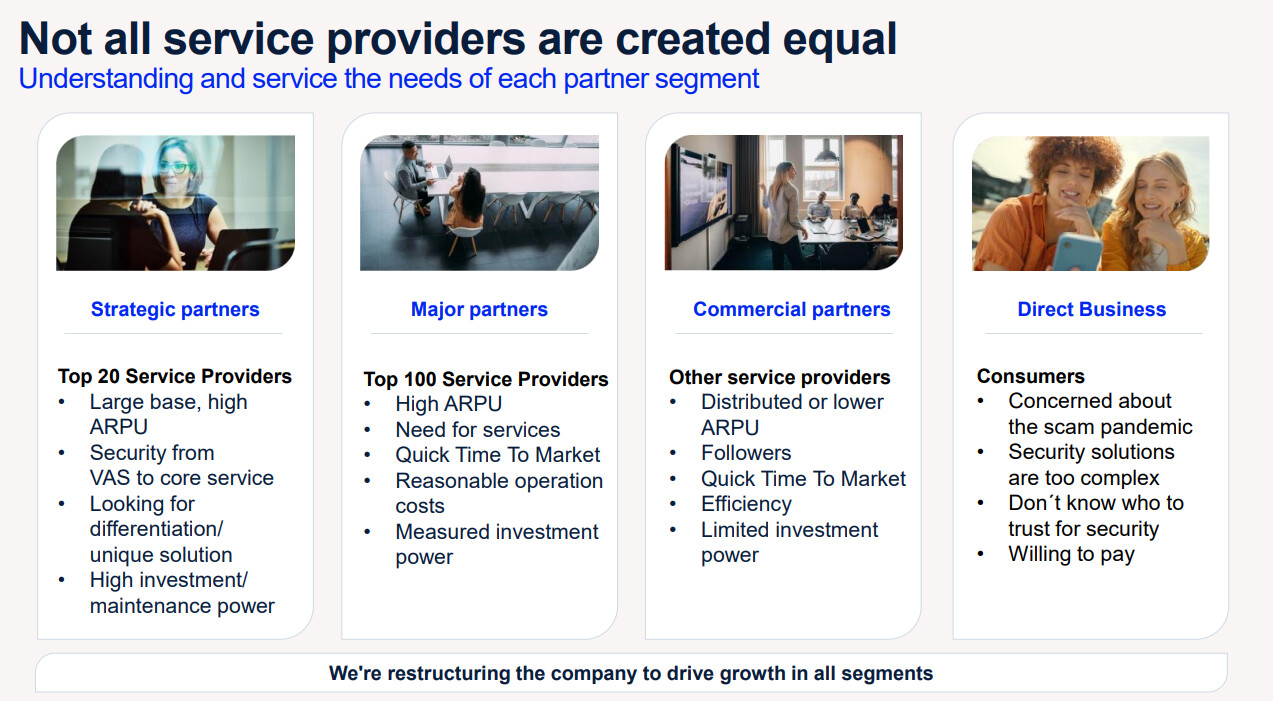
At the 2024 Investor Day, partners were further categorized into these different categories:
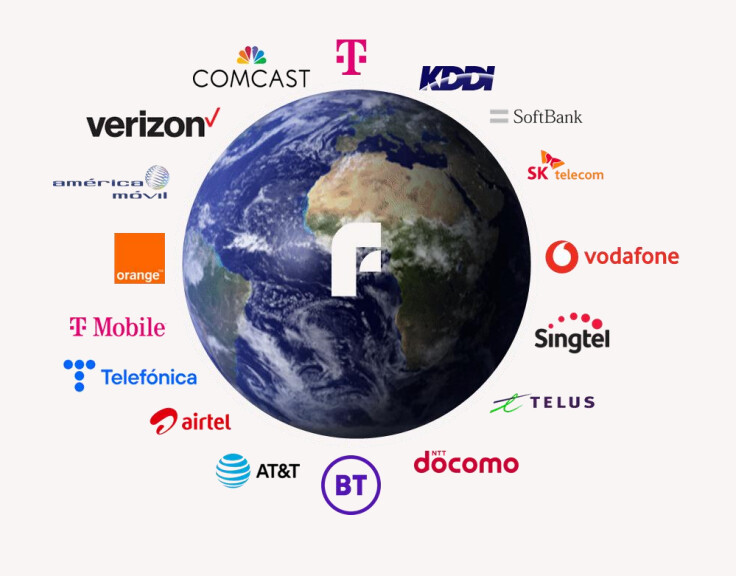
Large Tier 1 partners can largely be found in this chart, some of whom are already F-Secure customers.
My view on the impact of potential tariffs on F-Secure
Direct tariff impact: 0%
F-Secure sells digital licenses and services. U.S. Customs does not stop “bits & bytes” traffic at the border or tax it like physical goods.
Currency exchange effect (Positive):
Tariffs and protectionism have historically strengthened the dollar. For F-Secure, the United States is a significant market area (approx. 30–40% of revenue).
When F-Secure sells products in dollars and reports its results in euros, a strong dollar improves the company’s reported figures. This is a so-called “translation gain” for the company.
Macroeconomic risk (Negative):
If tariffs accelerate inflation in the United States, consumer purchasing power will weaken. Cybersecurity is a necessity, but in a tight economic situation, consumers may switch to cheaper or free solutions.
 Perhaps several times higher?