Hello @Haminan_Mursu,
The valuation of the stock as an acquisition target is a good question worth pondering. This is a broader issue than just Bioretec, but at least we can begin to unpack it here. First, however, a couple of points to avoid potential misunderstandings.
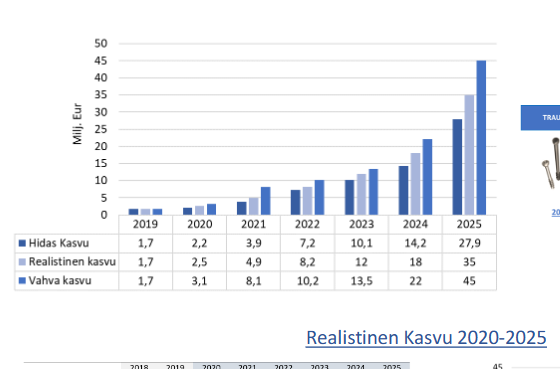
Our fundamental forecasts are based on GlobalData’s market forecasts, which are among the highest quality available and are widely referenced in the forecasts section and elsewhere in the report. For biodegradable trauma screws, for example, this market is illustrated in the graph on page 18. In addition, the topic is discussed on pages 15 and 16. Our forecasts are based on the projected market size (GlobalData) multiplied by estimated future market shares. Acquisitions are a separate matter, which is discussed more below.
As I understand it, Bioretec’s competitors are already selling biodegradable metal implants on the European market, meaning, to my knowledge, Bioretec has the potential to be the first specifically in the US market, but it is not the first in the world, as described in our report. As for your opinion that this was not understood in the report, I would point out that a quick glance shows that this “first in the US market” point is referred to on at least pages 3, 6, 7, 14, 18, 19, and 23 of the report. In my opinion, it is one of the report’s key themes. It is essential that our forecasted market shares include the assumption of precisely the advantage the company gains by being first/among the first to market. If they were not timely, the forecasts would be more conservative. Of course, Bioretec’s market share in trauma screws in 2027 and other products later could be significantly above/below our forecasted 7.5%, but that is a different discussion, addressed in the scenarios on page 29 and the risk/opportunity analysis on page 23.
Well then, to the actual question, which is the consideration of the acquisition option in valuation. This is indeed a broader theme than Bioretec alone, and I will try to elaborate on it here.
Inderes’ analysis is fundamentally a fundamental analysis. In Bioretec’s case, this fundamental valuation relies primarily on discounting future cash flows to their present value using the DCF model. Other valuation methods are more or less useless when operations are unprofitable and the targeted growth rates are truly ambitious. Fundamental analysis answers the question of what the company’s valuation looks like from the perspective of a long-term owner. In the spirit of fundamental analysis, Inderes’ principle is that, for example, mergers and acquisitions or share issues are not modeled into forecasts. This is because the timing, terms, and amounts of these transactions cannot be known in advance. Of course, we do highlight these themes elsewhere. The report discusses Bioretec as a potential acquisition target on pages 17-18. Additionally, the Biorez acquisition, with a total potential of 250 MUSD, is presented as an example on page 18.
In my opinion, basing an investment case on an acquisition is not so much fundamental analysis but rather resembles private equity investing: buying a stake in a company, growing its intrinsic value, and selling it off once targets are met. This is, of course, no worse an approach as an investment style than fundamental investing, but the perspective is shorter than forecasting cash flows for a decade.
I agree that in Bioretec’s case, value can very well be realized through an acquisition. Why then did it not affect the valuation? One reason is the aforementioned unpredictability and reliance on fundamental analysis. Secondly, if one starts to guess the value of an acquisition option, then one must logically also consider negative aspects such as the dilutive effect of share issues, etc. Thirdly, I believe assessing a company as an acquisition target requires a somewhat different logic from an industry perspective than what is used in fundamental analysis.
In summary: Investing in Bioretec with the idea that value will be realized through an acquisition is a perfectly valid approach. However, for the average investor, we must explain why, in our opinion, the stock is worth/not worth investing in for the long term, based on available information. Speculating about an uncertain acquisition, which, if it occurs, will be at an unknown price, time, and with unknown terms, does not fit well with this. As mentioned, the acquisition option is indeed highlighted in the report. Investors then have the opportunity to take a view on the acquisition and its value if they wish.
 Until then, RemeOs does not exist in the commercial markets, and Bioretec is still a semi-worthless company.